
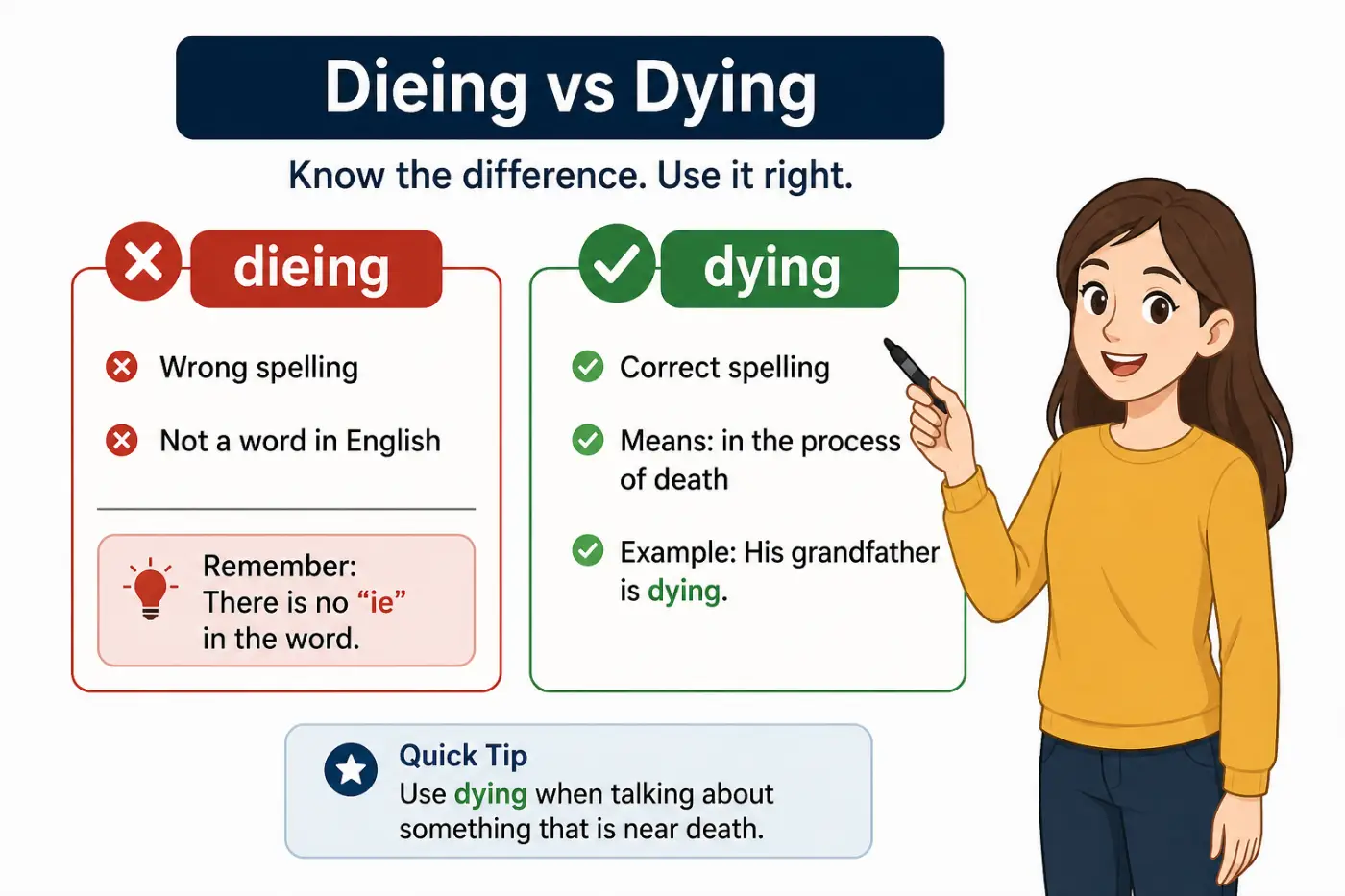
Dieing vs Dying can be confusing because the two words look almost the same, but they are not used in the same way. Dying is the correct spelling when you mean the process of becoming dead, such as “The plant is dying.”
Dieing is much less common and usually appears only in special cases, such as when die means a tool used for shaping or cutting material. In this guide, you’ll learn the simple difference between dieing and dying, when to use each word, and how to avoid this common spelling mistake.
For another common grammar confusion, see It Is Must vs It Is a Must: Simple English Guide (2026).
Simple Answer in One Look
Dying is the correct word for death or coming to an end.
Dieing is a rare word that refers to using a die to cut, shape, or stamp materials in manufacturing.
What Does Dieing vs Dying Mean in Simple English?
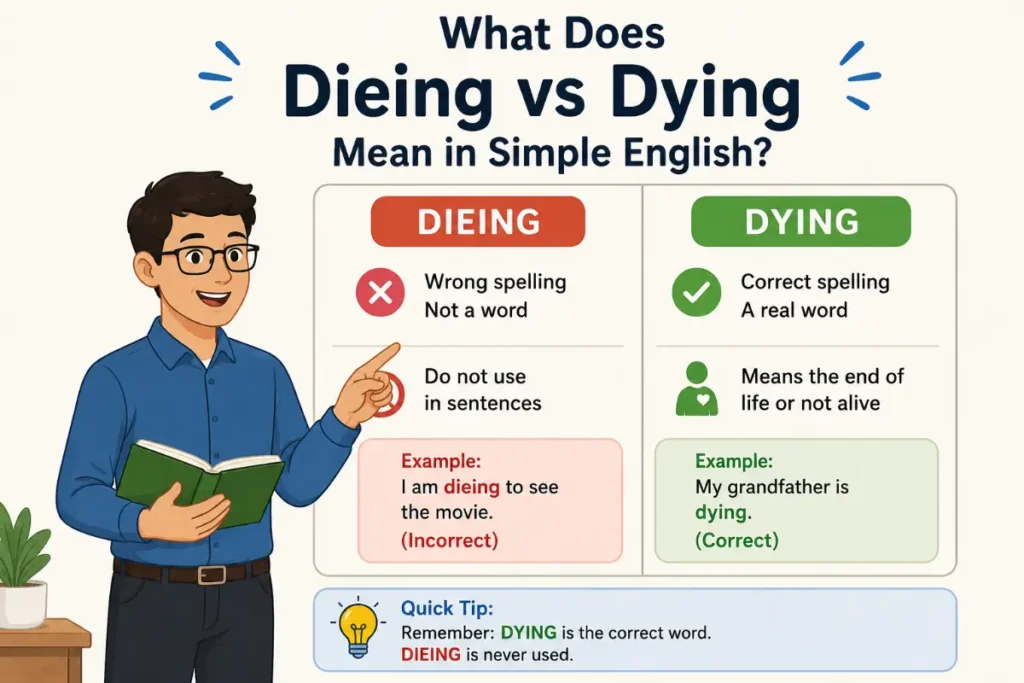
The easiest way to understand is to think about what you are talking about. If you mean that a person, animal, or plant is losing life, use dying.
Examples:
- The old tree is dying.
- The fish is dying.
- His phone battery is dying.
- The fire is dying.
Notice that dying is also used for things that are slowly ending, even when nobody is actually dying.
For example:
- My excitement is dying.
- The music is dying away.
- The tradition is slowly dying.
Now look at dieing.
This word has nothing to do with death. It comes from the noun die, which is a special tool used in factories. A die cuts, stamps, or shapes metal, paper, plastic, leather, and many other materials.
Example:
- The company is dieing metal sheets for car parts.
Most people never use this word because it belongs mainly to engineering and manufacturing.
Why Do People Mix These Words Dieing vs Dying?
Many English spelling mistakes happen because English does not always follow one simple rule. The confusion between is one of those cases.
Here are the biggest reasons.
The spelling changes unexpectedly
Usually, English verbs ending in e simply drop the e before adding ing.
Examples:
- Make → making
- Take → taking
- Bake → baking
People naturally think this rule should also work with die.
They expect:
- Die → dieing
But English does something different.
The correct spelling becomes:
- Die → dying
The letter y replaces the ie before ing.
The words look almost the same
Only one letter is different.
- Dieing
- Dying
Because they look so similar, many people type the wrong one without noticing.
Spell check does not always help
Some spelling tools accept dieing because it is actually a real English word in manufacturing.
That means your computer may not mark it as wrong, even if you meant dying.
People rarely hear the manufacturing meaning
Almost everyone knows the word dying.
Very few people work with industrial dieing.
Since the rare word exists, it creates extra confusion.
Clear Difference Explained Simply
Here is an easy comparison.
| Dying | Dieing |
|---|---|
| Means losing life | Means using a die in manufacturing |
| Very common | Very rare |
| Used in everyday English | Used mostly in factories |
| Correct in almost all conversations | Correct only in technical work |
| Everyone learns this word | Few people ever need this word |
You can also remember it this way:
- Talking about death? Use dying.
- Talking about factory machines? Use dieing.
That simple rule works almost every time.
Quick Memory Trick
Think of this sentence:
People are dying. Machines are dieing.
This is one of the easiest ways to remember the difference.
Which Form Should You Use?
For almost every conversation, school paper, email, social media post, or article, you should use dying.
Examples:
- The flowers are dying.
- My phone is dying.
- The patient is dying.
- The fire is dying out.
- The old language is dying.
You only need dieing if you are talking about manufacturing equipment that uses a die.
Example:
- The factory is dieing aluminum parts.
Unless you work in engineering or industrial production, you may never need this word.
That is why most English teachers simply tell students to use dying.
Easy Real-Life Sentences You Can Use Dieing vs Dying
These examples show how dying is used in everyday English.
- My phone battery is dying.
- The flowers are dying because they need water.
- The fire is dying slowly.
- The old tree is dying after the storm.
- Many people thought the tradition was dying.
- The patient is dying peacefully.
- The puppy looked sick but is not dying.
- The light is dying as the sun goes down.
Now look at a few examples of dieing.
- The company is dieing metal parts for airplanes.
- Workers are dieing steel sheets into small pieces.
- The factory uses automated dieing machines.
- Dieing equipment must be cleaned regularly.
- The new production line improved dieing accuracy.
Notice how every example relates to manufacturing.
Where This Word Comes From (Simple History)
The word die meaning “to lose life” is very old. It has been part of English for hundreds of years. Over time, English developed a special spelling when adding ing. Instead of writing dieing, the language changed it to dying. This spelling became the standard and is now used around the world.
The other word, die meaning a tool for cutting or shaping material, has a different history. It comes from old manufacturing and metalworking traditions. From this meaning, the rare word dieing developed to describe the process of using a die. Even though both words are spelled with die, they come from different meanings. That is why dying and dieing do not mean the same thing.
As English changed over the years, dying became one of the most common words in everyday language, while dieing remained a technical word used mostly by engineers and factory workers. Knowing this small piece of history makes the spelling much easier to remember. One word became part of daily English, while the other stayed in the world of manufacturing.
As you can see, the difference between words are much more than spelling. One word belongs to everyday conversations, while the other belongs to a specialized industry. Once you understand this basic idea, the rest becomes much easier. Next, we will look at how these words appear in culture, stories, symbolism, common mistakes, related words, and practical everyday use so you can remember the correct spelling with confidence.
How Is Dieing vs Dying Understood in Culture and Stories?
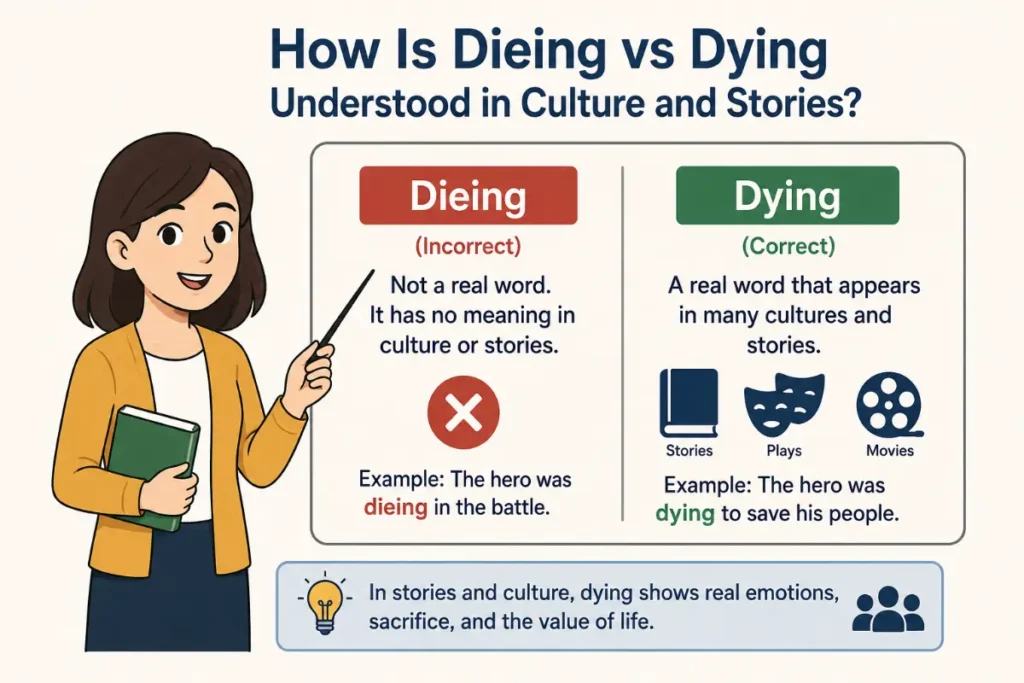
Words often carry meanings beyond their dictionary definitions. When people hear the word dying, they usually think about the end of life. They may also think about change, loss, hope, or the start of something new. Many books, movies, songs, and poems use dying to describe both real death and the end of an idea, dream, or tradition.
For example:
- A hero may be dying while saving others.
- An old tradition may be dying because people no longer follow it.
- A fire may be dying as the night becomes quiet.
- A friendship may seem to be dying after a long disagreement.
In these examples, dying helps people express strong feelings. It can describe sadness, change, peace, or even hope for a better future. The word dieing is very different. It is almost never used in stories or daily conversations. Instead, it appears in manufacturing books, factory manuals, and engineering discussions. Most readers will never see it unless they work with industrial equipment.
Because of this, when people compare both words, nearly every cultural meaning belongs to dying.
Learn the difference in Focussing or Focusing: Complete Grammar Guide (2026).
What Does Dieing vs Dying Mean in the Bible and Mythology?
The Bible often talks about dying because it discusses life, death, faith, and hope. In many Bible stories, dying is not shown as the final end. It is often followed by the promise of eternal life, peace, or resurrection.
For example, the Bible teaches that people die physically, but faith brings hope beyond death. This makes the word dying part of many important spiritual lessons.
In mythology from different cultures, heroes, kings, and even gods sometimes die. Their deaths often represent courage, sacrifice, or the beginning of a new age. The word dieing does not have a special biblical or mythological meaning. Since it refers to shaping materials with a die, it belongs to the world of manufacturing rather than religion or ancient stories.
So, if you see dying in religious or mythological writing, it refers to life and death. You are very unlikely to see dieing in those kinds of texts.
Symbolism Explained in Simple Words
What Does Dying Represent?
The word dying often represents much more than physical death.
It can symbolize:
- The end of one stage of life
- Personal change
- Letting go of the past
- Hope for a fresh beginning
- The passing of time
- A fading memory
- The end of a season
- The end of an old habit
People also use dying to describe something slowly disappearing.
Examples include:
- A dying language
- A dying tradition
- A dying business
- A dying fire
In these cases, nothing is literally losing life. Instead, the word describes something that is slowly coming to an end.
What Does Dieing Represent?
The word dieing has a practical meaning instead of an emotional one.
It represents:
- Manufacturing
- Precision
- Engineering
- Industrial production
- Cutting and shaping materials
- Factory work
Unlike dying, it does not carry deep emotional or cultural ideas.
This simple comparison makes the difference clear.
- Dying represents endings, change, and life.
- Dieing represents machines, tools, and manufacturing processes.
Related Words You Should Know
Learning related words makes it easier to remember the correct spelling.
Die
This is the base verb that means to stop living. Example:
People die every day.
Dying
The present form that means losing life or slowly ending. Example:
The flowers are dying.
Dead
This describes someone or something that no longer has life. Example:
The fish is dead.
Death
This is the noun for the end of life. Example:
The story talks about death.
Lifeless
This means having no life or energy. Example:
The old plant looks lifeless.
Fade
This means to slowly disappear or become weaker. Example:
The music began to fade.
End
This means something finishes or stops. Example:
Every movie has an end.
Die
This can also be a noun that means a tool used to cut or shape material. Example:
The machine uses a steel die.
Dieing
This is the manufacturing process of using that tool. Example:
The factory is dieing metal parts.
How Do People Actually Use Dieing vs Dying in Daily English?
Most people only use dying in everyday life.
Here are common examples.
- My phone is dying.
- The flowers are dying because nobody watered them.
- The campfire is dying.
- His excitement is dying after hearing the news.
- The old tree is dying.
- Our small town is slowly dying as people move away.
- The battery is dying again.
- The noise is dying down now.
- That old tradition is dying.
- The patient’s condition is improving, so she is not dying anymore.
Now look at a few examples of dieing.
- The factory is dieing aluminum parts.
- Workers learned new dieing methods.
- The dieing machine needs maintenance.
These examples are correct, but they belong to manufacturing. Most English learners never need to use them.
Common Mistakes People Make
This spelling mistake is very common.
Mistake 1
Incorrect:
The flowers are dieing.
Correct:
The flowers are dying.
Mistake 2
Incorrect:
My phone is dieing.
Correct:
My phone is dying.
Mistake 3
Incorrect:
The patient is dieing.
Correct:
The patient is dying.
Mistake 4
Using dying when talking about factory production.
Incorrect:
The company is dying steel parts.
Correct:
The company is dieing steel parts.
Easy Rule to Remember
If something is losing life or coming to an end, choose dying.
If someone is using a die to shape materials in a factory, choose dieing.
That single rule solves almost every question.
Final Teacher Explanation About Dieing vs Dying
Imagine you are sitting in an English classroom.
A student asks,
“Teacher, should I write dieing or dying?”
The answer is simple.
If you mean that someone or something is losing life, always write dying.
If you are talking about a factory using a metal die to cut or shape materials, the correct word is dieing.
Most students, writers, and English learners only need dying because it is used in everyday conversations, books, news, movies, and school writing.
The rare word dieing belongs to engineering and manufacturing.
Whenever you see both words, first ask yourself one question.
“Am I talking about life and death or about factory tools?”
If your answer is life or death, choose dying.
If your answer is manufacturing, choose dieing.
That is the easiest way to remember the correct spelling.
Final Answer About Dieing vs Dying (Quick Recap)
The answer to words are simple once you know the meanings.
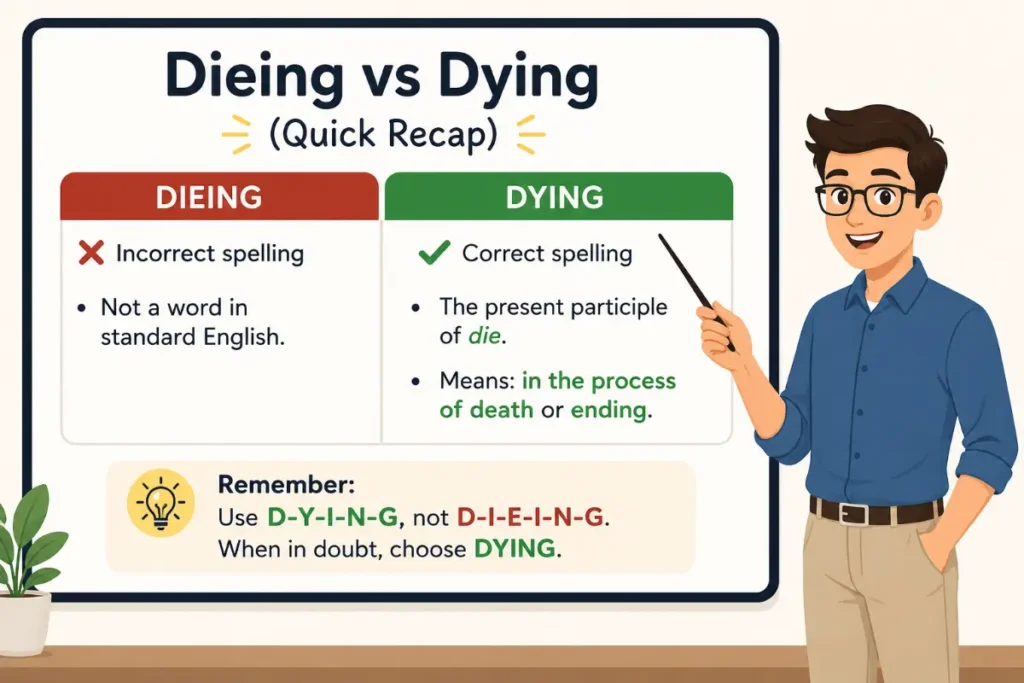
Dying is the correct spelling when someone or something is losing life or slowly coming to an end. It is the word you will use in almost every piece of everyday English, from conversations to books, emails, and school assignments.
Dieing is also a real English word, but it has a completely different meaning. It refers to using a die to cut, stamp, or shape materials during manufacturing. Unless you work in engineering or factory production, you will rarely need this word.
The easiest way to remember the difference is this:
Use dying for life and endings. Use dieing only for manufacturing.
Still confused? Compare Figoro or Masingo: Which Word Should You Use (2026)?.
Conclusion
The difference between dieing vs dying is simple once you know the meaning of each word. Dying is the correct and common spelling when you mean the process of becoming dead or gradually stopping to live. Dieing is a rare word used mainly when die refers to a tool or machine used to shape or cut materials. For everyday English, remember this easy rule: if you mean the opposite of living, use dying. This simple trick will help you avoid one of the most common spelling mistakes.
Frequently Asked Questions (FAQs)
What does mean in simple words?
Dying means losing life or slowly ending. Dieing means using a die to shape or cut materials in manufacturing.
Which is correct, dieing or dying?
For almost every everyday situation, dying is the correct spelling.
Why do people confuse?
The words look very similar, and many people expect die + ing to become dieing. English uses the special spelling dying instead.
Can I use dieing in normal writing?
Usually, no. Most writing should use dying unless you are discussing manufacturing processes.
Is dieing a real English word?
Yes. It is a real but uncommon word used in engineering and factory work.
When should I use dying?
Use dying when talking about death, something fading away, or something coming to an end.
How can I remember the difference?
Remember this simple rule: People are dying. Machines are dieing.
