
Many people get confused about time slot vs timeslot because both forms appear online. You may see one spelling on a website and another in a message or advertisement. That makes it hard to know which one is correct.
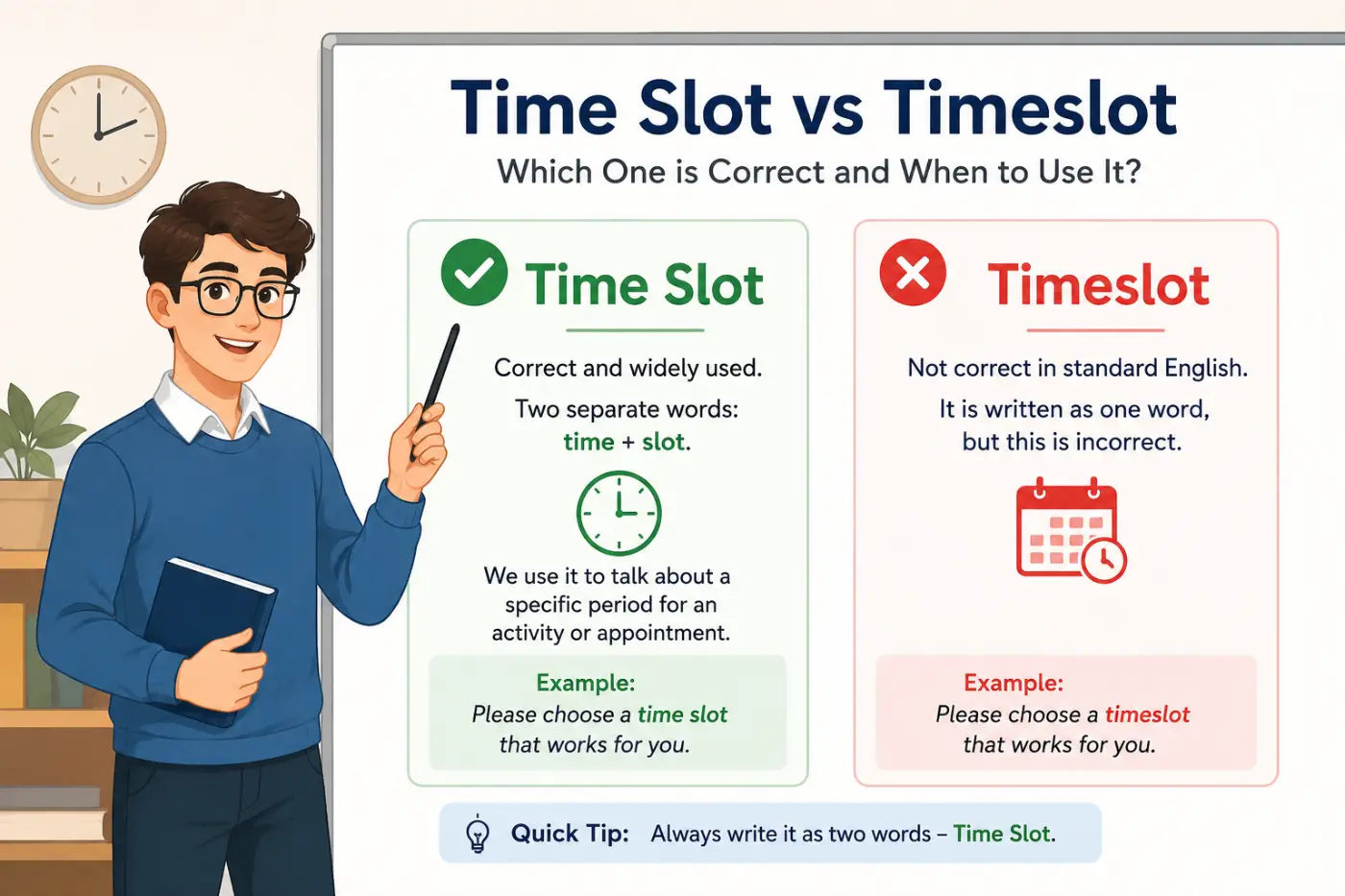
The short answer is simple. Time slot is the standard spelling in modern English. It is written as two separate words. Most dictionaries, style guides, and professional writers prefer this form. Timeslot as one word is much less common, although you may still find it in some company names, software, or informal writing.
This guide will explain both words in very simple English. You will learn the difference, see easy examples, understand why people mix them up, and know which form you should use in school, work, emails, websites, and everyday conversations.
Learn the difference in Pricy or Pricey: Which Is Correct and How Should You Use It?.
Simple Answer in One Look
Time slot is the correct and standard form in most English writing.
Timeslot is a less common spelling that appears in some brands, software, and informal writing.
If you are unsure, always write time slot as two words.
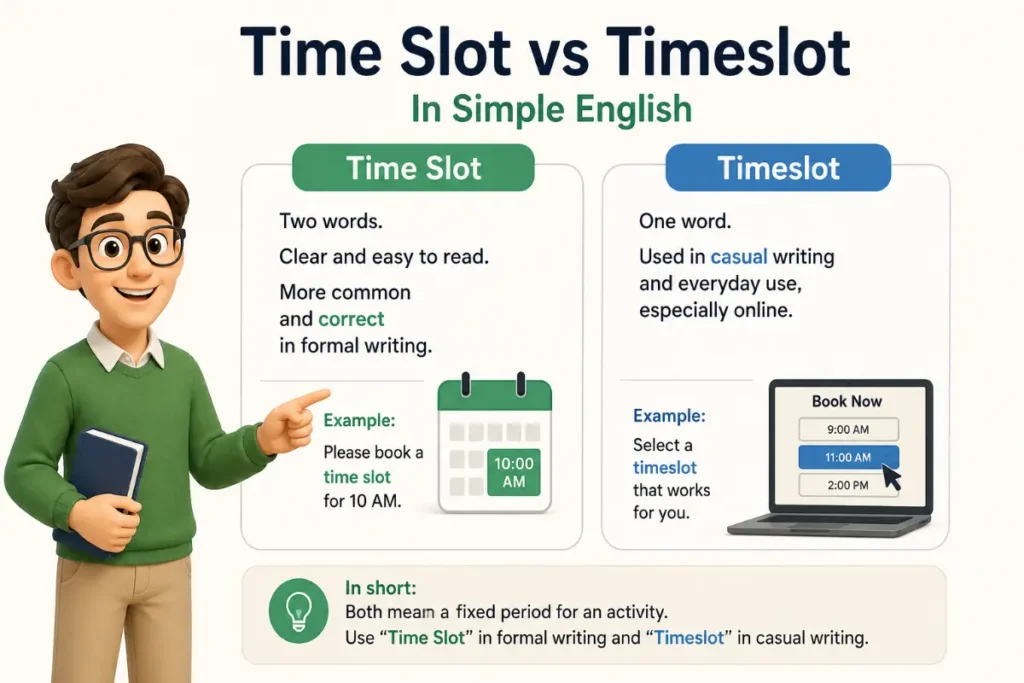
What Does Time Slot vs Timeslot Mean in Simple English?
A time slot is a period of time set aside for a specific activity. Think of it as a space on a schedule. For example:
- A doctor gives each patient a time slot.
- A teacher gives every student a presentation time slot.
- A TV show has its own weekly time slot.
The meaning stays the same whether someone writes time slot or timeslot. The only difference is the spelling. Imagine your day as a row of empty boxes. Each box is one time slot. You fill each box with something to do. For example:
- 9:00–9:30 for a meeting.
- 10:00–11:00 for class.
- 2:00–3:00 for a doctor’s visit.
Each one is a separate time slot. People often use this expression when talking about:
- School schedules.
- Business meetings.
- TV programs.
- Online appointments.
- Interviews.
- Flight departures.
- Sports events.
- Reservations.
Whenever someone reserves a certain period of time, they are talking about a time slot.
Why Do People Mix These Words Time Slot vs Timeslot?
The confusion happens for several simple reasons.
Many Compound Words Change Over Time
English changes as people use it. Some words begin as two words. Later they become one word. For example:
- Web site → Website
- Data base → Database
- Note book → Notebook
Because of this pattern, some people think time slot has also become timeslot. However, standard English still prefers time slot.
People Copy What They See Online
Many websites, apps, and booking systems use timeslot.
Someone may see that spelling and believe it is the official one.
Then they start using it everywhere.
Fast Typing
When people type quickly, they often join words together.
Instead of writing:
time slot
they write:
timeslot
This habit spreads through emails, chats, and social media.
Different Companies Have Different Styles
Some businesses intentionally use Timeslot as part of their branding.
That does not mean it becomes the standard spelling for everyday English.
Brand names often break normal spelling rules.
Spell Check Does Not Always Help
Some software accepts both spellings.
Others only suggest time slot.
This can make people even more confused.
Clear Difference Explained Simply
Here is the easiest way to remember the difference.
| Time Slot | Timeslot |
|---|---|
| Two words | One word |
| Standard English | Less common spelling |
| Preferred in writing | Seen in some software and brands |
| Used in schools and business | Mostly informal or company style |
| Best choice for exams | Usually avoid unless matching a brand |
You can also remember this simple rule.
If you are writing for other people, choose “time slot.”
It is the safest choice.
Which Form Should You Use?
You should almost always use time slot.
It works well in:
- School assignments.
- Business emails.
- Office reports.
- Blog posts.
- Books.
- News articles.
- Professional websites.
- Job applications.
Use timeslot only if:
- A company officially writes it that way.
- A product name uses that spelling.
- You are matching someone else’s style exactly.
When you write your own English, time slot is usually the better choice.
Think of it this way.
If you are taking an English test, writing an article, or sending an important email, choose time slot.
Easy Rule to Remember
Ask yourself one question.
Am I talking about a period of scheduled time?
If the answer is yes, write:
time slot
Two words.
That simple rule will be correct almost every time.
Easy Real-Life Sentences You Can Use Time Slot vs Timeslot
Here are some everyday examples.
- Please choose a time slot for your appointment.
- Our meeting starts in the 10:00 AM time slot.
- Every student has a different time slot for the interview.
- The TV show moved to a new time slot.
- We booked the last time slot available.
- Your delivery time slot is between 2 PM and 4 PM.
- I missed my time slot, so I had to book another one.
- Which time slot works best for you?
Notice that every example uses time slot as two words.
That is the form you should copy in your own writing.
Where This Expression Comes From (Simple History)
The expression time slot comes from two very common English words. Time means a period when something happens. A slot originally meant a narrow opening or space where something could fit. Later, English speakers started using slot in a new way. Instead of talking about a physical space, they also talked about a space in a schedule.
So a time slot became an empty place on a calendar waiting for an activity. As schedules became more common in schools, television, hospitals, airlines, and businesses, the expression time slot became popular. Today, people use it everywhere.
You can hear it when booking:
- Medical appointments.
- Haircuts.
- Online meetings.
- Flights.
- TV programs.
- Job interviews.
- Restaurant reservations.
Although some writers combine the words into timeslot, dictionaries and professional writing still usually keep them separate as time slot.
As you can see, the spelling is only one part of the story. The meaning stays the same, but understanding why the standard form is preferred helps you write more clearly and confidently. Next, we’ll look at how is understood in culture, everyday communication, common mistakes, related words, and practical situations so you always know which form to use.
You may also want to read Lacs or Lakhs: Which Is Correct? Simple Meaning and Difference.
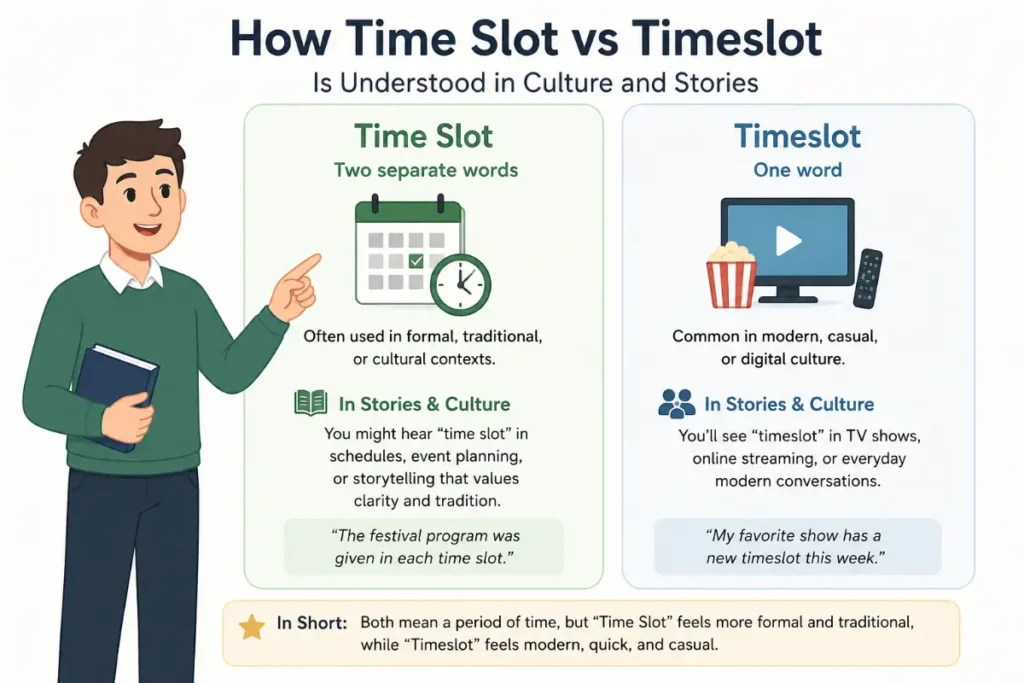
How Time Slot vs Timeslot Is Understood in Culture and Stories
People do not usually think of both words as a cultural topic. Still, the idea behind a time slot appears in many parts of everyday life. Almost every culture values time. People make plans, keep schedules, and arrive at meetings. A time slot helps everyone know when something should happen.
For example, schools give each class a time slot. Hospitals give patients appointment time slots. Television channels give each program its own time slot. These simple schedules help people stay organized.
Stories also use the idea of planned time. A hero may have a short time slot to complete an important task. A student may only have one time slot to take an exam. A family may have one free time slot to spend together. The words may seem simple, but the meaning is easy to understand. A time slot is simply a planned period for doing something.
Different countries may organize schedules in different ways, but the idea stays the same. People everywhere need a way to divide their day into smaller parts. That is why time slot has become a common expression in modern English.
Biblical and Mythological Meaning
There is no direct biblical meaning for time slot or timeslot. The Bible does not use these words because they are modern English expressions. However, the Bible often teaches that everything has its proper time. People pray at certain times. Festivals happen at special times. Important events happen according to God’s plan. This teaches a simple lesson. Every activity has its right time.
The same idea appears in many old stories and myths. Heroes often have a limited time to finish a journey or complete a mission. They cannot wait forever. So while time slot is not a biblical word, the idea of having the right time for an action has been part of human stories for thousands of years.
Symbolism Explained in Simple Words
What Time Slot Represents
The standard form time slot often represents:
- Good planning.
- Organization.
- Responsibility.
- Punctuality.
- Respect for other people’s time.
- Clear communication.
When someone books a time slot, they show they value planning and order.
What Timeslot Represents
The word timeslot usually represents the same idea. The only real difference is spelling. Sometimes timeslot may feel more modern because software companies, booking systems, or apps write it as one word. Emotionally, there is no difference.
Both spellings talk about a reserved period of time. The important thing to remember is that time slot is still the preferred spelling in standard English.
Related Words You Should Know
Learning related words makes English easier.
Schedule
A schedule is a complete plan showing when different activities happen.
Appointment
An appointment is a meeting planned for a certain time.
Reservation
A reservation saves a place or time for someone.
Booking
A booking means arranging something ahead of time.
Calendar
A calendar helps people organize days, weeks, and months.
Timetable
A timetable shows when events, buses, trains, or classes happen.
Session
A session is a period spent doing one activity.
Shift
A shift is a period when someone works.
Deadline
A deadline is the latest time something must be finished.
Availability
Availability means the times when someone is free.
All of these words are commonly used with time slot.
How People Actually Use Time Slot vs Timeslot in Daily English
People use time slot every day without thinking much about it.
Here are some natural examples.
- Which time slot would you like for your haircut?
- We still have one afternoon time slot available.
- I missed my interview time slot.
- Can we move our meeting to another time slot?
- Every student gets a fifteen-minute time slot.
- The doctor changed my appointment time slot.
- Our favorite TV show has a new time slot.
- Please choose your preferred time slot online.
- That morning time slot is already full.
- I’ll save that time slot for you.
These examples sound natural because they match everyday English.
Common Mistakes People Make
Many learners make the same mistakes.
Mistake 1: Writing Timeslot Everywhere
Incorrect:
Please select your timeslot.
Better:
Please select your time slot.
Mistake 2: Thinking Both Are Always Equal
Some websites use timeslot, but that does not make it the standard spelling.
Professional writing usually prefers time slot.
Mistake 3: Forgetting the Space
Many people type quickly and accidentally remove the space.
Always check your writing before sending it.
Mistake 4: Mixing Styles
Incorrect:
Choose a time slot.
The next timeslot is full.
Better:
Choose a time slot.
The next time slot is full.
Stay consistent throughout your writing.
Mistake 5: Using Time Slot for Any Time
A time slot is a planned period.
It is not simply another word for “time.”
Correct:
Our meeting time slot starts at 2 PM.
Not as natural:
I woke up at my time slot.
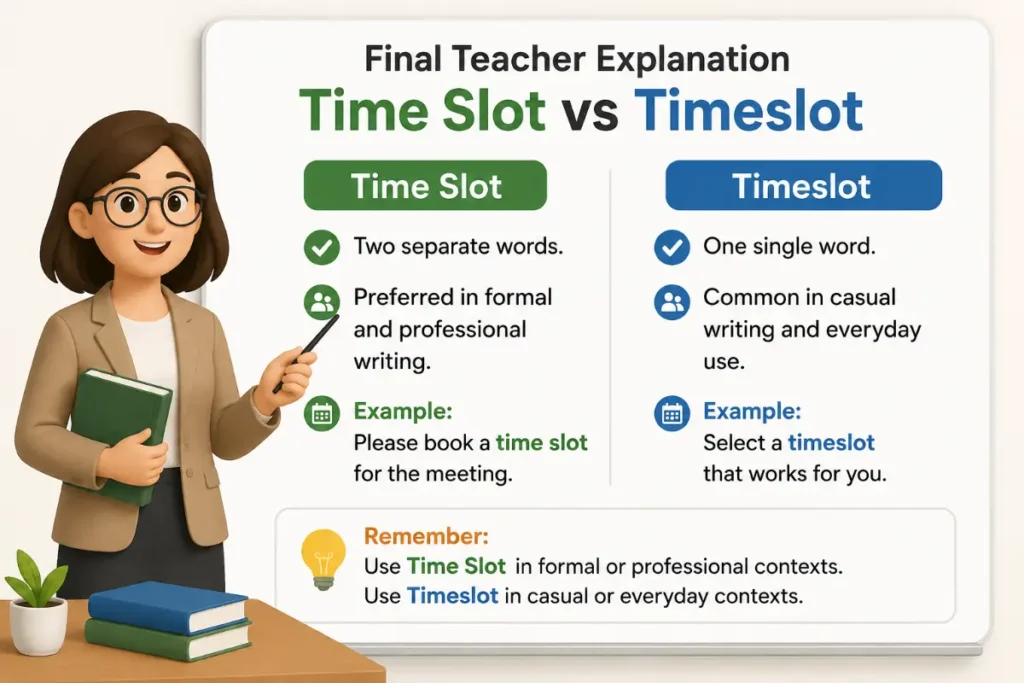
Final Teacher Explanation About Time Slot vs Timeslot
Imagine you are sitting in my English class.
A student asks, “Which one should I write, time slot or timeslot?”
My answer is always simple.
Write time slot.
It is the spelling you will see in dictionaries, schools, offices, newspapers, and professional websites.
Can you find timeslot?
Yes.
Some apps, booking systems, and companies write it as one word.
That is their style.
But if you want your English to look correct almost everywhere, choose time slot.
You do not have to memorize difficult grammar rules.
Just remember one easy sentence.
“A time slot is a planned period of time.”
Write it as two words, and you will usually be correct.
Final Answer (Quick Recap)
When people ask about words, the safest answer is easy. Time slot is the standard spelling in modern English. It is the form most dictionaries, teachers, editors, and businesses recommend.
You may still notice timeslot in some apps, websites, or brand names. That spelling is not always wrong, but it is much less common in everyday writing. If you are writing an email, school assignment, report, article, or professional document, choose time slot. It is clear, natural, and widely accepted.
Need another quick comparison? Read Passerby or Passerbyers Which Word Is Correct (Guide 2026).
Conclusion
Understanding does not have to be difficult. Both forms describe a planned period for an activity, but time slot is the spelling that most people expect to see in standard English.
Whenever you are unsure, remember the simple rule from this guide. Write time slot as two separate words. It will help your writing look more natural and professional.
The easiest takeaway is this: When in doubt, choose “time slot.”
Frequently Asked Questions (FAQs)
What does time slot mean in simple words?
A time slot is a planned period of time for a meeting, class, appointment, or another activity.
Is time slot or timeslot correct?
Time slot is the standard and preferred spelling. Timeslot appears sometimes but is much less common.
When should I use time slot?
Use time slot in schoolwork, business writing, emails, reports, websites, and everyday English.
Why do people get confused?
People see both spellings online. Some apps and companies use timeslot, while most dictionaries prefer time slot.
Can I use both forms in writing?
You can, but time slot is the safer and more professional choice for almost every situation.
Is timeslot one word in every dictionary?
No. Most major dictionaries list time slot as the standard spelling, while timeslot is less common or shown as a variant.
Does the meaning change between time slot and timeslot?
No. Both spellings have the same meaning. The difference is only the way they are written.
