

Many people get confused about lacs or lakhs when writing numbers in English. You may see both words online, in books, or in business documents. This makes many learners wonder which form is correct.
The short answer is simple. Lakhs is the standard and correct modern spelling used in India and many other South Asian countries. Lacs is an older spelling that still appears in some places but is much less common today.
If you have ever wondered this guide will explain everything in very simple English. You will learn what these words mean, why people mix them up, and which one you should use in everyday writing.
You may also want to read Encode vs Incode: Meaning, Differences, and Examples.
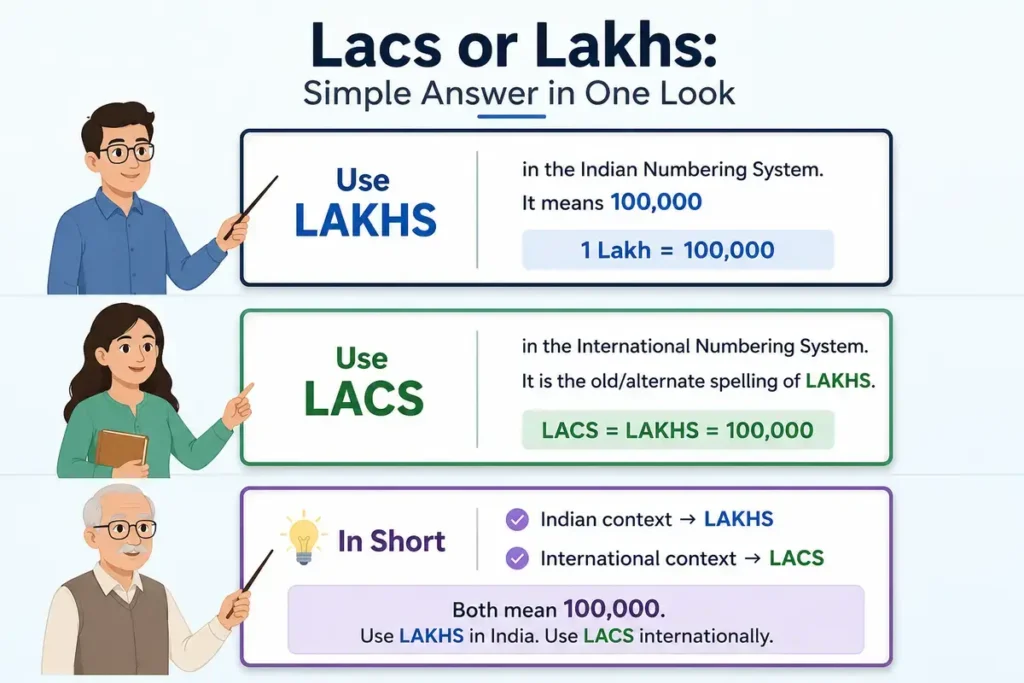
Lacs or Lakhs: Simple Answer in One Look
When comparing lakhs is the preferred modern spelling.
- Lakhs = common and widely accepted spelling
- Lacs = older spelling, less common today
- Both refer to the number 100,000
Example:
- 1 lakh = 100,000
- 5 lakhs = 500,000
What Does Lacs or Lakhs Mean in Simple English?
A lakh is a number used in the Indian numbering system. One lakh equals:
100,000
That means:
- 10 lakh = 1,000,000
- 20 lakh = 2,000,000
- 50 lakh = 5,000,000
People use lakh when talking about:
- Money
- Population
- Property prices
- Salaries
- Business numbers
For example:
- The house costs 40 lakh rupees.
- The city has 15 lakh people.
- She earns 12 lakh rupees a year.
The word helps make large numbers easier to read and understand.
Why People Mix These Words Lacs or Lakhs
Many learners become confused because both spellings can be found in English writing. There are a few simple reasons for this confusion.
Older Books Use “Lacs”
During earlier periods, especially under British influence in South Asia, the spelling lac was common. As a result, older documents often used:
- 5 lacs
- 10 lacs
- 20 lacs
People who read these documents may continue using that spelling today.
Modern Writing Uses “Lakhs”
Over time, the spelling lakh became more popular and accepted. Now most newspapers, schools, businesses, and government sources use:
- 5 lakhs
- 10 lakhs
- 20 lakhs
This is why learners often see two different versions.
Different Regions Follow Different Habits
Language changes from place to place. Some families, businesses, or local communities still write lacs because they have used it for many years. Others use lakhs, which is now considered the standard form.
Internet Content Creates More Confusion
Online articles are written by many different people. One website may write:
- 50 lacs
Another may write:
- 50 lakhs
Both refer to the same amount. Because both forms exist online, learners often wonder which one is correct.
Clear Difference Explained Simply
When comparing the meaning stays exactly the same. The main difference is spelling and modern usage.
| Word | Meaning | Modern Use |
|---|---|---|
| Lakh | 100,000 | Very common |
| Lakhs | More than one lakh | Very common |
| Lac | Older spelling of lakh | Less common |
| Lacs | Older plural form | Less common |
Think of it this way:
- Lakhs = modern choice
- Lacs = older choice
Both represent the same number.
Quick Visual Comparison
Modern Style
- 2 lakhs
- 5 lakhs
- 10 lakhs
Older Style
- 2 lacs
- 5 lacs
- 10 lacs
The value never changes. Only the spelling changes.
Which Form Should You Use?
For most situations, you should use lakhs. This is the spelling people expect to see today. Use lakhs when writing:
- School assignments
- Blog posts
- News articles
- Business documents
- Professional emails
- Website content
Examples:
- The company earned 15 lakhs in profit.
- The project cost 25 lakhs.
- The car was sold for 8 lakhs.
When Might You See Lacs?
You may still find lacs in:
- Older books
- Historical records
- Some business documents
- Traditional writing styles
Even though it is not wrong, it is less common today.
Easy Rule to Remember
If you are unsure choose:
Lakhs
That choice will look natural to most modern readers.
Easy Real-Life Sentences You Can Use for Lacs or Lakhs
Here are some simple examples.
- The apartment costs 35 lakhs.
- She saved 2 lakhs in three years.
- The company invested 50 lakhs in the project.
- They sold the land for 75 lakhs.
- The school received 10 lakhs in donations.
- His annual salary is 18 lakhs.
- The city welcomed several lakhs of visitors.
- The business earned 5 lakhs last month.
Older style examples:
- The apartment costs 35 lacs.
- The company invested 50 lacs.
- The land was sold for 75 lacs.
These sentences mean exactly the same thing.
Where Lacs or Lakhs Comes From (Simple History)
The word lakh has a very long history. It comes from an ancient language called Sanskrit. The original word was laksha, which referred to a large number. Over many centuries, the word changed as languages developed across South Asia. People continued using it when talking about large amounts of money, people, and property.
When British writers recorded local words, some spelled it as lac. That spelling appeared in many old English documents. Later, lakh became the more accepted spelling and started appearing more often in schools, newspapers, and official writing. Today, lakh and lakhs are the forms most people recognize As language changed, the meaning stayed the same:
1 lakh = 100,000
No matter how the word is spelled, the number remains unchanged. As you can see, understanding is mostly about understanding spelling choices. The basic meaning is easy. In the next section, we will look at how this word is used in culture, business, daily life, symbolism, and common expressions so you can understand it even more clearly.
How Lacs or Lakhs Is Understood in Culture and Stories
When people talk they are usually talking about large amounts of money, wealth, success, or value. In many South Asian countries, the word lakh is part of everyday life. People use it when discussing salaries, house prices, business profits, education costs, and savings. For example, someone may say:
- He earns 12 lakhs a year.
- The house costs 50 lakhs.
- The company made several lakhs in profit.
Because the number is used so often, it has become part of daily culture. In stories, a lakh can represent:
- Financial success
- Hard work paying off
- Family wealth
- Business growth
- Big dreams becoming reality
A character who saves a few lakhs may be shown as responsible and hardworking. A business owner who earns lakhs may be shown as successful. The word itself does not carry special emotions. However, because it often refers to large amounts, many people connect it with achievement and progress.
In Everyday Conversations
You can hear the word in many situations:
- Family discussions
- Real estate talks
- Business meetings
- News reports
- Job interviews
- School conversations
For millions of people, using lakh feels as natural as using thousand or million.
Still confused? Compare On to vs Onto: Which One Is Correct And Simple Rules 2026.
Biblical and Mythological Meaning of Lacs or Lakhs (If Applicable)
The words do not have a direct meaning in the Bible. The Bible was written long before the modern Indian numbering system became common in English. Because of this, the word lakh does not appear as a special biblical term. However, the Bible often mentions large numbers when discussing:
- Wealth
- Armies
- Blessings
- Populations
- Offerings
In those cases, the idea is similar. Large numbers are used to show abundance or greatness.
Mythological Meaning
In South Asian mythology and traditional stories, large numbers appear often. Ancient stories sometimes describe:
- Huge kingdoms
- Large armies
- Great treasures
- Vast populations
Although the exact word used may differ, the idea of counting in lakhs has existed for a very long time. So do not have a special mythological meaning, the concept of large numbers has been part of storytelling for centuries.
Symbolism Explained in Simple Words
What One Version Represents in Lacs or Lakhs
The spelling lakhs usually represents:
- Modern usage
- Current education standards
- Professional writing
- Newspapers and websites
- Business communication
When people see “lakhs,” they often view it as the standard modern form. It feels updated and widely accepted.
What the Other Version Represents in Lacs or Lakhs
The spelling lacs usually represents:
- Older writing styles
- Historical documents
- Traditional habits
- Earlier English spellings
Some people still use it because they learned it that way years ago.It may remind readers of older records, reports, and publications.
Simple Comparison
| Lakhs | Lacs |
|---|---|
| Modern spelling | Older spelling |
| More common today | Less common today |
| Preferred in current writing | Seen in older writing |
| Used by most publications | Used by some traditional writers |
The meaning stays exactly the same. Only the spelling changes.
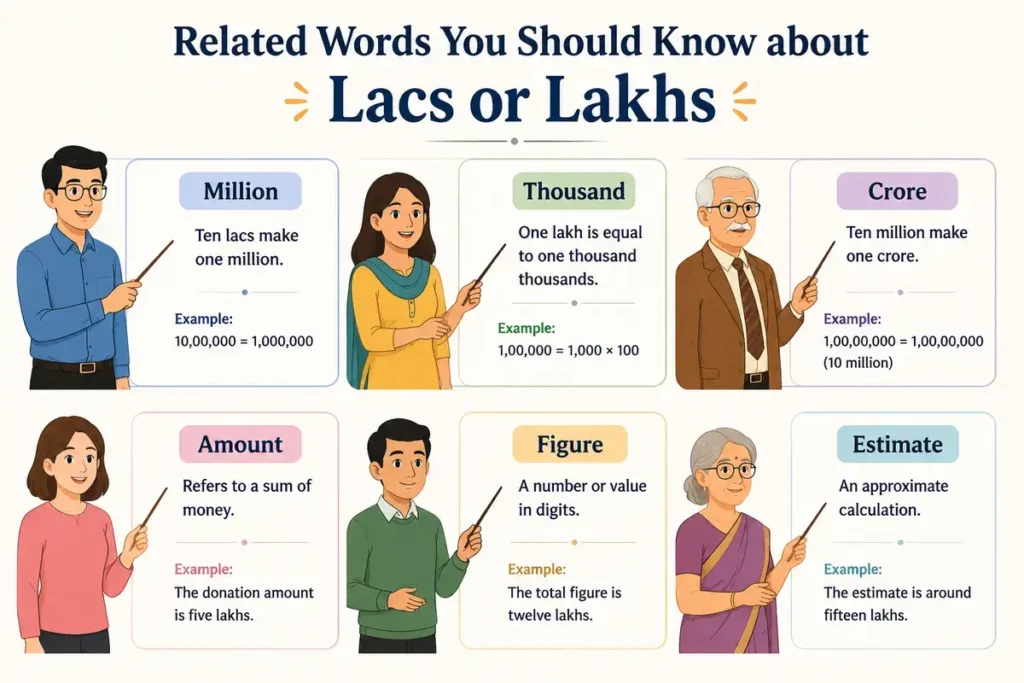
Related Words You Should Know about Lacs or Lakhs
When learning it helps to know some related number words.
Thousand
A thousand equals 1,000. Example:
- The bike costs ten thousand rupees.
Lakh
A lakh equals 100,000. Example:
- The property costs 25 lakh rupees.
Million
A million equals 1,000,000. Example:
- Ten lakh equals one million.
Crore
A crore equals 10,000,000. Example:
- The company earned one crore rupees.
Revenue
Revenue means money earned by a business. Example:
- The firm’s revenue reached several lakhs.
Salary
Salary means regular payment from a job. Example:
- Her annual salary is 15 lakhs.
Investment
Investment means money put into something for future profit. Example:
- They invested 20 lakhs in the project.
Savings
Savings means money kept for future use. Example:
- He has savings of several lakhs.
Knowing these words makes understanding financial conversations much easier.
How People Actually Use Lacs or Lakhs in Daily English
People use in many everyday situations. Here are some common examples.
- I bought my car for 8 lakhs.
- The apartment costs 45 lakhs.
- She earns 10 lakhs a year.
- They invested 25 lakhs in the business.
- We raised 5 lakhs for charity.
- The project budget is 30 lakhs.
- His family saved several lakhs over the years.
- The company made 12 lakhs in profit.
- The school received donations worth 2 lakhs.
- The land was sold for 60 lakhs.
In Business
- Sales crossed 50 lakhs this year.
- The startup received funding of 80 lakhs.
For Real Estate
- The house is worth 90 lakhs.
- The plot was purchased for 20 lakhs.
In Jobs and Careers
- She got a package of 18 lakhs.
- His salary increased to 22 lakhs.
These examples show how naturally the word fits into daily conversation.
Common Mistakes People Make With Lacs or Lakhs
Many learners make small mistakes when using the good news is that they are easy to fix.
Mistake 1: Thinking They Mean Different Numbers
Incorrect idea:
- Lacs and lakhs are different amounts.
Correct idea:
- Both refer to the same number: 100,000.
Mistake 2: Using the Older Form Without Knowing It
Some writers use:
- 50 lacs
This is not wrong, but modern writing usually prefers:
- 50 lakhs
Mistake 3: Mixing Number Systems
Incorrect:
- 1 lakh million
Correct:
- 1 lakh
- 1 million
Use one system at a time.
Mistake 4: Confusing Lakh and Crore
Incorrect:
- 1 lakh equals 1 crore.
Correct:
- 1 lakh = 100,000
- 1 crore = 10,000,000
They are very different numbers.
Mistake 5: Using the Wrong Plural Form
Incorrect:
- Five lakhses
Correct:
- Five lakhs
The plural form is simply lakhs.
Easy Fix
Whenever you feel unsure remember:
- Meaning = same
- Modern spelling = lakhs
That simple rule solves most mistakes.
Final Teacher Explanation of Lacs or Lakhs
Imagine you are sitting in a classroom and asking me which word is correct. My answer would be very simple. Both lacs and lakhs refer to the same number: 100,000
The confusion comes from spelling, not meaning. Years ago, many writers used lacs. Today, most people use lakhs. If you are writing:
- A blog
- A school paper
- A business report
- A website article
- Professional content
Choose lakhs. Readers will recognize it immediately. There is no difference in value, money, or quantity. The only real difference is that one spelling is modern and the other is older. That is the key lesson to remember.
Conclusion
Understanding lacs or lakhs is actually very easy once you know the basic rule. Both words represent the same number: 100,000. The spelling lacs comes from older English usage, while lakh is the modern and widely accepted form used today.
For most writing situations, choosing lakhs is the safest and clearest option. It is the form commonly seen in education, business, media, and everyday communication. So if someone asks you can confidently explain that the meaning is the same, but lakhs is the spelling most people use today.
For another common grammar confusion, see Fact or Fiction: How Do You Use Them Correctly (2026)?.
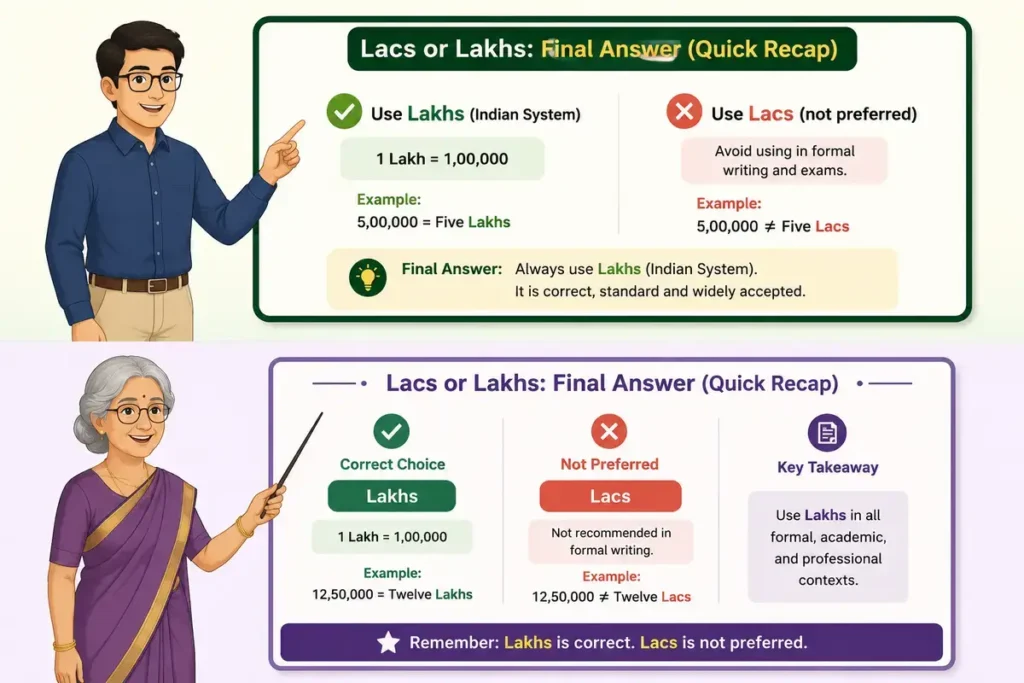
Lacs or Lakhs: Final Answer (Quick Recap)
When comparing lacs or lakhs, both mean 100,000. The difference is spelling, not meaning. Lakhs is the modern and preferred spelling, while lacs is an older form that is less common today. If you are unsure, use lakhs.
Frequently Asked Questions (FAQs)
What does mean in simple words?
Both words mean 100,000. They refer to the same number.
Is it correct to use?
Yes. Both are correct, but lakhs is more common in modern writing.
Which is correct?
Most modern writers use lakhs. It is the preferred spelling today.
Why do people get confused between lacs or lakhs?
People see both spellings online, in books, and in older documents, which creates confusion.
Can I use both forms in writing?
Yes, but lakhs is usually the better choice for modern readers.
Is lakh the same as million?
No. One lakh equals 100,000, while one million equals 1,000,000.
What is the plural form of lakh?
The plural form is lakhs.
Do represent different amounts?
No. They represent exactly the same amount.
