
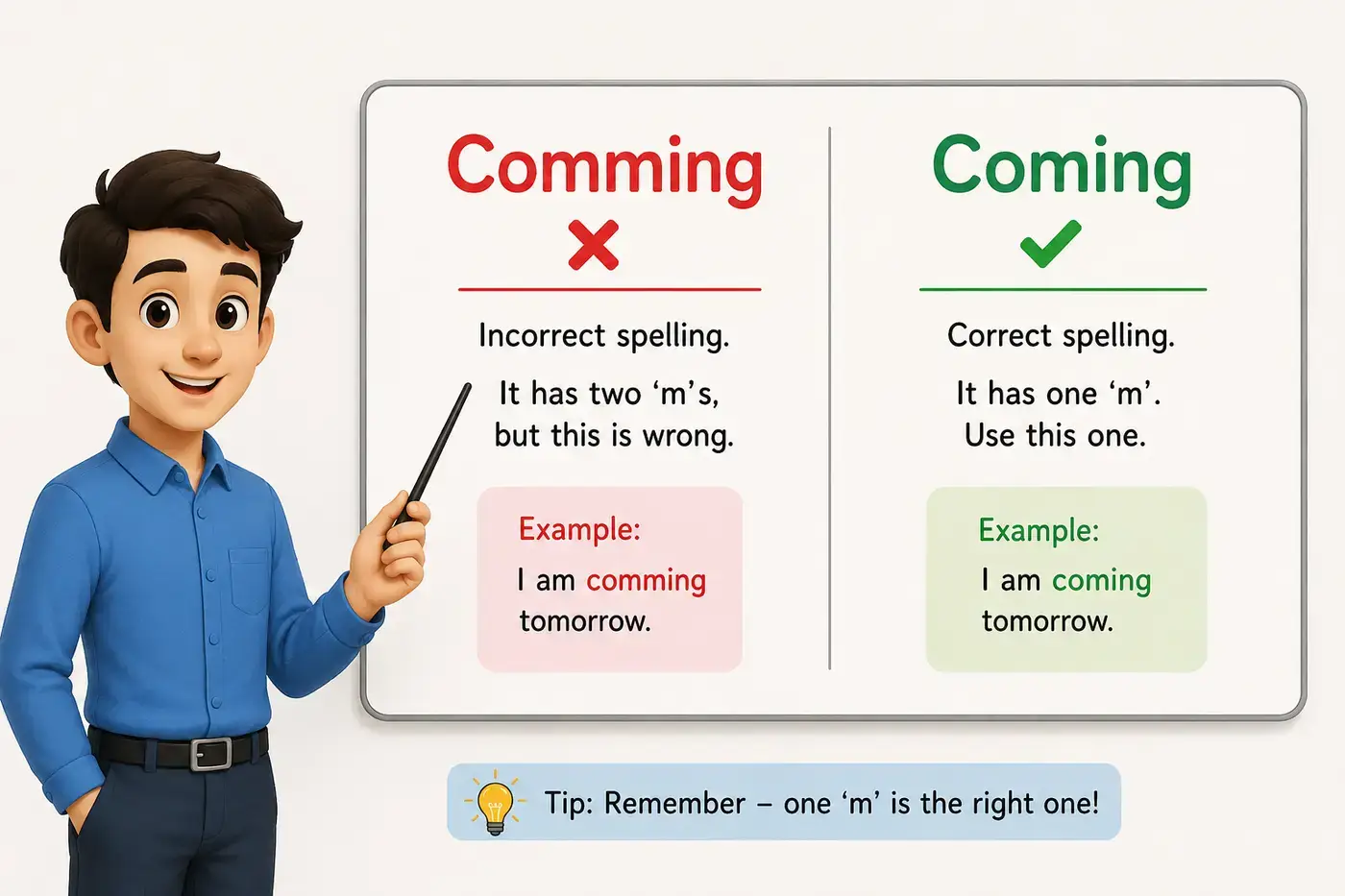
If you have ever typed comming vs coming, you are not alone. Many English learners and even native speakers pause for a second before writing this word. The extra m looks right to many people, but looks can be confusing. The good news is that this spelling mistake is easy to fix once you know one simple rule.
The difference between is very clear. Coming is the correct spelling. Comming is a spelling mistake. You should always write coming when talking about someone or something moving closer or arriving.
This guide explains in very simple English. You will learn the correct spelling, why people make this mistake, how to remember the rule, and how to use coming correctly in everyday conversations and writing.
For another common grammar confusion, see Prooving vs Proving: Which Spelling Is Correct?.
Simple Answer in One Look
Coming is correct.
Comming is incorrect.
Always write coming because the verb come drops the final e before adding ing.
Correct: I am coming home.
Incorrect: I am comming home.
What Comming vs Coming Means in Simple English
The word coming means moving toward someone or something. It can also mean arriving soon or happening in the future. Think about these simple examples.
- My dad is coming home.
- The bus is coming.
- Summer is coming soon.
- Your birthday is coming next week.
In each sentence, coming shows movement or something that will happen soon. The base word is come. When we want to show an action happening now, we add ing.
Come → Coming
The final e disappears before adding ing. This is why coming has only one m after the vowel. Many beginners think another m should be added, but English does not follow that pattern here.
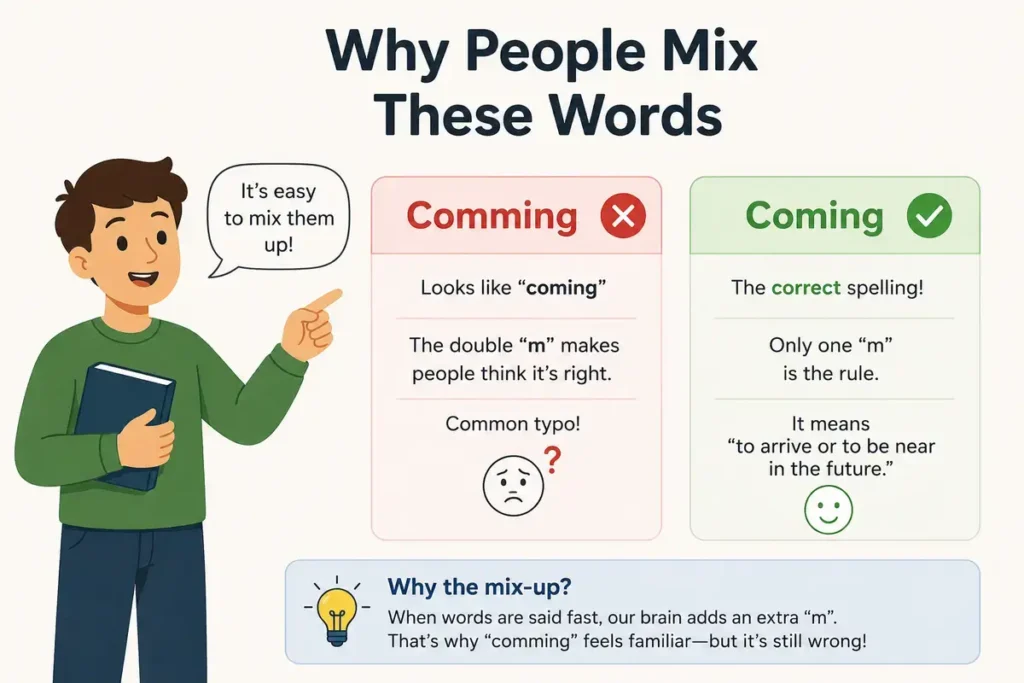
Why People Mix These Words Comming vs Coming
The confusion between happens for several simple reasons.
The Word Sounds Longer
When people say coming, the middle sound feels strong. Some writers think they hear two m sounds. So they type comming instead. The pronunciation stays almost the same, but the spelling does not.
Other English Words Double Letters
English has many words like these.
- Running
- Swimming
- Sitting
- Hopping
These words really do double the last letter.
Because of these examples, learners often believe come should become comming. It does not.
Fast Typing Causes Mistakes
Sometimes people know the correct spelling but type too quickly.
Their fingers accidentally add another m.
Spell check often catches this mistake.
English Spelling Can Be Tricky
Some verbs double the last letter.
Others simply remove the final e.
Knowing which rule applies makes writing much easier.
Clear Difference Explained Simply
Here is an easy comparison.
| Word | Correct? | Meaning |
|---|---|---|
| Coming | ✅ Yes | Moving closer or arriving |
| Comming | ❌ No | Incorrect spelling |
Another quick comparison.
Coming
- Correct English spelling.
- Used in school, books, newspapers, and business writing.
- Accepted everywhere.
Comming
- Not a real English spelling.
- Considered a typo.
- Should always be corrected.
Remember this simple fact.
There is no situation where comming is the correct spelling.
Which Form Should You Use?
You should always use coming. Here is the easy rule. If the base word ends with e, remove the e before adding ing. Look at these examples.
- Come → Coming
- Make → Making
- Bake → Baking
- Smile → Smiling
- Move → Moving
Notice what happens.
The e disappears.
No extra m is added to come.
That gives us:
Come + ing = Coming
Not:
Come + ing = Comming
This is one of the easiest spelling rules once you remember it.
A Quick Memory Trick
Think of this sentence.
The silent E goes away before ING comes to stay.
Come
Remove e
Add ing
Coming
This little trick helps many students remember the correct spelling.
Easy Real Life Sentences You Can Use for Comming vs Coming
These examples show how people use coming every day.
- I am coming to your house now.
- My teacher is coming into the classroom.
- Winter is coming soon.
- Are you coming with us?
- The train is coming.
- My friends are coming tonight.
- Good news is coming.
- We are coming back tomorrow.
Notice that every sentence uses coming.
You will never see comming in correct English writing.
More Everyday Examples
At home
Mom is coming home after work.
At school
The teacher is coming in five minutes.
At work
Our manager is coming to the meeting.
Talking to friends
I’m coming with you.
Planning a trip
Our vacation is coming soon.
These are natural examples you can use every day.
Where Comming vs Coming Expression Comes From Simple History
The word come is very old. People have used it in English for hundreds of years. It comes from early forms of English spoken long before modern dictionaries existed. Over time, English spelling became more regular. One rule stayed the same. When a verb ends with a silent e, the e usually disappears before adding ing. That is why people write:
- Come → Coming
- Dance → Dancing
- Hope → Hoping
- Share → Sharing
The spelling comming has never been the standard English form. It appears mostly because of typing mistakes or confusion about spelling rules. As dictionaries became common, coming remained the accepted spelling everywhere. Today, schools, publishers, teachers, and English dictionaries all use coming. The spelling has stayed the same for generations.
As you continue learning English, you will notice many words follow this same pattern. Once you understand why coming is correct, many other spelling rules become easier too. In the next section, we will look at how this word is understood in culture, simple symbolism, common expressions, learning tips, and the everyday situations where people use it most.
How Is Understood in Culture and Stories
The word coming is more than just a spelling. It often gives people a feeling that something is on its way. It may be a person, a special day, good news, or even a new season. People use coming in books, movies, songs, and daily conversations because it creates a sense of hope or expectation. Here are a few common examples.
- Spring is coming.
- Better days are coming.
- Help is coming.
- Change is coming.
These sentences make people feel that something new is getting closer. The word comming has no cultural meaning because it is not a correct English word. When readers see it, they usually think it is just a typing or spelling mistake. That is why choosing the correct spelling matters. It helps your writing look clear, natural, and professional.
You may also want to read Distress vs Duress: Meaning and Real-Life Examples.
Biblical and Mythological Meaning of Comming vs Coming
The word coming appears many times in religious writing because it simply means arriving or appearing. For example, many Bible translations talk about someone’s coming or the coming of a special event. In these places, the word means that a person or event will happen in the future. You may also hear phrases like these.
- The coming of peace.
- The coming of a new king.
- The coming days.
These examples use the normal meaning of arrival or the future. The spelling comming has no biblical meaning because it is not a real English spelling. So even in religious or historical writing, you should always use coming.
Symbolism Explained in Simple Words
What Coming Represents
The correct word coming often represents positive ideas. It can stand for:
- Hope.
- A new beginning.
- Progress.
- Change.
- Opportunity.
- Growth.
- Good news.
- A fresh start.
For example, when someone says, “Your chance is coming,” they are giving hope for the future. When a teacher says, “The exam is coming,” it reminds students to get ready. The word can bring excitement, happiness, or even a little nervousness depending on the situation.
What Comming Represents
The word comming does not have a symbolic meaning.
Instead, it usually represents a spelling mistake.
If someone writes comming, readers may think:
- The writer typed too fast.
- The writer is still learning English.
- The word was not checked before publishing.
That is why using coming instead of comming makes your writing stronger and easier to trust.
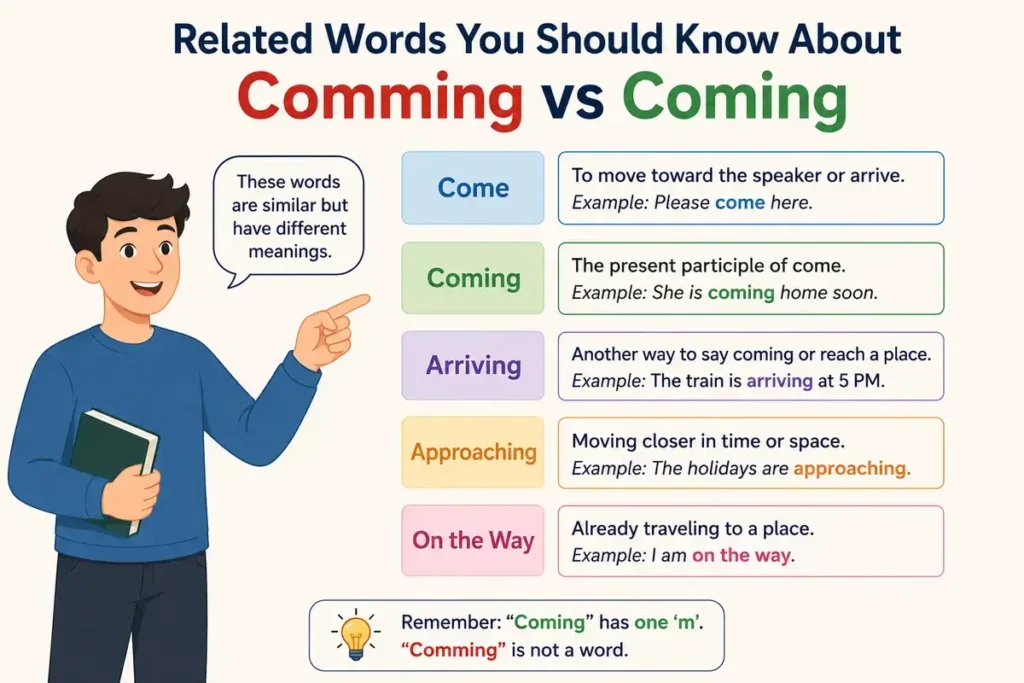
Related Words You Should Know About Comming vs Coming
Here are some helpful words related to coming.
Come
The base word. It means to move toward someone or arrive. Example:
Please come inside.
Came
This is the past form of come. Example:
She came home early.
Comeback
This means returning after being away or becoming successful again. Example:
The team made a great comeback.
Arrival
This means the moment someone reaches a place. Example:
We waited for the arrival of the train.
Approach
This means moving closer. Example:
The storm is starting to approach.
Future
This means the time that has not happened yet. Example:
Nobody knows the future.
Soon
This means after a short time. Example:
Dinner will be ready soon.
Near
This means close in distance or time. Example:
The holidays are near.
Learning these words will help you understand and use coming more naturally.
How People Actually Use Comming vs Coming in Daily English
People use coming every day in conversations. Here are some real examples.
- I am coming home now.
- Are you coming with us?
- My parents are coming tomorrow.
- The movie is coming out next week.
- Rain is coming this afternoon.
- Christmas is coming soon.
- Thank you for coming today.
- The doctor is coming in a minute.
- Our food is coming.
- Good things are coming your way.
Notice something important.
Every sentence uses coming.
None of them use comming because that spelling is always incorrect.
You will hear these kinds of sentences in schools, offices, airports, restaurants, and homes every day.
Common Mistakes People Make
Many learners make the same spelling mistakes. Here are the most common ones.
Mistake 1
Incorrect:
I am comming home.
Correct:
I am coming home.
Mistake 2
Incorrect:
She is comming tomorrow.
Correct:
She is coming tomorrow.
Mistake 3
Incorrect:
Winter is comming.
Correct:
Winter is coming.
Mistake 4
Incorrect:
Thanks for comming.
Correct:
Thanks for coming.
Mistake 5
Incorrect:
The bus is comming.
Correct:
The bus is coming.
The easiest way to avoid these mistakes is to remember one simple rule.
Remove the silent e from come, then add ing.
Come
Coming
Never add another m.
Quick Memory Tip
Think about this sentence every time you write.
“The silent E leaves before ING arrives.”
This simple trick works almost every time.
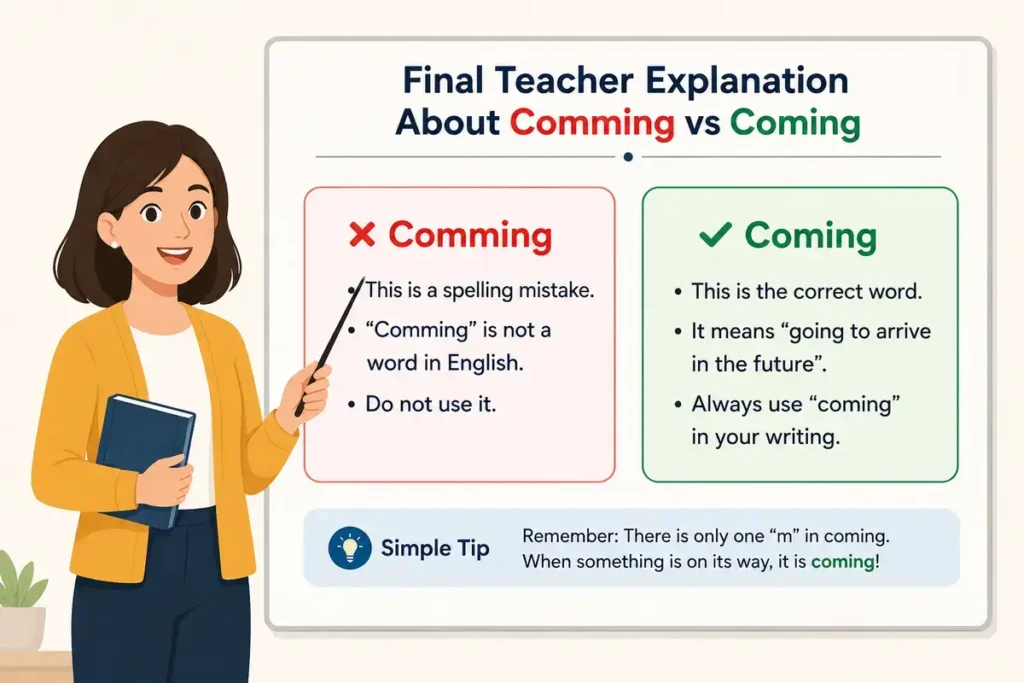
Final Teacher Explanation About Comming vs Coming
Imagine I am standing in front of a classroom. A student asks, “Should I write comming or coming?” My answer is always the same.
Write coming.
The word comming is a spelling mistake.
Remember the base word is come.
Take away the last e.
Then add ing.
You do not need another m.
That is the whole rule.
English has many spelling rules, but this one is simple and easy to remember.
The more you read books, articles, and stories, the more often you will see coming.
Soon the correct spelling will feel natural.
If you ever stop and wonder about both words, just remember this lesson.
There is only one correct spelling.
It is coming.
Final Answer About Comming vs Coming Quick Recap
If you are choosing between words, the answer is easy.
Coming is the correct spelling in every kind of English writing.
Comming is always a spelling mistake.
Remember this simple rule.
Drop the final e from come, then add ing to make coming.
Need another quick comparison? Read Serpent Vs Snake: Easy Guide Every Student Needs (2026).
Conclusion
The confusion between is common, but the answer is simple. Coming is the only correct spelling, while comming is always a mistake. The rule is easy to remember. Start with come, remove the silent e, and add ing. Once you practice this pattern a few times, writing coming will become natural. Whenever you are unsure, remember this simple teacher rule: one m, no final e, and always write coming.
Frequently Asked Questions
Is comming or coming correct?
Only coming is correct. Comming is always a spelling mistake.
Why do people write comming?
Many people think another m should be added because some English words double their last letter. The word come does not follow that pattern.
What does coming mean in simple words?
It means moving closer, arriving, or happening soon.
Can I ever use comming in English writing?
No. Standard English always uses coming.
Why is the e removed from come?
English usually drops the silent e before adding ing.
How can I remember the correct spelling?
Remember this easy rule: Remove the e, add ing, and never add another m.
Is coming used in formal writing?
Yes. Coming is correct in school work, emails, books, business writing, and everyday conversations.
Is coming used in speaking too?
Yes. People use coming every day when talking about arriving, moving closer, or something happening soon.
