
If you have ever wondered about totalling vs totaling, you are not alone. Many English learners and even native speakers stop and think before writing this word. Both spellings look correct, but only one fits the type of English you are using.
The good news is that the answer is simple. The difference between is based on regional spelling. One form is common in American English, while the other is common in British English. Once you know this rule, choosing the right spelling becomes easy.
This guide explains everything in very simple words. You will learn the difference, see real examples, understand why people confuse these spellings, and know which one to use in your own writing.
For another common grammar confusion, see Chefs Or Cheves: Correct Answer Explained Clearly (2026).
Simple Answer in One Look
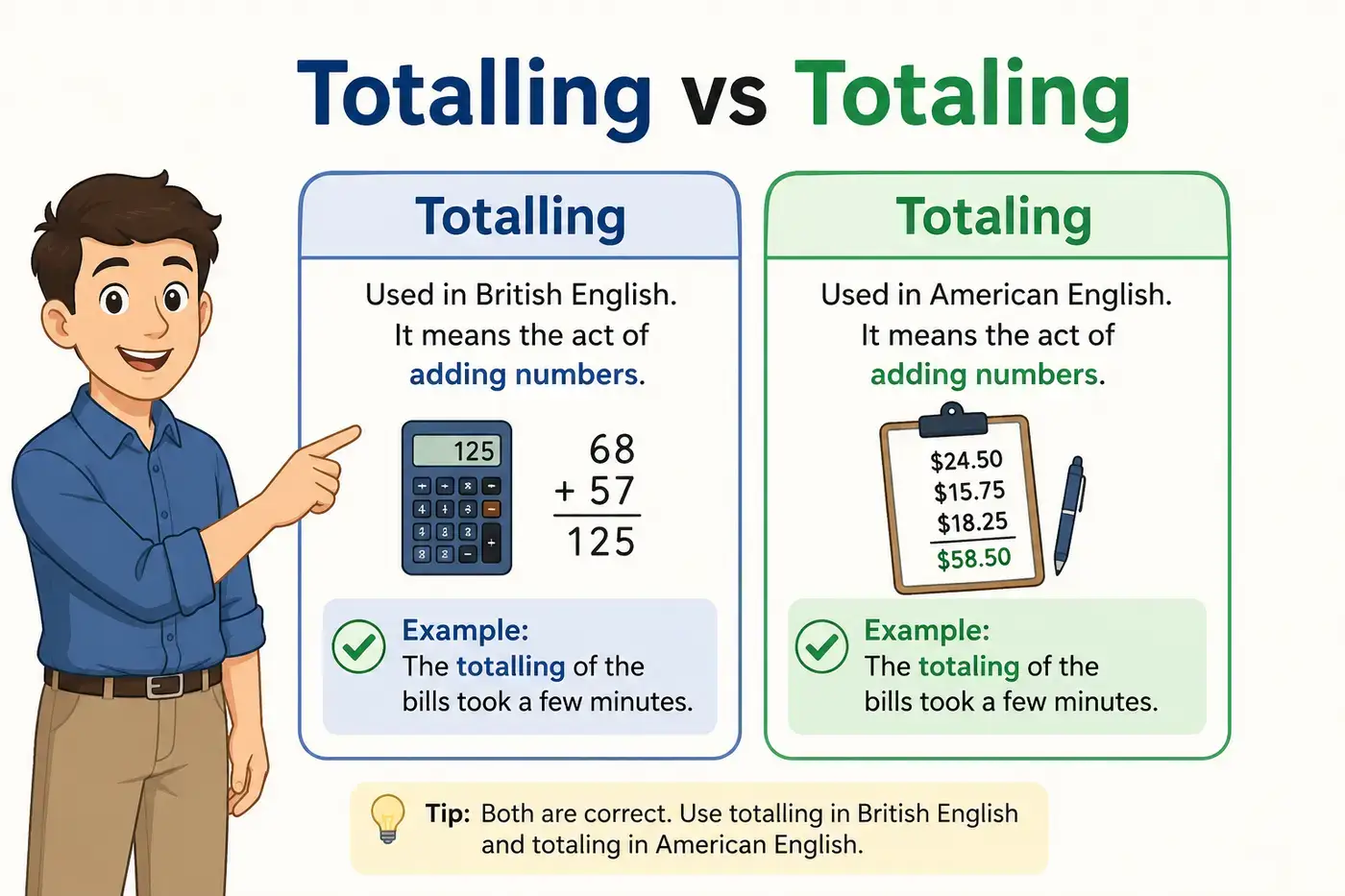
Totaling is the correct spelling in American English.
Totalling is the correct spelling in British English.
Both words have the same meaning. The only difference is the spelling style.
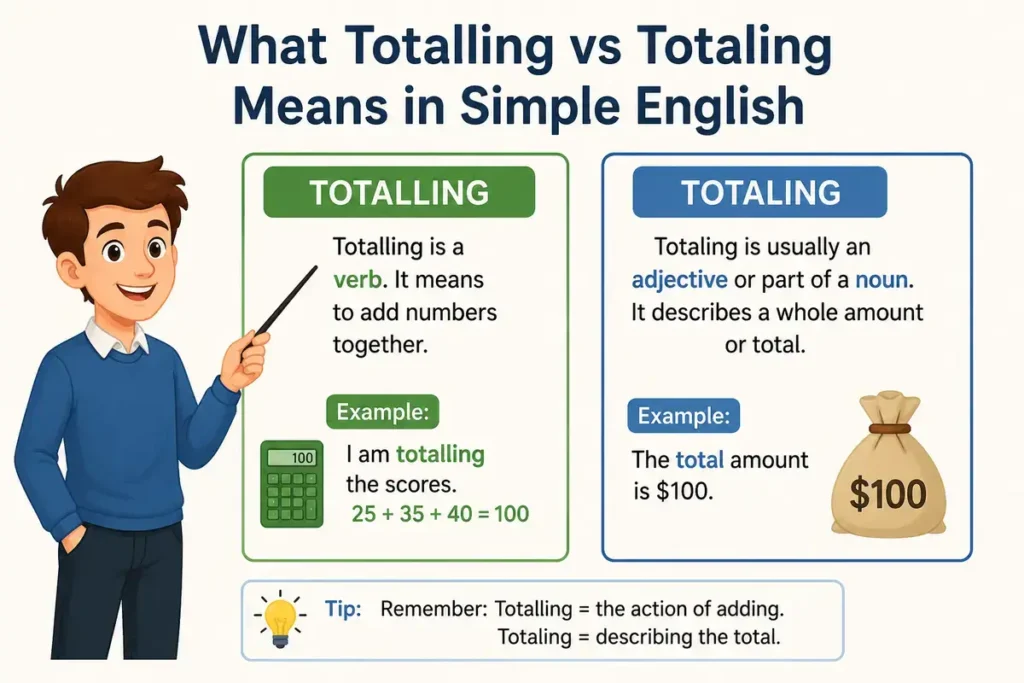
What Totalling vs Totaling Means in Simple English
The words totalling and totaling both come from the verb total. They mean:
- Adding numbers together.
- Finding the final amount.
- Reaching a complete sum.
- Causing something to add up to a certain number.
Think about adding the prices of everything in your shopping cart. When you find the final amount, you are totaling or totalling the prices. Here are some easy examples.
- She is totaling the bill.
- She is totalling the bill.
- We are totaling all the points.
- We are totalling all the points.
The action is exactly the same. Only the spelling changes.
A Simple Classroom Example
Imagine your teacher gives a math test. You answer ten questions. At the end, the teacher adds your points together.
The teacher is totaling your score in American English.
The teacher is totalling your score in British English.
Nothing else changes.
Easy Definition
Totaling or totalling means:
- Adding everything together.
- Finding the complete amount.
- Reaching the final number.
Everyday Situations
You may see this word when someone is:
- Adding a grocery bill.
- Counting sports points.
- Calculating business costs.
- Finding monthly expenses.
- Adding classroom scores.
- Counting votes.
- Checking travel costs.
- Calculating work hours.
In every case, the meaning stays the same.
Why People Mix These Words Totalling vs Totaling
Many people become confused because they see both spellings online.
One website writes totaling.
Another website writes totalling.
Both look professional.
Both appear in newspapers.
So people naturally ask which one is correct.
The answer depends on the type of English.
American English Uses One L
American English usually removes one extra L when adding ing to many words ending in L. Examples include:
- traveling
- canceled
- signaling
- totaling
This spelling is standard across the United States.
British English Often Uses Double L
British English often doubles the final L before adding ing. Examples include:
- travelling
- cancelling
- signalling
- totalling
This spelling is common in the United Kingdom and many countries that follow British English.
Both Look Correct
Since people read books, blogs, and websites from many countries, they often see both spellings. That makes it easy to think one must be wrong. Actually, both are accepted. The key is using the correct style for your audience.
Spell Check Can Add to the Confusion
Your computer or phone may also confuse you.
If your language setting is American English, it suggests totaling.
If your language setting is British English, it suggests totalling.
Neither suggestion is wrong.
The software is simply following the spelling style you selected.
Students Often Copy What They Read
Imagine two students.
One studies with American textbooks.
The other studies with British textbooks.
The first student writes totaling.
The second student writes totalling.
Both students are following the rules they learned.
That is why this spelling question is so common.
Clear Difference Explained Simply
Here is the easiest way to remember.
| American English | British English |
|---|---|
| totaling | totalling |
| one L before ing | two Ls before ing |
| Used in the United States | Used in the United Kingdom |
| Same meaning | Same meaning |
Quick Comparison
Totaling
- American spelling.
- Uses one L.
- Common in US schools.
- Used in American newspapers.
- Preferred in American business writing.
Totalling
- British spelling.
- Uses two Ls.
- Common in the UK.
- Used in British schools.
- Preferred in British publications.
They Mean Exactly the Same Thing
These sentences have the same meaning.
American English:
- We are totaling today’s sales.
British English:
- We are totalling today’s sales.
Nothing changes except the spelling.
Think About Similar Words
You may already know these spelling pairs.
| American | British |
|---|---|
| traveling | travelling |
| canceled | cancelled |
| modeling | modelling |
| signaling | signalling |
| totaling | totalling |
Seeing this pattern makes the rule much easier to remember.
Which Form Should You Use Totalling vs Totaling?
The best choice depends on who will read your writing.
Use Totaling If
- You write in American English.
- Your school follows US spelling.
- Your company uses American style.
- Your audience is mainly in the United States.
Use Totalling If
- You write in British English.
- Your school follows UK spelling.
- Your audience is in the United Kingdom.
- Your publisher uses British spelling.
Stay Consistent
The most important rule is consistency. Do not mix the spellings in the same document. For example, avoid writing:
- We are totaling the costs and totalling the profits.
Choose one style and keep using it.
A Helpful Trick
Ask yourself one question before writing.
Am I using American English or British English?
If the answer is American English, write totaling.
If the answer is British English, write totalling.
That simple question can prevent many spelling mistakes.
Easy Real Life Sentences You Can Use
These examples show how both spellings work.
American English
- I am totaling the bill.
- She is totaling the points.
- We are totaling our expenses.
- Dad is totaling the shopping cost.
- The teacher is totaling our test scores.
- They are totaling the travel budget.
- We finished totaling the numbers.
British English
- I am totalling the bill.
- She is totalling the points.
- We are totalling our expenses.
- Dad is totalling the shopping cost.
- The teacher is totalling our test scores.
- They are totalling the travel budget.
- We finished totalling the numbers.
Each sentence has the same meaning.
Only the spelling changes.
Short Conversations
Conversation One
Anna: Have you finished totaling the bill?
Ben: Yes. The final amount is fifty dollars.
Conversation Two
Emma: Have you finished totalling the bill?
James: Yes. Here is the final amount.
Both conversations sound natural.
The only difference is the regional spelling.
Where Totalling vs Totaling Words Expression Comes From Simple History
The word total comes from an old Latin word that meant whole or complete. Later, it became part of French. From there, it entered English many years ago. People first used total as a word that described the complete amount of something.
Later, English speakers started using total as a verb. That verb meant adding everything together to reach one final number. As English spread across different countries, spelling rules slowly changed. American English simplified many words by removing extra letters. British English kept many of the older spelling patterns. That is why we now have:
- totaling in American English
- totalling in British English
The meaning has stayed exactly the same for many years. Today, people around the world use both spellings every day in schools, offices, banks, stores, and homes. Now that you understand the basic difference between both words, the next step is learning how these spellings are used in different cultures, writing styles, common expressions, and everyday situations. Understanding these deeper examples will help you choose the right spelling with confidence wherever you write.
How Is Understood in Culture and Stories
The spelling difference between both words are not about changing the meaning. It is simply a sign of where the writer learned English. In the United States, people naturally write totaling because that is the spelling they learn in school. In the United Kingdom, people naturally write totalling because that is the spelling used in British English. This is much like saying the same thing with a different accent. The message stays the same. You may notice this difference in many places.
- Books.
- Newspapers.
- School lessons.
- Business reports.
- Online articles.
- News websites.
A British novel may say:
“The accountant spent the afternoon totalling the expenses.”
An American novel may say:
“The accountant spent the afternoon totaling the expenses.”
Readers understand both sentences without any problem. People also use these words in stories to show someone adding things together before making an important decision. For example:
A family totals the cost of a vacation.
A student totals test scores before checking the final grade.
A coach totals team points after a game.
In each story, the word suggests reaching a final answer.
That idea of finding the complete amount is understood in many cultures. No matter where people live, they often need to count, calculate, and make decisions. That is why this word appears in everyday life across the English speaking world.
A related grammar guide is Developed vs Developped: Easy Guide for English Learners.
Biblical and Mythological Meaning of Totalling vs Totaling
There is no special Biblical meaning. The Bible does not use these modern English spellings. However, the idea of finding a total or complete amount appears in many parts of Scripture. For example, people counted families, soldiers, gifts, animals, and supplies.
The focus was on careful counting and honesty. In mythology, there is also no special meaning connected to these spellings. Stories from ancient Greece, Rome, and other cultures often include counting treasures, people, or victories, but they do not connect this idea with the spellings totalling or totaling. So, the spelling itself has no religious or mythical meaning. It is simply a language choice based on regional English.
Symbolism Explained in Simple Words
Even though this is only a spelling difference, the word “total” can have a simple symbolic meaning. It often reminds people of completion, balance, and reaching the final result.
What Totalling Represents
In British English, totalling represents:
- Completing a calculation.
- Reaching the final answer.
- Careful counting.
- Accuracy.
- Following British spelling traditions.
The extra letter does not change the meaning.
It only shows that the writer is using British English.
What Totaling Represents
In American English, totaling represents:
- Adding everything together.
- Finding the complete amount.
- Clear and simple writing.
- American spelling style.
- Everyday communication in the United States.
Again, the meaning stays exactly the same.
Easy Comparison
| Totalling | Totaling |
|---|---|
| British English | American English |
| Two Ls | One L |
| Same meaning | Same meaning |
| Complete amount | Complete amount |
| Final result | Final result |
The only thing that changes is the spelling.
Related Words You Should Know About Totalling vs Totaling
Learning similar words makes easier to remember.
Total
The complete amount of something. Example:
The total is 85 dollars.
Sum
The answer after adding numbers together. Example:
The sum is 120.
Count
To find how many things there are. Example:
Please count the books.
Calculate
To work out an answer using numbers. Example:
She calculated the bill.
Add
To put numbers together. Example:
Add ten and five.
Amount
How much there is. Example:
The amount is correct.
Figure
A number used in counting or math. Example:
Check the final figure.
Balance
The amount left after adding or subtracting. Example:
Your balance is twenty dollars.
Estimate
A close guess before knowing the exact total. Example:
The estimate was very close.
Cost
The money needed to buy something. Example:
The total cost surprised us.
Knowing these words will help you understand many conversations about numbers, money, shopping, school, and work.
How People Actually Use it in Daily English
Here are some everyday examples.
American English:
“I am totaling this week’s expenses.”
“The cashier is totaling your bill.”
“We finished totaling the scores.”
“My phone is totaling today’s steps.”
“The accountant is totaling the company’s costs.”
British English:
“I am totalling this week’s expenses.”
“The cashier is totalling your bill.”
“We finished totalling the scores.”
“My phone is totalling today’s steps.”
“The accountant is totalling the company’s costs.”
More natural conversations:
“Can you finish totaling the numbers before lunch?”
“We are totalling all the donations.”
“She kept totaling the prices to stay within her budget.”
“They spent the evening totalling the travel costs.”
“The teacher is totaling the final grades.”
These examples show that people use this word in shopping, school, sports, banking, travel, business, and daily life.
Common Mistakes People Make With Totalling vs Totaling
Many learners make small spelling mistakes. Here are the most common ones.
Mistake 1
Writing both spellings in one document.
Wrong:
The report is totaling the costs and totalling the profits.
Correct American English:
The report is totaling the costs and totaling the profits.
Correct British English:
The report is totalling the costs and totalling the profits.
Mistake 2
Thinking one spelling is always wrong.
Wrong idea:
Only totaling is correct.
Correct idea:
Both spellings are correct.
Choose the one that matches your English style.
Mistake 3
Changing spelling in the middle of an essay.
Always keep one spelling style from beginning to end.
Mistake 4
Believing the meanings are different.
They are not.
Both words mean adding everything together.
Mistake 5
Ignoring your audience.
If you write for American readers, use totaling.
If you write for British readers, use totalling.
Easy Memory Trick
Remember this simple rule.
American English usually prefers one L.
British English often keeps two Ls.
That quick rule also works for words like:
Traveling and travelling.
Canceled and cancelled.
Modeling and modelling.
Signaling and signalling.
Final Teacher Explanation
Imagine you are sitting in my classroom.
A student asks,
“Teacher, which is correct, totalling or totaling?”
My answer is simple.
Both are correct.
If you are writing American English, use totaling.
If you are writing British English, use totalling.
The meaning never changes. Both words mean adding everything together until you reach the final amount. Do not worry if you see both spellings online. Books, websites, and newspapers come from different countries. That is why both forms appear so often. The most important rule is consistency. Choose one spelling style. Keep using that same style throughout your writing. If you remember that one rule, you will almost never make a mistake with words again.
Final Answer About Totalling vs Totaling
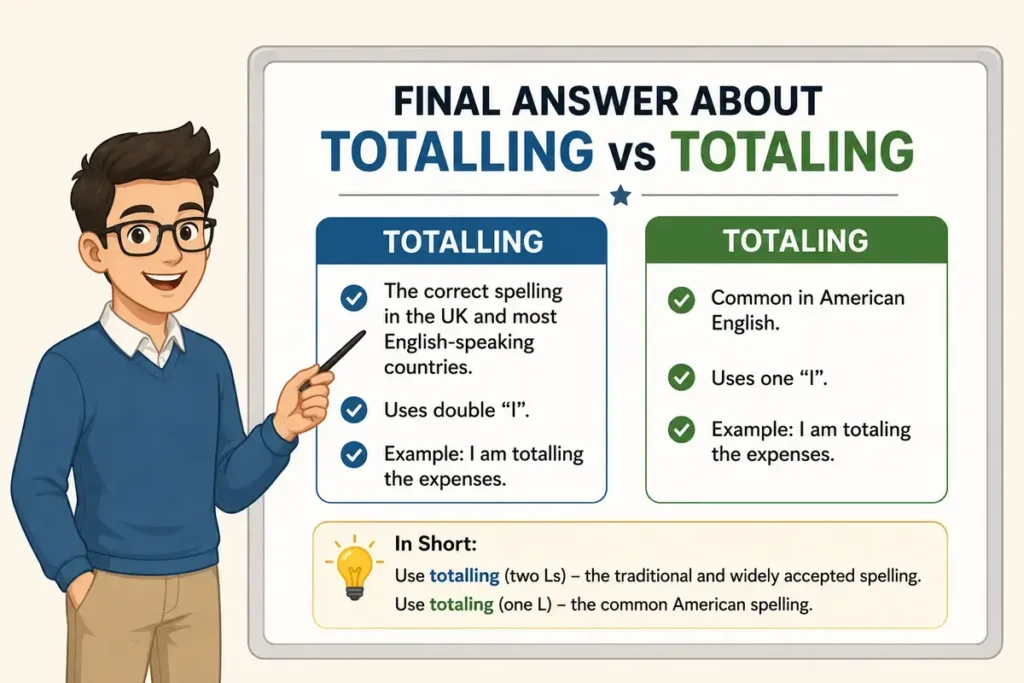
The difference between is only the spelling.
Use totaling in American English.
Use totalling in British English.
Both spellings have the same meaning and are correct in the right type of English. Stay consistent with one spelling throughout your writing.
Need another quick comparison? Read Busing or Bussing: Which Spelling Is Correct?.
Conclusion
The difference between is very easy once you know the rule. Both spellings are correct, and both mean adding numbers together to find the final amount. The only difference is the type of English you are using. Choose totaling if you are writing in American English. Choose totalling if you are writing in British English. Neither spelling is better than the other. They simply follow different spelling rules.
The best habit is to stay consistent. Do not switch between the two spellings in the same document. Pick the spelling that matches your audience, school, workplace, or style guide, and use it throughout your writing. Now, when someone asks about keywords, you can confidently explain that both spellings are correct, the meaning is exactly the same, and the only difference is American English versus British English.
Frequently Asked Questions
What does both words mean in simple words?
Both words mean adding everything together to get the final amount.
Is totaling correct?
Yes. It is the correct American English spelling.
Is totalling correct?
Yes. It is the correct British English spelling.
Why do people get confused?
People read books and websites from different countries, so they see both spellings.
Can I use both forms in one document?
No. Choose one spelling style and use it from start to finish.
Which spelling should students use?
Use the spelling your school or teacher follows. American schools usually use “totaling,” while British schools usually use “totalling.”
Does the meaning change between totalling and totaling?
No. The meaning stays exactly the same. Only the spelling changes.
Which spelling is better for American readers?
American readers expect to see totaling because it follows standard American English.
