
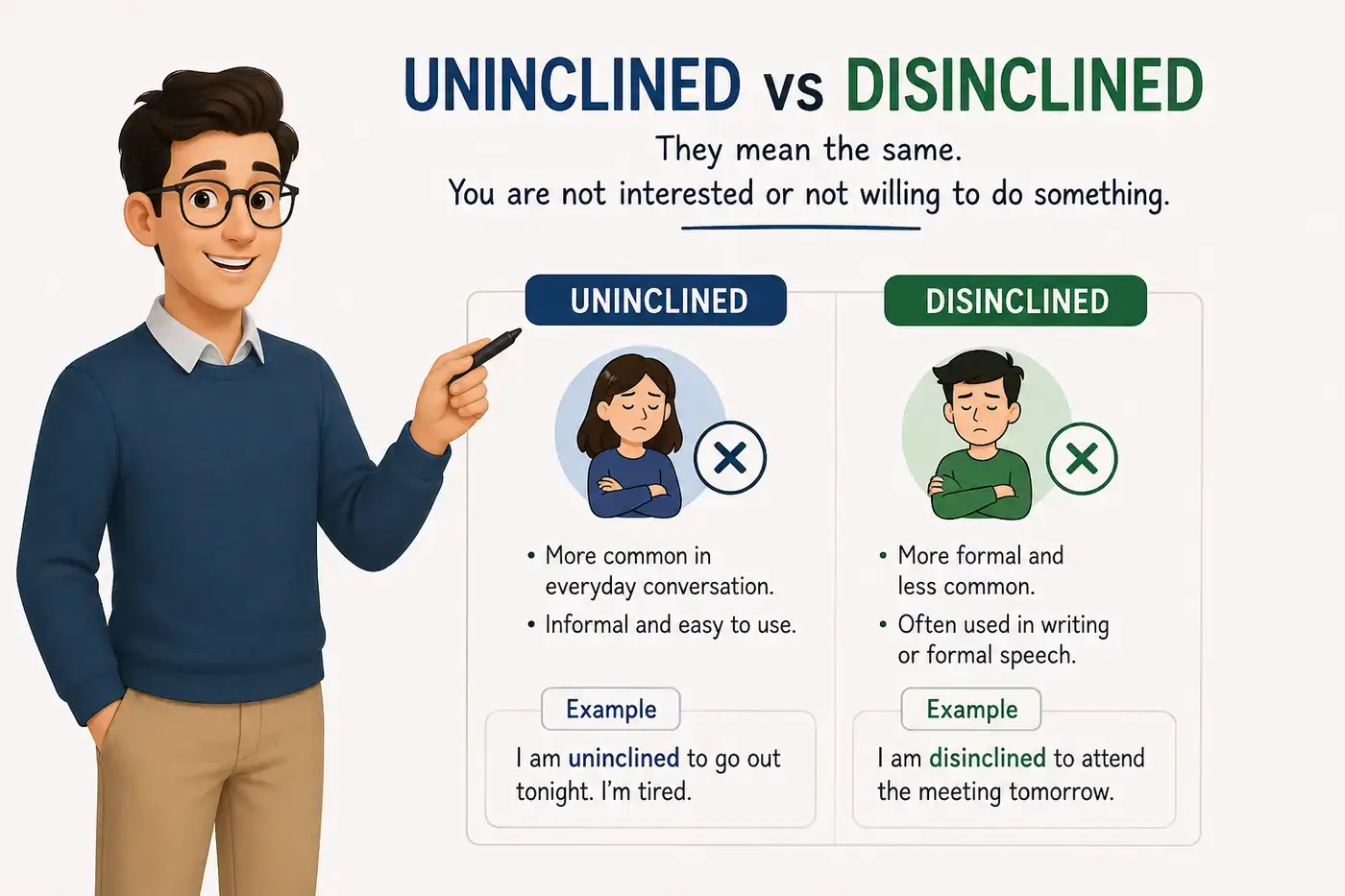
Many English learners confuse Uninclined vs Disinclined because both words describe not wanting to do something. At first, they seem almost the same. That is why many people wonder which one is correct and when to use each word.
The good news is that both words are correct. They simply have a small difference in meaning. One word often shows a gentle lack of interest. The other can show a stronger feeling of dislike or unwillingness. Once you understand that small difference, choosing the right word becomes much easier.
In this guide, you will learn the difference between in very simple English. You will see clear meanings, easy examples, and simple tips that you can remember every time you write or speak.
A related grammar guide is Freshmen vs Freshman: Which One Is Correct (Grammar 2026).
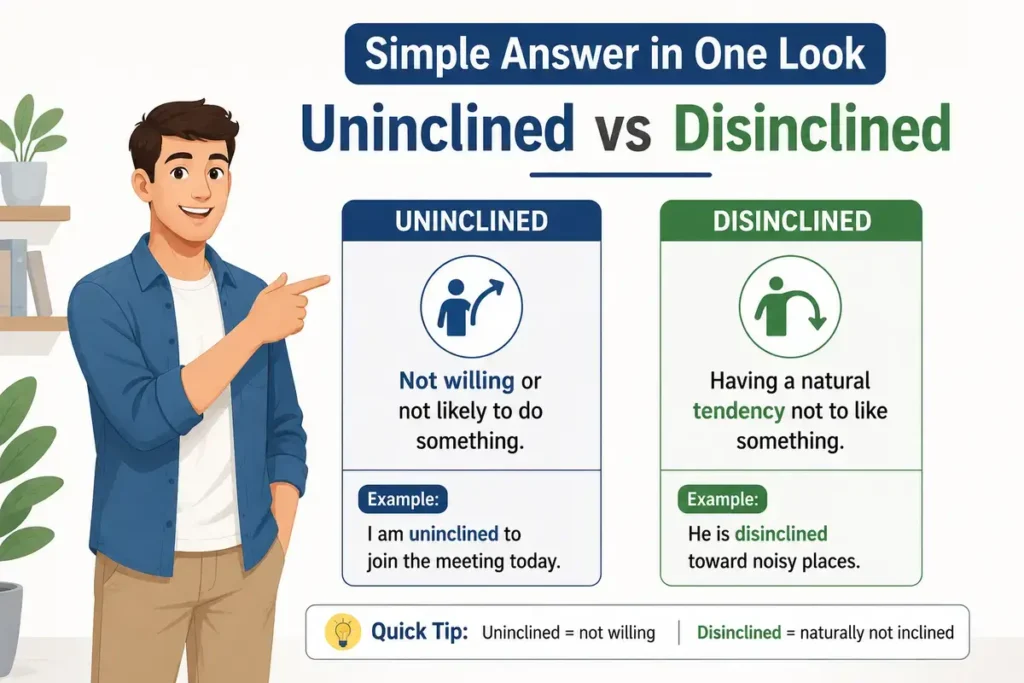
Simple Answer in One Look about Uninclined vs Disinclined
Uninclined means that you are not interested in or not willing to do something.
Disinclined means you are not willing and often slightly against doing it.
Both words are correct, but disinclined usually sounds a little stronger than uninclined.
What does Means in Simple English
Imagine your friend asks you to go hiking. You are tired, but you want to say no politely. You could say, “I am uninclined to go hiking today.” This means you simply do not feel like going. Now imagine someone asks you to work on your day off. You really do not want to do it. You might say: I am disinclined to work this weekend.
This sounds stronger. It shows that you are more against the idea. Think about these words like this. Uninclined means your interest is low. Disinclined means your interest is low and your feelings are more negative. Here is another simple way to remember them.
Uninclined
- Not interested.
- Not eager.
- Politely unwilling.
- Mild feeling.
Disinclined
- Unwilling.
- Slightly opposed.
- More reluctant.
- Stronger feeling.
Both words are formal. You will see them more often in books, news articles, business writing, and careful conversations than in casual daily speech. In everyday English, people usually say things like:
- I do not want to.
- I do not feel like it.
- I would rather not.
- I am not interested.
These are much more common in daily conversations.
Why People Mix These Words
Many learners mix up these words because the words look alike. Both end with inclined, which comes from the idea of leaning toward something. If you are inclined to do something, you feel like doing it. For example: I am inclined to agree. That means you mostly agree. Now look at the two opposite forms. Uninclined The beginning un simply means not. So the word means not inclined.
Disinclined The beginning dis also creates the opposite meaning. But it often adds the feeling of moving away from something or showing reluctance. That is why many people cannot easily tell the difference. Another reason is that dictionaries often use similar definitions. You may see both explained as:
- unwilling
- reluctant
- not interested
While these meanings are close, real English speakers often feel a small difference. Here are two examples.
She was uninclined to join the game. This sounds calm. Maybe she was just tired. Now compare it with this.
She was disinclined to join the game. This suggests she had stronger reasons for saying no. Maybe she disliked the activity. Maybe she was uncomfortable.
That tiny difference is what makes these words unique.
Clear Difference Explained Simply
Here is the easiest way to compare both words.
| Uninclined | Disinclined |
|---|---|
| Means not interested | Means unwilling or slightly opposed |
| Softer feeling | Stronger feeling |
| Calm refusal | More reluctant refusal |
| Gentle lack of desire | Greater hesitation |
| Sounds polite | Sounds firmer |
| Less emotional | Slightly more emotional |
You can also picture them on a simple scale.
Interested
↓
Inclined
↓
Uninclined
↓
Disinclined
↓
Strongly unwilling
This picture helps many students remember the difference. Here are more examples.
Uninclined
I felt uninclined to watch TV.
You simply were not interested.
Disinclined
I felt disinclined to argue.
You wanted to avoid arguing. Another example.
Uninclined
The student seemed uninclined to answer.
Maybe the student was shy.
Disinclined
The student seemed disinclined to argue with the teacher.
This suggests the student chose not to argue.
The feeling is stronger.
Which Form Should You Use?
Choosing between is actually very simple. Follow these easy rules.
Use uninclined when the feeling is mild.
Examples.
I am uninclined to travel this week.
She was uninclined to stay late.
They seemed uninclined to complain.
The people simply do not feel like doing something.
There is no strong emotion.
Use disinclined when the feeling is stronger.
Examples.
He was disinclined to trust strangers.
They were disinclined to accept the offer.
She felt disinclined to continue the discussion.
Here the people actively prefer not to do something.
Ask Yourself One Question
Is the person simply not interested?
Choose uninclined.
Is the person reluctant or slightly against it?
Choose disinclined.
That simple question will help most of the time.
Which Word Is More Common?
Both words are correct. However, disinclined appears more often in formal English. You may read it in:
- books
- newspapers
- academic writing
- legal writing
- business reports
Uninclined is also correct but is slightly less common. In everyday speech, most people simply say:
- I do not want to.
- I do not feel like it.
These sound more natural in casual conversations.
Easy Real Life Sentences You Can Use
Here are simple examples using both words.
- I was uninclined to go outside because it was raining.
- My brother felt disinclined to lend his bike.
- She seemed uninclined to watch another movie.
- The teacher seemed disinclined to cancel the test.
- My parents are disinclined to buy another car.
Notice something.
The uninclined examples sound softer.
The disinclined examples sound firmer.
That is the easiest way to hear the difference.
Where these Word Expression Comes From Simple History
The words uninclined and disinclined both come from the word incline. Long ago, incline meant to lean or bend toward something. Later, English speakers also used it to describe feelings. If you are inclined to do something, your mind leans toward doing it. Over time, two opposite forms appeared. Uninclined simply meant not leaning toward something. Disinclined came to mean leaning away from something or feeling unwilling.
As English changed through the years, both words stayed in the language. Today, they still have very similar meanings. The main difference is the strength of the feeling. Uninclined usually sounds softer. Disinclined usually sounds stronger and more formal.
That small difference has remained for many years. As you read books and articles, you will notice that good writers choose between these words based on how strong they want the feeling to sound. Understanding this makes much easier to remember.
The basic meanings are close, but the feeling behind each word is slightly different. In the next section, you will learn how these words are used in culture, books, writing, and everyday situations. You will also discover common mistakes, useful memory tricks, and simple examples that make and even easier to understand.
How Is Understood in Culture and Stories
When people read stories or watch movies, they often see characters who do not want to do something. The writer may describe those characters as uninclined or disinclined. The choice of word helps readers understand the character’s feelings.
A character who is uninclined usually feels calm. They are simply not interested. They just do not feel like doing something. For example, a child may be uninclined to clean a messy room. The child is not fighting. The child simply does not want to start.
A character who is disinclined often feels more resistant. The person may have a reason for saying no. They may dislike the idea or feel uncomfortable. For example, a king might be disinclined to trust a stranger. His choice comes from caution, not just lack of interest.
Stories often use these small word choices to show personality. A quiet person may seem uninclined to join a noisy party. A careful person may seem disinclined to take a dangerous risk. That is why understanding of words can help you understand stories better. The words tell us how strong a person’s feelings are.
For another common grammar confusion, see Provider vs Providor: Meaning, Usage, and Mistakes.
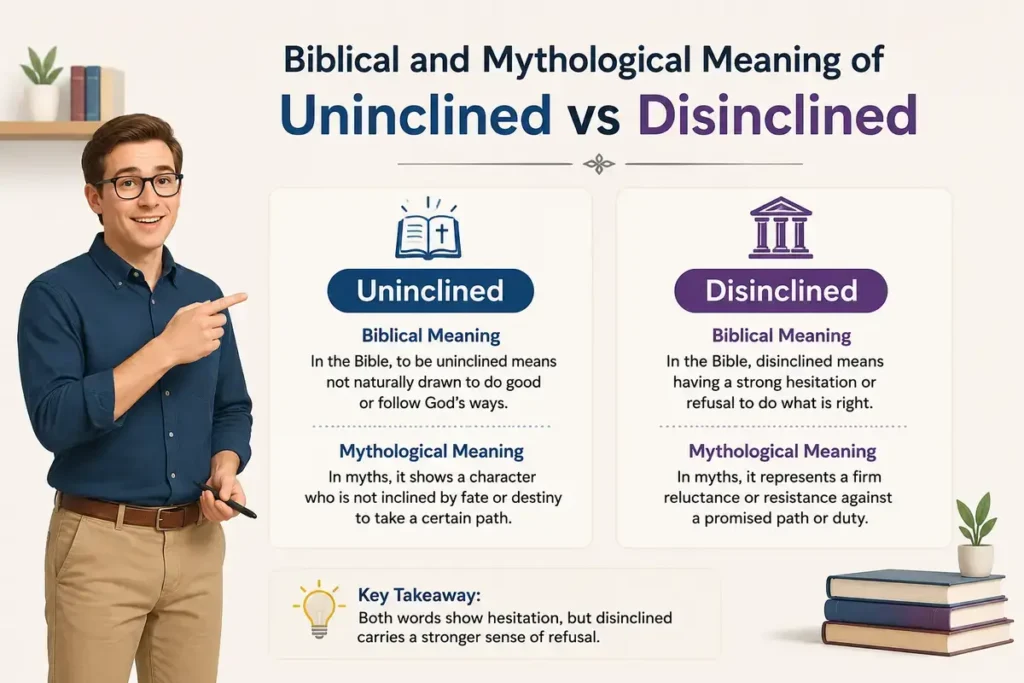
Biblical and Mythological Meaning of Uninclined vs Disinclined
The Bible does not use the exact words uninclined and disinclined in most modern translations. However, the ideas behind these words appear many times. Some people were unwilling to listen. Some refused to change. Others were slow to believe. These examples describe people who were not ready to follow advice or accept a message. In many Bible stories, people who were unwilling often changed after learning an important lesson.
Mythological stories also show this idea. Here is a smoother and more natural version: A hero may be uninclined to begin a difficult journey because they feel unsure. Another hero may be disinclined to trust someone because they were tricked before. These stories teach that feelings can change. Someone who is uninclined today may become willing tomorrow. Someone who is disinclined may change after gaining trust. The words themselves are not special religious words. They simply describe common human feelings.
Symbolism Explained in Simple Words
Words can also have symbolic meaning. That means they can represent ideas or emotions beyond their dictionary meaning.
What Uninclined Represents
Uninclined often represents gentle hesitation. It can show:
- Low interest.
- Quiet thinking.
- Taking your time.
- Being careful before acting.
- A calm decision.
People who are uninclined are usually not fighting against something. They simply do not feel ready. It often gives a peaceful feeling.
What Disinclined Represents
Disinclined often represents stronger resistance. It can show:
- Reluctance.
- Caution.
- Doubt.
- Personal choice.
- Strong unwillingness.
A disinclined person usually has a clearer reason for saying no. This word can suggest stronger emotions than uninclined. Here is a simple comparison.
| Uninclined | Disinclined |
|---|---|
| Gentle hesitation | Stronger hesitation |
| Low interest | Active reluctance |
| Quiet feeling | Firmer feeling |
| Soft refusal | Stronger refusal |
| Mild choice | Clear choice against something |
Remember this simple idea.
Uninclined sounds softer.
Disinclined sounds stronger.
Related Words You Should Know
Learning similar words makes much easier.
Inclined
Means willing or likely to do something.
We are inclined to agree.
Reluctant
Not wanting to do something but doing it anyway.
She was reluctant to speak.
Unwilling
Not wanting to do something.
He was unwilling to help.
Hesitant
Feeling unsure before acting.
The student was hesitant to answer.
Resistant
Trying not to accept something.
They were resistant to change.
Opposed
Clearly against an idea.
Some people were opposed to the plan.
Indifferent
Not caring very much.
She seemed indifferent about the result.
Interested
Wanting to know or do something.
I am interested in learning English.
These related words help you express different levels of willingness.
How People Actually Use it in Daily English
These words are correct, but they are not very common in casual conversation. Most native speakers choose simpler expressions when talking with friends. Still, you may hear or read these words in formal situations. Here are some natural examples.
- I do not want to go out tonight because I am tired.
- She seemed uninclined to answer the question.
- We felt uninclined to spend money this month.
- The judge appeared disinclined to accept the excuse.
- The team seemed uninclined to take unnecessary risks.
In everyday speech, people often replace these words with simpler ones.
Instead of saying:
I do not uninclined to cook.
Most people say:
I do not feel like cooking.
Instead of saying:
She does not disinclined to travel.
Many people simply say:
She does not want to travel.
Knowing both styles helps you understand books and formal writing while also speaking naturally.
Common Mistakes People Make
Many learners make the same mistakes. Here are the most common ones.
Mistake 1
Using the two words as if they always mean exactly the same thing.
Correct idea:
They are similar, but disinclined usually sounds stronger.
Mistake 2
Thinking one word is wrong.
Correct idea:
Both words are correct English.
Mistake 3
Using them in casual conversation all the time.
Correct idea:
Most people use simpler phrases like:
- I do not want to.
- I do not feel like it.
- I would rather not.
Mistake 4
Forgetting the strength of the feeling.
Easy tip.
If the feeling is mild, choose uninclined.
If the feeling is stronger, choose disinclined.
Mistake 5
Using these words for every situation.
Sometimes a simpler word works better.
For example:
Instead of:
I do not feel like eating pizza.
You can simply say:
I do not want pizza.
Simple English is often the best choice.
Final Teacher Explanation
Imagine I am standing in front of a classroom. A student asks me about words. This is what I would say. Both words are correct. Both describe someone who does not want to do something. The difference is very small. Uninclined usually means you are not interested. The feeling is gentle.
Disinclined usually means you are more unwilling. The feeling is stronger. You do not need to worry about choosing the perfect word every time. If you remember one simple rule, you will be fine. Think about the strength of the feeling. Small feeling. Use uninclined. Stronger feeling. Use disinclined. Also remember that everyday English is usually much simpler. People often say:
- I do not want to.
- I do not feel like it.
- I would rather not.
These expressions sound natural in daily conversation. As your English grows, you will notice uninclined and disinclined more often in books, newspapers, and formal writing. When you see them, you will understand exactly what the writer means.
Final Answer About Uninclined vs Disinclined Quick Recap
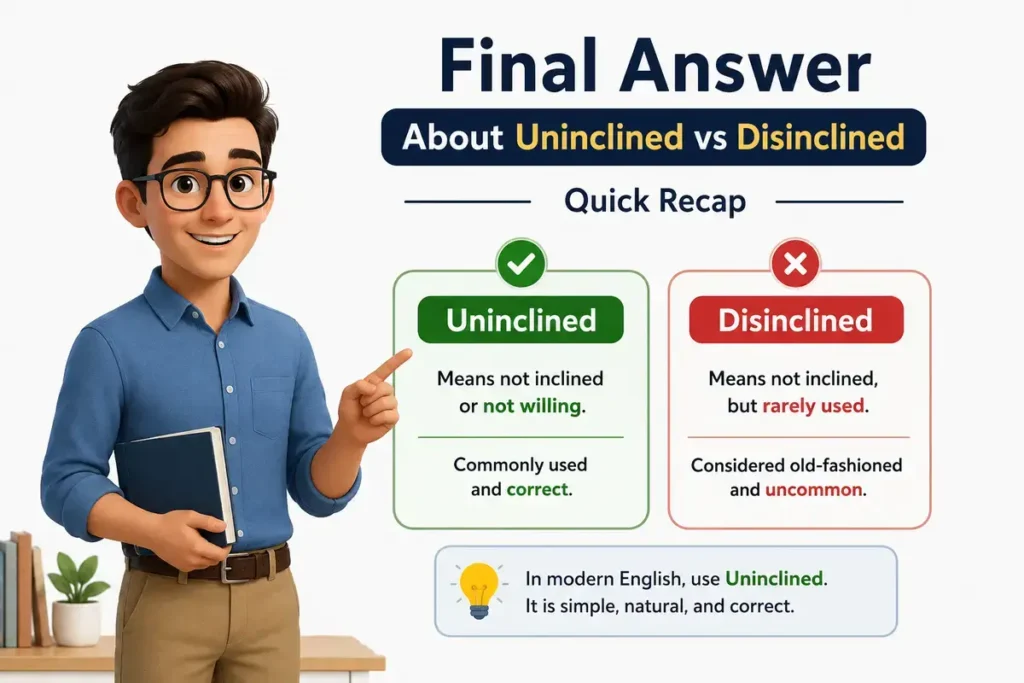
The difference between is small but useful.
Uninclined means you are simply not interested or not willing.
Disinclined means you are more unwilling or slightly against doing something.
Remember this easy rule. Uninclined is softer. Disinclined is stronger.
Still confused? Compare Busing or Bussing: Which Spelling Is Correct?.
Conclusion
Understanding uninclined vs disinclined is easier than it first appears. Both words describe someone who does not want to do something, but the feeling is not equally strong. Uninclined usually shows a gentle lack of interest, while disinclined suggests stronger reluctance or a clearer decision not to act. Keep this simple difference in mind, and you will choose the right word with confidence. As you read more English, you will recognize these words more easily and understand the feeling the writer wants to share.
Frequently Asked Questions
What does uninclined mean in simple words?
It means you do not feel like doing something. Your lack of interest is usually gentle.
What does disinclined mean in simple words?
It means you are unwilling to do something. It often shows a stronger feeling than uninclined.
Which is correct?
Both words are correct. The best choice depends on how strong the feeling is.
What is the difference?
Uninclined shows mild unwillingness. Disinclined shows stronger reluctance or resistance.
Can I use both words in writing?
Yes. Both are correct in formal writing. Disinclined is slightly more common.
Which word is better for everyday English?
Most people use simpler phrases like I do not want to or I do not feel like it instead of either word.
Why do people confuse?
Both words have very similar meanings and both come from the word inclined, so they look and sound alike.
Do people consider “disinclined” more formal than “uninclined”?
Yes. Both are formal, but disinclined appears more often in books, articles, and professional writing.
