
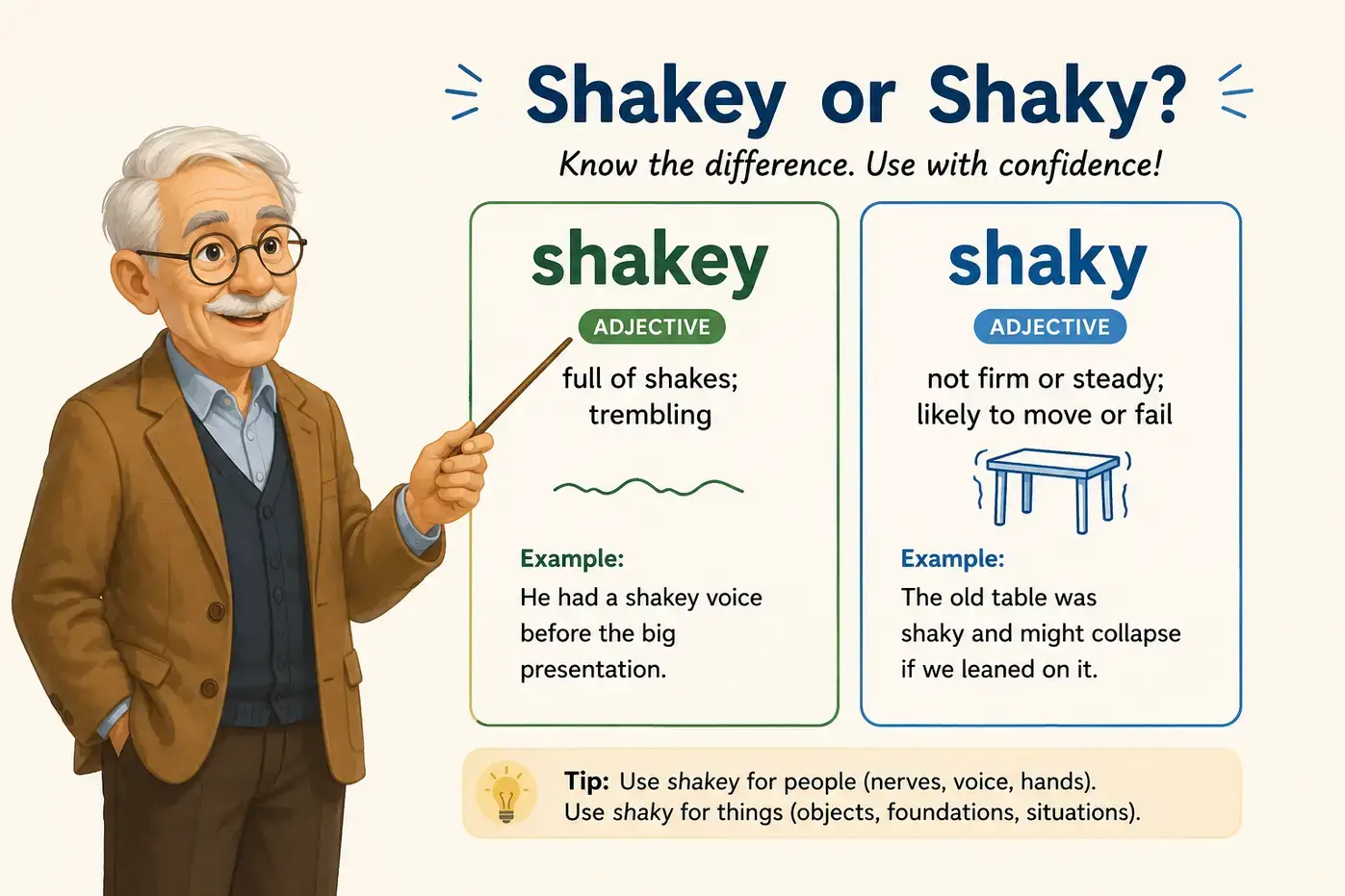
People often ask Shakey or Shaky because both spellings look possible. However, shaky is the standard and correct spelling in modern English. You use shaky to describe something that shakes, is unsteady, or seems weak and uncertain.
The word shakey is usually a misspelling of shaky. So, if you are writing schoolwork, an email, a blog post, or any other standard English text, shaky is the spelling you should use.
In this guide, you will learn the difference, the correct spelling, common mistakes, easy examples, and the simple history behind the word. By the end, you will know exactly which form to use.
A related grammar guide is Gradual vs Insidious: Easy Guide with Real-Life Sentences.
Simple Answer in One Look
Shaky is the standard and correct spelling in modern English.
Shakey is sometimes seen as a variant spelling, but it is much less common and is usually not preferred in formal writing.
Best choice: Use shaky.
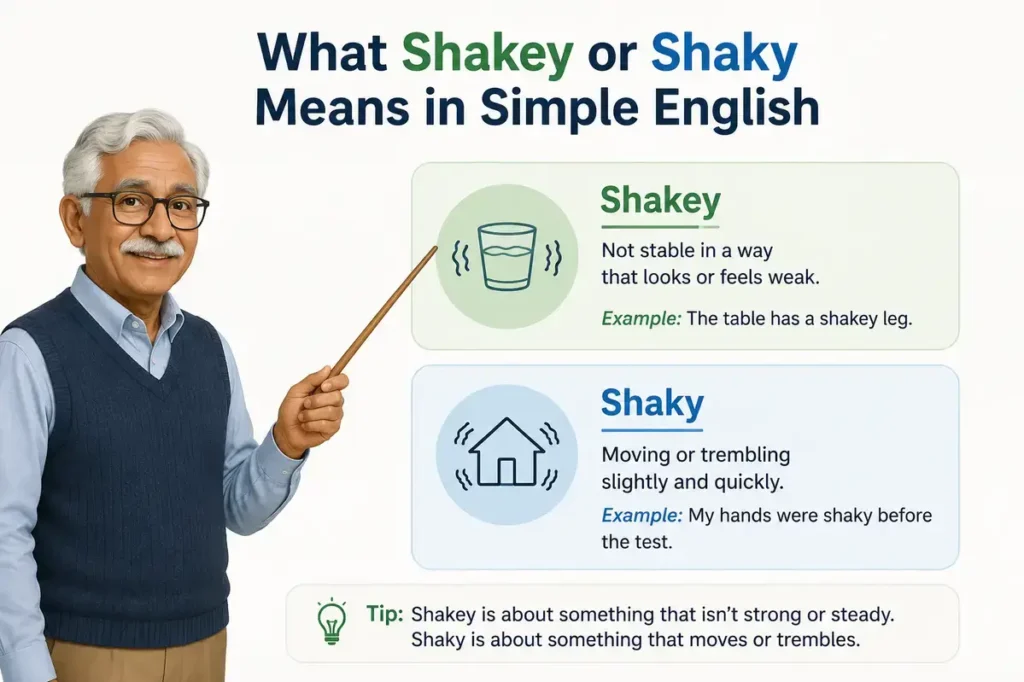
What Shakey or Shaky Means in Simple English
The word shaky describes something that shakes, moves unsteadily, or does not feel strong or stable. It can describe people, objects, feelings, plans, or situations. For example:
- My hands felt shaky after the long run.
- The table is shaky because one leg is loose.
- Their relationship became shaky after the argument.
In simple words, shaky means:
- Not steady.
- Not strong.
- Not stable.
- Moving with small shakes.
The word can be used in both physical and non-physical situations.
Physical Meaning
Something is actually shaking or moving. Examples:
- The bridge felt shaky.
- Her voice sounded shaky.
- The ladder looked shaky.
Figurative Meaning
Something seems uncertain or weak. Examples:
- We have a shaky plan.
- The company is in a shaky position.
- His explanation was shaky.
In these examples, nothing is physically shaking. The word shows weakness or uncertainty.
Why People Mix These Words
Many English learners wonder about both words because the two spellings look almost the same. There are several reasons for this confusion.
1. Both Spellings Exist Online
When people search the internet, they often find both versions. Seeing two spellings can make it seem like both are equally correct. In reality, shaky is much more common and widely accepted.
2. English Spelling Is Not Always Predictable
English has many words that do not follow one simple spelling pattern. For example:
- Smoke → smoky
- Ice → icy
- Shine → shiny
Because of this, some people expect “shake” to become “shakey.” But standard English chose shaky as the preferred spelling.
3. People Spell Words the Way They Sound
When saying the word aloud, some people hear the “shake” part and naturally write shakey. That seems logical at first. However, standard spelling rules and dictionary usage favor shaky.
4. Older or Informal Usage Can Cause Confusion
You may occasionally see shakey in older texts, nicknames, usernames, or informal writing. This can make learners think it is the normal spelling. Most modern dictionaries and style guides recommend shaky.
Clear Difference Explained Simply
When comparing words, the meaning is usually the same. The main difference is spelling preference.
| Word | Meaning | Common Today? | Best for Writing? |
|---|---|---|---|
| Shaky | Unsteady, weak, trembling | Yes | Yes |
| Shakey | Same meaning | Rare | Usually No |
Think of it this way:
✅ Shaky = Standard English spelling
⚠️ Shakey = Less common variant spelling
Quick Comparison
Shaky
- Found in dictionaries.
- Used in schools.
- Used in books.
- Used in news articles.
- Best for everyday writing.
Shakey
- Less common.
- Sometimes appears informally.
- May be seen in names or nicknames.
- Not usually recommended for formal writing.
Which Form Should You Use Shakey vs Shaky?
You should almost always use shaky. This is the spelling most readers expect to see. It looks natural in:
- School assignments.
- Business emails.
- Blog posts.
- Articles.
- Reports.
- Social media posts.
Simple Rule
If you are choosing choose shaky. That rule works in nearly every situation.
Examples
Correct:
- I felt shaky after riding the roller coaster.
- The old chair is shaky.
- We are standing on shaky ground.
Less preferred:
- I felt shakey after riding the roller coaster.
- The old chair is shakey.
Most teachers, editors, and dictionaries would change those examples to shaky.
A Helpful Memory Trick
Look at these words:
- Lucky
- Funny
- Sunny
- Shaky
Many common English adjectives end with -y. Thinking of this pattern can help you remember the correct spelling.
Easy Real-Life Sentences You Can Use Shakey and Shaky
Here are some everyday examples using shaky.
- My hands were shaky after the scary movie.
- The small table feels shaky.
- She gave a shaky answer during the interview.
- The old fence looks shaky.
- I felt shaky before the test started.
- Their travel plans are still shaky.
- His voice sounded shaky when he spoke.
- The ladder was too shaky to climb safely.
These examples show how shaky works in everyday English.
The first sentence, shaky describes hands that are trembling.
In Second sentence, it describes a table that is not stable.
Third sentence, it describes a voice that shakes, perhaps because of fear, sadness, or nervousness.
In the fourth sentence, shaky can show a nervous physical feeling.
In the fifth sentence, it describes something weak or unsteady.
Sixth sentence, the word helps show uncertainty or nervousness.
This makes shaky a flexible word for daily speaking and writing.
You can also use it in questions.
Why is the chair so shaky?
Do you feel shaky after running?
Is the table still shaky?
Why does his story sound shaky?
Each question uses the same spelling. You do not need to change shaky based on the meaning.
Where This Word Expression Comes From (Simple History)
The word shaky comes from the verb shake. The verb “shake” has been part of English for hundreds of years. People used it to describe movement, trembling, and instability. Over time, English speakers created the adjective shaky to describe something that shakes or seems unstable. Examples include:
- A shaky hand.
- A shaky bridge.
- A shaky argument.
- A shaky economy.
As English developed, shaky became the standard spelling used by writers and dictionaries. The spelling shakey appeared occasionally, but it never became as common. Today, shaky remains the preferred form across most English-speaking countries.
Transition to Deeper Meaning
Now that you know the basic meaning, and the correct spelling, there is more to understand. The word also appears in culture, stories, symbolism, and everyday expressions. In the next section, we will look at the deeper meaning of shaky, how people use it beyond physical movement, and what it can represent in different situations.
Still confused? Compare Steam vs Steem: Which Is Correct And Simple Meaning (2026).
How Is Understood in Culture and Stories
The word shaky is easy to understand in stories because it can describe both the body and a person’s feelings.
For example, a character may have shaky hands before opening an important letter. The shaking shows fear, worry, excitement, or nervousness. The writer does not always need to say exactly how the character feels. The word shaky can help the reader understand the emotion.
A shaky voice is also common in books, movies, and everyday storytelling. Imagine someone standing in front of a large crowd for the first time. They begin to speak, but their voice is shaky. Right away, we understand that the person may feel nervous.
The word can also describe an uncertain situation in a story.
For example:
Their friendship was on shaky ground.
This means the friendship had problems. It does not mean the friends were standing on ground that moved. The phrase uses the idea of unstable ground to show an unstable relationship.
Stories often connect steadiness with safety and confidence. On the other hand, something shaky can suggest fear, weakness, danger, or uncertainty.
A shaky bridge may make us think of danger.
A shaky voice may make us think of fear.
Still, shaky does not always mean something terrible will happen. A person can feel shaky and still succeed. Someone may give a shaky speech at first and then become more confident. A shaky start can also lead to a strong finish.
That is why the word is useful in stories. It can show that something is not fully stable yet. It leaves room for change.
When discussing words, remember that the standard word used for these meanings is shaky. Writers use it to create clear pictures of movement, emotion, and uncertainty.
Biblical and Mythological Meaning
The word shaky itself does not have a direct biblical meaning. However, ideas connected to the word appear often in religious and mythological stories. In many traditions, strong foundations represent faith, strength, and stability. Weak foundations represent doubt, fear, or uncertainty. For example, stories may talk about:
- Standing on solid ground.
- Building on a strong foundation.
- Remaining firm during difficult times.
These ideas are the opposite of being shaky. In mythology, heroes often begin their journeys in uncertain situations. Their confidence may feel shaky at first. As they grow stronger, they become more stable and confident. So while shaky is not a special religious word, its meaning connects with common themes found in many stories around the world.
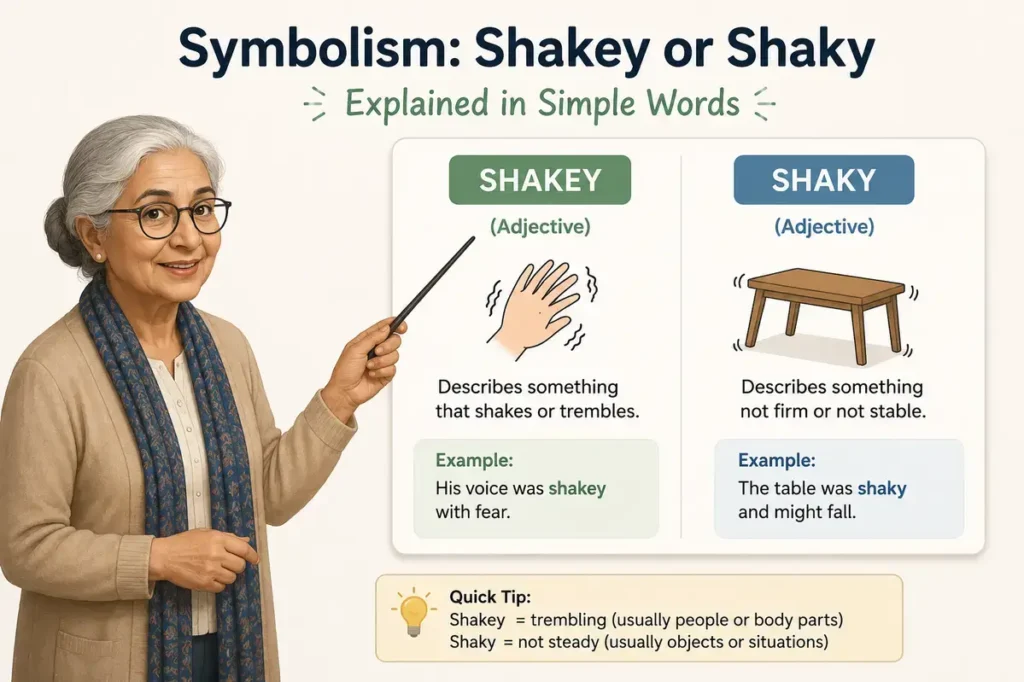
Symbolism Shakey or Shaky Explained in Simple Words
When people compare the symbolism is mostly the same because both spellings share the same meaning. Still, it helps to understand what the word often symbolizes.
What Shakey Represents
In normal English, Shakey does not represent a separate meaning. It is usually just a nonstandard spelling when someone means the adjective shaky.
Still, Shakey may appear as a person’s name, nickname, username, or other chosen name. In that case, it represents a specific name rather than the normal English adjective.
For example, someone may choose the nickname Shakey because they like the sound of it. A special name can use its own spelling.
However, if you write:
My hands feel shakey.
The spelling is not standard for normal English writing.
The correct form is:
My hands feel shaky.
So, when looking at words, do not think of them as two different standard words with different emotional meanings.
What Shaky Represents
Shaky can represent several simple ideas.
It can represent fear.
Her shaky voice showed that she was scared.
It can represent nervousness.
He had a shaky smile before the interview.
It can represent weakness.
Their argument was shaky because the facts did not support it.
It can represent uncertainty.
The future of the project looked shaky.
It can also represent a difficult beginning.
She made a shaky start but soon felt more confident.
The deeper idea is simple. Something shaky is not fully firm or secure.
This can happen in the body, such as shaky hands. It can happen in feelings, such as shaky confidence. It can also happen in plans and relationships.
That is why the word creates a strong picture in the reader’s mind.s.
Related Words You Should Know
Learning related words can make your English stronger.
Unsteady
Something that does not stay balanced. Example:
The bicycle felt unsteady.
Wobbly
Moving from side to side. Example:
The table is wobbly.
Trembling
Shaking slightly because of fear, cold, or excitement. Example:
Her hands were trembling.
Nervous
Feeling worried or anxious. Example:
I felt nervous before the interview.
Weak
Not strong. Example:
The weak fence fell during the storm.
Uncertain
Not sure about something. Example:
We are uncertain about the outcome.
Fragile
Easy to break or damage. Example:
This box contains fragile items.
Insecure
Not feeling confident or safe. Example:
He felt insecure about speaking in public.
All of these words connect in some way to the meaning of shaky.
How People Actually Use Shakey and Shaky in Daily English
Most native speakers use shaky regularly. Here are some natural examples.
Physical Situations
- This chair feels shaky.
- The ladder looks shaky.
- My hands are still shaky after the ride.
- The bridge seemed shaky during the storm.
Emotional Situations
- I felt shaky before giving my speech.
- She sounded shaky on the phone.
- He looked shaky after hearing the news.
Plans and Ideas
- Their business plan seems shaky.
- The explanation sounds a little shaky.
- We have a shaky agreement right now.
At School
- My answer was shaky because I was nervous.
- The project started on a shaky note.
At Work
- The company is in a shaky position.
- The deal still looks shaky.
In Everyday Conversation
- Everything felt shaky for a while, but things got better.
These examples show that shaky works in many different situations.
Common Mistakes People Make
Many learners make the same mistakes. Let’s fix them.
Mistake 1: Using Shakey in Formal Writing
Incorrect:
The bridge looked shakey.
Better:
The bridge looked shaky.
Remember that shaky is the preferred spelling.
Mistake 2: Thinking the Words Have Different Meanings
Some people think mean different things.
They do not.
The meaning is generally the same.
The main difference is spelling preference.
Mistake 3: Using Shaky for Everything
Sometimes another word works better.
Instead of:
The glass is shaky.
You might say:
The glass is fragile.
Choose the word that best matches the situation.
Mistake 4: Confusing Physical and Emotional Meanings
Physical:
My hands are shaky.
Emotional:
I feel shaky about the decision.
Both are correct, but the meaning changes.
Mistake 5: Forgetting the Standard Spelling
Many learners remember the word “shake” and write “shakey.” A simple trick is to remember:
Shake → Shaky
Just like:
Sun → Sunny
Fun → Funny
Lucky → Lucky
The accepted spelling is shaky.
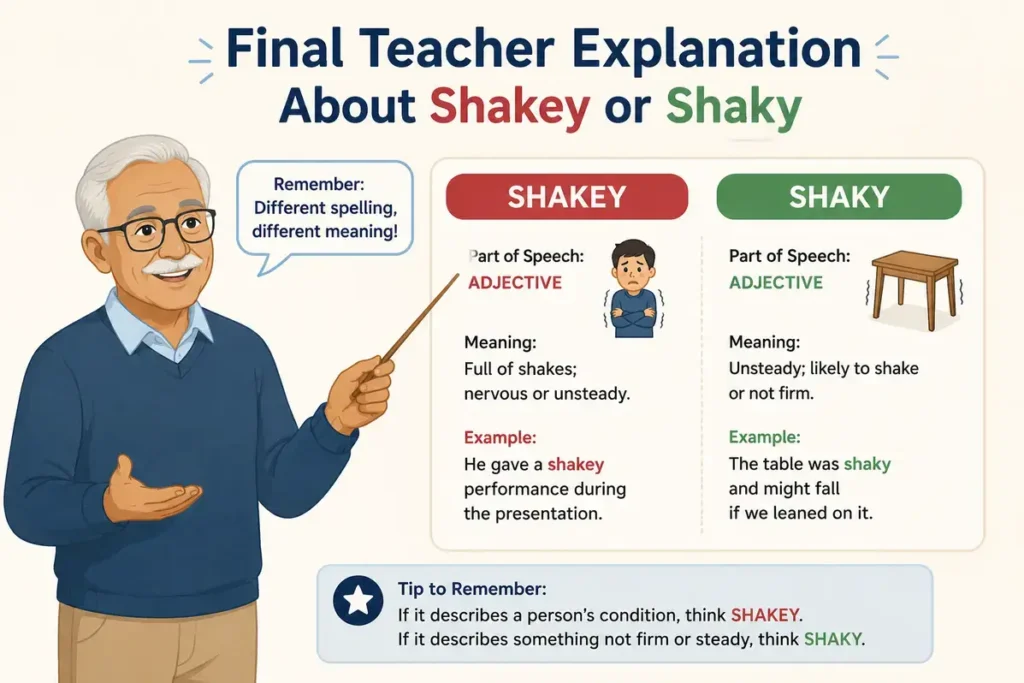
Final Teacher Explanation About Shakey or Shaky
Imagine you are sitting in a classroom and asking me which spelling you should use. My answer would be simple. Use shaky. That is the spelling most dictionaries, teachers, editors, and native speakers prefer. The word means something is not steady, not stable, or not fully secure. It can describe:
- Objects.
- People.
- Emotions.
- Plans.
- Relationships.
- Situations.
The spelling shakey may appear sometimes online or in informal writing, but it is much less common. If you want safe, correct English, choose shaky. That one rule will help you in almost every situation.
Final Answer
If you are deciding between words, use shaky.
Shaky is the standard English spelling found in dictionaries and everyday writing.
Shakey exists as a less common variant, but it is usually not the preferred choice.
The easiest way to remember is:
Shaky = Correct choice for most writing.
Need another quick comparison? Read Etc or Ect: Which Is Correct, Meaning and Usage 2026.
Conclusion
The question has a simple answer. Shaky is the correct standard spelling when you mean unsteady, trembling, weak, or uncertain.
You can use shaky for a physical object, such as a shaky chair. You can also use it for a person’s hands or voice. It can even describe weak confidence, an uncertain plan, or an argument that does not seem strong.
So, do not let the spelling confuse you. For normal English writing, choose shaky.
Easy takeaway: If it means unsteady or uncertain, the correct spelling is shaky.
Frequently Asked Questions (FAQs)
Which is correct?
Shaky is the standard and preferred spelling in modern English.
What does shaky mean in simple words?
It means not steady, not strong, or slightly shaking.
Why do people confuse?
People connect the word to “shake” and naturally assume the spelling should be “shakey.”
Can I use shakey in writing?
You can, but most teachers, editors, and dictionaries prefer shaky.
Do they have different meanings?
No. They generally mean the same thing.
Which spelling should students use?
Students should use shaky because it is the accepted standard spelling.
Is shaky used for emotions too?
Yes. You can feel shaky when you are nervous, scared, or uncertain.
Is shaky a positive or negative word?
Usually it suggests weakness, uncertainty, or instability, though sometimes it simply describes a temporary situation.
