
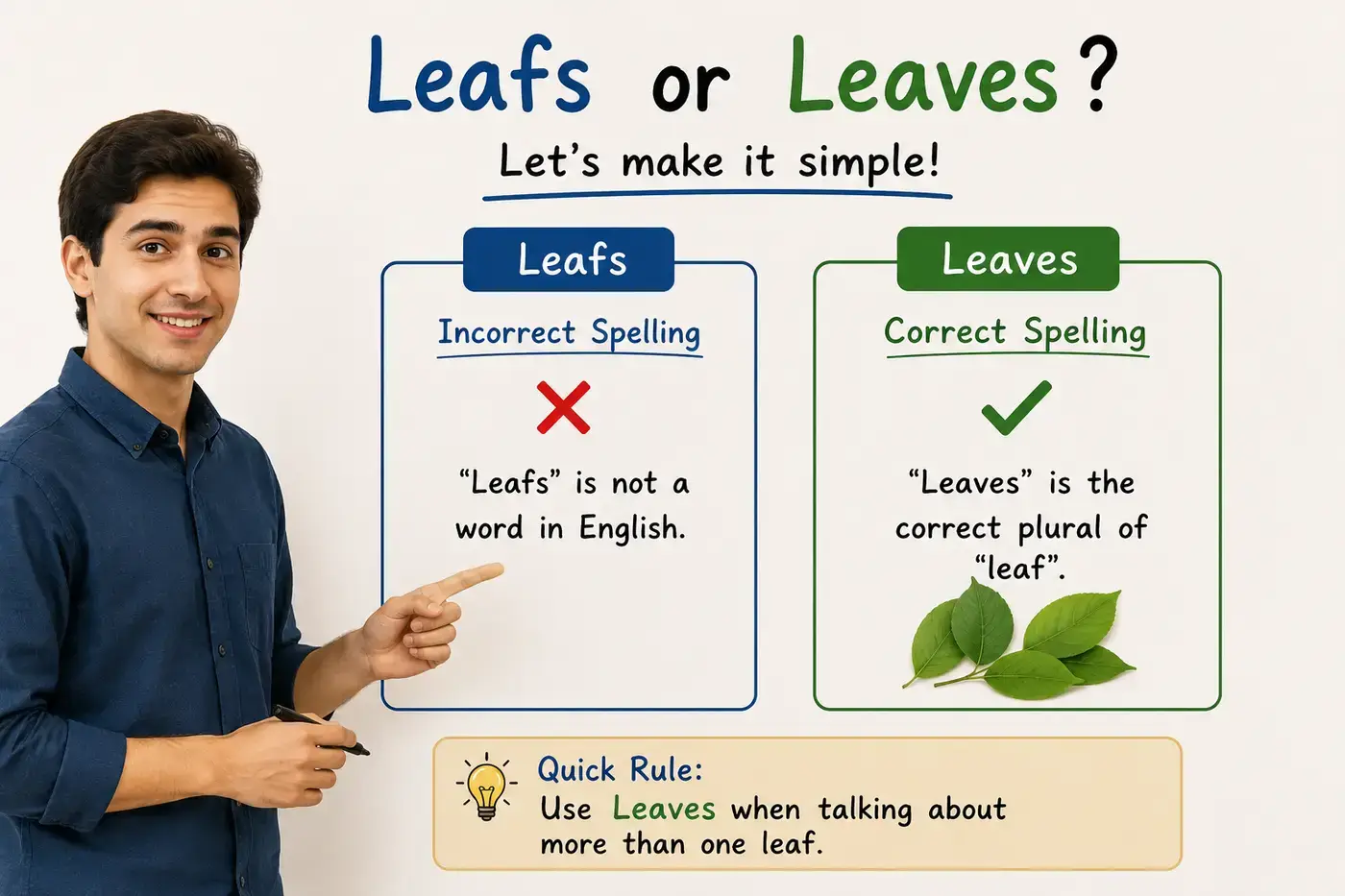
Many people ask about leafs or leaves because both words look possible. You may see one in a book and another in a game or company name. That can make English feel confusing. The good news is that the rule is easy once you know it.
If you are trying to choose between words, the correct answer depends on what you are talking about. In most everyday English, leaves is the correct plural of leaf. The word leafs is only correct in a few special situations.
This guide explains in very simple English. You will learn the difference, see real examples, understand why people get confused, and know which form to use with confidence.
You may also want to read Holistic or Wholistic: Difference Explained Simply(2026).
Simple Answer in One Look
Leaves is the correct plural of leaf in almost every situation.
Leafs is only used in a few special names or as a verb.
What Does Leafs or Leaves Mean in Simple English
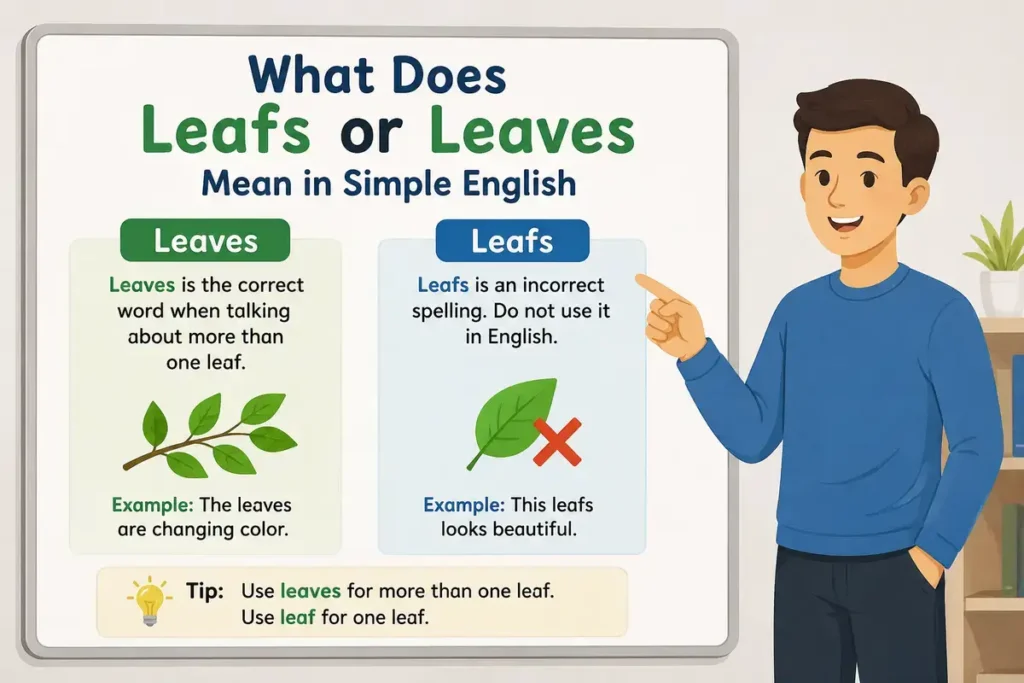
A leaf is the flat green part that grows on a plant or tree. When there is more than one leaf, you usually say leaves. Examples:
- One leaf.
- Two leaves.
- Many leaves covered the ground.
- The wind blew the leaves across the yard.
This follows a common English spelling pattern. Some words that end in f change to ves when they become plural. For example:
- Leaf becomes leaves.
- Wolf becomes wolves.
- Knife becomes knives.
- Shelf becomes shelves.
This is why leaves is the word you will use most of the time.
The word leafs does exist, but it has a different use. It is not the normal plural of the plant part.
Why People Mix These Words
Many English learners wonder about both words because English does not always follow one simple spelling rule. Here are the biggest reasons for the confusion.
Some Words Simply Add S
Most English nouns become plural by adding s. Examples:
- Book becomes books.
- Car becomes cars.
- Chair becomes chairs.
People naturally think leaf should become leafs.
Some Words Change F to Ves
A small group of English words changes f into ves. Examples:
- Leaf becomes leaves.
- Life becomes lives.
- Wife becomes wives.
- Calf becomes calves.
Since only some words follow this pattern, learners often forget which words change.
People See Leafs in Special Names
You may have seen Leafs in names like the Toronto Maple Leafs. That makes some people think leafs is the normal plural. It is not. The team kept the spelling Leafs as part of its official name.
English Has Exceptions
English is full of words that do not follow every rule.
That is why reading real examples helps more than trying to memorize every grammar rule.
Clear Difference Explained Simply
The easiest way to remember words and it is think about what you are talking about.
| Word | When to Use It | Example |
|---|---|---|
| Leaves | Normal plural of leaf | The leaves are falling. |
| Leafs | Special names or the verb leaf | She leafs through a magazine. |
Think About Trees
One tree has one leaf.
Many trees have many leaves.
That is the correct everyday English.
Think About Books
The verb leaf means to turn pages quickly. Examples:
- He leafs through the newspaper every morning.
- She leafs through the notebook before class.
Here, leafs is a verb, not a plural noun.
Which Form Should You Use
If you are talking about plants, flowers, trees, or nature, always use leaves. Examples:
- The leaves are green.
- Autumn leaves are beautiful.
- The leaves fell after the storm.
- Wet leaves covered the road.
Only use leafs in these special situations.
When It Is Part of a Name
Examples:
- Toronto Maple Leafs.
- A company or product named Leafs.
When It Is a Verb
Examples:
- He leafs through the book.
- She leafs through old magazines.
If you are writing for school, work, or everyday conversation, leaves is almost always the right answer.
Easy Rule You Can Remember
Use this simple trick.
If it grows on a tree use leaves.
If it is a special name or means turning pages quickly, leafs can be correct.
This one rule will help you avoid most mistakes.
Easy Real Life Sentences You Can Use
Here are simple sentences you can copy into your own speaking and writing.
- The leaves are turning yellow.
- I picked two leaves from the tree.
- The wind blew the leaves across the park.
- My little brother collects colorful leaves.
- We swept the leaves from the sidewalk.
- She leafs through her notebook before every lesson.
- He leafs through the sports magazine every weekend.
- The Toronto Maple Leafs won the game.
Notice that the first five examples use the normal plural leaves.
The last three examples show the special uses of leafs.
Common Examples of Leafs or Leaves
Here are questions people often ask.
Is it five leafs or five leaves?
Correct: five leaves.
Is it tree leafs or tree leaves?
Correct: tree leaves.
Is Leafs Ever Correct?
Yes.
But only in special situations. Examples:
- Toronto Maple Leafs.
- He leafs through the report.
These are exceptions.
Common Mistakes People Make
Many learners make the same mistakes.
Mistake One
❌ The tree has many leafs.
✅ The tree has many leaves.
Mistake Two
❌ I collected red leafs.
✅ I collected red leaves.
Mistake Three
❌ The garden is full of leafs.
✅ The garden is full of leaves.
Mistake Four
❌ Autumn leafs are beautiful.
✅ Autumn leaves are beautiful.
Mistake Five
❌ The leafs fell from the tree.
✅ The leaves fell from the tree.
These small changes make your English sound natural.
Memory Trick That Really Works
Picture a tree in your mind.
One branch has one leaf.
Another branch has many leaves.
Now say this sentence.
One leaf. Many leaves.
Repeat it a few times.
Your brain will quickly remember the correct plural.
Many readers also check Inbalance or Imbalance: Correct Spelling With Examples.
Where This Word Comes From Simple History
The word leaf is very old. People have used it for hundreds of years to describe the green part of a plant. Long ago, English changed the plural of some words ending in f. Instead of adding only s, speakers changed the ending to ves. That is how leaf became leaves. Over time, this spelling became the standard form used in schools, books, newspapers, and dictionaries.
The spelling leafs stayed alive in only a few special places. It became part of names like the Toronto Maple Leafs and also remained the present tense form of the verb leaf, which means to turn pages quickly. So the history helps explain why both spellings exist, even though leaves is the correct plural almost every time.
As you can see, choosing between words becomes easy once you know the simple rule. Most people only need leaves in everyday English. In the next section, you will learn about how this word appears in culture, stories, symbols, common expressions, and daily conversations, along with more practical examples that make the difference even easier to remember.
How Is Understood in Culture and Stories
The word leaves appears in many stories, poems, songs, and traditions. People often use leaves to show the changing seasons and the passing of time. A green leaf can remind us of new life, while a brown leaf can remind us that every season has its own beauty. When children read storybooks, they often see leaves covering forest paths or falling from trees in autumn. These pictures help create a peaceful and colorful scene. Because of this, many people connect leaves with nature, growth, and change.
The word leafs is different. Most people only see it as part of a proper name, such as the Toronto Maple Leafs, or as the verb meaning to turn pages quickly. It does not usually carry the same cultural meaning as leaves. Many artists also use leaves to show hope. A tiny green leaf growing after winter reminds people that good things can begin again. This simple image is easy to understand in almost every culture.
People also decorate homes with leaf designs during autumn festivals. Schools use leaf crafts to teach children about seasons. Parks become popular places to enjoy colorful leaves during the fall. These everyday experiences make the word leaves feel familiar and warm. So, when people think about both words, the cultural meaning almost always belongs to leaves.
Biblical and Mythological Meaning of Leafs or Leaves
The Bible mentions leaves many times. They often represent life, healing, and God’s creation. For example, the Garden of Eden includes trees with beautiful leaves. Another well known picture in the Bible is the Tree of Life, whose leaves are described as bringing healing. The olive leaf is another important symbol. After the great flood, a dove returned to Noah with an olive leaf.
This showed that the floodwaters were going away and that peace and hope were returning. In many old myths from different cultures, leaves also stand for nature and the cycle of life. Trees lose their leaves and grow new ones each year. This reminds people that endings can lead to new beginnings. The word leafs does not have a special biblical or mythological meaning. These stories almost always use leaves, which is the correct plural form.
Symbolism Explained in Simple Words
What Leaves Represents
When people hear the word leaves, they often think about positive ideas.
Leaves can represent:
- New life.
- Growth.
- Hope.
- Nature.
- Peace.
- Healing.
- Change.
- Fresh beginnings.
A single green leaf can remind someone that spring has arrived. Colorful autumn leaves can remind people that every season has its own purpose.
What Leafs Represents
The word leafs usually has very little symbolic meaning. Most people connect it with:
- The Toronto Maple Leafs.
- Turning pages in a book.
- Business or product names.
This makes the difference between words even easier to remember.
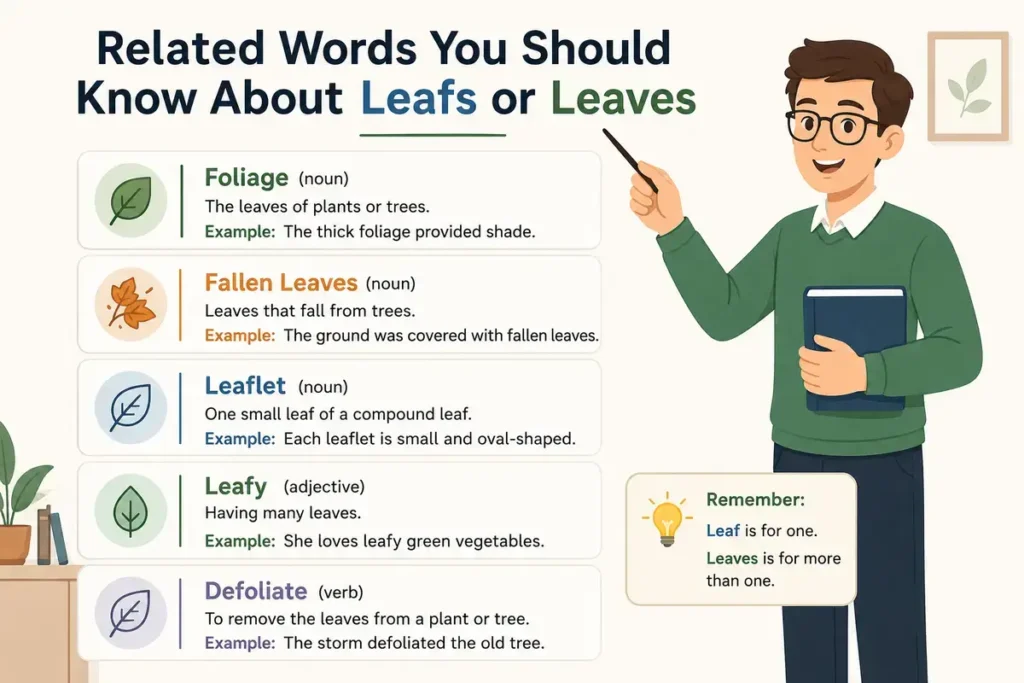
Related Words You Should Know About Leafs or Leaves
Leaf
One flat green part of a plant or tree.
Leaves
More than one leaf. This is the correct everyday plural.
Foliage
All the leaves growing on trees or plants together.
Branch
A part of a tree where leaves grow.
Tree
A large plant that grows leaves every year.
Forest
A place filled with many trees and leaves.
Autumn
The season when many leaves change color and fall.
Evergreen
A tree that keeps most of its leaves all year.
Blossom
The flower that appears on many trees before fruit grows.
Nature
Everything that grows naturally, including trees and leaves.
Learning these words together helps you build a stronger English vocabulary.
How People Actually Use It in Daily English
Here are real examples that sound natural in everyday conversation.
- The leaves are falling into the yard.
- I love the colors of autumn leaves.
- Please rake the leaves before dinner.
- Those leaves look healthy and green.
- The wind carried the leaves across the road.
- My little sister collected leaves for school.
- He leafs through the newspaper every morning.
- She leafs through the recipe book before cooking.
- My friend is a Toronto Maple Leafs fan.
- We pressed colorful leaves inside a notebook.
Common Mistakes People Make
Many learners make the same mistakes because English has some unusual spelling rules.
Mistake One
Wrong:
The tree has many leafs.
Correct:
The tree has many leaves.
Mistake Two
Wrong:
I picked three green leafs.
Correct:
I picked three green leaves.
Mistake Three
Wrong:
Autumn leafs are beautiful.
Correct:
Autumn leaves are beautiful.
Mistake Four
Wrong:
The garden is full of leafs.
Correct:
The garden is full of leaves.
Mistake Five
Wrong:
Leaves through the magazine.
Correct:
He leafs through the magazine.
Remember that leafs is correct here because it is a verb. The easiest way to avoid mistakes is to ask yourself one question. Are you talking about more than one leaf on a plant? If the answer is yes, use leaves.
Final Teacher Explanation About Leafs or Leaves
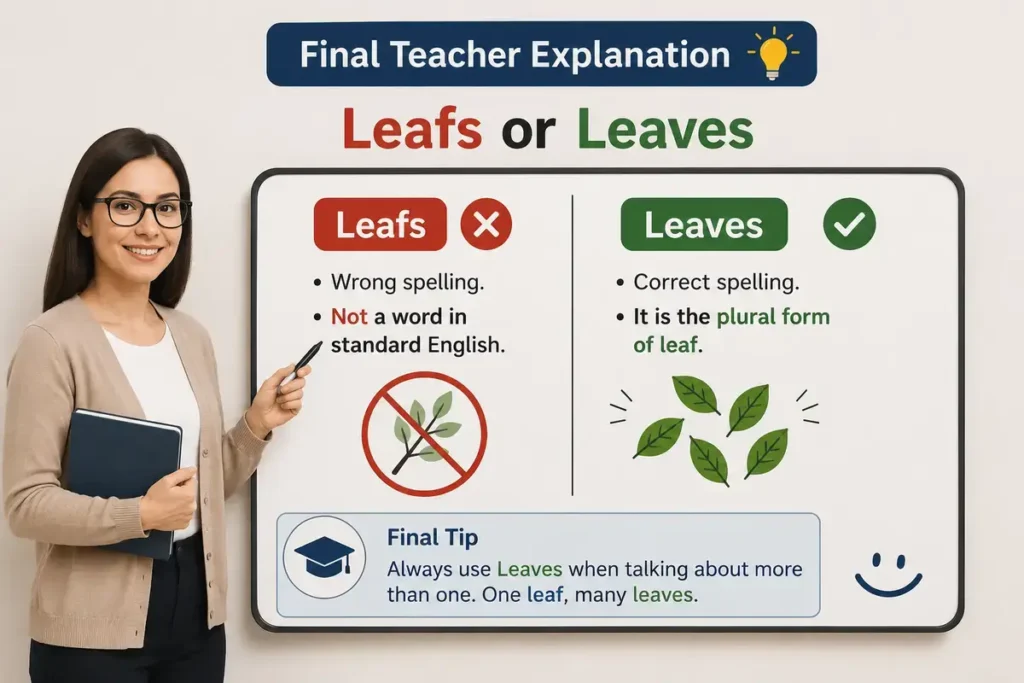
Imagine you are sitting in a classroom, and someone asks, “Should I write?” My answer would be simple. If you are talking about the green parts of a tree or plant, always write leaves. This is the correct plural that native English speakers use every day.
The word leafs is only correct in special situations. It can be the present tense of the verb meaning to turn pages quickly, or it can be part of an official name like the Toronto Maple Leafs. You do not need to memorize long grammar rules. Just remember one easy sentence. One leaf becomes many leaves. That simple idea will help you every time you write.
As you continue learning English, you will notice that some words follow special spelling patterns. Do not worry about remembering every exception at once. Read often, practice with simple sentences, and the correct form will soon feel natural.
Final Answer About Leafs or Leaves
If you are choosing between both words, the correct answer is almost always leaves. Use leafs only for special names or as the verb meaning to turn pages. For everyday English, school writing, and conversation, leaves is the correct and natural choice.
A related grammar guide is Spicey vs Spicy: Which Spelling Is Correct Guide (2026).
Conclusion
Many English words can be confusing at first, and leafs or leaves is one of them. The good news is that this question has a simple answer. In almost every everyday situation, the correct plural of leaf is leaves. You will see this spelling in books, schools, newspapers, and conversations.
The word leafs is not wrong, but it belongs to a few special situations. It appears in proper names like the Toronto Maple Leafs and as the verb that means turning pages quickly. Outside of these exceptions, you should choose leaves with confidence.
The more you read and practice, the easier this spelling will become. Just remember the simple classroom rule: one leaf becomes many leaves. That one sentence can help you avoid mistakes and write clear, natural English every time.
Frequently Asked Questions
What is the correct plural of leaf?
The correct plural is leaves. This is the form used in normal English writing and speaking.
Is leafs ever a correct word?
Yes. It is correct as a verb meaning to turn pages or as part of names like the Toronto Maple Leafs.
Why do people confuse?
Most English nouns simply add the letter s to become plural, so many learners expect leaf to become leafs.
Can I write leafs in school assignments?
No. If you mean more than one leaf, you should write leaves.
Is it autumn leaves?
The correct phrase is autumn leaves.
Which is correct?
The correct phrase is green leaves because it is the normal plural form.
How can I remember the difference?
Remember this simple rule: one leaf becomes many leaves. Use leafs only for special names or as a verb.
Is leaves used in formal and informal writing?
Yes. Leaves is correct in both formal and informal English.
