
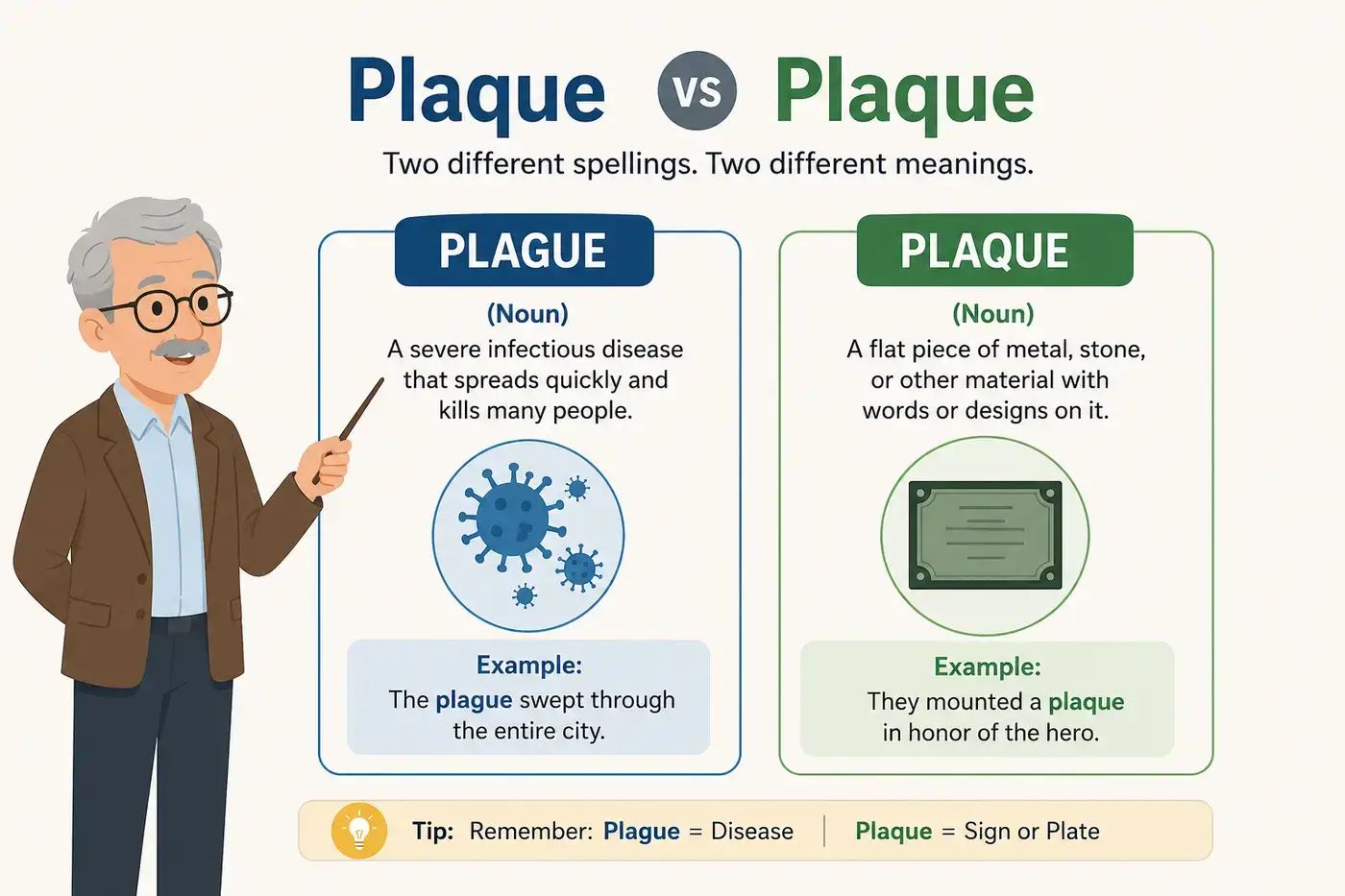
Many people search for the difference between placque vs plaque because the two words look very similar. At first glance, it is easy to think both spellings are correct. However, only one of them is accepted in standard English.
If you are confused about placque vs plaque, you are not alone. This spelling mistake appears in school papers, online posts, business writing, and even signs. The extra letters can make people wonder which version is right.
The simple answer is that plaque is the correct spelling. Placque is a misspelling and should not be used in formal or everyday writing. Once you understand why, the difference becomes very easy to remember.
Still confused? Compare Hello world!.
Placque vs Plaque: Simple Answer in One Look
Plaque is the correct spelling.
Placque is incorrect and is considered a spelling mistake.
If you need to write this word, always choose plaque.
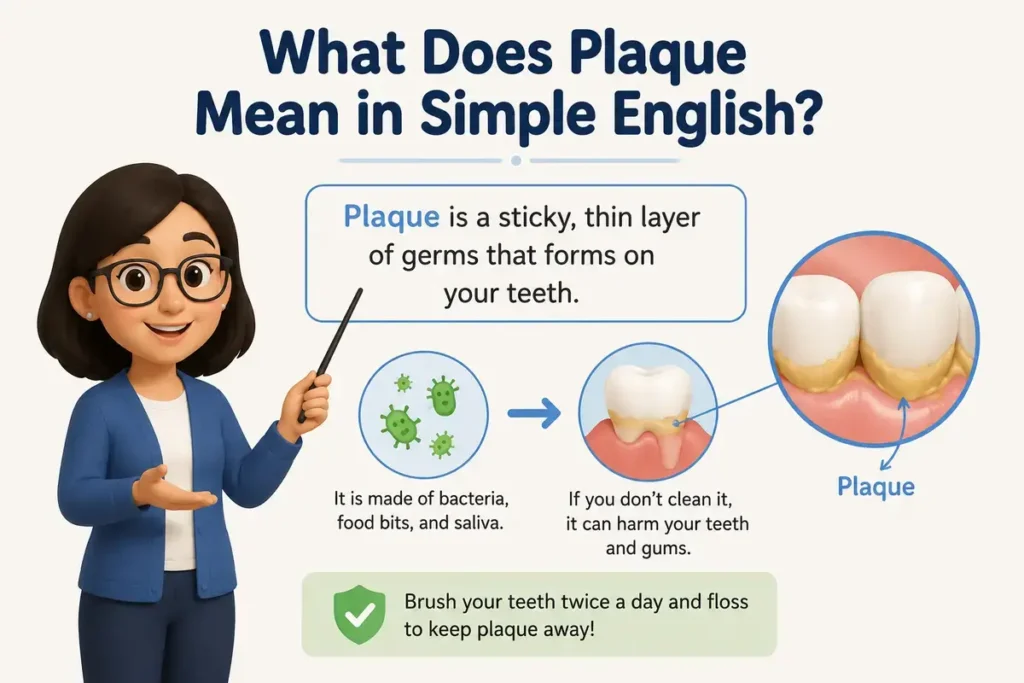
What Does Plaque Mean in Simple English?
The word plaque has more than one meaning in English. Most commonly, a plaque is a flat piece of metal, stone, wood, or another material that contains words or information. You often see plaques on buildings, monuments, schools, and memorials. For example:
- A school may place a plaque near its entrance.
- A city may install a plaque to honor a local hero.
- A museum may use a plaque to explain an exhibit.
A plaque is usually meant to remember, celebrate, or identify something important.
Plaque Can Also Mean a Dental Build-Up
Dentists use the word plaque too. In dental care, plaque is a soft, sticky layer that forms on teeth. It contains bacteria and can cause problems if it is not removed. For example:
- Brush your teeth to remove plaque.
- Plaque can lead to cavities.
- Daily flossing helps reduce plaque.
Even though the meanings are different, the spelling stays the same.
Two Meanings, One Correct Spelling
Whether you are talking about:
- A memorial sign
- A building marker
- A dental coating
The correct word is always plaque.
Why Do People Mix These Words Placque vs Plaque?
The confusion behind placque vs plaque usually comes from spelling patterns. English contains many words that use similar letter combinations. Examples include:
- Black
- Attack
- Mosque
- Antique
Because of these patterns, some people accidentally add an extra “c” and write placque instead of plaque.
The Word Looks Unusual
Another reason for confusion is that plaque does not follow a spelling pattern many learners see every day. The ending “-aque” can look strange. People may try to spell the word the way it sounds. That often leads to:
- Placque
- Plack
- Plaq
- Plak
However, standard English only accepts plaque.
Typing Errors Happen Easily
Sometimes people know the correct word but make a typing mistake. The letters are close together, and an extra letter can accidentally appear. For example:
- Correct: plaque
- Incorrect: placque
This is a common spelling error, especially when typing quickly.
Pronunciation Can Be Misleading
Many English words are not spelled exactly as they sound. The word plaque is pronounced like:
“plack”
Because of this pronunciation, people sometimes guess the spelling incorrectly. That is why learning the correct written form is helpful.
Placque vs Plaque: Clear Difference Explained Simply
The difference between placque vs plaque is very easy once you see it clearly.
| Word | Correct? | Meaning |
|---|---|---|
| Plaque | Yes | A sign, marker, award, or dental build-up |
| Placque | No | Misspelling of plaque |
Quick Visual Comparison of Placque vs Plaque
Correct:
- Plaque on a wall
- Memorial plaque
- Dental plaque
- Bronze plaque
Incorrect:
- Placque on a wall
- Memorial placque
- Dental placque
- Bronze placque
Easy Memory Trick for Placque vs Plaque
Look at the correct spelling:
Plaque
Notice that it starts with:
Pla-
and ends with:
-que
There is only one “c” sound in the word.
There is no extra “c” before the “q.”
If you remember that, you will avoid the mistake.
Think of Common Examples
You may hear people say:
- Award plaque
- Name plaque
- Historical plaque
- Dental plaque
You will never see professional dictionaries using placque. That is a strong clue that it is incorrect.
Placque vs Plaque: Which Form Should You Use?
When choosing between placque vs plaque, always use plaque. There are no situations in standard English where placque is preferred.
Use Plaque for Awards
Example:
“The company gave her a plaque for ten years of service.”
Use Plaque for Memorial Signs
Example:
“A plaque was placed outside the old building.”
Use Plaque for Dental Health
Example:
“The dentist found plaque on my teeth.”
Use Plaque in School Writing
If you are writing:
- Essays
- Homework
- Reports
- Emails
- Blog posts
Choose plaque every time.
Placque vs Plaque: Teacher’s Rule
Remember this simple rule:
If you see placque, remove the extra “c.”
The correct spelling becomes plaque.
Placque vs Plaque in Everyday Situations
Learning words becomes easier when you see them in real life.
At School
A school may hang a plaque to honor a former principal. Example:
“The plaque listed the names of past principals.”
At a Park
Many parks have plaques that explain local history. Example:
“We stopped to read the plaque near the monument.”
At Work
Companies often give plaques to employees for achievements. Example:
“She proudly displayed her plaque in her office.”
At the Dentist
Dentists often talk about plaque during checkups. Example:
“The dentist recommended brushing twice a day to reduce plaque.”
In every example, the spelling remains plaque.
Easy Real-Life Sentences You Can Use Placque vs Plaque
Here are simple examples you can use in daily English.
- The plaque was attached to the front wall.
- I read the plaque beside the statue.
- She received a plaque for her hard work.
- The museum displayed a plaque with historical facts.
- The dentist showed me where plaque had formed.
- We cleaned the plaque from the memorial sign.
- The award plaque sat on his desk.
- Visitors stopped to read the plaque near the entrance.
Notice that every sentence uses plaque, not placque.
Common Mistakes People Make Placque vs Plaque
Many learners accidentally write:
- Placque
- Plack
- Plaq
- Plak
These forms are not accepted in standard English. Only plaque is correct.
Why Spell Check Matters
Modern spell-check tools often catch the word placque because it is not recognized as a standard English word. If your writing tool highlights placque, it is usually suggesting plaque as the correction.
How to Avoid the Mistake
Use these simple steps:
- Remember that plaque has no extra “c.”
- Read the word slowly.
- Check your spelling before publishing.
- Think about common phrases such as “dental plaque” or “award plaque.”
These habits make the correct spelling easier to remember.
Where Does the Word Placque vs Plaque Come From? (Simple History)
The word plaque comes from French. Long ago, it referred to a flat plate, panel, or surface. Over time, English borrowed the word and gave it similar meanings. People began using plaque for:
- Decorative signs
- Memorial markers
- Award plates
- Information displays
Later, the medical field adopted the word plaque for certain deposits or build-ups, including dental plaque. Even though the meanings expanded, the spelling remained the same. That spelling has been plaque for many years. Because the word came from another language, its spelling may look unusual compared to many English words. That unusual spelling is one reason people sometimes write placque by mistake.
Is Placque Ever Correct?
No.
Standard English dictionaries recognize plaque. They do not recognize placque as a correct spelling. If you are comparing the answer is straightforward:
- Plaque = correct
- Placque = incorrect
This rule applies in academic, professional, and everyday writing.
Need another quick comparison? Read Anyway vs Anyways: Which Is Correct and How to Use(2026).
Transition to the Next Section
Now that you understand the basic difference between placque vs plaque, the next section will go deeper into cultural meaning, symbolism, historical use, and how the word plaque appears in stories, traditions, and everyday life.
Placque vs Plaque: How This Word Is Understood in Culture and Stories
When people hear the word plaque, they often think about something important being remembered. Across many cultures, plaques help keep history alive. They tell stories about people, places, and events that mattered. A plaque can be found on a famous building, near a monument, or beside a statue.
For example, a city may place a plaque where an important person once lived. Years later, visitors can read it and learn about that person’s life. That is why plaques are often connected with:
- Memory
- Honor
- Achievement
- History
- Respect
In stories and movies, plaques sometimes appear when a character receives recognition for doing something great. You may see:
- A sports plaque for a winning athlete.
- A memorial plaque remembering someone special.
These examples show that plaques are more than simple signs. They often carry meaning and tell a story.
Placque vs Plaque in Cultural Use
When discussing culture, history, or recognition, the correct word is always plaque. The spelling placque does not have a separate cultural meaning. It is simply a misspelling of plaque.
Placque vs Plaque: Biblical and Mythological Meaning
The word plaque itself does not have a special biblical meaning. You will not find the word plaque used as a major symbol in most Bible translations. However, objects similar to plaques have existed throughout history. People have often used stone tablets, engraved markers, and carved signs to record important messages. In biblical times, written records were placed on stone or other materials so people could remember important events.
In mythology and ancient stories, leaders sometimes left inscriptions on monuments or buildings. These markers served a purpose similar to modern plaques. They helped preserve:
- Names
- Victories
- Historical events
- Important messages
So while plaque is not a major biblical symbol, the idea of recording and remembering important things has existed for thousands of years.
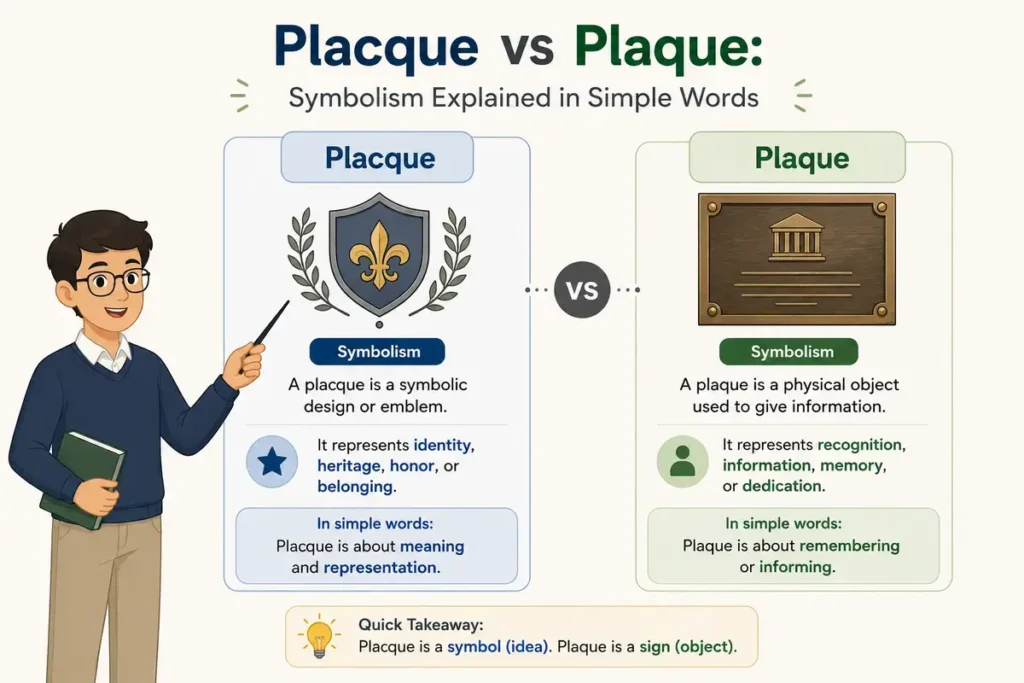
Placque vs Plaque: Symbolism Explained in Simple Words
Words often carry symbolic meaning beyond their basic definitions. The discussion is good because one form represents correct communication while the other represents a common mistake.
What Placque Represents
The word placque usually represents:
- A spelling error
- Confusion
- Guessing at a word
- Misunderstanding of spelling rules
People often write placque because they are trying to spell the word from memory. The mistake is understandable, but it is still incorrect. In a symbolic way, placque reminds us that English spelling can sometimes be tricky.
What Plaque Represents
The word plaque often represents:
- Recognition
- Honor
- Achievement
- History
- Memory
- Respect
When someone receives a plaque, it usually means they accomplished something important.
When a plaque appears in a museum, it teaches visitors about the past.
Simple Comparison
| Word | Symbolic Meaning |
|---|---|
| Placque | Mistake or spelling confusion |
| Plaque | Memory, honor, recognition, history |
This is another reason why using the correct spelling matters.
Related Words You Should Know about Placque vs Plaque
Learning related words can help you understand plaque more clearly.
Memorial
A memorial is something that honors or remembers a person or event. Example:
“The memorial honored local heroes.”
Monument
A monument is a structure built to remember someone or something important. Example:
“The monument stood in the town square.”
Marker
A marker identifies a place or provides information. Example:
“A historical marker explained the site’s history.”
Inscription
An inscription is writing carved or printed on an object. Example:
“The inscription was easy to read.”
Award
An award is something given to recognize success. Example:
“She received an award for excellence.”
Recognition
Recognition means receiving praise or credit. Example:
“He earned recognition for his work.”
Dental Plaque
Dental plaque is the sticky layer that forms on teeth. Example:
“Brushing helps remove dental plaque.”
These words often appear in discussions about plaques.
Placque vs Plaque: How People Actually Use It in Daily English
Most people use plaque in everyday situations without thinking much about its spelling. Here are some common examples.
At School
“The school installed a plaque near the library.”
At Work
“He received a plaque for twenty years of service.”
At a Museum
“We stopped to read the plaque beside the exhibit.”
During a Tour
“The guide pointed to a plaque on the old building.”
At the Dentist
“My dentist said I should remove plaque every day.”
During an Award Ceremony
“She proudly held her plaque after winning.”
In a Historical Area
“The plaque explained what happened there.”
At a Community Event
“A plaque was unveiled to honor volunteers.”
During a Family Visit
“We took pictures beside the plaque.”
While Learning History
“The plaque helped us understand the event.”
These examples show how commonly the word plaque appears in everyday English.
Placque vs Plaque: Common Mistakes People Make
Many people make the same spelling mistakes when using this word.
Mistake 1: Adding an Extra C
Incorrect:
Placque
Correct:
Plaque
This is the most common error.
Mistake 2: Writing the Word the Way It Sounds
Incorrect:
Plack
Correct:
Plaque
English spelling does not always match pronunciation.
Mistake 3: Forgetting the Meaning
Some people only know the dental meaning of plaque. Others only know the memorial meaning. Remember that the same word can have both meanings.
Mistake 4: Assuming Both Spellings Are Correct
Some spelling differences are accepted in English. For example:
- Color and colour
- Theater and theatre
But placque and plaque are not like that. Only plaque is correct.
Easy Correction Rule
Whenever you see placque, remove the extra “c.” You will instantly have the correct spelling:
Plaque
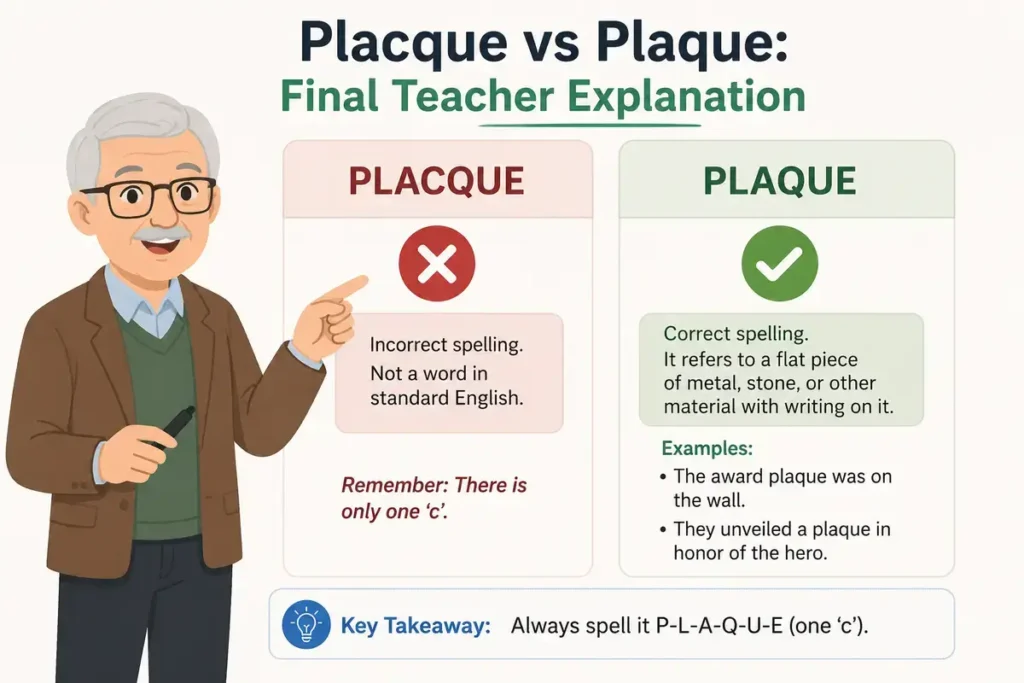
Placque vs Plaque: Final Teacher Explanation
Imagine we are sitting together in a classroom. A student raises a hand and asks:
“Which is correct, placque or plaque?”
My answer would be very simple. Use plaque. That is the correct English spelling. The word placque is a spelling mistake. Remember that plaque can mean:
- A sign on a wall
- An award plate
- A memorial marker
- A sticky layer on teeth
No matter which meaning you use, the spelling stays the same. One helpful memory trick is this. When you see the word on a building, in a museum, at school, or at the dentist, it is always plaque. The more you read and write the word correctly, the easier it becomes to remember. English contains many confusing spellings, but this one has a clear answer. Choose plaque every time.
Placque vs Plaque: Final Answer (Quick Recap)
If you are choosing between placque vs plaque, use plaque. Plaque is the correct spelling for memorial signs, awards, historical markers, and dental build-up. Placque is a misspelling and should be avoided in all forms of writing.
Many readers also check Better Than or Better Then: Easy Guide With Examples (2026).
Conclusion
The comparison between placque vs plaque is actually very simple once you know the rule. Plaque is the correct spelling used in standard English. It refers to memorial signs, awards, historical markers, and dental build-up on teeth. Placque is not an accepted English spelling. It is simply a common mistake caused by confusion about how the word looks and sounds.
If you remember one thing from this lesson, remember this: Plaque is always correct. Placque is always incorrect. That simple rule will help you avoid mistakes in school, work, and everyday writing.
Frequently Asked Questions (FAQs)
What does plaque mean in simple words?
Plaque is usually a sign, marker, award plate, or a sticky layer that forms on teeth.
Is placque a real English word?
No. Placque is considered a misspelling of plaque.
Which is correct: placque or plaque?
Plaque is the correct spelling. Placque is incorrect.
Why do people confuse?
People often add an extra “c” because the spelling looks unusual.
Can I use placque in formal writing?
No. Formal writing should always use plaque.
Does plaque have more than one meaning?
Yes. It can mean a memorial sign or a dental build-up on teeth.
How can I remember the correct spelling?
Remember that plaque has no extra “c.” If you see placque, remove the extra letter.
Is plaque used in everyday English?
Yes. People use it when talking about awards, memorials, museums, history, and dental health.
