
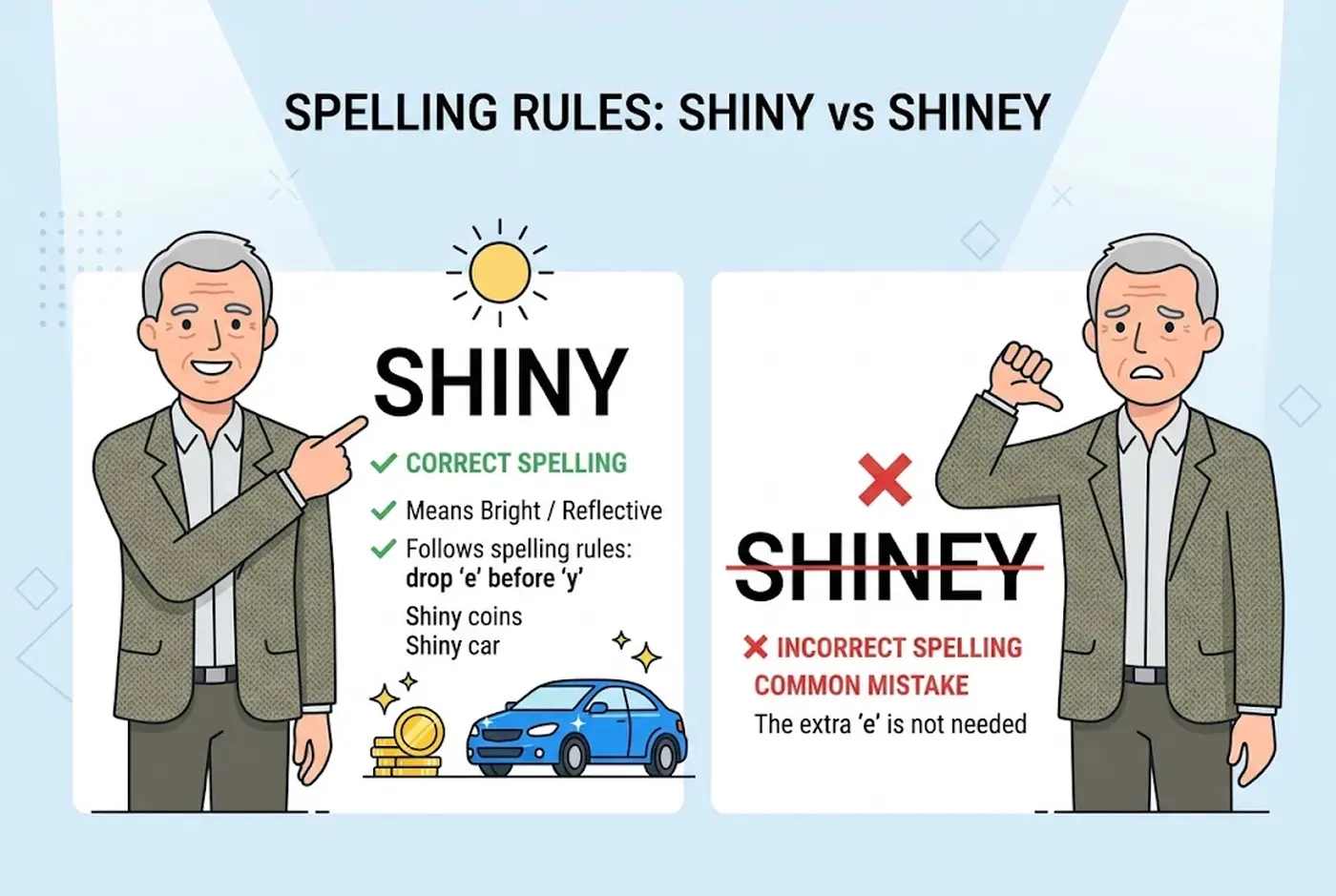
If you are confused about Shiny vs Shiney, you are not alone. These two spellings look almost the same, but only one is the standard spelling in modern English. The correct word is shiny.
Shiny means something has a bright, smooth surface that reflects light. For example, you can say, “She bought a shiny new car.” Shiney is usually a misspelling of shiny and should not be used in standard English.
The difference between words are simple once you see the spelling pattern. If you mean “bright” or “reflecting light,” use shiny. You will see this word often when people talk about cars, shoes, jewelry, floors, metal, hair, and other things that look bright or polished.
A related grammar guide is Better Than or Better Then: Easy Guide With Examples (2026).
Simple Answer in One Look
Shiny is the correct spelling.
Shiney is generally incorrect in standard English.
| Word | Correct? | Meaning |
|---|---|---|
| Shiny | Yes | Bright or reflecting light |
| Shiney | No | Usually a misspelling of shiny |
A quick rule to remember is:
Use shiny when you mean bright, polished, or reflecting light.
For example:
- The new shoes are shiny.
- She has shiny hair.
- I bought a shiny silver watch.
Do not write:
- The new shoes are shiney.
- She has shiney hair.
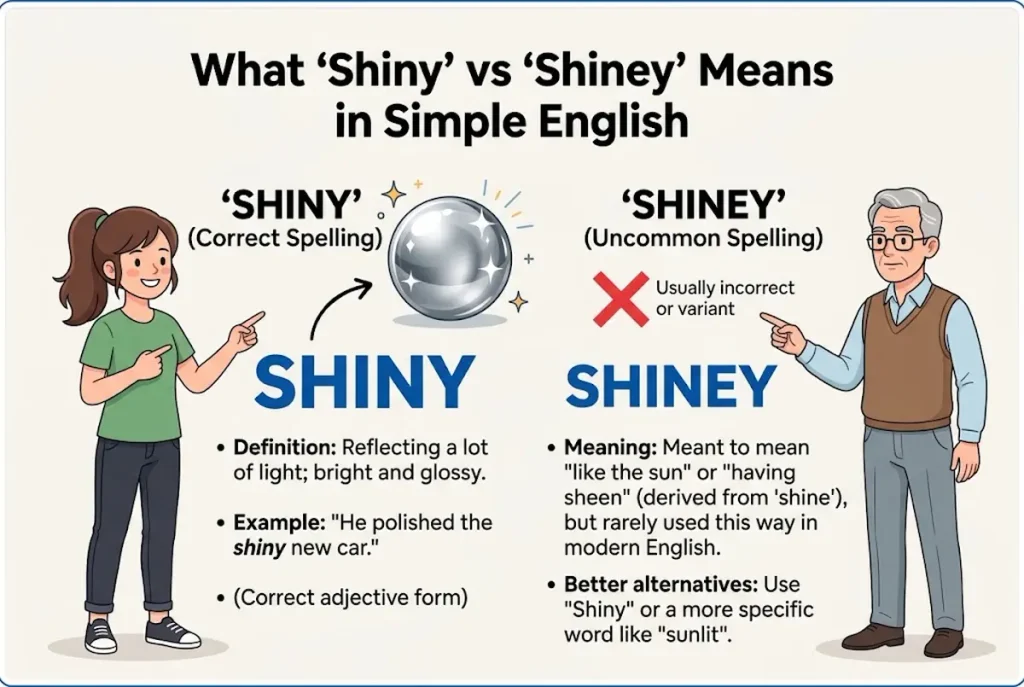
What Shiny vs Shiney Means in Simple English
The word shiny describes something that looks bright because it reflects light.
Think about a clean window on a sunny day. Light hits the glass and reflects back. The glass may look shiny.
Now think about a new pair of black shoes. If the shoes have a bright, polished surface, you can call them shiny.
The same idea works with many everyday objects.
You can have:
- a shiny car
- a shiny floor
- shiny shoes
- shiny hair
- a shiny ring
- a shiny table
- shiny metal
- shiny paper
Here are a few simple examples:
The floor looks shiny after cleaning.
This tells us that the floor reflects light and looks bright.
Her hair is shiny and smooth.
Here, shiny describes the healthy-looking, bright appearance of her hair.
He wore shiny black shoes.
The shoes have a bright or polished surface.
The word can also describe something that seems new or attractive because of its bright appearance. For example, a child might become excited after seeing a shiny new toy.
So, when you see shiny, think:
bright + reflecting light + polished appearance
That simple idea will help you use the word correctly.
Why People Mix These Words Shiny or Shiney
The confusion between words are mostly comes from the way the word sounds. When you say shiny, it sounds like “shine-ee.” Because of that sound, some people naturally think the spelling should be shiney. That seems reasonable at first.
Look at the base word:
shine
Then think about the sound:
shine + y
It is easy to imagine:
shiney
But English spelling does not always work by simply adding letters based on pronunciation.
The standard spelling is:
shiny
The word keeps the main idea of shine, but the final silent e is removed before the ending -y.
This is one reason shiny may look a little surprising to English learners. There are many English words where spelling and pronunciation do not match perfectly. Sometimes a word sounds as if it should contain a certain letter, but standard spelling uses another form.
For example, people sometimes write:
shiney shoes
because they hear the “shine” sound.
The correct form is:
shiny shoes
Another reason people mix up word is that English has many words ending in -y.
Consider these common words:
- sunny
- funny
- rainy
- messy
- noisy
- shiny
- sleepy
- lucky
The ending -y is very common in English adjectives.
Once you become familiar with words like these, shiny starts to look more natural.
Why “Shiney” Looks Right to Some People
There is a simple visual reason for the mistake.
The word shine is familiar:
shine
So when people want to turn it into an adjective, they may think:
shine + y = shiney
But English does not always form words by adding the new ending without changing the original spelling.
In this case, the standard spelling is:
shine → shiny
not:
shine → shiney
You can remember this by focusing on the word you see in dictionaries and edited writing:
shiny
Clear Difference Explained Simply
The difference is mainly a spelling difference. The meanings are not two different ideas. In standard English, shiney is not normally treated as a separate word with its own meaning. It is usually an incorrect spelling of shiny.
Here is the easiest way to see it:
Shiny
Shiny is the standard English word.
It means:
- bright
- reflecting light
- polished
- smooth and bright-looking
Examples:
I bought a shiny new phone.
The kitchen floor is shiny.
Her shoes are very shiny.
Shiney
Shiney is generally not the standard spelling. You may see it online, in informal writing, or in text written by someone who is unsure about the spelling. However, you should use shiny in school assignments, professional writing, articles, emails, and other standard English. So if you are asking, “Which is correct, shiny or shiney?” the answer is clear:
Shiny is correct.
Which Form Should You Use?
Use shiny when you want to describe something that reflects light or has a bright, polished appearance.
A simple rule is:
If something looks bright because it reflects light, call it shiny.
For example:
The car is shiny.
My new shoes are shiny.
The silver spoon looks shiny.
She has shiny hair.
The floor became shiny after it was cleaned.
You do not need shiney.
This rule works in both everyday speech and formal writing.
Shiny as an Adjective
The word shiny is used to describe a person, place, animal, object, or thing.
For example:
The shiny car is parked outside.
Here, shiny describes the car.
I found a shiny coin.
Here, shiny describes the coin.
The table has a shiny surface.
Here, shiny describes the surface.
The word can come before a noun:
a shiny ring
shiny shoes
a shiny floor
It can also come after a linking verb:
The ring is shiny.
Her hair looks shiny.
The floor became shiny.
The basic meaning stays the same.
Easy Real Life Sentences You Can Use Shiny and Shiney
Here are some natural sentences you can use in everyday English.
- My new shoes are shiny.
- The car has a shiny black surface.
- She has long, shiny hair.
- I found a shiny coin on the ground.
- The kitchen floor looks shiny and clean.
- He bought a shiny new watch.
- The silver spoon is very shiny.
- The children liked the shiny toy.
Notice something important in all these examples.
The word is always spelled:
shiny
Not:
shiney
If you replace shiny with shiney, the sentence may still be understood by a reader, but the spelling is not standard.
Where Does the Word “Shiny” Come From?
The word shiny comes from the older English word shine, which has been used for a very long time.
Shine can be used as a verb. For example:
The sun shines brightly.
It can also be connected with the idea of light or brightness.
The adjective shiny describes something that has a bright or reflective appearance.
The spelling follows the familiar English form shiny, rather than shiney.
This is a useful lesson because English words do not always form new words in the way we might expect. Looking at a word’s history and spelling pattern can explain why a form that seems logical is still not the standard spelling.
That is exactly what happens with Shiny vs Shiney.
The correct modern spelling for the adjective is:
shiny
As you read more English, you will see this spelling again and again.
In Everyday English
In normal conversation, shiny is the word native speakers expect to hear and see.
Imagine someone showing you a new car.
You might say:
“Wow, that’s shiny!”
If someone buys new shoes, you might say:
“Those shoes are really shiny.”
If someone cleans a table until it reflects light, you might say:
“The table looks shiny now.”
These sentences sound natural because shiny is the standard word.
You do not need to use a complicated expression. In most cases, simply saying shiny is enough.
The word is common in descriptions because it gives the listener a quick picture. When someone says “a shiny red car,” you can easily imagine a red car with a bright, reflective surface.
Common Situations Where You Need “Shiny”
You can use shiny in many parts of daily life.
Cars
He bought a shiny new car.
Shoes
Her black shoes are shiny.
Jewelry
She wore a shiny gold necklace.
Hair
The shampoo made her hair look shiny.
Floors
The cleaner left the floor shiny.
Metal
The new metal surface is shiny.
Toys
The child picked up a shiny toy.
Paper and Decorations
The gift had shiny paper around it.
These examples show why shiny is such a useful word. It can describe many things that have a bright or polished appearance.
A Quick Memory Trick
If you often forget the spelling, use this simple memory trick:
Shine becomes shiny.
Think:
shine → shiny
Not:
shine → shiney
You can also remember the phrase:
Shiny shoes.
The first spelling has no extra e before the y.
So when you need to write the word, picture a pair of shiny shoes.
That small memory trick can help you avoid the common spelling mistake.
What About “Shine” and “Shiny”?
It also helps to understand the difference between shine and shiny.
Shine is commonly used to talk about giving off or reflecting light.
For example:
The sun shines.
The lamp shines brightly.
Her shoes shine in the light.
Shiny, on the other hand, describes something that has a bright or reflective surface.
For example:
Her shoes are shiny.
So you can think of it this way:
shine = the action or idea of giving off or reflecting light
shiny = describes something that looks bright or reflective
This makes it easier to understand why shiny is the correct adjective.
For another common grammar confusion, see Filed vs Filled: Meaning, Difference, and How to Use (2026).
Is “Shiney” Ever Correct?
For normal standard English, you should use shiny.
You may sometimes see shiney as a name, username, informal spelling, brand name, character name, or other special use. In those cases, the spelling may be intentional.
But if you are writing a normal English sentence and want to describe something as bright or reflective, use:
shiny
For schoolwork, business writing, websites, essays, and everyday standard English, shiny is the safe and correct choice.
In School and Professional Writing
Spelling matters more in formal writing because readers expect standard English.
Suppose you are writing:
The report contains a picture of a shiney car.
A teacher or editor will likely see shiney as a spelling error.
Change it to:
The report contains a picture of a shiny car.
Now the spelling is standard.
The same rule applies to:
shiney shoes → shiny shoes
shiney floor → shiny floor
A Simple Test
Ask yourself:
“Am I describing something that looks bright, polished, or reflective?”
If the answer is yes, use shiny.
For example:
Is the floor bright and reflective?
Yes.
The floor is shiny.
Do the shoes have a polished surface?
Yes.
The shoes are shiny.
Does the ring reflect light?
Yes.
The ring is shiny.
This test is easy because you do not need to remember a long grammar rule.
Just remember the correct spelling:
shiny
The spelling shiney should not be your choice in standard English.
A Teacher’s Quick Rule
Here is the rule I would give a student in class:
When you mean bright, polished, or reflecting light, spell the word “shiny.”
That’s it.
You do not need to write shiney.
You do not need to add an extra e.
Write:
shiny
This one small spelling choice can make your writing look much more polished.
The basic question is now clear: Shiny vs Shiney is not a choice between two standard words with different meanings. Shiny is the standard adjective, while shiney is usually a spelling mistake.
But the word shiny has more uses than simply describing a bright object. It can also appear in common expressions, descriptions, comparisons, and cultural ideas about newness, beauty, attraction, and appearance. Understanding those uses will help you recognize the word more easily and use it naturally in real English.tips, and frequently asked questions to help you use this word with confidence.
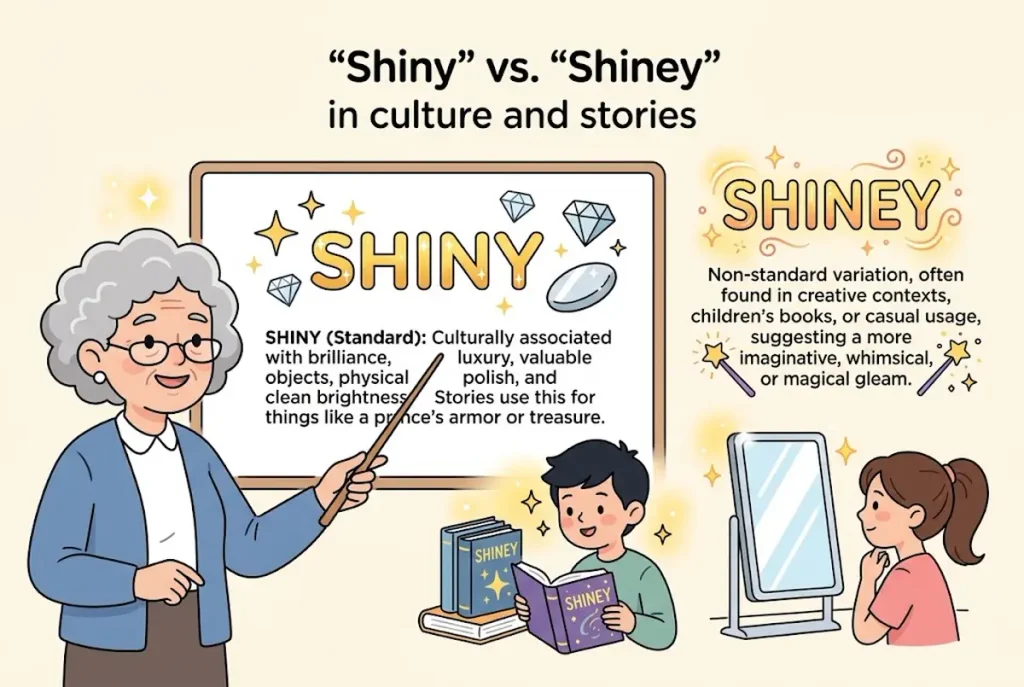
How Shiny vs Shiney Words Is Understood in Culture and Stories
The word shiny often has a positive meaning in stories and everyday life. People connect it with things that are clean, new, and beautiful.
For example, a hero in a story may carry a shiny sword or wear shiny armor. The bright surface makes the object look special and powerful.
Children’s books also use shiny to describe stars, treasure, coins, or magical objects.
Examples:
- The princess found a shiny crown.
- The pirate opened a box full of shiny gold.
- The bird picked up a shiny pebble.
The spelling shiney is not used in standard books or dictionaries. Professional writers almost always choose shiny.
Biblical and Mythological Meaning of Shiny or Shiney
The word shiny does not have a special biblical meaning.
However, many religious stories describe bright or shining objects as symbols of goodness, hope, or glory.
For example, light is often connected with truth and guidance.
In myths and legends, magical swords, shields, and treasures are often described as shiny because they stand out and attract attention.
The spelling remains shiny in all of these uses.
Symbolism Explained in Simple Words
What Shiny Represents
The word shiny often represents:
- cleanliness
- beauty
- success
- value
- freshness
- hope
Example:
- A shiny trophy can symbolize victory.
What Shiney Represents
The spelling shiney does not have its own symbolic meaning.
It is usually just a misspelling of shiny.
When you want to describe something bright or polished, always use shiny.
Related Words You Should Know
Bright
Gives off a lot of light.
Example:
- The sun is bright today.
Glossy
Has a smooth, reflective surface.
Example:
- The magazine cover is glossy.
Sparkling
Shines with many small flashes of light.
Example:
- The water looked sparkling.
Polished
Made smooth and shiny by cleaning.
Example:
- The silver was carefully polished.
Gleaming
Shining strongly with reflected light.
Example:
- The gleaming windows reflected the sun.
Radiant
Very bright or full of light.
Example:
- She had a radiant smile.
These words can help make your writing more interesting.
How People Actually Use Shiny and Shiney in Daily English
People use shiny in many everyday situations.
Here are some natural examples.
- My shoes are shiny after polishing.
- She bought a shiny blue dress.
- The clean mirror looks shiny.
- We washed the car until it was shiny.
- His watch is shiny and new.
- The puppy has shiny black fur.
- The kitchen floor became shiny after cleaning.
- The child picked up a shiny stone.
- I like shiny decorations at holiday time.
- The fresh paint makes the table look shiny.
You will almost never see careful writers use shiney in these examples.
Common Mistakes People Make
Mistake 1: Writing shiney instead of shiny
Wrong:
- The ring is shiney.
Correct:
- The ring is shiny.
Mistake 2: Thinking both spellings are accepted
Only shiny is the standard spelling in modern English.
Mistake 3: Keeping the final “e” from shine
Many learners write shiney because the base word is shine.
The final e is dropped before adding -y.
Mistake 4: Copying incorrect online spelling
Some websites and social media posts use shiney by mistake.
Always check a trusted dictionary if you are unsure.
Mistake 5: Believing spell-check is always unnecessary
Many spelling tools quickly point out that shiney should be shiny.
Using them can help you avoid simple errors.
Final Teacher Explanation of Shiny or Shiney
Imagine you ask me in class, “Should I write shiny or shiney?”
My answer is very simple.
Write shiny every time.
It is the correct spelling found in dictionaries and grammar books.
The word comes from shine, but English drops the final e before adding -y.
If you remember this one rule, you will avoid almost every mistake with this word.
Many readers also check Cacoon or Cocoon: Which Spelling Is Correct (2026).
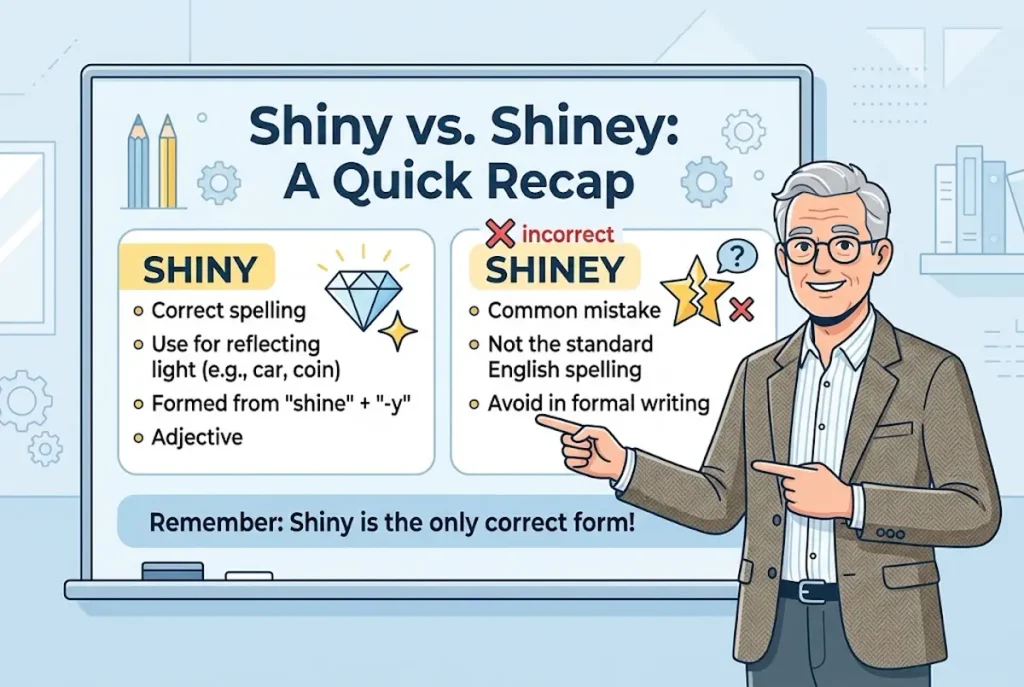
Final Answer about Shiny vs Shiney (Quick Recap)
When comparing, the correct spelling is shiny.
Shiney is generally considered a spelling mistake.
For school, work, and everyday writing, always choose shiny.
Conclusion
The question has a clear answer. Shiny is the correct spelling in modern English and should be used in school, business, and everyday writing. Although you may sometimes see shiney on websites or social media, it is generally considered a misspelling and should be avoided. When you want to describe something bright, polished, or reflective, always choose shiny. Following this simple rule will make your writing look more accurate and professional.
Frequently Asked Questions (FAQs)
Which is correct: shiny or shiney?
Shiny is the correct spelling.
Is shiney a real word?
It sometimes appears online, but it is generally treated as a spelling mistake.
Why is shiny spelled without the letter “e”?
English usually drops the final e before adding -y.
Can I use shiney in formal writing?
No. Use shiny instead.
What does shiny mean?
It describes something that reflects light or looks bright and polished.
Is shiny an adjective?
Yes. It describes the appearance of a person or object.
How can I remember the correct spelling?
Remember that the final e is dropped before adding -y, giving you shiny.
Do dictionaries accept shiney?
Most standard dictionaries list shiny as the correct form.

1 thought on “Shiny vs Shiney: Which Spelling Is Correct (2026 Guide)?”