
Have you ever wondered if the correct spelling is “Theater or Theatre”? You may have seen both forms in books, signs, websites, and movie listings. The good news is that both spellings are correct. The main difference is where they are commonly used.
“Theater” is the usual spelling in American English. “Theatre” is more common in British English and is also widely used in many other English-speaking places. Both words can mean a place where people watch plays, movies, or other performances. They can also describe the art or business of putting on plays.
So, which one should you use? If you are writing for an American audience, “theater” is usually the best choice. If you are following British English, “theatre” is usually preferred. The meaning stays almost the same, so the spelling depends mainly on the variety of English you are using.
For another common grammar confusion, see Shinning or Shining: Correct Usage Masterclass Guide 2026.
Simple Answer in One Look
The simple answer is this:
Theater is the standard spelling in American English.
Theatre is the standard spelling in British English.
Both words are correct. The difference is mainly a matter of English variety and writing style.
For example:
- American English: We went to the movie theater.
- British English: We went to the movie theatre.
- American English: She loves musical theater.
- British English: She loves musical theatre.
You do not need to worry that one spelling is wrong. The important thing is to choose the spelling that matches your audience and use it consistently.
What Theater or Theatre Means in Simple English
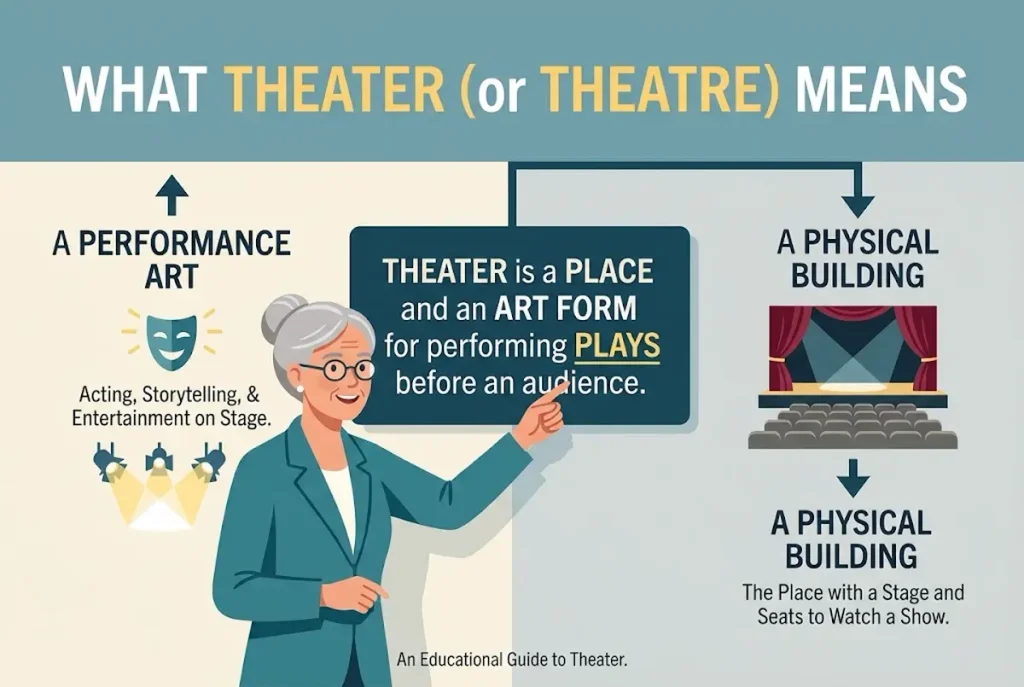
The word has several common meanings. First, it can mean a building or place where people watch a performance. A play, musical, concert, or movie may take place there.
For example:
We arrived at the theater at seven.
Here, “theater” means the place where the event is happening.
Second, the word can refer to plays and live performances as an art form.
For example:
Maria studies theater at college.
In this sentence, “theater” does not mean one particular building. It means the subject or art of performing plays. Third, the word can be used when talking about the world of acting and stage performances.
For example:
He wants to work in theater.
This means he wants to work in the field of live performance. The spelling changes depending on the type of English. American writers normally use “theater.” British writers normally use “theatre.” Think of it like two different labels for the same basic idea. The label may change, but the meaning does not change very much.
Why People Mix These Words
People mix up words because both spellings are used in English. You may read an American website in the morning and a British website later in the day. One may use “theater,” while the other uses “theatre.” This can make the difference seem confusing. Movies also add to the confusion.
In the United States, people commonly say “movie theater.” In the United Kingdom, “cinema” is often used instead. However, “theatre” is still common when talking about live plays and stage performances. There is another reason people get confused. Some organizations choose a spelling as part of their official name.
The same thing can happen with schools, clubs, businesses, and theaters. So, when you see “theatre” in an American setting, do not automatically assume it is a mistake. It may simply be part of a proper name or a style choice.
Clear Difference Explained Simply
Here is the easiest way to remember the difference between words:
| Spelling | Common English Variety | Example |
|---|---|---|
| Theater | American English | We went to the theater. |
| Theatre | British English | We went to the theatre. |
The key difference is spelling, not meaning.
Theater
” Theater” is the normal American English spelling.
Use it in American writing when you are talking about:
- A place for movies.
- A place for plays.
- The art of live performance.
- The theater industry.
- Theater studies.
Examples:
The theater is near my house.
We bought tickets for the theater.
She wants to study theater.
The theater was full last night.
Theatre
“Theatre” is the common British English spelling.
It can be used in the same situations.
Examples:
The theatre is near my house.
We bought tickets for the theatre.
She wants to study theatre.
The theatre was full last night.
The meaning remains clear in both forms.
Which Form Should You Use?
The best rule is simple: match the spelling to your audience.
If you are writing American English, use “theater.”
If you are writing British English, use “theatre.”
For example, an American student might write:
I joined the school theater club.
A British student might write:
I joined the school theatre club.
Both sentences are correct in their own variety of English. If you are writing for a website that mainly serves readers in the United States, “theater” is usually the safer choice. If your readers are mainly in the United Kingdom, “theatre” is usually better. The same rule applies to school assignments, articles, business writing, and general communication.
Is Theater Correct in American English?
Yes. “Theater” is the standard American English spelling.
You will commonly see it in phrases such as:
- movie theater
- theater ticket
- theater company
- theater production
- theater actor
- theater class
- theater program
For example:
The movie theater opens at noon.
Is Theatre Correct in American English?
Yes, but it is less common as the general spelling. An American organization may use “Theatre” in its official name. Writers may also use it when discussing a British institution or following a particular artistic style. For general American English, however, “theater” is the usual choice.
Is Theatre British English?
Yes. “Theatre” is the standard British English spelling.
You will often see it in phrases such as:
- theatre production
- theatre company
- theatre ticket
- theatre actor
- theatre school
- theatre audience
For example:
The theatre was packed for the evening show.
In American English
If your goal is to write natural American English, choose “theater.”
This applies to both the physical place and the general field of performance.
For example:
We watched a movie at the theater.
My sister is interested in theater.
The theater has 500 seats.
He works in musical theater.
Our school has a theater program.
These sentences sound natural to American readers. There is one small point to remember. American English often uses “movie theater” for a place where movies are shown. British English often uses “cinema” for the same place.
So an American might say:
Let’s go to the movie theater.
A British speaker might say:
Let’s go to the cinema.
But when talking about live plays, British English commonly uses “theatre.”
In British English
If you are following British English, “theatre” is the normal spelling.
For example:
We went to the theatre last night.
The theatre was built in the nineteenth century.
She works in musical theatre.
He wants to become a theatre actor.
British English uses the “re” ending in several words that American English spells with “er.”
A familiar example is “centre” and “center.”
British English:
The town centre is busy.
American English:
The town center is busy.
The same basic spelling pattern appears in words. This does not mean one form is more correct. English has several standard varieties, and spelling differences are a normal part of the language.
Easy Real Life Sentences You Can Use Theater vs Theatre
Here are some simple sentences to help you use the word naturally.
- We went to the theater to watch a movie.
- The theater was crowded on Saturday night.
- She loves musical theater.
- Our school has a small theater.
- They performed a play at the theatre.
- The theatre was built many years ago.
- He wants to become a theater actor.
- The new theatre has beautiful seats.
Notice that the meaning stays the same. Only the spelling changes.
In Common Phrases
You will often see the word in common expressions.
Movie Theater
“Movie theater” is especially common in American English.
We are going to the movie theater tonight.
It means a place where people watch movies on a large screen.
In British English, “cinema” is often more natural:
We are going to the cinema tonight.
Musical Theater
“Musical theater” means live performances that combine acting, music, and often dancing.
American English usually writes:
musical theater
British English usually writes:
musical theatre
For example:
She wants to perform in musical theater.
Community Theater
Community theater refers to local theater groups and performances, often involving people from the local community.
American English:
My brother performs in community theater.
British English may use:
My brother performs in community theatre.
Theater Company
A theater company is a group that produces plays or other performances.
American English:
The theater company is performing a new play.
British English:
The theatre company is performing a new play.
Where Theater or Theatre Word Comes From
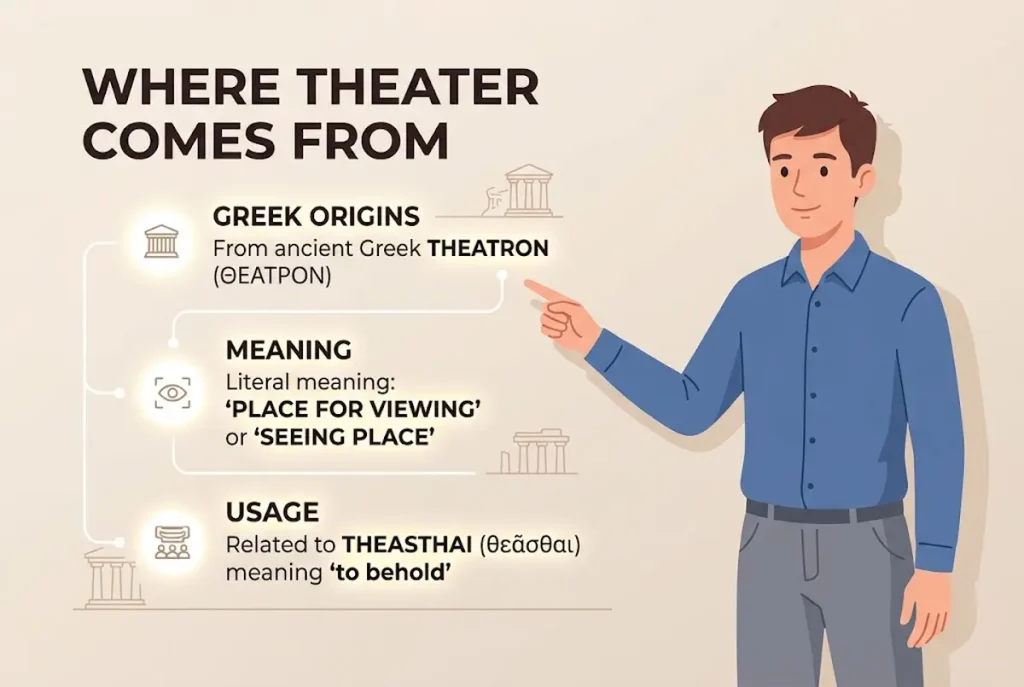
The history of words are quite old. The English word came through French from the Latin word “theatrum.” The Latin word came from Greek, where a related word referred to a place for viewing performances. Over many years, English spelling changed.
Different countries and writers developed different spelling habits. The “re” ending in “theatre” became strongly connected with British English. The “er” ending in “theater” became the usual American form. This is similar to other spelling differences between American and British English.
For example:
- American: center
- British: centre
- American: color
- British: colour
- American: favorite
- British: favourite
- American: theater
- British: theatre
These differences do not usually create a difference in meaning. They show which spelling tradition the writer is following.
Need another quick comparison? Read Figoro or Masingo: Which Word Should You Use (2026)?.
Why Does American English Use Theater?
American English developed its own spelling preferences over time. One major influence was the American writer and dictionary maker Noah Webster. He supported simpler and more distinct American spelling patterns. His work helped establish several spellings that are common in American English today.
The Difference Between Words
The difference between is very simple.
“Theater” is the standard American English spelling.
“Theatre” is the standard British English spelling.
Both can refer to a place where performances happen or to the art of live performance.
The most useful thing to remember is not to ask, “Which spelling is always correct?”
Instead, ask:
“Which English style am I using?”
If you are using American English, choose “theater.”
If you are using British English, choose “theatre.”
That one rule will help you in most situations.
The two spellings may look different, but they are really two versions of the same word. Once you know the English variety you are writing in, the choice becomes easy.
Now that the basic spelling difference is clear, we can look more closely at how words are used in culture, stories, education, everyday speech, and different English-speaking communities. These deeper uses can help you understand why both spellings continue to appear in English.
In Culture and Stories
These words are more than simple spellings. They are connected to art, entertainment, and storytelling. People visit a words to laugh, cry, learn, and enjoy performances. It is a place where actors bring stories to life. In many countries, going to the theater is a popular family activity. Schools also take students to watch plays because they help children learn history, language, and culture.
Whether you see both words describe the same idea. The spelling changes, but the experience stays the same.
Biblical and Mythological Meaning
The words do not have a direct biblical meaning. However, ancient people often gathered in large public places to watch speeches and performances. Some historical writings mention places where crowds came together for entertainment or public events. In Greek mythology and history, theatres were important places for drama and storytelling. The spelling does not change the meaning. It only changes according to regional English.
Symbolism Explained in Simple Words
What Theater Represents
The American spelling theater often represents:
- creativity
- entertainment
- movies
- live performances
- imagination
For many people, a theater is a place where stories become real.
What Theatre Represents
The British spelling theatre represents the same ideas. Some people also connect theatre with classic stage performances and traditional acting. Many famous acting schools and performance groups prefer this spelling because it reflects British style. The emotional meaning is exactly the same.
Related Words You Should Know About Theater and Theatre
Stage
The raised area where actors perform. Example:
- The singer walked onto the stage.
Play
A story performed by actors. Example:
- We watched a funny play.
Musical
A performance with songs and acting. Example:
- The musical was amazing.
Cinema
A place where people watch movies. Example:
- We went to the cinema yesterday.
Actor
A person who performs in plays or films. Example:
- The actor greeted the audience.
Audience
The people watching a performance. Example:
- The audience clapped loudly.
These words are useful when talking.
In Daily English
Here are simple examples of how people use these words.
- We are going to the theater tonight.
- She studies theatre at university.
- My family loves the local theater.
- They visited an old theatre in England.
- The theater is close to my house.
- He works in musical theatre.
- We bought tickets for the theater.
- The theatre hosts many live shows.
- I enjoy performing in the school theater.
- The city built a new theatre.
In American English, most people write theater. In British English, most people write theatre.
Common Mistakes People Make
Mistake 1: Thinking one spelling is wrong
Both spellings are correct. The choice depends on the type of English you use.
Mistake 2: Mixing both spellings in one article
Example:
- The new theater opened yesterday.
- The theatre sold out quickly.
Choose one style and use it throughout your writing.
Mistake 3: Using the wrong spelling for your audience
If you write for American readers, choose theater. If you write for British readers, choose theatre.
Mistake 4: Forgetting consistency
Switching between spellings can make writing look unprofessional.
Final Teacher Explanation of Theater or Theatre
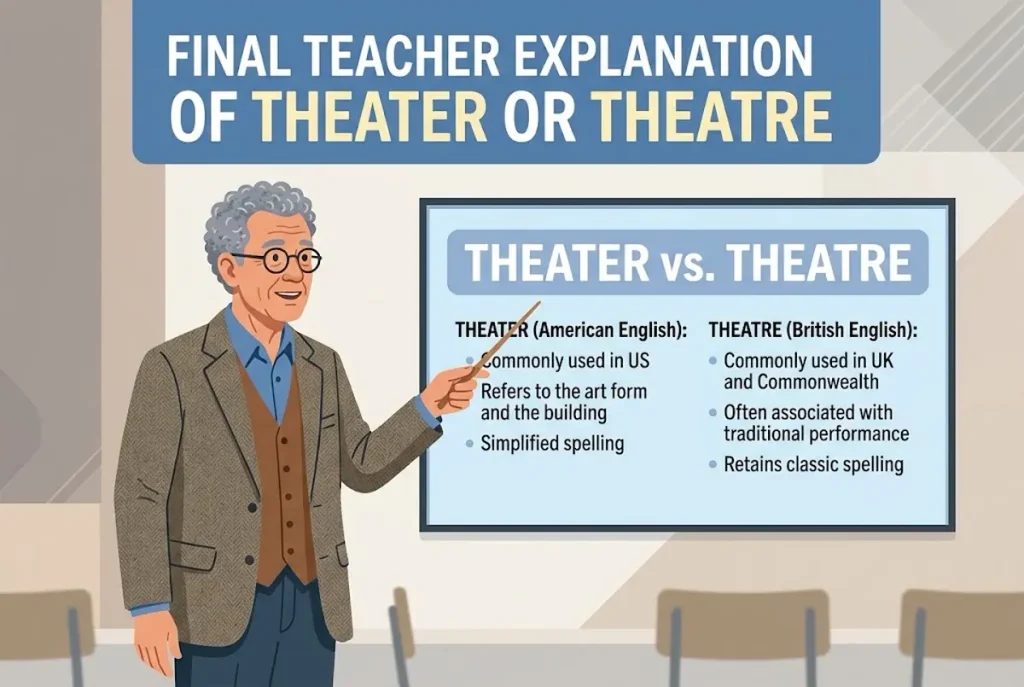
Imagine you ask me in class, “Should I write?” My answer is simple. If you use American English, write theater. If you use British English, write theatre. Both spellings are correct. Both mean the same thing. The only real difference is the spelling style used in different parts of the English-speaking world. Choose one style and stay consistent. That is the easiest way to avoid mistakes.
Final Answer (Quick Recap)
If you are remember this rule:
- Theater is the preferred American spelling.
- Theatre is the preferred British spelling.
The meaning never changes. Only the spelling does.
You may also want to read Passtime or Pastime Which Word Is Correct and Why.
Conclusion
The question has a simple answer. Both spellings are correct and describe the same place or art form. Use theater when writing in American English. Use theatre when writing in British English. Once you know your audience and stay consistent, choosing the right spelling becomes easy.
Frequently Asked Questions (FAQs)
Is correct?
Both are correct. The choice depends on American or British English.
Which spelling is used in the United States?
American English usually uses theater.
Which spelling is used in the United Kingdom?
British English usually uses theatre.
Do have different meanings?
No. They both refer to the same place or performing art.
Can I use both spellings in one article?
It is better to choose one style and stay consistent.
Why do some American businesses use theatre?
Some choose it for tradition or artistic style, even though theater is more common.

1 thought on “Theater or Theatre: When Should You Use It (2026 Guide)?”