
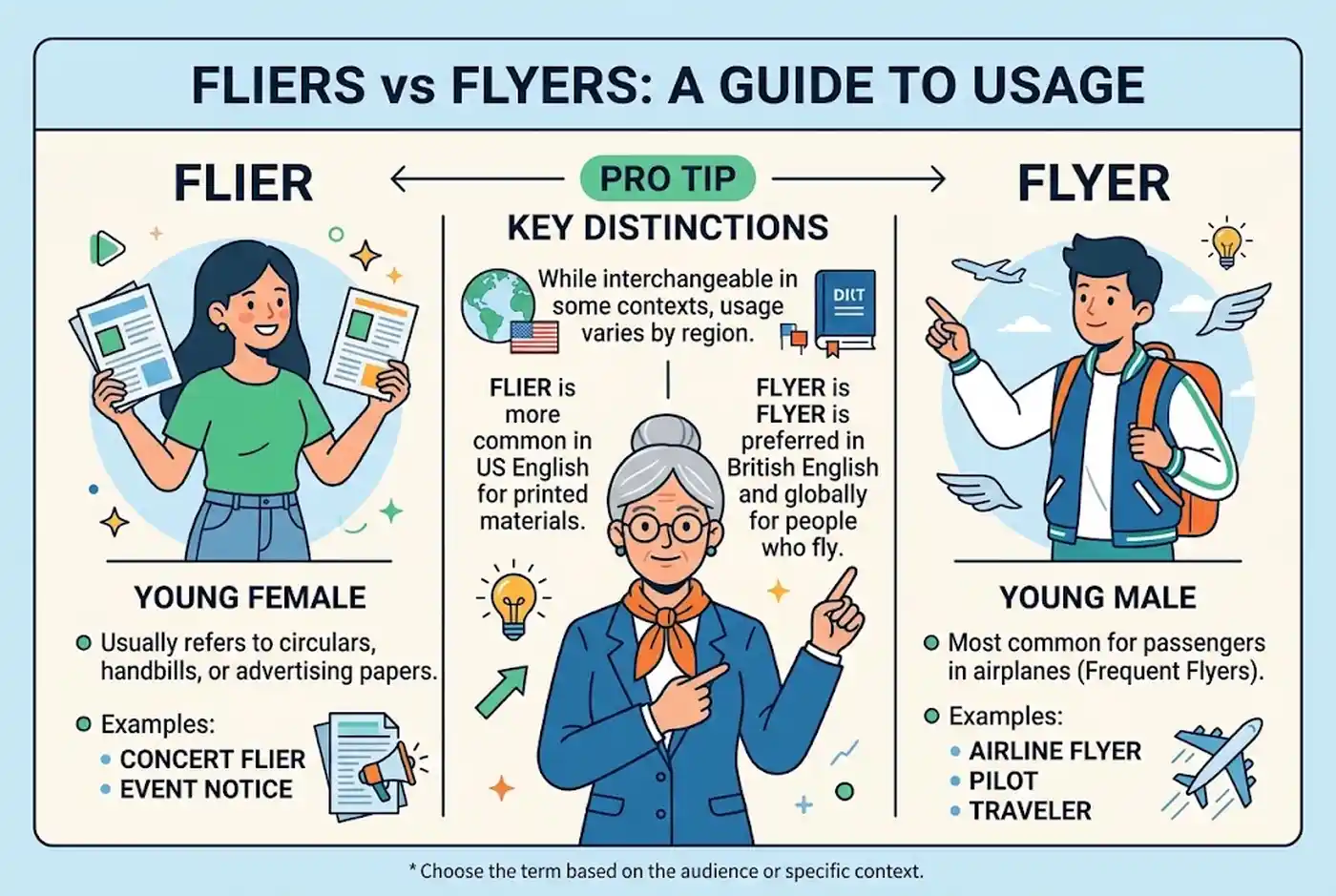
If you have ever wondered about Fliers vs Flyers, you are not alone. These two words look almost the same, and both can be correct. The right choice depends on what you mean and, in some cases, the style of English you are using.
The word flyer is very common when you mean a small printed paper used to share information, advertise something, or announce an event. For example, a school may hand out flyers about a concert. The word flier can also have this meaning, but it is often used for a person or thing that flies.
So, It is not simply a case of one word being right and the other being wrong. Both forms are used in English. The key is understanding their meanings and knowing which form sounds most natural in a specific sentence.
Still confused? Compare Woman vs Women: Easy Difference Explained Clearly (2026).
Simple Answer in One Look
Flyers is the more common choice for small advertising papers, notices, or handouts.
Fliers can also mean those papers, but it is often used for people or things that fly.
| Word | Common meaning | Example |
|---|---|---|
| Flyers | Small printed advertisements or notices | We handed out flyers for the event. |
| Fliers | People or things that fly; also printed notices | The fliers arrived early. |
A simple rule is this:
Use “flyers” for advertising papers. Use “fliers” when talking about people or things that fly.
However, there is an important detail. Fliers can also be used for advertising papers. That means you may see both forms in real English.
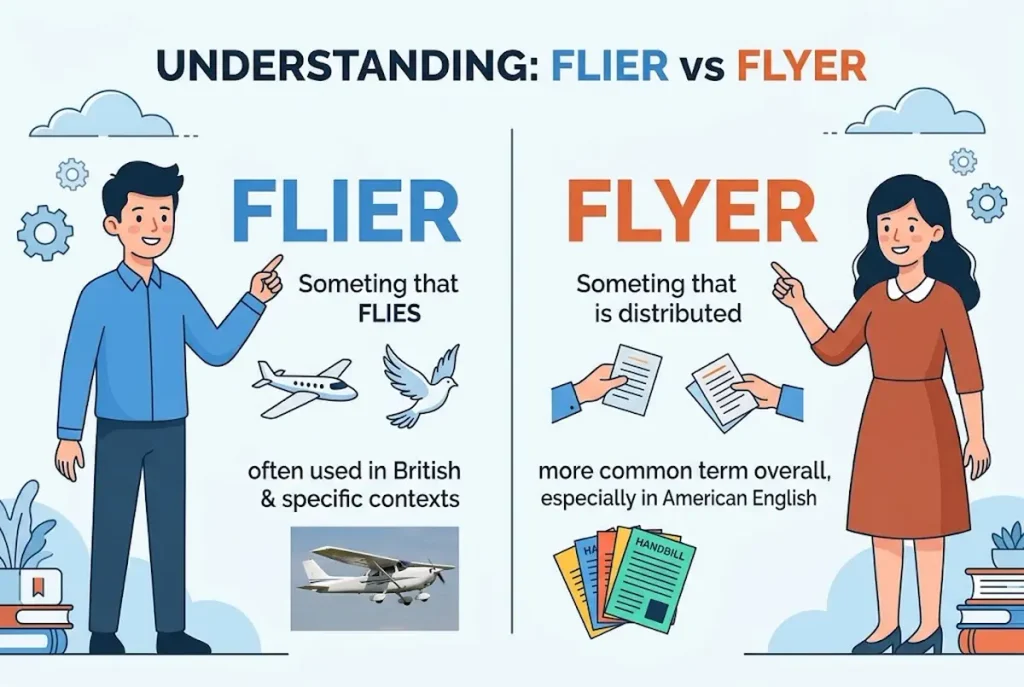
What Fliers vs Flyers Means in Simple English
Think about the word fly. A person can fly in an airplane. A bird can fly through the sky. An airplane can fly from one city to another. When we talk about people or things that fly, flier can be used.
For example:
- She is a frequent flier.
- The young flier trained every day.
- Those birds are fast fliers.
- The plane is a smooth flier.
Here, flier connects clearly with the idea of flying.
But English also uses flyer for a small piece of paper.
A flyer might tell you about:
- A school event.
- A concert.
- A sale.
- A new restaurant.
- A job opening.
- A community meeting.
- A special offer.
For example:
The store gave us a flyer about its weekend sale.
In this sentence, flyer means a printed advertisement or notice.
In a Simple Example
Imagine that your school is having a music show.
Your teacher prints 100 small pages with information about the show. You take those pages around the school and give them to students.
You would normally call them flyers:
We handed out flyers for the school concert.
Now imagine that you are talking about people who travel by plane many times.
You might say:
Frequent fliers can earn extra miles.
Here, fliers means people who fly often.
This small difference can make the two words easier to remember.
Why People Mix These Words Fliers and Flyers
People mix up fliers and flyers because they look and sound very similar. Both words begin with fly. Both can be connected to flying. That creates a natural problem for English learners. You might see one website use flyers and another use fliers for the same type of printed paper. This can make you wonder:
Which spelling is correct? The answer is that both spellings can be correct when they mean a printed handout. English has more than one accepted spelling for this word. The difference often comes down to common usage, regional preference, and the meaning of the sentence.
Why “Flyers” Is Common for Advertisements
The spelling flyer has become very common for a small piece of advertising material.
For example:
I made flyers for my new business.
The teacher gave us flyers about the field trip.
We saw flyers posted around town.
These sentences sound natural to most American English speakers.
If you are writing a website, advertisement, school notice, or business announcement, flyer is usually the safest and most familiar choice for this meaning.
Why “Flier” Still Appears
The spelling flier has a long history in English.
It is also used for a person or thing that flies.
For example:
My brother is a frequent flier.
The eagle is an excellent flier.
You may also see flier used for a printed handout:
The company distributed fliers about its new service.
That sentence is correct too.
So, don’t think of flier as a misspelling of flyer. It is a real English word.
Clear Difference Explained Simply
The easiest way to understand both words is to look at the main meanings.
1. Flyers Can Mean Printed Advertisements
This is probably the meaning you will see most often in everyday American English.
A flyer is a small piece of paper that gives information or advertises something.
Examples:
We printed 500 flyers for the sale.
The restaurant handed out flyers.
I saw a flyer for a free English class.
She designed a flyer for the school event.
In these sentences, flyer means a printed notice or advertisement.
The plural is flyers.
2. Fliers Can Mean People Who Fly
A flier can mean someone who flies, especially someone who travels by airplane.
For example:
He is a frequent flier.
This means he travels by plane often.
The plural is fliers:
Frequent fliers often know how airports work.
You may also use flier for something that flies.
For example:
The eagle is a powerful flier.
Here, the word describes the eagle’s ability to fly.
3. Both Can Mean Printed Handouts
This is the part that causes the most confusion.
Flier and flyer can both refer to a printed piece of paper used to give information or promote something.
For example:
We handed out flyers at the mall.
and:
We handed out fliers at the mall.
Both sentences can be correct.
However, flyer is usually the more familiar spelling for this meaning in American English.
A Quick Visual Rule
Think of it this way:
Flyer = paper
I picked up a flyer about the sale.
Flier = person or thing that flies
She is a frequent flier.
But remember that flier can also mean a paper.
This is a helpful rule, not an absolute rule.
Which Form Should You Use Fliers or Flyers?
If you are writing in American English and you mean an advertisement or small printed notice, flyer is usually the easiest choice.
Use flyers when you have more than one.
For example:
The business printed new flyers.
We put flyers on the tables.
The students passed out flyers.
If you are talking about people who fly, use fliers.
For example:
Frequent fliers may know the airport very well.
The airline offers special rewards to frequent fliers.
If you are talking about a bird, airplane, or another thing that flies, fliers can also be used.
For example:
Eagles are strong fliers.
What About “Fliers” for Advertisements?
You don’t have to consider it wrong.
You may find sentences like:
The company distributed fliers around the neighborhood.
This is accepted English.
Some writers prefer fliers, while others prefer flyers.
Still, if your goal is to use the spelling most readers expect for an advertising handout, flyers is a good choice.
Which One Is Better for American English?
For everyday American English, flyers is a very common choice for printed advertisements.
For people who travel by plane often, fliers is common in the phrase frequent fliers.
So you can remember:
Flyers are often papers.
Fliers are often people or things that fly.
This simple distinction will help you in most situations.
Easy Real Life Sentences You Can Use
Here are some natural examples of flyers and fliers in everyday English.
Examples With “Flyers”
- We handed out flyers for the school event.
- I found a flyer for a new restaurant.
- The store printed flyers for its weekend sale.
- She put flyers on the community board.
- The students made colorful flyers for the charity event.
- I saw several flyers on the wall.
- Our team designed flyers to promote the fundraiser.
These examples use flyers to mean printed papers that share information.
Examples With “Fliers”
- My father is a frequent flier.
- Frequent fliers may receive special rewards.
- The eagle is a powerful flier.
- Some fliers feel nervous during takeoff.
- Experienced fliers usually know what to expect at the airport.
These examples connect fliers with people or animals that fly.
Examples Where Both Forms Can Work
Now look at these sentences:
The company gave out flyers about the new product.
The company gave out fliers about the new product.
Both can be used.
The meaning does not change. Both sentences describe printed material.
This is why the question “which is correct?” does not have only one answer.
The better question is:
Which spelling fits my meaning and style?
For printed advertising material, flyer is usually the simpler choice.
For people who fly often, flier is a natural choice.
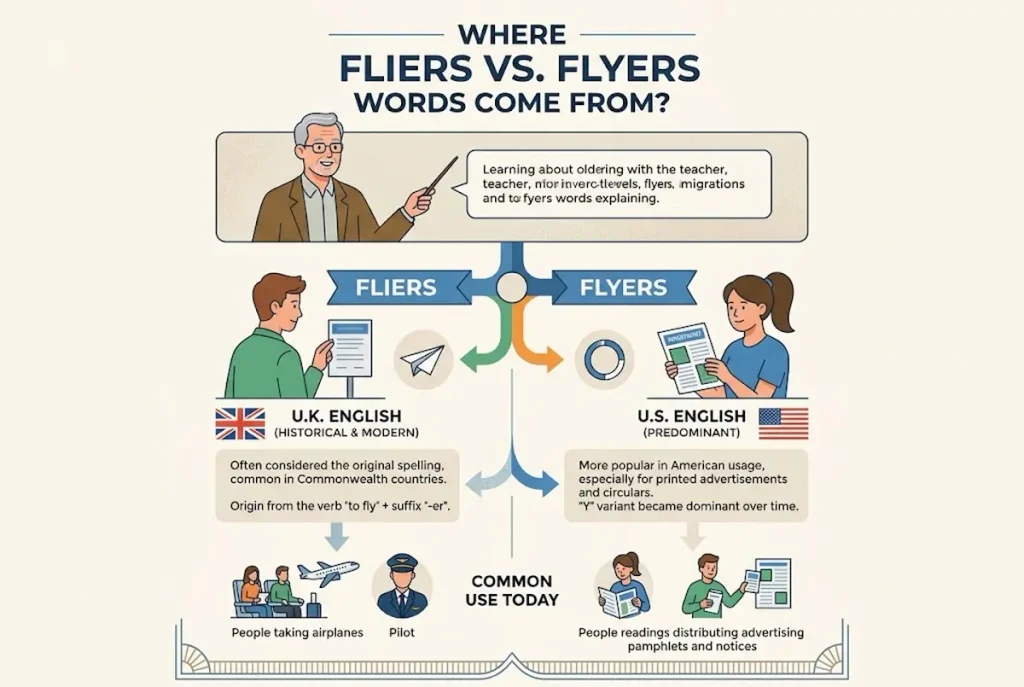
Where Fliers vs Flyers Word Comes From?
The spellings come from the word fly. The word fly has been used in English for a very long time. English speakers have used related forms to describe people, animals, and things that move through the air. Over time, English developed both flier and flyer. The ending -er often helps form a word for someone or something that does an action.
For example:
- teach → teacher
- run → runner
- drive → driver
- fly → flier
The spelling flyer developed as another form.
Both spellings became established in English, and both are still used today. This is one reason English spelling can sometimes feel confusing. A word may have more than one accepted form.
Why English Has Two Spellings
English has borrowed words and spelling patterns from many sources over hundreds of years. It has also changed as people used words in different places and situations. As a result, some words have two common spellings.
Flier and flyer are a good example.
Neither spelling needs to be treated as a simple mistake. The important thing is to understand the meaning and use the form that fits your sentence.
A Quick Classroom Test
Here is an easy test you can use when you are unsure.
Ask yourself:
Am I talking about a piece of paper?
If yes, flyer is usually the best choice.
I picked up a flyer about the concert.
Am I talking about a person or animal that flies?
If yes, flier is a natural choice.
The eagle is a skilled flier.
Am I talking about people who travel by plane often?
Use fliers.
Frequent fliers can earn travel rewards.
Am I using a different spelling for a printed handout?
Both fliers and flyers can work.
This simple test will solve most everyday questions about these words.
A Common Mistake to Avoid
One common mistake is thinking that fliers is always wrong because flyers looks more familiar.
That’s not true.
For example:
The airline offers benefits to frequent fliers.
The word fliers is correct because it refers to people who fly frequently.
Another mistake is thinking that flyers can only mean advertising papers.
The word can have other meanings too. Context tells you what the writer means.
For example:
The two flyers left the airport.
Depending on the context, flyers could refer to people or things that fly.
So don’t judge the word only by its spelling. Read the whole sentence.
Still confused? Compare Suit vs Suite: What Is the Difference?.
The Easiest Way to Remember Fliers or Flyers
Here’s the classroom trick I would give my students:
Paper? Think “flyer.”
A flyer tells you about a sale.
Flying person or thing? Think “flier.”
A flier travels through the air.
And if you see fliers used for printed advertisements, don’t panic. That spelling is also accepted.
The safest everyday choice for a printed advertisement in American English is usually flyer.
Final Teacher Tip
Don’t spend too much time worrying about this pair.
If you’re writing:
We need to print some ______ for the event.
Choose:
flyers
If you’re writing:
My uncle is a frequent ______.
Choose:
flier
That simple distinction will cover most common situations.
Now that the basic difference is clear, we can look more closely at how these words are used in everyday English, business writing, travel, advertising, and other situations. Understanding those uses will make words much easier to recognize when you read or write English. and frequently asked questions to help you use the right spelling with confidence.
In Culture and Stories
The words fliers and flyers are used in many parts of everyday life. You can see them in schools, businesses, airports, and community events. When people organize a concert, they often print flyers to tell others about it. Local shops also use flyers to share sales and special offers. The word can also describe people who travel by air. For example, airlines often reward frequent flyers with points or miles. Whether you see fliers or flyers, the meaning is almost always the same. The difference is mainly the spelling.
Biblical and Mythological Meaning
The words fliers and flyers do not have a direct biblical meaning. They also do not play a special role in mythology. However, many old stories include birds, angels, or magical creatures that fly through the sky. In modern English, people may describe them as fliers or flyers depending on the writing style they choose. The spelling does not change the meaning.
Symbolism Explained in Simple Words
What Fliers Represents
The spelling fliers often represents movement, travel, and communication. Some organizations and style guides prefer this version, especially in aviation-related writing. It can also suggest sharing information through printed notices.
What Flyers Represents
The spelling flyers represents the same ideas. It is the more common form in American English and is widely used for advertising papers and airline passengers. For many readers, flyers simply feels more familiar because they see it more often. Both words carry the same meaning and message.
Related Words You Should Know About Fliers and Flyers
Flyer
A single printed advertisement or a person who flies. Example:
- I picked up a flyer at the store.
Flier
Another accepted spelling of flyer. Example:
- The airport welcomed every flier.
Brochure
A folded paper that gives information. Example:
- The hotel gave us a brochure.
Poster
A large printed sign used for advertising. Example:
- They hung a poster on the wall.
Advertisement
A message that promotes a product or event. Example:
- The advertisement appeared online.
Passenger
A person traveling in a car, train, or airplane. Example:
- Every passenger boarded safely.
In Daily English
Here are simple examples.
- We handed out flyers before the event.
- The students designed colorful flyers.
- Frequent flyers receive extra rewards.
- The company mailed advertising flyers.
- Experienced fliers know airport rules.
- Local businesses print flyers every week.
- The pilot spoke with several fliers.
- I found a flyer on my front door.
- They distributed flyers across the city.
- Many frequent flyers join loyalty programs.
Most people use flyers in everyday writing because it is more common.
Common Mistakes People Make
Mistake 1: Thinking one spelling is wrong
Both spellings are correct. The difference is preference and style.
Mistake 2: Believing flyers only means advertising papers
It can also describe people who fly. Example:
- Frequent flyers travel often.
Mistake 3: Mixing both spellings in one article
Choose one version and stay consistent. This makes your writing look cleaner.
Mistake 4: Assuming every dictionary prefers the same spelling
Different dictionaries may list both forms. Some may show flyers first because it is more common.
Mistake 5: Forgetting your audience
For general writing, flyers is usually the easiest choice because readers see it more often.
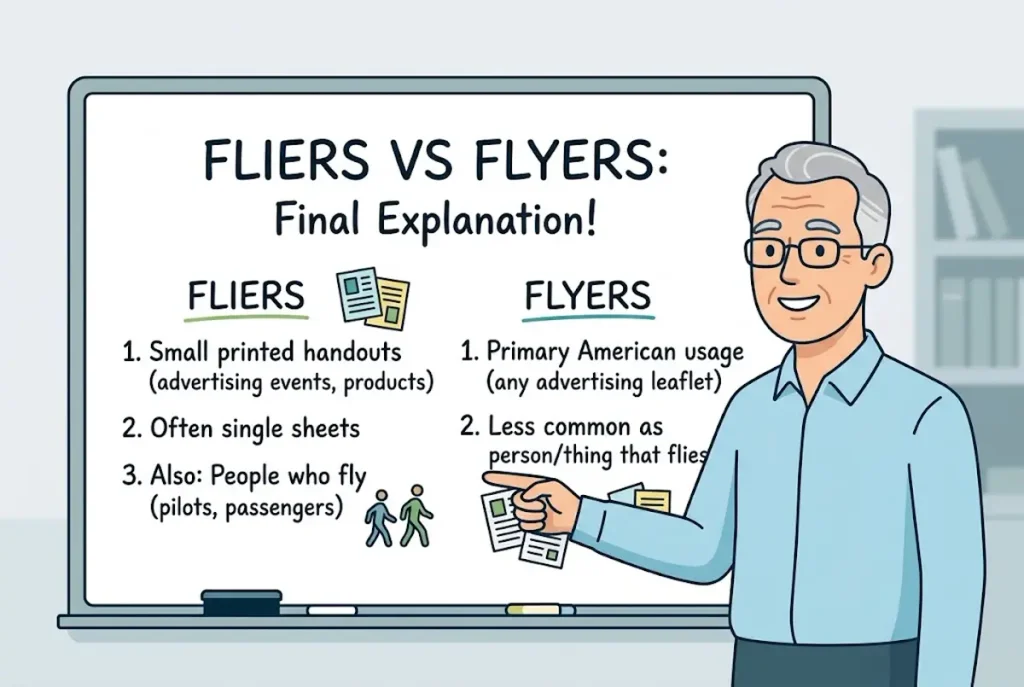
Final Teacher Explanation about Fliers vs Flyers
Imagine you ask me in class, “Should I write fliers or flyers?” My answer is simple. Both spellings are correct. But if you want the safest and most common choice, use flyers. Most businesses, schools, and websites prefer this spelling. If a company or style guide tells you to use fliers, that is also perfectly correct. The important rule is to stay consistent.
Final Answer About Fliers or Flyers (Quick Recap)
When comparing words, both spellings are correct. Flyers is the more common and widely accepted form. Fliers is also correct but appears less often. Choose one style and use it consistently.
For another common grammar confusion, see Stich vs Stitch: Which Spelling Is Correct?.
Conclusion
The question fliers vs flyers is easier than it first appears. Both words are accepted in English and share the same meaning. However, flyers is the more popular spelling in modern American English and is often the better choice for general writing. Pick one spelling, use it consistently, and your writing will be clear and professional.
Frequently Asked Questions (FAQs)
Which is correct, fliers or flyers?
Both are correct, but flyers is more common.
Is flyers the better spelling?
For most modern writing, yes. It is the spelling many readers expect.
Can fliers mean people who travel by air?
Yes. It can refer to people who fly or travel by airplane.
Do flyers only mean advertising papers?
No. They can also mean people or things that fly.
Can I use both spellings in one document?
It is better to choose one spelling and stay consistent.
Why do people get confused between fliers and flyers?
Because dictionaries accept both forms, and different organizations may prefer different spellings.
Which spelling should students use?
If you are unsure, flyers is usually the safest choice.
How can I remember the difference?
Remember that flyers is the spelling you will see most often in everyday English.

1 thought on “Fliers vs Flyers: When Should You Use It (2026 Guide)?”