
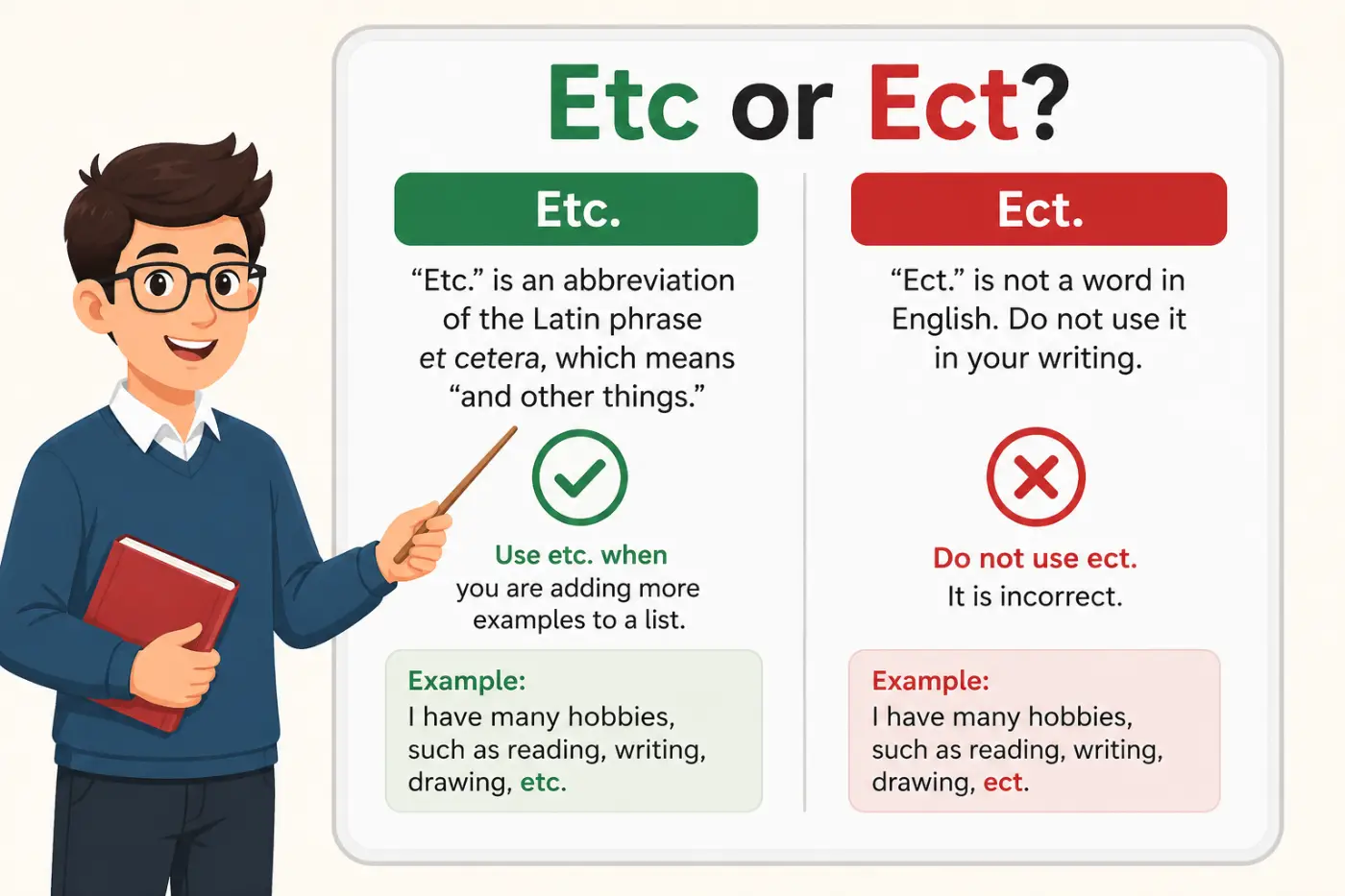
If you’ve ever wondered about etc or ect, you’re not alone. These two forms look very similar, but only one is correct in standard English. The correct form is etc. It is a short form of the Latin phrase et cetera, which means “and other things” or “and so on.”
It is not the correct spelling of this common abbreviation. You may see it in texts, messages, or online posts because people often write words the way they hear them. However, it is considered a spelling mistake when someone means etc.
Learning the difference between words and it is easy once you know what etc. means. You can use etc. when you give a list and want to show that there are more similar things that you don’t need to name.
Learn the difference in Writing Or Writting: Correct Simple Guide With Examples (2026).
Simple Answer in One Look
The correct form is etc.
Etc. means “and other things” or “and so on.”
Correct: I bought apples, oranges, bananas, etc.
Incorrect: I bought apples, oranges, bananas, ect.
What Does Etc or Ect Mean in Simple English
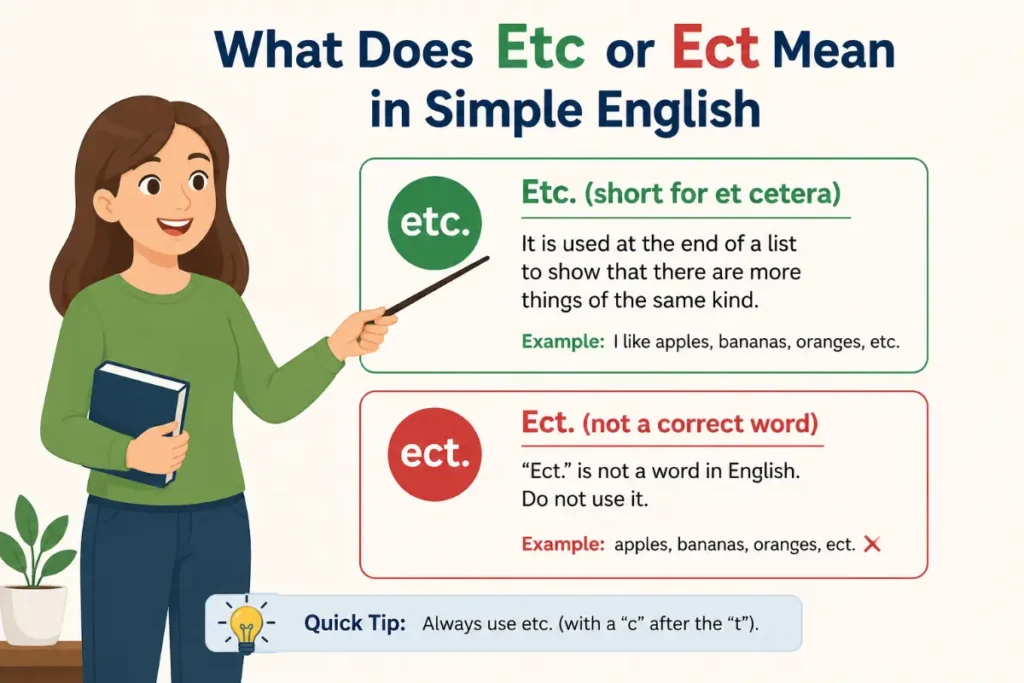
Etc. is short for the Latin words et cetera. In simple English, it means “and other similar things.”
Think about making a list.
You might say:
“I packed shirts, pants, socks, shoes, etc.”
You don’t need to name every item in your suitcase. The word etc. tells the reader that there are other things on the list too.
For example:
“I need to buy paper, pens, pencils, etc.”
This means you need paper, pens, pencils, and other similar school supplies.
The word etc. can save time. Instead of writing a very long list, you can name a few examples and then use etc.
Here is another example:
“Many fruits are sweet, such as apples, mangoes, grapes, etc.”
The writer doesn’t need to list every sweet fruit. The reader understands that apples, mangoes, grapes, and other similar fruits are included.
You can think of etc. as a small sign that says:
“There are more things like these.”
That is the basic idea.
What Does Etc Stand For
Etc. stands for et cetera.
The phrase comes from Latin. Et means “and,” while cetera means “the other things.”
So, et cetera has the basic meaning of “and the other things.”
English uses many shortened forms like this. For example, Mr. is used for “Mister,” and Dr. is used for “Doctor.” In the same way, etc. is a shortened form of et cetera.
You do not need to know Latin to use etc. correctly. You only need to remember its meaning and spelling.
Why Do People Mix Up Etc or Ect
The confusion between both words mostly comes from pronunciation.
When people say etc. quickly, This can make learners think the word is spelled.
That is a common mistake.
For example, someone might hear:
“Books, notebooks, pens, etc.”
When spoken quickly, the final sound may not make the spelling obvious. The same thing happens with many English words. A word can sound different from the way it looks on paper. That is one reason English spelling can be tricky. There is another reason people write wrong word. They may have seen the incorrect spelling online many times. After seeing it again and again, they may start to believe it is correct.
For example, someone may write:
“I like pizza, burgers, fries.”
Another person may copy the same spelling. Over time, the mistake can spread.
Is a Word
It is not the standard spelling of the abbreviation etc.
If you want to say “and so on” or “and other things,” write etc.
For example:
Correct: Bring your books, notebooks, pencils, etc.
Incorrect: Bring your books, notebooks, pencils, ect.
Clear Difference Explained Simply
The difference between is very simple.
| Form | Correct? | Meaning | Example |
|---|---|---|---|
| etc. | Yes | And other things | Bring pens, pencils, paper, etc. |
| ect | No | Incorrect spelling of etc. | Bring pens, pencils, paper, ect. |
The main point is this:
Etc. is correct.
You don’t need to memorize a long grammar rule. Just remember the three letters:
E-T-C
A useful memory trick is to remember the phrase et cetera. The first letters give you E-T-C.
Et cetera → etc.
In a Sentence
Look at these examples:
Correct: You can use fruits like apples, oranges, bananas, etc.
Incorrect: You can use fruits like apples, oranges, bananas, ect.
In every example, etc. is the correct form.
Which Form Should You Use
If you’re choosing between words, always choose etc. when you mean “and so on” or “and other similar things.”
Here is the easiest rule:
Use etc. after a list when you don’t want to name everything.
For example:
“I bought milk, eggs, bread, etc.”
The list gives some examples. Etc. tells the reader that there are more similar items.
You can also use etc. in everyday writing.
For example:
“We talked about school, work, family, etc.”
This means the conversation included school, work, family, and other related topics.
However, you should not use etc. just anywhere. It works best when the missing items are clear from the list.
For example:
“I like apples, oranges, bananas, etc.”
This makes sense because the items are all fruits.
But consider this sentence:
“I like apples, cars, blue, etc.”
This is unclear because the items don’t form a clear group.
The reader may ask, “What other things are you talking about?”
So, etc. works best when the reader can easily understand what kind of things are being left out.
Easy Real-Life Sentences You Can Use Etc or Ect
Here are some simple examples that show how etc. works in everyday English.
- I need to buy milk, bread, eggs, etc.
This means there are more items to buy.
- We talked about school, homework, sports, etc.
This means the conversation included other similar topics.
- Bring your pencils, pens, notebooks, etc.
This tells someone to bring these items and other similar school supplies.
- Many animals, such as dogs, cats, horses, etc., can be trained.
Here, etc. shows that other similar animals are also included.
- I enjoy reading books about history, science, nature, etc.
This means the person enjoys books about these subjects and other related subjects.
- You can find restaurants, stores, hotels, etc., in this area.
The list gives examples of places in the area.
- We need to clean the kitchen, bathroom, bedroom, etc.
The word etc. shows that other areas may also need cleaning.
- She likes apples, peaches, grapes, etc.
This means she likes these fruits and other similar fruits.
Notice that the meaning stays simple in every sentence. Etc. tells the reader that the list continues.
How to Use Etc Correctly
There are a few simple points to remember when using etc.
Use the Correct Spelling
Always write:
etc.
Use a Period
The abbreviation normally appears as etc. with a period.
For example:
“I bought pens, pencils, paper, etc.”
The period is part of the standard abbreviation.
Don’t Repeat the Meaning
Avoid sentences like:
“I bought pens, pencils, paper, etc., and other things.”
The phrase etc. already means that there are other things.
A cleaner sentence is:
“I bought pens, pencils, paper, etc.”
Use It After a Clear List
The reader should understand the kind of things you are listing.
For example:
“She bought apples, oranges, grapes, etc.”
This is clear because all the items are fruits.
Formal or Informal
Etc. can be used in both everyday and formal writing, but it should be used carefully.
You may see it in school writing, business writing, emails, instructions, articles, and everyday messages.
For example:
“Please bring your ID, passport, tickets, etc.”
This can be perfectly normal.
Still, in very formal writing, some writers prefer to give the full list instead of using etc. This is especially true when the reader needs exact information.
For example, imagine a legal form asking for specific documents. Writing etc. could make the instructions unclear.
In normal situations, though, etc. is a familiar and useful expression.
In Text Messages
You may see ect in text messages and online comments.
For example:
“I like movies, music, games”
The writer probably means etc., but the spelling is wrong.
Texting often has informal spelling. People may leave out punctuation or make quick spelling mistakes. That doesn’t change the standard English form.
If you’re chatting with a friend, the mistake may not cause a problem. But if you’re writing something for school, work, a website, or a professional setting, use etc.
This small correction can make your writing look much cleaner.
Where Etc Comes From
The history of etc. is actually quite simple. It comes from the Latin phrase et cetera. Latin was once widely used in education, law, science, religion, and formal writing. Many Latin expressions became part of English. Et cetera means roughly “and the rest” or “and other things.” English speakers eventually shortened the phrase to etc.
Today, most people use etc. without thinking about its Latin history. It has become a familiar part of English writing. You don’t need to use the full phrase et cetera in normal everyday writing. The short form etc. is much more common. The important thing to remember is the spelling:
Et cetera → etc.
That connection also explains. The abbreviation follows the order of the letters in et cetera.
A Quick Memory Trick
If you often forget the spelling, use this simple trick:
Think:
ET CETERA = ETC.
The first part gives you the exact order:
E → T → C
You can also say the phrase slowly in your head:
et cetera
Then write:
etc.
This is much easier than trying to remember the spelling as three random letters.
Still confused? Compare Uncollectible vs Uncollectable: Which Word Is Correct (2026)?.
How Etc or Ect Understood in Culture and Stories
The expression etc. is very common in everyday English. You can see it in books, school work, emails, lists, instructions, and online writing. It helps people shorten a list when they do not want to name every item. In stories, etc. does not usually have a special cultural meaning. It works as a writing shortcut. A writer may mention a few things and then use etc. to show that more similar things are included.
For example:
“She packed clothes, shoes, books, snacks, etc.”
The writer does not need to name every item in the bag. The reader understands that there are other things too. In casual conversation, people also use the idea behind etc. when they say “and so on” or “and things like that.” These expressions help speakers avoid making a list too long.
For example:
“We talked about school, work, family, etc.”
The person probably talked about other related subjects too. This makes etc. useful in normal communication. It keeps a sentence short while still giving the reader the main idea. The word can also appear in stories when a character is describing many things.
For example:
“He brought food, water, blankets, tools, etc.”
The exact items are not all important to the story. The writer only wants the reader to understand that the character brought many supplies. So, the cultural meaning of etc. is mostly connected to simple communication. It represents the idea that a list continues beyond the examples already given.
Biblical and Mythological Meaning of Etc or Ect
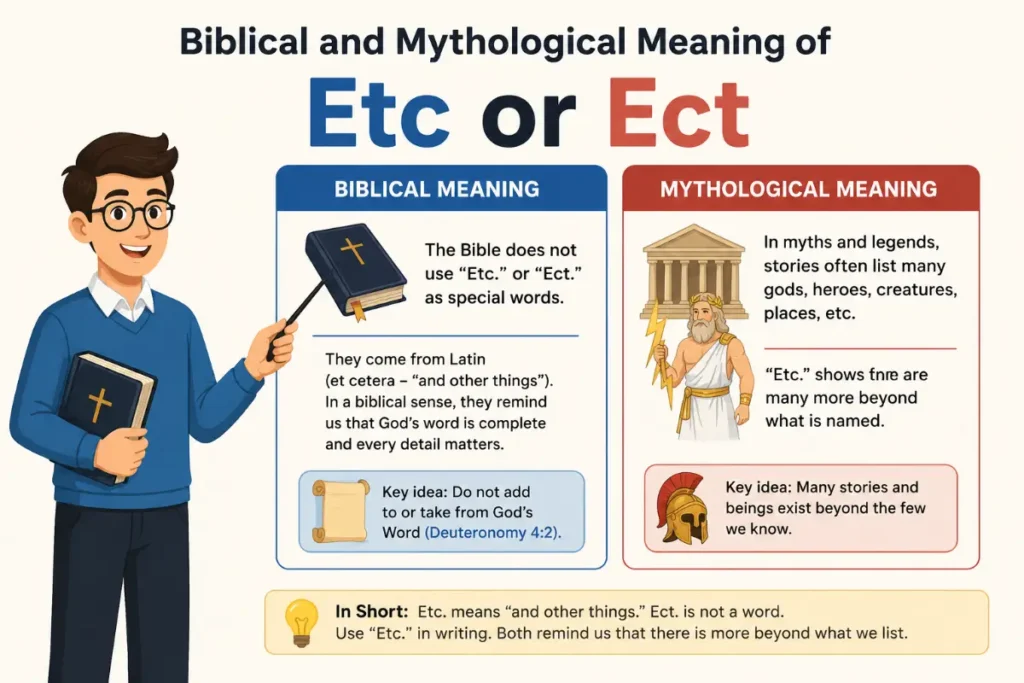
There is no special biblical or mythological meaning attached to etc. The abbreviation is simply a shortened way of saying that more things are included in a list. You may see etc. in modern writing about the Bible, religion, history, or mythology. However, that does not give the abbreviation a special religious meaning.
For example, someone writing about ancient stories might say:
“Greek gods such as Zeus, Athena, Apollo, etc., appear in many stories.”
Here, etc. simply means that other Greek gods are also being included.
The same idea works with biblical subjects:
“People, places, events, etc., are discussed throughout the text.”
The abbreviation is doing the same job it does in any other sentence. The important point is simple. Etc. does not represent faith, religion, good, evil, mystery, or any other special idea. It is simply a useful English abbreviation. Ancient stories often contain long lists of names, places, objects, and events. A modern writer may use etc. to avoid listing every example. So, if you see etc. in a religious or mythological discussion, read it as “and other similar things.”
Symbolism Explained in Simple Words
Etc. has a very simple symbolic idea. It can suggest that a list is larger than the examples shown.
It can make the reader think:
“There are more things like these.”
The abbreviation itself does not have a deep emotional meaning. Its meaning comes from how the writer uses it.
What Etc. Represents
Etc. represents continuation.
When you see:
“Books, magazines, newspapers, etc.”
you know the list does not stop at newspapers. Other similar items may also be included.
In this simple sense, etc. represents an unfinished list.
It can also represent variety. A writer may give three or four examples and use etc. to show that many more examples exist.
For example:
“People enjoy hobbies such as painting, reading, cooking, etc.”
The writer gives a few hobbies but leaves room for many others.
What Ect Represents
It is not represent a different meaning.
They usually mean etc. but have put the letters in the wrong order.
For example:
“Books, pens, notebooks”
The writer probably means:
“Books, pens, notebooks, etc.”
Related Words You Should Know
Learning related expressions can make etc. easier to understand.
Et Cetera
Et cetera is the full phrase behind etc. It means “and other things” or “and so on.” Example:
“We need food, water, clothing, et cetera.”
And So On
And so on has almost the same meaning as etc. It tells the reader that a list continues. Example:
“We talked about school, sports, music, and so on.”
And So Forth
And so forth can also mean that similar examples continue. Example:
“She listed several rules, such as being polite, arriving on time, and so forth.”
And Other Things
This phrase directly tells the reader that other similar things are included. Example:
“He bought books, pens, paper, and other things.”
Such As
Such as introduces examples. It does not mean exactly the same thing as etc. Example:
“You can eat fruits such as apples, oranges, and grapes.”
Including
Including tells the reader that the examples named are part of a larger group. Example:
“Several students, including Tom and Sarah, joined the club.”
And More
And more tells the reader that there are additional items or examples. Example:
“The store sells shirts, pants, shoes, and more.”
List
A list is a group of things written or spoken one after another. Example:
“I made a list of things I need.”
Abbreviation
An abbreviation is a shortened form of a word or phrase.
Etc. is an abbreviation of et cetera.
These related expressions can help you choose the best wording for your sentence.
How People Actually Use Etc or Ect in Daily English
People use etc. when they want to give examples without creating a very long list. It is common in both everyday writing and many types of formal writing.
Here are some natural examples.
Shopping
“I need to buy milk, bread, eggs, etc.”
The speaker has other things to buy but does not need to list everything.
School Supplies
“Bring pencils, pens, paper, notebooks, etc.”
The teacher is naming some common supplies. Other similar supplies may also be needed.
Hobbies
“I enjoy reading, drawing, cooking, gardening, etc.”
The person has several hobbies and gives only a few examples.
Food
“We bought pizza, burgers, fries, drinks, etc.”
The list shows some of the food that was bought.
Places
“We visited parks, museums, stores, restaurants, etc.”
The group visited these places and probably others too.
Work
“The report includes sales numbers, customer information, costs, etc.”
The writer is showing some of the information in the report without listing every detail.
Household Items
“We packed clothes, towels, blankets, shoes, etc.”
The person packed several things for a trip or move.
Conversation
“We talked about movies, music, sports, school, etc.”
The conversation covered these topics and other related subjects.
Online Writing
“Popular file types include PDF, Word, Excel, etc.”
The writer names several examples and leaves out other similar file types.
Instructions
“You may need a pen, paper, ruler, calculator, etc.”
The writer gives examples of useful items.
Notice the common pattern. A few examples come first. Etc. comes at the end to show that the list continues.
Common Mistakes People Make
The difference between words causes a few very common mistakes. The good news is that they are easy to fix.
Writing
This is the most common mistake.
Correct:
“I like apples, oranges, bananas, etc.”
Remember the letter order:
E-T-C
Not:
E-C-T
Thinking Ect Is Another English Form
Some people think might be an alternative spelling of etc.
It is not the standard spelling when you mean “and so on.”
There is no need to choose between two correct forms here.
The correct abbreviation is etc.
Forgetting the Period
Because etc. is an abbreviation, it is normally written with a period.
Correct:
“I bought apples, oranges, and bananas, etc.”
The period helps show that the word is an abbreviation.
Using Etc. When the List Is Complete
Sometimes people use etc. even when they have already named everything.
For example:
“There are three primary colors: red, blue, yellow, etc.”
If you are giving a complete list, etc. does not belong there.
A better sentence is:
“There are three primary colors: red, blue, and yellow.”
Use etc. when other similar examples exist.
Using Etc. Without Enough Context
Consider this sentence:
“I like red, dogs, Monday, etc.”
The reader may not understand what connects these examples.
A better list should contain items that belong together.
For example:
“I like red, blue, green, etc.”
Now the reader understands that the list contains colors.
Repeating the Same Meaning
Avoid writing:
“I bought pens, pencils, paper, etc., and other things.”
Both parts already tell the reader that the list continues.
Better:
“I bought pens, pencils, paper, etc.”
Or:
“I bought pens, pencils, paper, and other things.”
Using Etc. When Exact Information Is Needed
Imagine a teacher says:
“Bring your textbook, notebook, pen, etc.”
Students may not know what else they need.
If every item matters, the writer should give the complete list.
For example:
“Bring your textbook, notebook, pen, ruler, and calculator.”
This is clearer.
Using Etc. Too Often
A paragraph filled with etc. can become unclear and lazy.
For example:
“I like books, movies, music, games, etc. I visit stores, parks, restaurants, etc.
This may feel repetitive.
Sometimes it is better to give a little more detail or use “and other similar items” when needed.
Final Teacher Explanation of Etc or Ect
If I were teaching about words in a classroom, I would make the rule very simple.
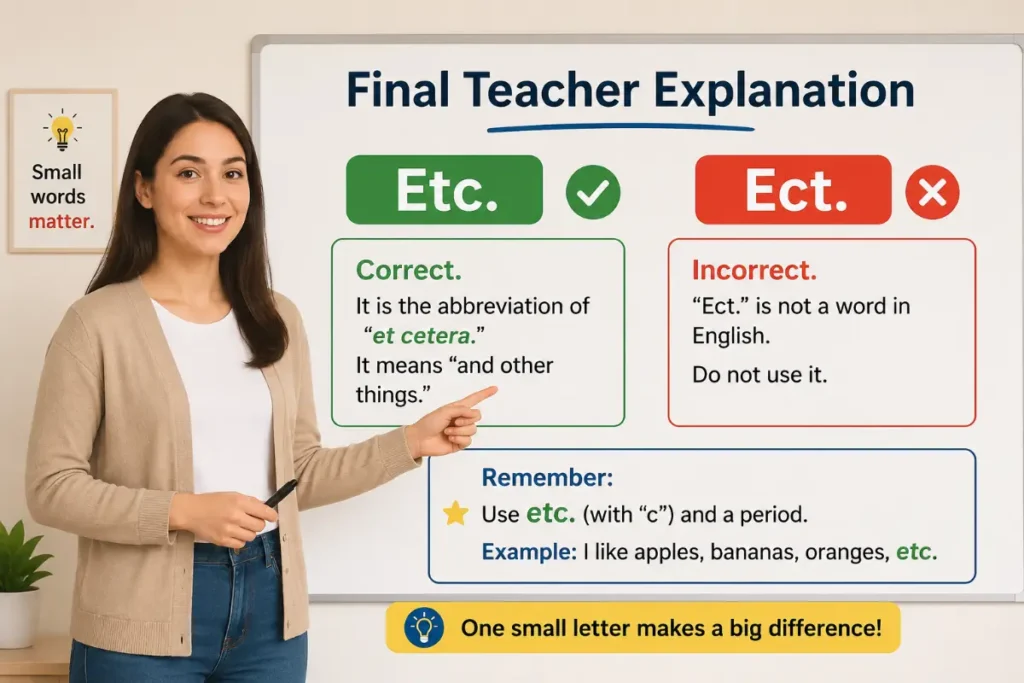
There is one standard spelling for this abbreviation:
etc.
It means:
“and other similar things.”
For example:
“I bought apples, oranges, grapes, etc.”
This means I bought apples, oranges, grapes, and other similar things.
The spelling is a common mistake. It usually happens because people hear etc. and write the letters in the order they sound to them.
So, remember the full phrase:
et cetera
The short form is:
etc.
The letters stay in the same order.
E-T-C
If you are writing an email, school assignment, article, report, or message, use etc. when you want to shorten a clear list.
You can also replace it with phrases such as and so on, and so forth, or and other similar things when they fit your sentence better.
But don’t use etc. when the reader needs a complete list.
Think of etc. as a small sign at the end of a list. It tells the reader:
“There are more examples like these.”
That is all you really need to remember.
Final Answer Quick Recap
When choosing words use etc. The correct abbreviation is spelled E-T-C and normally has a period.
Etc. means “and other things,” “and other similar examples,” or “and so on.” It is useful when you give a few examples and do not need to list everything.
It is not the standard spelling of this abbreviation. If you see ect in a text or online post, it is usually just a spelling mistake for etc.
The easiest memory trick is to remember et cetera → etc.
Still confused? Compare Spoilt vs Spoiled: Complete English Guide 2026.
Conclusion
The difference between is easy once you remember the correct letter order. Etc. is the correct abbreviation. Ect is the incorrect spelling when you mean “and so on.”
Use etc. after a clear list when you want to show that other similar things are included. If the reader needs every item, give the complete list instead.
The easiest takeaway is: Et cetera becomes etc. — always remember E-T-C.
Frequently Asked Questions FAQs
What does etc. mean in simple English?
Etc. means “and other things” or “and so on.” It shows that a list continues.
Which is correct?
Etc. is correct.
What does etc. stand for?
Etc. stands for et cetera, a phrase that means “and other things.”
Why do people write?
People often confuse the letters because of pronunciation or because they have seen the incorrect spelling before.
Can I use etc. in formal writing?
Yes. Etc. can be used in many types of writing, but avoid it when the reader needs a complete and exact list.
Should etc. have a period?
Yes. The standard abbreviation is written as etc.
Can I use “and so on” instead of etc.?
Yes. And so on has a very similar meaning and can often replace etc.
How can I remember the spelling of etc.?
Remember et cetera → etc. The letters are E-T-C, not E-C-T.
