
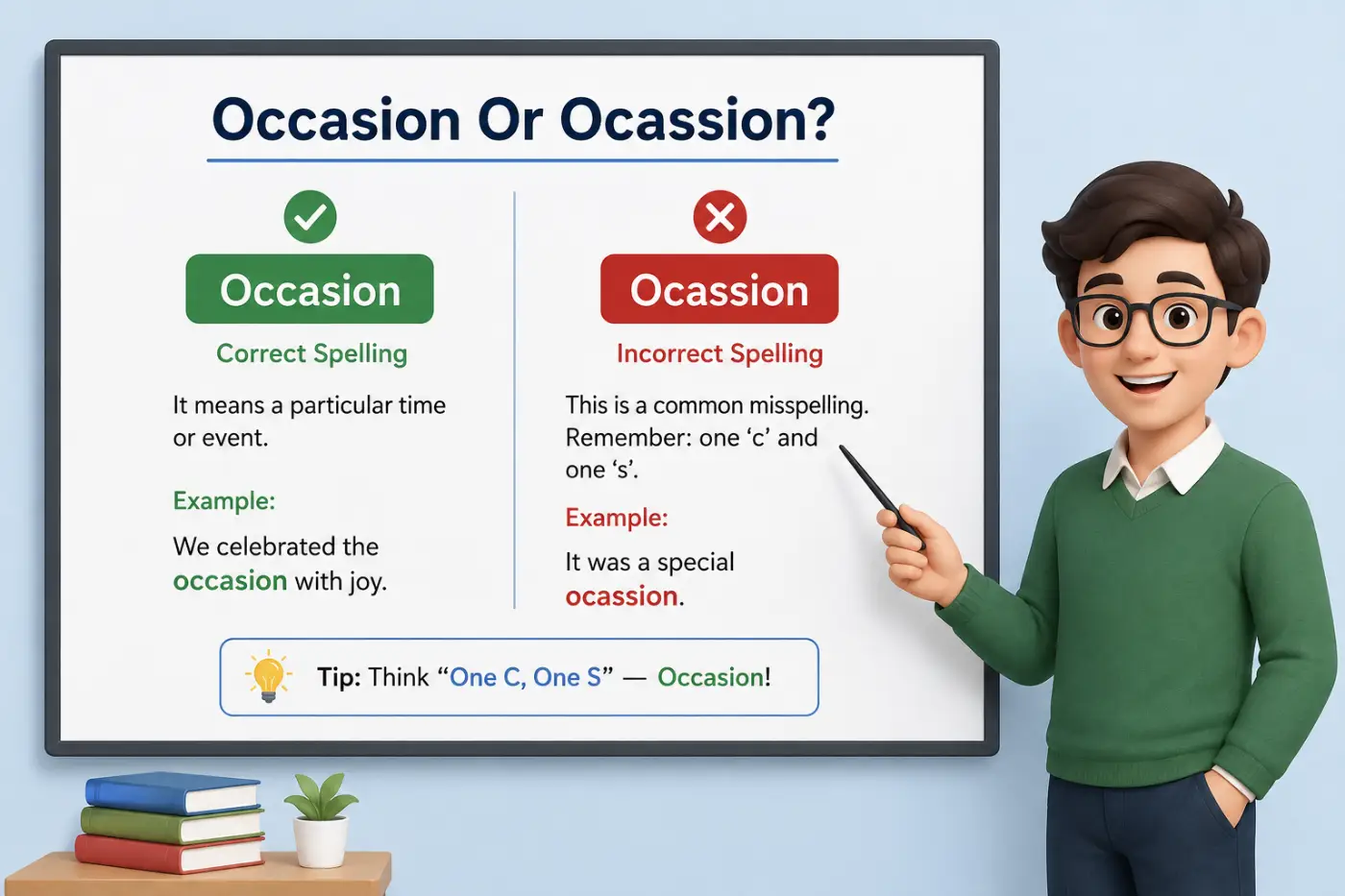
Many people get confused about occasion or ocassion because both words look almost the same. The only real difference is one letter. That small difference causes many spelling mistakes in school writing emails social media posts and even professional documents.
The short answer is simple. Occasion is the correct spelling. Ocassion is a spelling mistake. English dictionaries only accept occasion. If you want to write correct English always choose occasion.
This guide will explain in very simple English. You will learn what the word means why people confuse it how to remember the correct spelling and how to use it in everyday sentences.
Learn the difference in Zeroes Or Zeros: Which Is Correct Simple Answer (2026).
Simple Answer in One Look
Occasion is the correct spelling.
Ocassion is incorrect and should not be used.
Always write occasion when you mean a special event a particular time or a reason for something.
What Does Occasion or Ocassion Mean in Simple English?
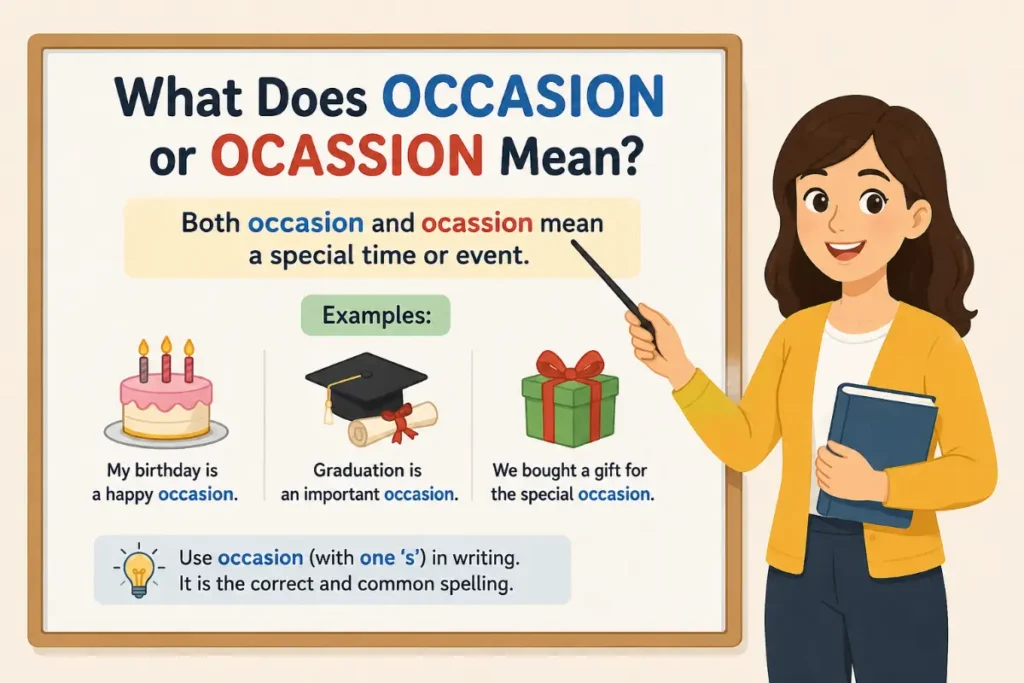
When people search they usually want to know which spelling is correct. The answer never changes. The correct word is occasion. The word occasion has more than one simple meaning.
It can mean a special event.
It can also mean a particular time when something happens.
Sometimes it means a reason or cause for something.
Think of it like this.
If your school holds a graduation ceremony that ceremony is an occasion.
If you wear your best clothes for a wedding the wedding is the occasion.
The word is very common in everyday English. You will hear it in conversations books movies news stories and business writing.
Here are a few easy examples.
- My birthday is a special occasion.
- We met on a happy occasion.
- This is the perfect occasion to thank everyone.
- They decorated the house for the occasion.
- We gathered for a family occasion.
In every example the spelling stays the same.
Always write occasion.
Never write ocassion.
Why Do People Mix These Words Occasion vs Ocassion?
Many English learners and even native speakers accidentally write ocassion.
There are several simple reasons for this mistake.
The Middle Sounds Confusing
When people say occasion the middle sound is soft.
Because of that sound many writers think the word has ss instead of s followed by sion.
That is why they type ocassion.
The pronunciation does not clearly show every letter.
English Has Many Similar Words
English contains many words ending with similar sounds.
For example.
- discussion
- profession
- expression
- permission
These words have different spelling patterns.
After seeing these words many people incorrectly assume occasion follows the same pattern.
It does not.
People Write Quickly
Typing fast often leads to spelling mistakes.
Someone may know the correct word but still write ocassion without noticing.
Spell check usually catches the error but not everyone uses it.
Memory Tricks Can Be Hard
Some words simply need practice.
Since occasion has double c and one s many learners forget which letter is doubled.
That creates confusion between words.
Similar Pronunciation
The wrong spelling sounds almost identical to the correct spelling.
That makes the mistake even easier to miss.
Clear Difference Explained Simply
Here is the easiest way to understand.
| Word | Correct | Meaning |
|---|---|---|
| occasion | Yes | A special event a certain time or a reason |
| ocassion | No | Incorrect spelling |
Remember these simple facts.
- Occasion is found in every English dictionary.
- Ocassion is not an accepted English word.
- Occasion is correct for school work.
- Occasion is correct for business writing.
- Occasion is correct in books.
- Occasion is correct in emails.
- Occasion is correct in text messages if you want proper spelling.
Think about another example.
Correct:
I bought flowers for the occasion.
Incorrect:
I bought flowers for the ocassion.
Only the first sentence is correct.
Which Form Should You Use Occasion and Ocassion?
You should always use occasion.
There are no situations where ocassion is correct.
If you are writing:
- homework
- essays
- emails
- job applications
- reports
- invitations
- greeting cards
- social media posts
- business letters
Always choose occasion.
A simple rule can help.
Double the c.
Keep only one s.
Then finish with ion.
You get:
occasion
That is the correct spelling every time.
Easy Way to Remember the Correct Spelling
Many students ask for an easy memory trick.
Try this one.
Occasion has two Cs but only one S.
Say it slowly.
Two Cs.
One S.
Occasion.
Another trick is to break the word into smaller parts.
oc + ca + sion
Practice writing it several times.
Occasion
Occasion
The more you write it the easier it becomes.
Reading books also helps because your eyes begin to recognize the correct spelling naturally.
Easy Real Life Sentences You Can Use Occasion or Ocassion
Here are simple examples that sound natural in everyday English.
- We celebrated the occasion with cake.
- Her birthday was a happy occasion.
- Thank you for coming to this special occasion.
- I bought a new shirt for the occasion.
- Graduation is an exciting occasion.
- This is the perfect occasion to say thank you.
- We invited everyone for the family occasion.
- Every occasion becomes more fun with friends.
Notice that every sentence uses occasion.
None of them use ocassion.
Common Mistakes With Occasion
Many learners make the same spelling errors.
Wrong:
- ocassion
- occassion
- ocasion
- occation
Correct:
- occasion
Reading the word carefully before sending an email or submitting homework can help you catch these mistakes.
Occasion as a Noun
The word occasion is a noun.
That means it names something.
Usually it names an event a time or a reason.
Examples include.
- A birthday is an occasion.
- A wedding is an occasion.
- Christmas is an occasion.
- A graduation is an occasion.
Sometimes it names a reason.
For example.
Your kindness gave us an occasion to celebrate.
Here the word means a reason.
Different Meanings of Occasion
The word can be used in several ways.
A Special Event
We met for the happy occasion.
A Certain Time
On one occasion I forgot my keys.
A Reason
The news gave everyone an occasion to celebrate.
Although the meanings change slightly the spelling never changes.
It is always occasion.
Occasion in Everyday Life
You probably use this word more often than you think.
People use it when talking about family events.
- birthday parties
- weddings
- anniversaries
- graduations
People also use it at work.
- company celebrations
- award ceremonies
- retirement parties
Teachers use it in school.
Parents use it at home.
Writers use it in books.
News reporters use it in stories.
Because it appears in many places learning the correct spelling is very useful.
Common Phrases With Occasion
English speakers often use these natural expressions.
- special occasion
- happy occasion
- joyful occasion
- memorable occasion
- formal occasion
- on one occasion
- for the occasion
- rise to the occasion
Learning these phrases helps your English sound more natural.
For example.
We dressed nicely for the special occasion.
She always rises to the occasion when her team needs help.
Many readers also check Implicit vs Complicit: Essential Meanings With Examples 2026.
Occasion in Formal and Casual English
The word works well in both styles.
Formal example.
The award ceremony was a memorable occasion.
Casual example.
It was a fun occasion.
This makes the word very flexible.
You can use it almost anywhere.
Occasion Compared With Event
Many learners also ask about these words.
An event is something that happens.
An occasion is often a special event or an important time.
Examples.
The meeting was an event.
The graduation was a special occasion.
Sometimes both words fit the sentence.
Sometimes occasion sounds warmer because it often suggests something meaningful or worth celebrating.
Occasion Compared With Celebration
A celebration is the party or activity.
An occasion is the reason for that celebration.
Example.
The birthday was the occasion.
The party was the celebration.
That small difference helps you choose the right word.
Where This Word Comes From Simple History
The word occasion has been part of English for hundreds of years.
It came into English from French.
Before that it came from Latin.
Long ago it meant a chance a cause or an opportunity. Over time English speakers began using it for special events important moments and reasons for something to happen. Even though the word has a long history its spelling has stayed the same. The correct spelling has always been occasion.
As you continue learning English you will discover many words that have interesting histories. Knowing where a word comes from can make it easier to remember and use correctly.
Now that you clearly understand the difference between both words you are ready to learn how the word is understood in culture stories common expressions and everyday life. The next section will build on these basics and help you use occasion with even more confidence.
How Occasion or Ocassion Is Understood in Culture and Stories
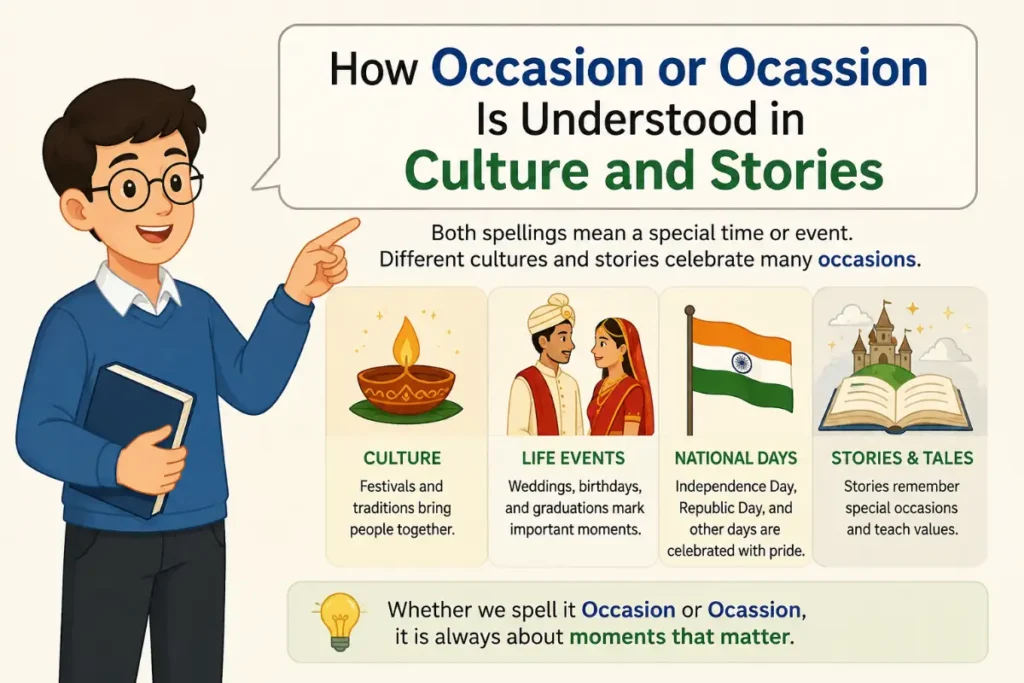
The word occasion is more than just a spelling word. It also carries a feeling. People often use it when talking about happy memories important moments and special events. Across many cultures an occasion brings people together. Families gather for birthdays. Friends meet for weddings. Communities celebrate holidays. These moments become memories that people remember for years.
Sometimes an occasion is joyful.
A new baby is a wonderful occasion.
Sometimes an occasion is serious.
A memorial service is also an important occasion.
The word itself does not tell us if something is happy or sad. It simply tells us that the moment has special meaning. When people search they are usually thinking about these important moments. The correct spelling is always occasion, no matter what kind of event you are describing.
Stories and movies also use this word often.
A hero may return home for a special occasion.
A family may gather for an important occasion.
A king may hold a grand occasion for the whole kingdom.
Because the word is connected with meaningful moments it often makes writing sound warmer and more natural.
Biblical and Mythological Meaning of Occasion vs Ocassion
The Bible does not use occasion as the name of a person or place. Instead the word appears in some English Bible translations to mean a reason or an opportunity.
For example someone may look for an occasion to help another person.
In another place someone may look for an occasion to cause trouble.
Here the word means a chance or a reason for something to happen.
The spelling is still occasion.
The spelling ocassion does not appear because it is not a correct English word.
In mythology there is no famous god goddess or hero named Occasion in the most common stories. However many old stories talk about the right moment or the perfect opportunity. That idea is very close to one meaning of occasion. So in simple words the word can sometimes mean a special chance as well as a special event.
Symbolism Explained in Simple Words
What Occasion Represents
The correct word occasion often represents something meaningful.
It can stand for:
- celebration
- family
- friendship
- achievement
- love
- respect
- remembrance
- opportunity
- important moments
- new beginnings
When someone says it is a special occasion people usually expect something memorable to happen.
That is why invitations greeting cards and speeches often include this word.
What Ocassion Represents
The word ocassion does not represent a different meaning.
It simply represents a spelling mistake.
If someone writes ocassion readers may think the writer typed too quickly or forgot the correct spelling.
That is why it is always better to write occasion in school work business writing emails and everyday messages.
The comparison is simple.
Occasion represents correct English.
Ocassion represents an incorrect spelling.
Related Words You Should Know
Learning related words helps you understand occasion or ocassion even better.
Event
An event is something that happens. An occasion is often a special event.
Celebration
A celebration is the activity or party. The occasion is the reason for celebrating.
Ceremony
A ceremony is a formal event like a graduation or wedding.
Anniversary
An anniversary remembers an important date every year.
Holiday
A holiday is a special day that many people celebrate.
Festival
A festival is a public celebration with activities food or music.
Gathering
A gathering is when people come together for a purpose.
Opportunity
Opportunity means a good chance to do something. Sometimes occasion also means a chance.
Moment
A moment is a short period of time. Some moments become special occasions.
Milestone
A milestone is an important achievement or stage in life such as graduating or retiring.
How People Actually Use Occasion and Ocassion in Daily English
People use occasion every day in many different situations.
Here are natural examples.
- We bought flowers for the occasion.
- This is a special occasion for our family.
- Thank you for joining us on this happy occasion.
- I wore my best shoes for the occasion.
- Graduation was an unforgettable occasion.
- We smiled because it was a joyful occasion.
- On one occasion I forgot my wallet.
- Every family occasion brings us together.
- This seems like the perfect occasion to celebrate.
- They decorated the room for the occasion.
You may also hear these common expressions.
- special occasion
- on one occasion
- for the occasion
- rise to the occasion
- happy occasion
These phrases are common in both spoken and written English.
Common Mistakes People Make
Many learners make the same mistakes. The good news is that they are easy to fix.
Mistake One
Wrong:
Ocassion
Correct:
Occasion
Always remember that occasion has two c letters but only one s.
Mistake Two
Using the wrong word because it sounds right.
People often trust their ears.
English spelling does not always match pronunciation.
When in doubt check the spelling.
Mistake Three
Mixing occasion with celebration.
Wrong idea:
The occasion is the party.
Better idea:
The occasion is the reason for the party.
Mistake Four
Using the word too often.
Instead of repeating occasion many times you can sometimes use words like event moment celebration or ceremony when they fit the meaning.
Mistake Five
Writing too quickly.
Many spelling mistakes happen because people type fast.
Reading your writing one more time can help you catch simple errors.
Final Teacher Explanation About Occasion vs Ocassion
Imagine I am standing in front of a classroom.
A student asks me which word is correct.
I smile and answer.
“There is only one correct spelling. It is occasion.”
Then another student asks why so many people write ocassion.
I explain that English spelling can sometimes be tricky. Some words have double letters in different places. Because of that people guess the spelling instead of remembering it.
Then I write this on the board.
Occasion = Correct
Ocassion = Incorrect
Next I tell the class to remember one easy rule.
Two c letters.
One s.
That simple rule helps most students remember the correct spelling for years.
If you keep reading writing and practicing the word occasion will soon feel natural.
Final Answer About Occasion or Ocassion
If you still wonder about words, the answer is very simple.
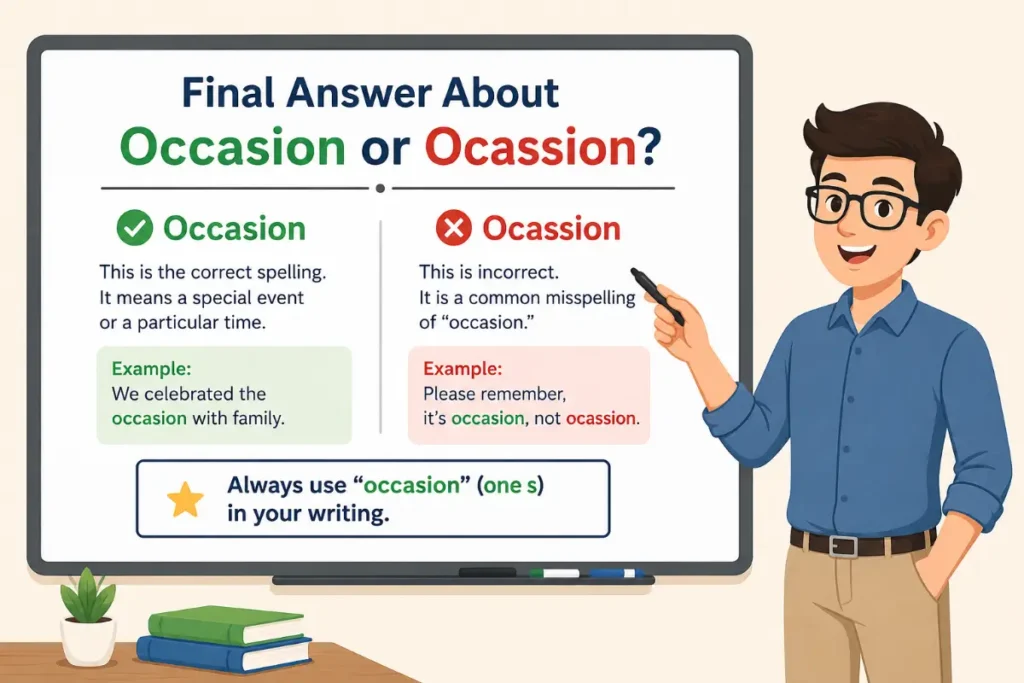
Occasion is the correct English spelling. It means a special event an important time or sometimes a reason for something to happen. English dictionaries books teachers and professional writers all use occasion.
Ocassion is only a spelling mistake. It should not appear in school assignments business documents emails or everyday writing. When you remember that the word has two c letters and one s, you will almost always spell it correctly.
Need another quick comparison? Read Meantime Or Mean Time: How To Use Each One (2026).
Conclusion
By now you should feel confident about words. The correct spelling is always occasion. It is the only form accepted in standard English.
You can use occasion when talking about birthdays weddings holidays graduations family gatherings or any other meaningful event. You can also use it when talking about a particular time or a reason for something to happen.
The easiest takeaway is this.
Two c letters. One s. Occasion is always correct.
Frequently Asked Questions (FAQs)
What is the correct spelling?
Occasion is correct. Ocassion is a spelling mistake.
What does occasion mean in simple words?
It means a special event an important time or sometimes a reason for something to happen.
Why do people confuse?
The pronunciation makes the spelling hard to remember. Many people accidentally place the double letters in the wrong spot.
Can I use ocassion in school writing?
No. Always use occasion because it is the correct spelling.
Is occasion used in everyday English?
Yes. People use it when talking about birthdays weddings holidays graduations and many other important events.
Does occasion only mean a celebration?
No. It can also mean a particular time or a reason for something to happen.
How can I remember the correct spelling?
Remember this simple rule: Occasion has two c letters and one s.
Is occasion a formal or informal word?
It works in both. You can use it in casual conversations and formal writing.
