
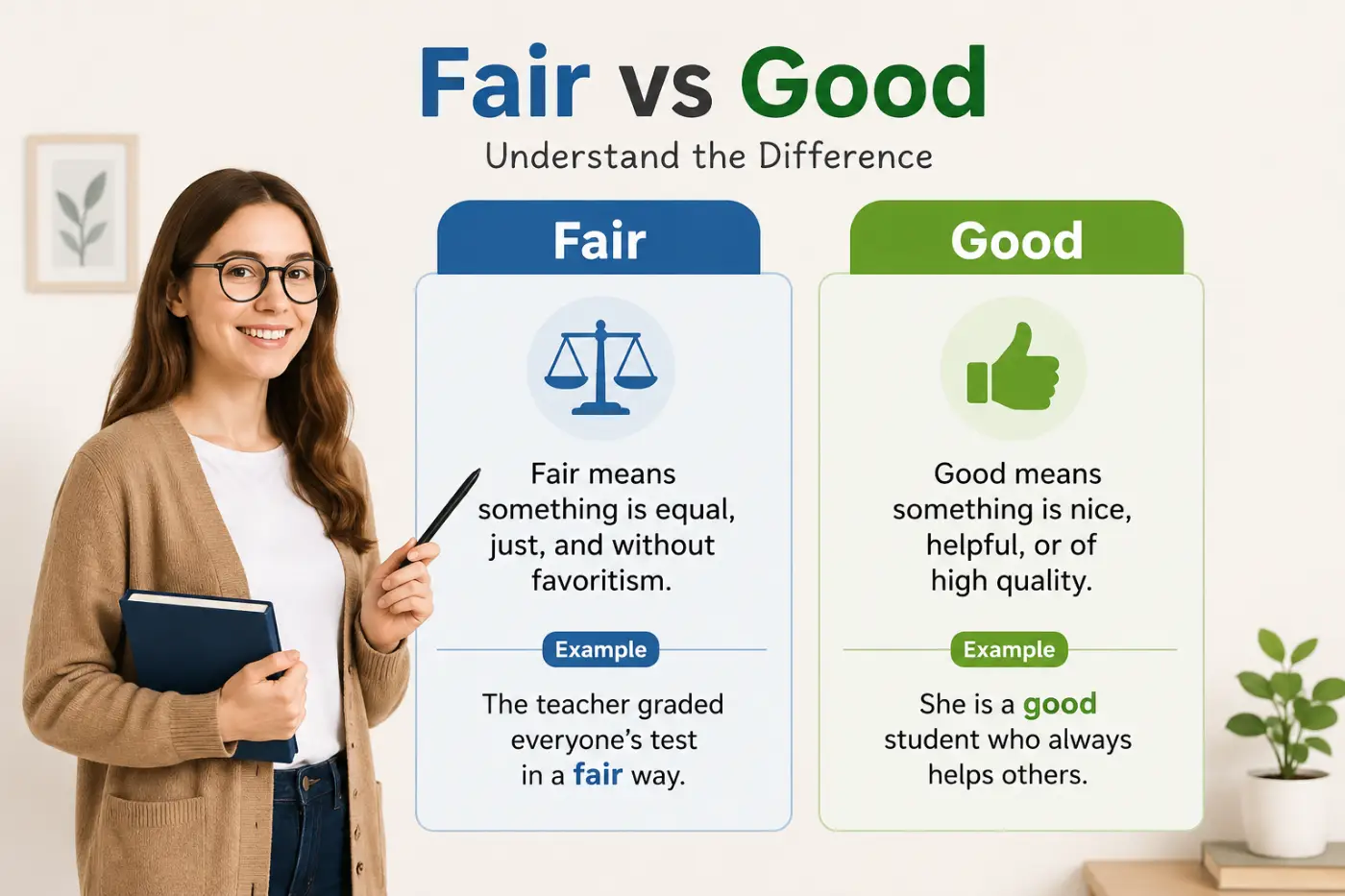
Many English learners get confused about fair vs good because both words can describe something positive. They seem similar, but they do not mean the same thing. Knowing the difference helps you speak and write more naturally.
The simple rule is this. Good means something is better than average or pleasing. Fair often means something is acceptable, average, or just and equal. The correct choice depends on what you want to say.
This guide explains in very simple English. You will learn the meaning of each word, see the difference between them, and read easy examples you can use every day.
You may also want to read Home Made or Homemade: Which Form Is Correct Today?.
Simple Answer In One Look
Good means something is nice, better than average, or of high quality.
Fair usually means average, acceptable, or treating everyone equally.
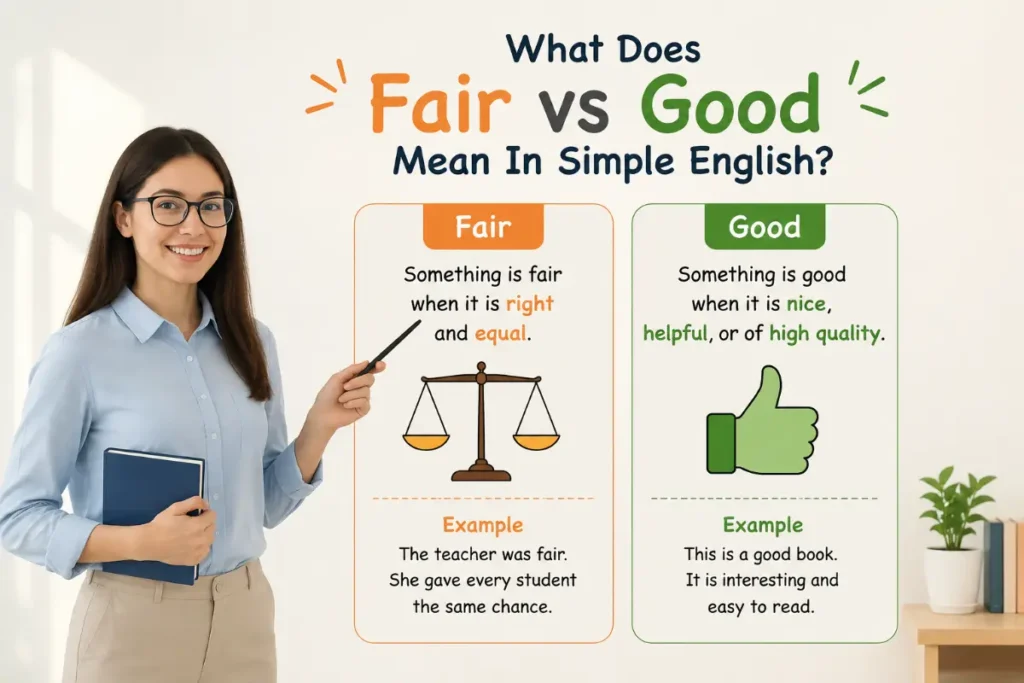
What Does Fair vs Good Mean In Simple English?
The easiest way to understand is to think about everyday life. The word good is used when you want to praise something. It tells people that something is better than normal or gives a positive feeling.
For example:
- The food is good.
- She did a good job.
- That is a good movie.
In each sentence, good shows approval.
The word fair has more than one common meaning.
One meaning is average or acceptable. It is not great, but it is not bad either.
For example:
- The movie was fair.
- His test score was fair.
- The weather was fair.
Another meaning is just and equal.
For example:
- The teacher was fair to every student.
- The referee made a fair decision.
- Everyone should have a fair chance.
So, when comparing both words, remember that good usually gives stronger praise, while fair often means average or equal treatment.
In Quality
Imagine you eat three pizzas.
The first pizza tastes amazing.
You say:
- This pizza is good.
The second pizza is okay. It is not exciting, but you can eat it.
You say:
- This pizza is fair.
The third pizza tastes terrible.
You say:
- This pizza is bad.
This simple example shows that good is higher than fair when talking about quality.
In Behavior
Now think about a teacher in a classroom.
If the teacher treats every student the same way, the teacher is fair.
If the teacher explains lessons clearly and helps everyone learn, the teacher is good.
A teacher can be both fair and good at the same time.
In Weather
Weather reports sometimes use both words.
Fair weather usually means clear skies with little or no rain.
People may also say:
- The weather is good today.
Here, good simply means pleasant weather.
Although both can describe weather, they focus on different ideas.
Why Do People Mix These Words Fair vs Good?
Many learners confuse words because both words can sound positive. Another reason is that dictionaries give several meanings for the word fair. This makes learners think it always means the same thing as good.
Here are some common situations that cause confusion.
Both Can Describe Something Nice
Look at these sentences.
- We had a good day.
- We had a fair day.
The first sentence means the day was enjoyable.
The second sentence usually means the day was only average or acceptable.
The meanings are different even though both sound positive.
School Grades
Some grading systems use words like these.
- Excellent
- Very Good
- Good
- Fair
- Poor
Here, fair is lower than good.
This is why saying your work is fair is usually not a compliment.
Performance Reviews
A manager might say:
- Your work is good.
This means the work is better than average.
If the manager says:
- Your work is fair.
It usually means the work is acceptable but needs improvement.
Different Meanings Of Fair
People also hear sentences like these.
- That is a fair price.
- She is fair to everyone.
- We had fair weather.
These examples show different meanings of fair.
Because the word has several meanings, learners sometimes use it when good is the better choice.
Clear Difference Explained Simply
Here is an easy comparison.
| Good | Fair |
|---|---|
| Better than average | Usually average |
| Shows praise | Often shows acceptable quality |
| Positive opinion | Neutral or slightly positive opinion |
| High quality | Medium quality |
| Can describe people, food, work, ideas, or places | Can describe quality, justice, prices, weather, and equal treatment |
Think about these examples.
Good
- Good food
- Good teacher
- Good friend
- Good book
- Good music
These all express clear approval.
Fair
- Fair score
- Fair decision
- Fair price
- Fair treatment
- Fair chance
These often focus on equality or acceptable quality instead of strong praise.
Quick Memory Trick
Use good when you want to say something is better than average.
Use fair when you mean average, acceptable, or equal.
That simple rule works in most everyday conversations.
Which Form Should You Use Fair vs Good?
When choosing between words, ask yourself one simple question. Am I praising something or talking about equality or average quality? If you are praising something, choose good.
Examples:
- She is a good singer.
- This cake is good.
- We had a good vacation.
If you are talking about equal treatment, choose fair.
Examples:
- The game was fair.
- The judge was fair.
- Every player had a fair chance.
If you are talking about average quality, fair is often the better choice.
Examples:
- His English is fair.
- The hotel was fair.
- The service was fair.
Notice that these sentences do not mean excellent. They simply mean acceptable.
When Both Words Can Appear Together
Sometimes both words fit in the same conversation.
For example:
- She is a good teacher because she is fair to every student.
Here, good describes the teacher’s overall quality.
Fair describes how the teacher treats students.
The two words have different jobs in the sentence.
Easy Real Life Sentences You Can Use
These examples make easy to remember.
- The food was good, so everyone wanted more.
- The service was fair, but it could be better.
- She is a good friend because she always helps me.
- The referee made a fair decision.
- We had a good weekend at the beach.
- The price looks fair to me.
- His performance was good enough to win.
- Every child deserves a fair chance.
Read these sentences aloud. They sound natural in everyday English.
Short Conversations
At a Restaurant
A: How was your dinner?
B: It was good. I really enjoyed it.
After An Exam
A: How did you do?
B: I think my score will be fair. I could have done better.
Watching A Game
A: Was the referee fair?
B: Yes. He treated both teams equally.
Shopping
A: Is fifty dollars a fair price?
B: Yes. I think it is reasonable.
These conversations show how the meaning changes with the situation.
Where This Expression Comes From. Simple History.
The words fair and good have been part of English for hundreds of years. The word good comes from very old English. It has always been connected with ideas like kindness, quality, usefulness, and value. Over time, people kept using it to describe things they like or approve of.
The word fair also comes from old English. Long ago, it described something beautiful or pleasing. As English changed, the word gained new meanings. It began to describe justice, equal treatment, reasonable prices, clear weather, and acceptable quality. That is why fair has more meanings than good today. Even though these words have long histories, their everyday use is still easy to understand.
Use good when you want to praise something.
Use fair when you mean average quality, equal treatment, or something reasonable.
As your English improves, you will notice these meanings everywhere. You will hear them in conversations, read them in books, and see them in movies, classrooms, sports, and daily life. Understanding now will make the next part even easier because you will see how these words are used in culture, common expressions, symbolism, and real life.
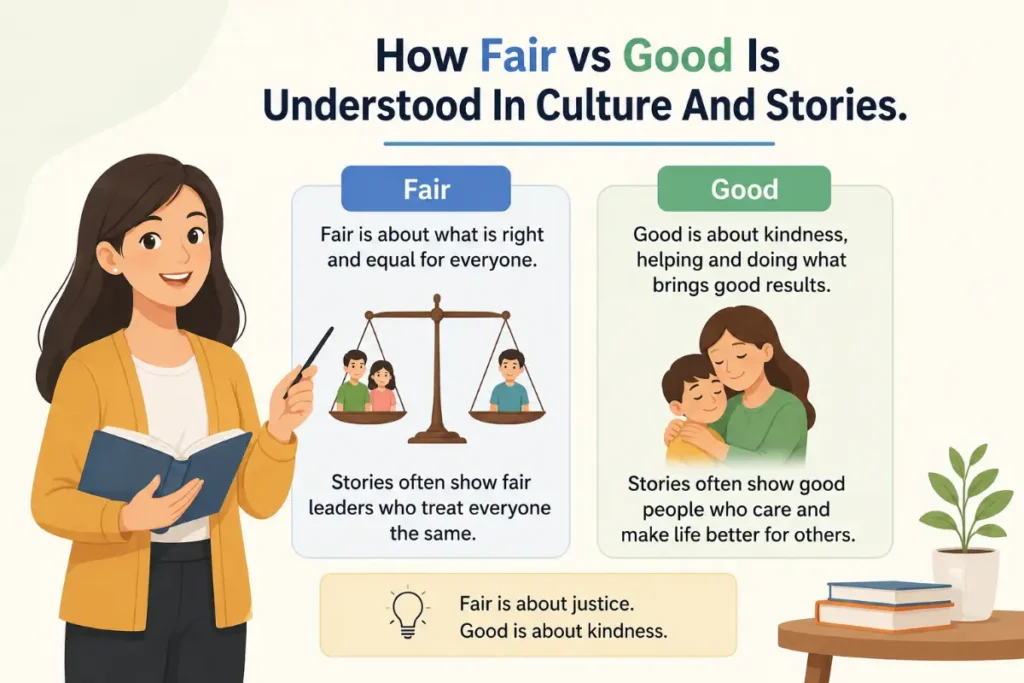
How Fair vs Good Is Understood In Culture And Stories
The difference between is not only about grammar. These words also appear in stories, movies, sports, and everyday life. People use them to share ideas about kindness, honesty, quality, and justice.
The word good is often connected with people who help others. A good person tells the truth, shows kindness, and tries to do the right thing. Many stories have a good hero who protects others and stands against evil.
The word fair usually reminds people of honesty and equal treatment. A fair person does not choose favorites. They listen to everyone before making a decision. This is why judges, teachers, coaches, and parents often try to be fair. Children hear this word from a young age.
For example:
- That is not fair.
- Please play fair.
- Give everyone a fair chance.
These simple sentences teach children about respect and equality.
Sports also help explain.
A good player may score many points and play very well. A fair player follows the rules, respects other players, and accepts the referee’s decisions. The best athletes are often both good and fair. Many stories also teach these lessons. A king may be good because he cares for his people. A queen may be fair because she gives everyone the same chance. These examples show that good and fair can work together, but they do not have the same meaning.
A related grammar guide is Time Flies or Time Flys: Which Is Correct and Why (2026)?.
Biblical And Mythological Meaning of Fair vs Good
The Bible often talks about good. Good is connected with love, kindness, honesty, mercy, and doing what is right. People are encouraged to do good works and care for others. The word fair appears in some older Bible translations with a different meaning. In those places, it sometimes means beautiful or pleasant to look at instead of equal or average.
For example, someone may be described as fair in appearance. This means the person is attractive or beautiful.
In modern English, people usually use beautiful, pretty, or handsome instead of this older meaning of fair.
In myths and old stories, good characters usually protect people or fight against evil. Fair rulers or fair judges are respected because they make honest decisions without showing favoritism.
So, in simple words:
- Good is often connected with kindness and doing the right thing.
- Fair is often connected with justice and equal treatment.
Symbolism Explained In Simple Words
What Fair Represents
When people hear the word fair, they often think about balance, honesty, and equality.
Fair represents:
- Equal chances
- Honest decisions
- Respect for rules
- Treating everyone the same
- Reasonable choices
If someone says, “Be fair,” they are asking for honesty instead of favoritism.
What Good Represents
The word good usually represents positive qualities.
Good represents:
- Kindness
- Success
- High quality
- Helpful actions
- Positive behavior
When someone says, “Be good,” they are asking a person to behave well and make good choices.
This simple comparison makes much easier to remember.
Fair is about equality.
Good is about quality or positive behavior.
Related Words You Should Know About Fair vs Good
Learning related words helps you understand more clearly.
Better
Better means higher quality than good. Example:
This phone is better than my old one.
Best
Best means the highest quality of all. Example:
She is the best player on the team.
Average
Average means normal or in the middle.
Fair sometimes has this meaning. Example:
His test score was average.
Excellent
Excellent means extremely good. Example:
The food was excellent.
Honest
Honest means telling the truth.
A fair person is usually honest. Example:
She gave an honest answer.
Equal
Equal means everyone gets the same chance or treatment. Example:
Every student deserves equal respect.
Just
Just means fair and honest. Example:
The judge made a just decision.
Poor
Poor means below average. Example:
The service was poor.
Knowing these related words makes it easier to choose the right word in different situations.
How People Actually Use It In Daily English
People use every day without thinking much about it.
Here are some natural examples.
- The movie was good. I want to watch it again.
- The restaurant was fair, but I probably will not visit again.
- My teacher is good because she explains everything clearly.
- My teacher is fair because she treats every student the same.
- That sounds like a fair price.
- We had good weather all weekend.
- Everyone should get a fair chance to speak.
- He is a good neighbor who always helps people.
- The team’s performance was good enough to win.
- The referee was fair during the entire game.
These are the kinds of sentences you hear in daily conversations.
Common Mistakes People Make With Fair vs Good
Many learners make the same mistakes when using these words.
Mistake 1. Using Fair Instead Of Good For Praise
Incorrect:
The cake is fair.
Correct:
The cake is good.
If you really enjoyed the cake, use good instead of fair.
Mistake 2. Using Good Instead Of Fair For Equal Treatment
Incorrect:
The teacher is good to every student equally.
Better:
The teacher is fair to every student.
Fair clearly shows equal treatment.
Mistake 3. Thinking Fair Always Means Good
Many people think fair is another way to say good.
That is not always true.
Fair often means acceptable or average.
Good usually means better than average.
Mistake 4. Forgetting That Fair Has More Than One Meaning
Fair can mean:
- Equal
- Average
- Reasonable
- Beautiful in older English
- Clear weather
The meaning depends on the sentence.
Mistake 5. Mixing School Grades
Some learners think fair is a compliment.
In many grading systems:
Excellent is higher than very good.
Very good is higher than good.
Good is higher than fair.
Fair is higher than poor.
Remember this order when talking about quality.
Final Teacher Explanation
Imagine you are sitting in a classroom.
I ask two questions.
Was the movie enjoyable?
You answer:
It was good.
Next I ask:
Did everyone get the same chance to speak?
You answer:
Yes. It was fair.
That is the easiest way to remember both words.
Use good when you want to praise something.
Use fair when talking about equality, honesty, or something that is only average.
Sometimes one person can be both.
A good teacher helps students learn.
A fair teacher treats every student equally.
One word talks about quality.
The other talks about justice or acceptable quality.
If you remember this simple idea, you will choose the correct word almost every time.
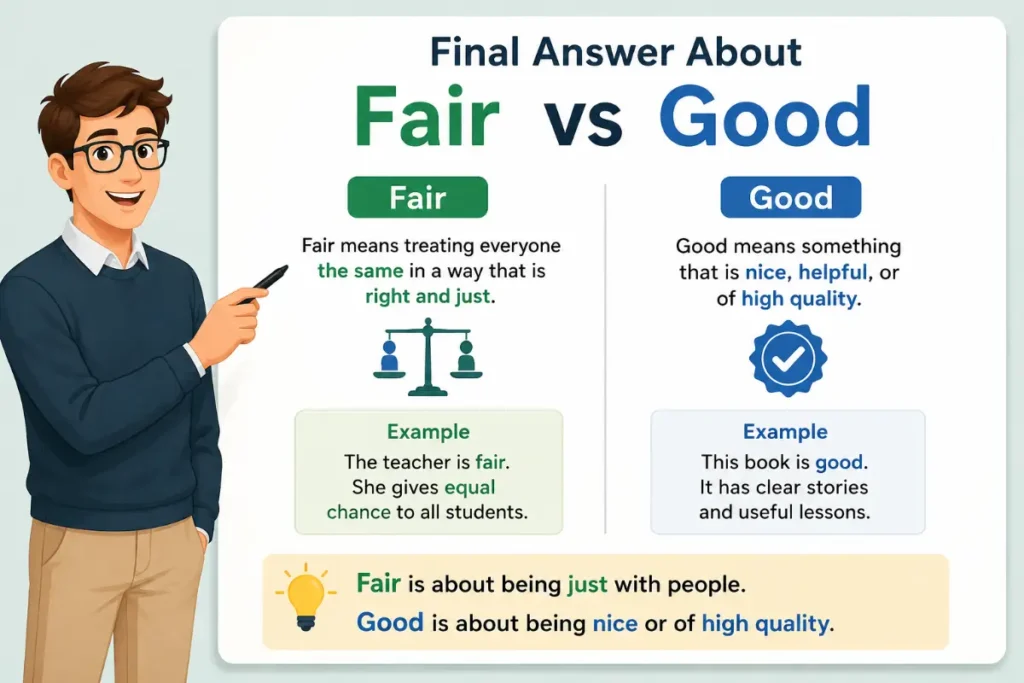
Final Answer About Fair vs Good
The difference between is simple once you know what each word means.
Use good when you want to describe something positive, enjoyable, helpful, or better than average. Good gives praise and shows approval.
Use fair when talking about equal treatment, honest decisions, reasonable prices, or something that is only acceptable or average. Fair does not always mean good. It often has its own special meaning.
The easiest way to remember this lesson is to think of one short rule. Good means positive quality. Fair means equality or average quality.
For another common grammar confusion, see Nosey or Nosy: Which Spelling Is Correct (2026 Guide)?.
Conclusion
Understanding will make your English sound more natural and more accurate. These two words may seem similar, but they are used in different ways. Good usually shows praise, while fair often shows equality, honesty, or acceptable quality.
The more you read, listen, and practice, the easier it becomes to choose the right word. Soon you will recognize the difference without stopping to think.
The easiest takeaway is this. When you want to praise something, choose good. When you want to talk about equal treatment or average quality, choose fair.
Frequently Asked Questions
What does fair mean in simple words?
Fair usually means equal, honest, reasonable, or average depending on the situation.
Is it correct to use fair or good?
Both are correct. Use good for praise and fair for equality or acceptable quality.
When should I use fair?
Use fair when talking about honest treatment, equal chances, reasonable prices, or average quality.
Why do people get confused between fair and good?
Both words can sound positive, but they have different meanings. Fair often means average or equal, while good means better than average.
Can I use both fair and good in one sentence?
Yes. For example, “She is a good teacher because she is fair to every student.”
Does fair always mean average?
No. Fair can also mean equal, honest, reasonable, or clear weather depending on the sentence.
Is fair better than good?
No. When talking about quality, good is usually better than fair.
What is the easiest way to remember?
Remember this simple rule. Good means positive quality. Fair means equality or acceptable quality.
