
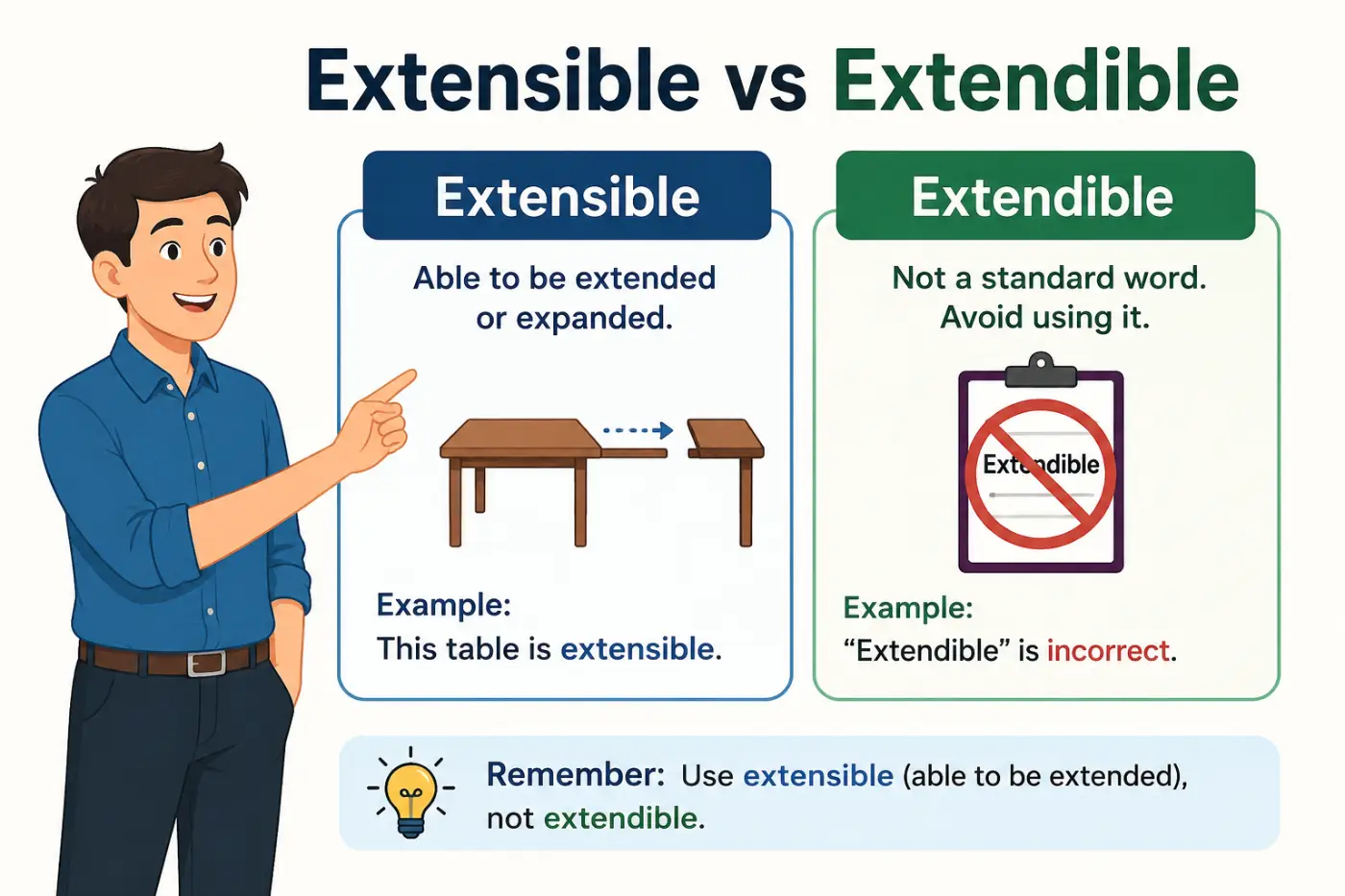
Many people get confused about extensible vs extendible because both words look almost the same. They even have very similar meanings. That makes it hard to know which one is correct. The good news is that both words are real English words, but they are not always used in the same way.
If you are searching for the difference between words, the short answer is simple. Both words mean “able to be extended.” Still, extensible is much more common, especially in software, engineering, science, and modern writing. Extendible is correct too, but you will see it less often.
This guide explains in very simple English. You will learn what each word means, why people confuse them, when to use each one, and how to remember the difference with easy examples.
Still confused? Compare Channel vs Chanel: Easy Grammar Guide Explained.
Simple Answer in One Look
Extensible and extendible both mean “able to be extended.”
Extensible is the preferred spelling in most modern writing. Extendible is also correct but is much less common.
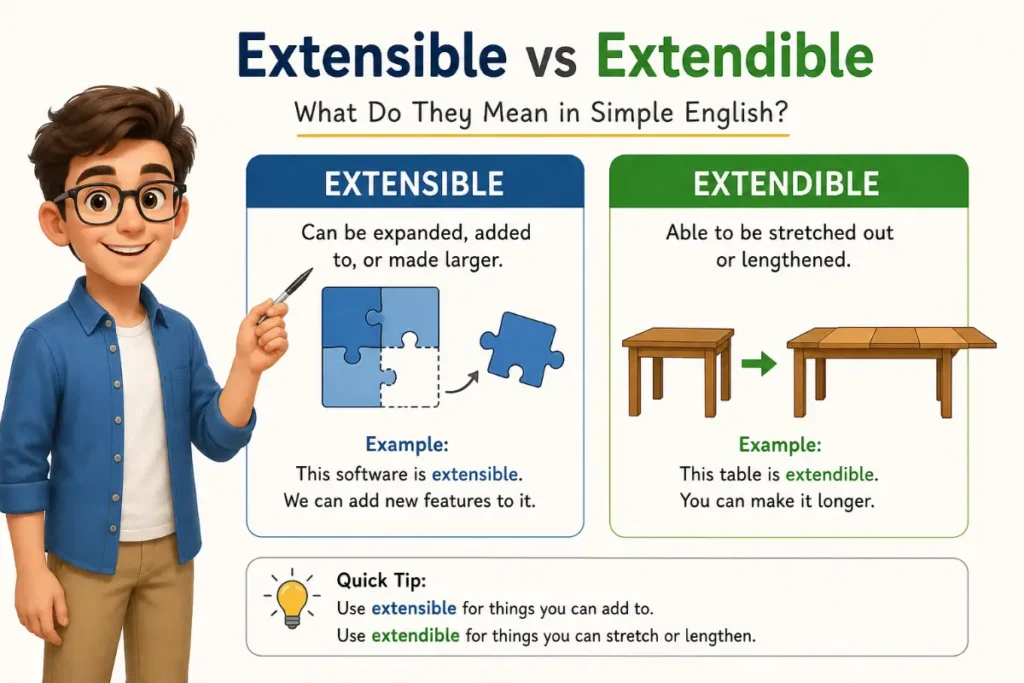
What Does Extensible vs Extendible Mean in Simple English?
Think about something that can become bigger, longer, or more useful. If it can be changed by adding more parts, features, or space, it can be called extensible or extendible. Here is a simple idea.
- A table with extra leaves is extensible.
- A computer program that allows new features is extensible.
- A schedule with room for more time can be called extendible.
The basic meaning stays the same.
Able to be extended.
The main difference is not the meaning. The difference is how often people use each word.
What Does Extensible Mean?
Extensible means something can be expanded or improved by adding more without changing the whole thing. This word is very common in technology.
Examples include:
- An extensible software system
- An extensible database
- An extensible learning platform
- An extensible design
The idea is that new parts can be added easily.
What Does Extendible Mean?
Extendible also means something can be extended. You may see it in general English or older writing.
Examples include:
- An extendible ladder
- An extendible dining table
- An extendible deadline
These examples are correct, although many writers would still choose extensible in formal writing.
Why People Mix These Words Extensible vs Extendible
There are several simple reasons why people confuse these words.
First, they have almost the same spelling.
- Extensible
- Extendible
Only a few letters are different.
Second, both words come from the verb extend.
That makes people think they must always be used in exactly the same way. Third, dictionaries accept both spellings. When learners see both in dictionaries, they wonder if one is wrong. Finally, different industries use different preferences. For example, software developers almost always write extensible. Someone writing about furniture might use either word. That is why the confusion continues.
Clear Difference Explained Simply
Although both words are correct, one is clearly more common.
Extensible
- More common in modern English
- Preferred in software and technology
- Often used in science and engineering
- Sounds more natural in formal writing
Extendible
- Also correct English
- Less common today
- Seen more in general descriptions
- Sometimes used for physical objects
Quick Comparison
| Feature | Extensible | Extendible |
|---|---|---|
| Correct English word | Yes | Yes |
| Same basic meaning | Yes | Yes |
| More common today | Yes | No |
| Preferred in technology | Yes | Rarely |
| Good for formal writing | Yes | Sometimes |
The meanings are almost identical.
The biggest difference is how often each word appears in modern English.
Which Form Should You Use?
If you are unsure, choose extensible.
That is the safest choice in most situations.
Use extensible when writing:
- School assignments
- Business documents
- Technical articles
- Computer programming
- Engineering reports
- Online content
You can still use extendible, especially when talking about something that physically becomes longer.
Examples include:
- An extendible pole
- An extendible shelf
- An extendible handle
Even then, many writers still choose extensible if they want a more modern style.
A Simple Rule to Remember
Ask yourself this question.
“Can I safely replace this word with extensible?”
Most of the time, the answer is yes.
That makes extensible the easier choice for everyday writing.
Easy Real Life Sentences You Can Use Extensible vs Extendible
Here are simple examples that sound natural.
- This software is extensible, so we can add new tools later.
- Our website has an extensible design.
- The teacher wants an extensible learning system.
- This project needs an extensible structure for future updates.
- We bought an extendible ladder for painting the house.
- The dining table has an extendible top.
- The company built an extensible platform for new customers.
- His plan is extensible and can grow over time.
Notice that technology examples almost always use extensible, while some physical objects may use extendible.
Where This Word or Expression Comes From (Simple History)
Both extensible and extendible come from the English verb extend, which means “to make longer,” “to increase,” or “to stretch.” The ending -ible means “able to.” So both words literally mean:
Able to be extended.
Over many years, English writers began using extensible more often, especially in technical subjects. As computers became more common, programmers needed a word for software that could accept new features. They almost always chose extensible. Today, that choice has influenced many other kinds of writing.
Because of this history, extensible has become the preferred form in modern English, while extendible remains a correct but less common alternative. As you continue learning about both words, it also helps to see how these words appear in different fields, everyday conversations, and even symbolic uses. Understanding those wider examples makes it much easier to remember which form sounds most natural in real English.
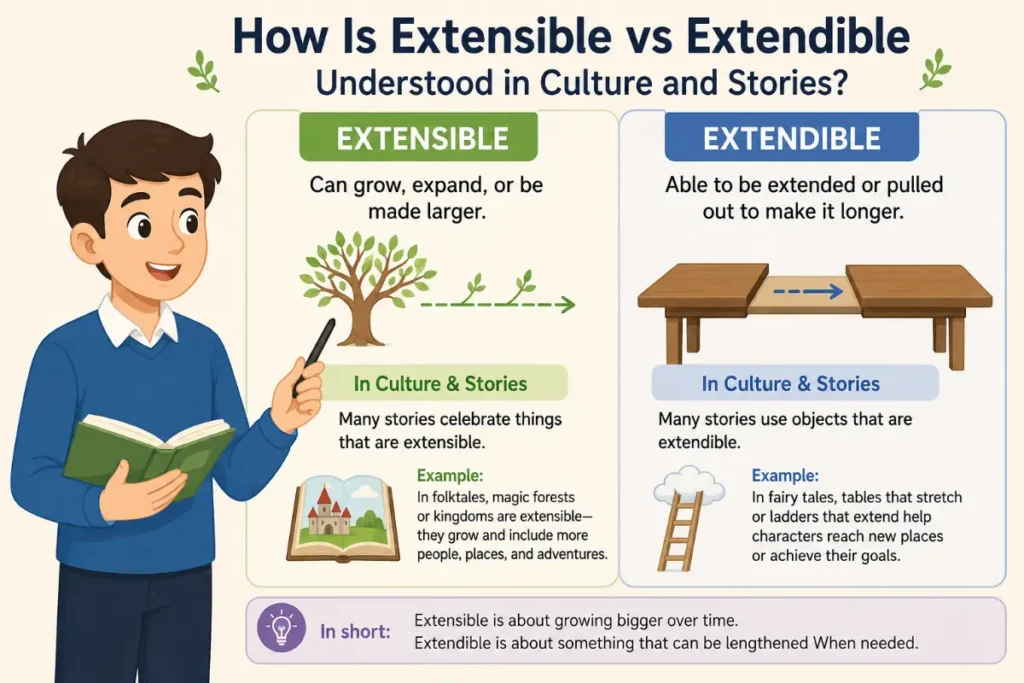
How Is Extensible vs Extendible Understood in Culture and Stories?
When people hear the words, they usually think about growth, change, and new possibilities. Even though these words are mostly used in technology, engineering, and everyday English, the idea behind them is easy to understand.
Many stories are about people who grow stronger, learn new skills, or become wiser. In a simple way, you can think of those people as being “extensible.” They are able to grow without losing who they are.
For example, a young student learns new subjects every year. The student’s knowledge becomes bigger. In that sense, the student’s learning is extensible because new ideas can always be added.
A city can also grow by adding new roads, parks, and schools. A business can grow by offering new products. A family can grow by welcoming new members. The idea behind extensible vs extendible is not just about making something longer. It is also about making something better, stronger, or more useful over time.
In modern culture, extensible is often linked with technology because many computer systems are built to accept new features in the future. This makes them useful for many years instead of becoming outdated quickly.
For another common grammar confusion, see Comming vs Coming: Rule Every Student Needs (2026).
What Is the Biblical and Mythological Meaning of Extensible vs Extendible?
There is no special biblical meaning for extensible or extendible. These words do not appear as important religious terms. However, the idea of growth appears many times in the Bible. People are encouraged to grow in wisdom, faith, kindness, and love. These ideas are similar to the meaning behind something that can continue to grow or expand.
In mythology, heroes often become stronger during their journey. They gain new knowledge, new courage, or new abilities. Their story keeps growing from beginning to end. So while words have no direct religious or mythological definition, both words remind us that growth is a natural part of life.
Symbolism Explained in Simple Words
What Does Extensible Represent?
In everyday life, extensible often represents:
- Growth
- Learning
- Flexibility
- Improvement
- New opportunities
- Future planning
Something that is extensible is ready for change. It has room to grow without starting over.
A good example is an extensible software program. New tools can be added without rebuilding everything.
The same idea works in life. A person who keeps learning is always growing.
What Does Extendible Represent?
Extendible represents many of the same ideas because its meaning is almost identical.
It often makes people think about physical objects that become longer or larger.
For example:
- An extendible ladder
- An extendible dining table
- An extendible handle
The word reminds us that some things are designed to stretch when needed.
Simple Comparison
Extensible often suggests planned future growth.
Extendible often reminds people of something that physically becomes larger.
Both ideas are positive because they describe something that can change instead of staying limited forever.
Related Words You Should Know
Learning similar words makes much easier to remember.
Extend
To make something longer or larger. Example:
We decided to extend the meeting by thirty minutes.
Expansion
The act of becoming bigger. Example:
The company plans another expansion next year.
Expand
To grow in size or number. Example:
The school wants to expand its library.
Flexible
Able to change easily. Example:
Her work schedule is flexible.
Adjustable
Able to change to fit different needs. Example:
The chair has an adjustable height.
Adaptable
Able to work well in different situations. Example:
Dogs are very adaptable animals.
Scalable
Able to grow without losing quality. Example:
The business needs a scalable plan.
Modular
Built from separate parts that can be added or removed. Example:
The classroom uses modular furniture.
Expandable
Able to become bigger. Example:
The suitcase has an expandable section.
These related words are common in both everyday English and technical writing.
How Do People Actually Use Extensible vs Extendible in Daily English?
Most people do not use these words every day in casual conversations. Still, they appear often at work, in school, and in technology.
Here are some natural examples.
- Our website has an extensible design.
- This program is extensible, so new tools can be added later.
- The teacher wants an extensible learning platform.
- We need an extensible system for future projects.
- The dining table has an extendible top for guests.
- She bought an extendible ladder for home repairs.
- The company built an extensible database.
- This storage shelf has an extendible frame.
- We chose an extensible solution because our business is growing.
- The handle is extendible, which makes cleaning easier.
Notice that extensible appears more often when talking about ideas, systems, software, or plans.
Extendible appears more often with physical objects that become longer.
Common Mistakes People Make
Many learners make the same mistakes.
Mistake 1: Thinking One Word Is Wrong
Incorrect idea:
Only extensible is a real word.
Correct answer:
Both extensible and extendible are correct English words.
Mistake 2: Using Extendible in Software Writing
Example:
The software is extendible.
Better choice:
The software is extensible.
Most technology companies prefer extensible.
Mistake 3: Thinking the Meanings Are Different
Some learners believe these words have completely different meanings.
They do not.
Their meanings are almost the same.
The biggest difference is which spelling is more common.
Mistake 4: Using Them Without Thinking About the Audience
If you are writing a school paper, business report, or technical article, extensible is usually the safer choice.
Mistake 5: Confusing Them With Expandable
Expandable and extensible are similar, but they are not always exactly the same.
Expandable usually means becoming physically larger.
Extensible often means new parts or functions can be added.
Final Teacher Explanation About Extensible vs Extendible
Imagine I am standing in front of a classroom.
A student asks, “Which word should I remember?”
My answer is simple.
Remember extensible first.
It is the word you will see most often in books, websites, software guides, engineering, and business writing.
Do not worry if you see extendible somewhere else.
It is also correct.
The meanings are almost the same.
The biggest difference is popularity.
When you are unsure, choose extensible.
That one choice will be correct in most situations.
This simple rule helps you avoid mistakes and makes your English sound more natural.
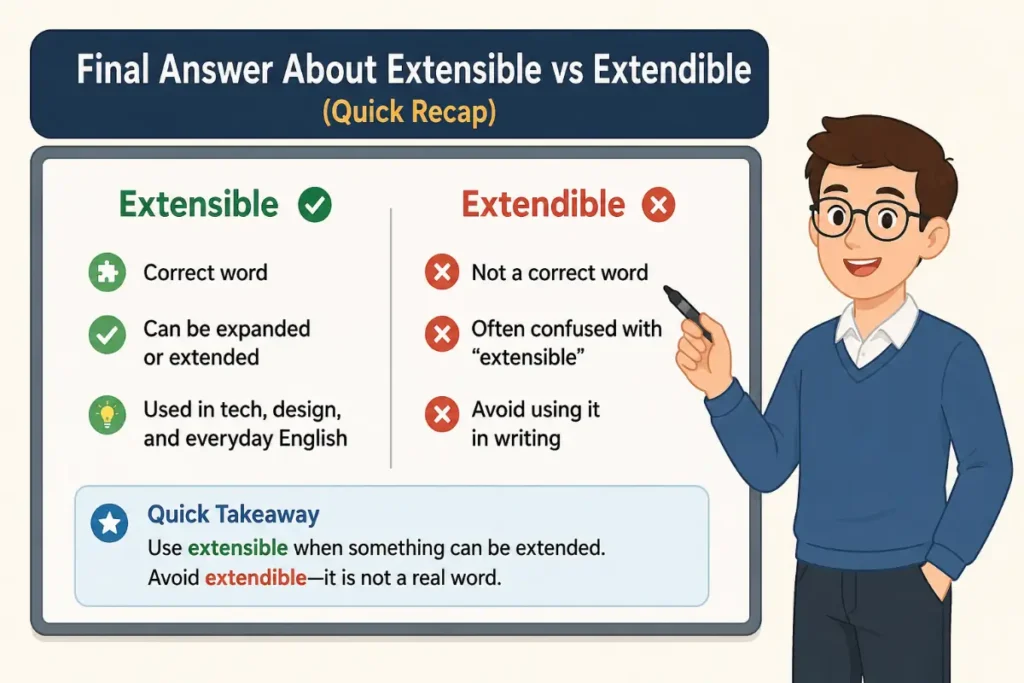
Final Answer About Extensible vs Extendible (Quick Recap)
If someone asks about both words, you can give a short answer. Both words mean “able to be extended.” However, extensible is the preferred spelling in modern English. It is especially common in technology, software, engineering, education, and business writing.
Extendible is still a correct English word. You may see it when people describe physical objects like ladders, tables, poles, or handles. Even then, many writers still choose extensible because it is more familiar.
The easiest rule to remember is this: If you are not sure which word to use, choose extensible.
You may also want to read Inbalance or Imbalance: Correct Spelling With Examples.
Conclusion
Understanding is much easier than it first appears. Both words describe something that can be extended, expanded, or improved. Their meanings are almost the same, so you do not need to worry about learning two completely different definitions.
The biggest difference is usage. Extensible is the spelling you will see most often in modern English, especially in technology, education, engineering, and professional writing. Extendible is still correct, but it appears less often and is more commonly used for physical objects.
The easiest takeaway is simple. When you are unsure about extensible vs extendible, choose extensible. It is the more common choice and will sound natural in almost every situation.
Frequently Asked Questions (FAQs)
What does extensible mean in simple words?
It means something can be extended, expanded, or improved by adding more parts or features.
Is extendible a correct English word?
Yes. Extendible is a correct English word, but it is less common than extensible.
Which is correct, extensible or extendible?
Both are correct. In modern writing, extensible is usually the better choice.
Why do people confuse?
They have almost the same spelling, come from the same verb, and share nearly the same meaning.
Can I use both words in formal writing?
Yes, but extensible is preferred in most formal, academic, and technical writing.
Is extensible used in software?
Yes. Extensible is the standard word for software, systems, databases, and computer programs that allow new features.
Does extendible only describe physical objects?
No. It can describe other things too, but it is more commonly used for objects like ladders, tables, and handles.
