
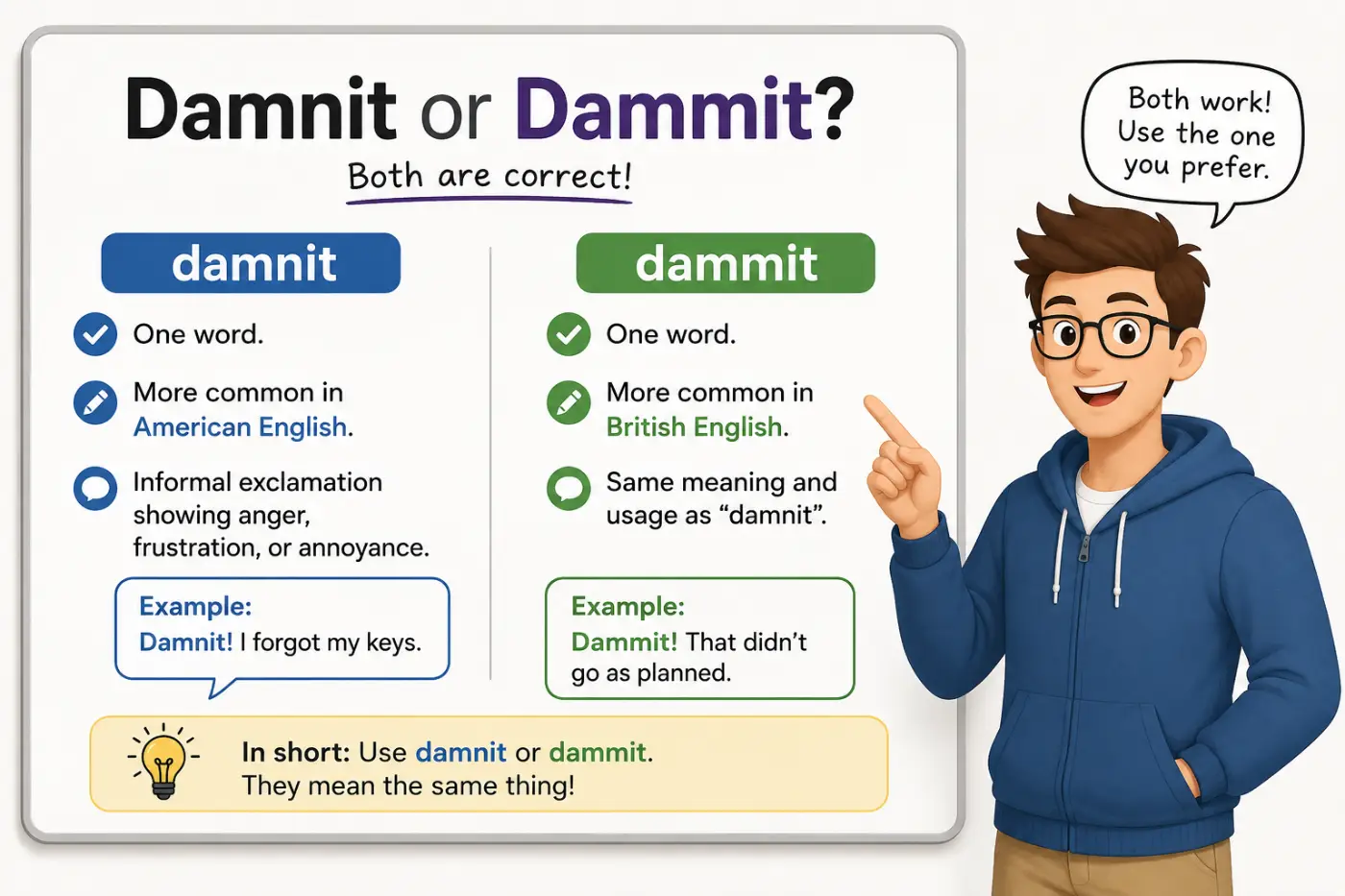
Have you ever typed damnit or dammit and stopped for a second because you were not sure which one was correct? You are not alone. Many English learners and even native speakers get confused by these two spellings. They look almost the same, and both appear in text messages, social media posts, and online comments.
The good news is that the answer is simple. Once you understand the small difference, you will know which spelling to use every time. This guide explains in clear, everyday English. You will see simple examples, learn why people mix them up, and discover which form is more common.
By the end of this lesson, you will feel confident using the right spelling in writing. You will also understand where these words came from and why both forms still appear in everyday English.
A related grammar guide is Busyness vs Business: Which One Should You Use?.
Simple Answer in One Look
Dammit is the standard and more widely accepted spelling.
Damnit is also used by many people, but it is a less common spelling that developed from the same expression.
If you want the safest choice, use dammit.
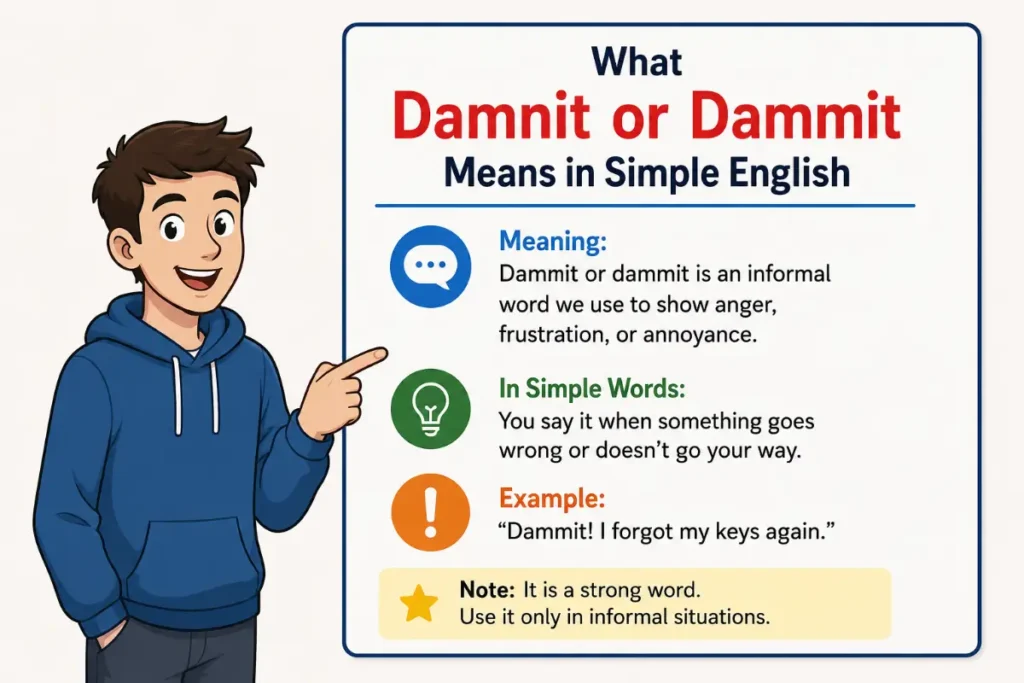
What Damnit or Dammit Means in Simple English
The words are both emotional expressions. People say them when they feel upset, annoyed, surprised, or frustrated. Think of them as short emotional reactions instead of full sentences. For example:
- “Dammit! I forgot my wallet.”
- “Dammit! The bus already left.”
The speaker is not trying to explain something. They are simply showing strong feelings.
People often say this expression after:
- Making a mistake.
- Losing something.
- Missing an opportunity.
- Breaking an object.
- Feeling disappointed.
You will hear it in movies, TV shows, books, and everyday conversations between adults.
Because it expresses frustration, many people consider it a mild swear word. It is less offensive than stronger curse words, but it is still not suitable for formal situations. For example, you should avoid using it in:
- School assignments.
- Business emails.
- Professional reports.
- Job interviews.
- Formal speeches.
Instead, choose softer expressions like:
- Oh no!
- Oops!
- That’s frustrating!
- What a mess!
- Oh dear!
These alternatives sound more polite.
Why People Mix These Words Damnit or Dammit
The confusion between both words happen for several simple reasons.
They Sound Almost the Same
When people speak quickly, the sounds are nearly identical.
For example:
“Dammit!”
“Damnit!”
Most listeners cannot hear a clear difference.
Both Spellings Appear Online
If you search social media or online forums, you will find both versions.
Someone may write:
“Dammit, I lost my keys.”
Another person may write:
“Damnit, my phone died.”
Seeing both spellings makes people wonder which one is actually correct.
The Original Phrase Changed Over Time
Long ago, people often said:
“Damn it.”
Over time, many speakers combined the two words into one.
That created:
- Dammit
- Damnit
Since spoken English changes naturally, both spellings spread through everyday writing.
Fast Typing Creates Habits
Many people type quickly on phones.
They often spell words the same way they hear them.
Because “damn it” is spoken very fast, people naturally create different spellings without thinking much about them.
Friends Copy Each Other
Language spreads through imitation.
If someone grows up seeing damnit, they may continue using it.
Someone else who mostly reads books may prefer dammit because it appears more often in published writing.
Clear Difference Explained Simply
Here is the easiest way to remember the difference.
| Dammit | Damnit |
|---|---|
| More common spelling | Less common spelling |
| Standard choice | Informal variation |
| Seen more often in books | Seen more often online |
| Better for general writing | Mostly personal preference |
| Recommended choice | Acceptable but less common |
You can also remember this simple rule:
- If you are unsure, choose dammit.
- If you see damnit, understand that many people still use it informally.
The meaning stays the same.
Which Form Should You Use?
If your goal is clear English, use dammit. That is the spelling most dictionaries, publishers, and editors recognize.
Choose dammit when writing:
- Stories.
- Articles.
- Blog posts.
- Fiction.
- Scripts.
- Personal journals.
Avoid using either spelling in formal writing because they are still mild profanity.
Instead, replace them with softer words.
For example:
Instead of:
“Dammit! I missed the train.”
You could write:
“Oh no! I missed the train.”
Or:
“That’s frustrating.”
These choices sound more polite.
Easy Rule
Remember this sentence:
Dammit is the standard spelling. Damnit is a common variation.
That single rule answers most questions about words.
Easy Real-Life Sentences You Can Use Damnit or Dammit
Here are some natural examples.
- Dammit! I forgot my homework.
- Dammit, my coffee spilled.
- Dammit! I pressed the wrong button.
- Dammit, we missed the movie.
- Dammit! My phone battery died.
- Dammit, I left my keys inside.
- Dammit! The game just crashed.
- Dammit, I was so close to winning.
Now compare them with the less common spelling.
- Damnit! I forgot my umbrella.
- Damnit, I made another mistake.
These examples still make sense, but most editors would prefer dammit.
Where This Word or Expression Comes From (Simple History)
The story behind this expression is easy to understand. Long ago, English speakers used the phrase:
Damn it.
The word damn has existed in English for hundreds of years. It originally referred to punishment or condemnation in religious language. Over time, people began saying “damn it” whenever something went wrong. As spoken English became faster, many people stopped pronouncing the space between the words.
Instead of saying:
“Damn…it”
they said:
“Dammit!”
Eventually, writers started spelling the spoken sound as one word. That is how dammit became common. Later, some people wrote the same sound as damnit, creating another informal spelling. Both spellings represent the same spoken expression. Today, dammit appears more often in published books, subtitles, and edited writing, while damnit remains a common informal variant in casual online communication.
Language changes because people speak naturally. Sometimes new spellings appear simply because different people hear the same sound in different ways. That is exactly what happened here. As a result, modern English now contains both spellings, even though dammit remains the preferred choice for most writers.
Understanding this history makes the answer to much easier to remember. The expression started as damn it, became joined together in everyday speech, and developed two common spellings, with dammit becoming the standard form.
As you continue learning English, you will notice many other words that change in similar ways. Spoken language often becomes shorter, faster, and easier to pronounce. Sometimes those spoken changes also create new spellings. Knowing how this happens will help you recognize similar expressions and feel more confident whenever you come across them. In the next section, we will look at how this expression is understood in culture, where it appears in stories and media, and how people use it naturally in everyday English.
How Damnit or Dammit Is Understood in Culture and Stories
The expression is often used to show sudden frustration. You will hear it in movies, TV shows, books, and everyday conversations. People usually say it when something goes wrong or when they make a mistake. For example, a character may drop a cup and say:
“Dammit!”
This tells the audience that the person is annoyed. The word adds emotion without needing a long explanation.
You may also hear it after someone:
- Misses a bus.
- Loses a game.
- Forgets something important.
- Breaks a phone.
- Makes a silly mistake.
Writers use this expression because it sounds natural. It helps readers understand how a character feels right away. In comedy, the word can make a funny scene feel more real. In action movies, it can show that a hero is angry after something unexpected happens. Mystery stories, it may show disappointment after a clue is lost.
Even though it is common in entertainment, remember that it is still considered mild profanity. Some families and workplaces avoid using it. People also choose softer words when speaking to children or in formal situations.
Still confused? Compare Pricy or Pricey: Which Is Correct and How Should You Use It?.
Biblical and Mythological Meaning of Damnit or Dammit
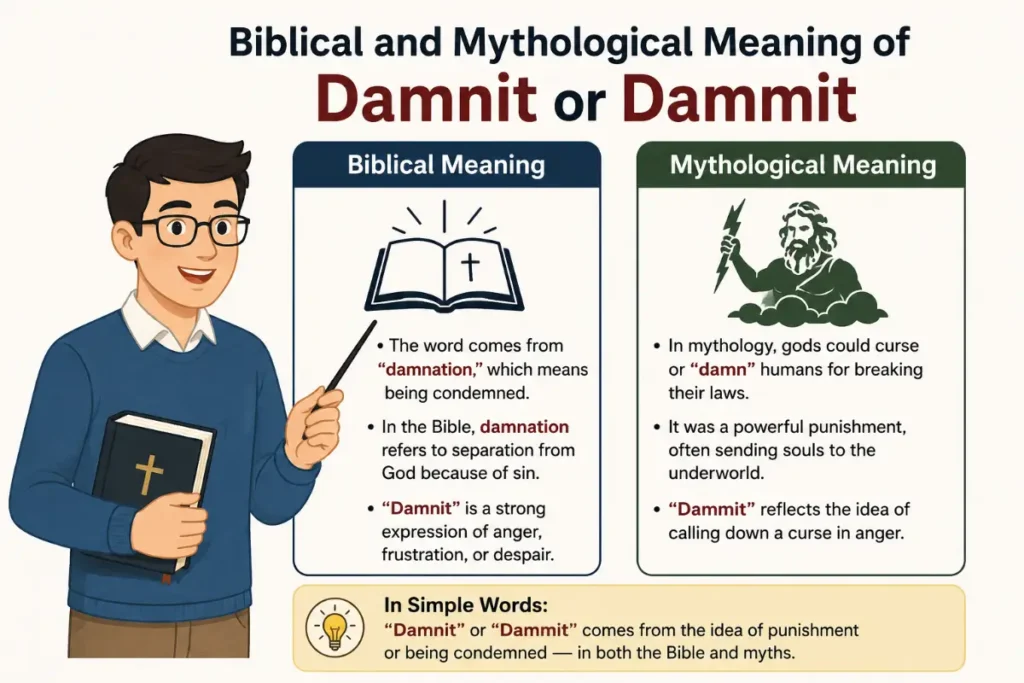
There is no special biblical meaning. The expression comes from the word “damn,” which appears in religious language. In older English, “damn” meant to condemn someone or something. Because of that history, some religious people avoid saying both words. They believe the word should not be used as a casual expression.
Others see it only as a common expression of frustration and do not think about its original meaning. There is also no well-known mythological meaning connected. Today, most people use the expression simply to show emotion, not to make a religious statement.
Symbolism Explained in Simple Words
What Dammit Represents
The spelling dammit usually represents quick frustration.
It often shows:
- Annoyance.
- Surprise.
- Disappointment.
- Stress.
- Regret.
Because it is the standard spelling, readers usually recognize it immediately.
It feels like a natural spoken reaction.
What Damnit Represents
The spelling damnit represents the same emotion.
It may also suggest:
- Casual online writing.
- Personal spelling habits.
- Informal texting.
- Fast typing.
It does not change the meaning.
The difference is mainly the spelling, not the feeling.
Both forms express frustration, but dammit is the spelling most teachers, editors, and dictionaries recommend.
Related Words You Should Know
Here are some related words and expressions that can help you understand better.
- Damn – The original word. It can be a verb or an exclamation depending on the sentence.
- Damn it – The original two-word phrase that later became “dammit.”
- Heck – A polite replacement for “damn.”
- Darn – A very mild and family-friendly substitute.
- Shoot – A soft expression people use after making a mistake.
- Oops – Used when something small goes wrong.
- Oh no – A polite way to show disappointment.
- Blast – An older English expression that shows frustration.
- Good grief – A gentle expression that shows surprise or annoyance.
- For goodness’ sake – A polite phrase used when someone feels frustrated.
Learning these alternatives helps you choose the right expression for different situations.
How People Actually Use It in Daily English
People usually say dammit during unexpected moments. Here are some real-life examples.
- “Dammit! I left my wallet at home.”
- “Dammit, I forgot your birthday.”
- “Dammit! The computer froze again.”
- “Dammit, we missed the last train.”
- “Dammit! I spilled coffee on my shirt.”
- “Dammit, my internet stopped working.”
- “Dammit! I answered the wrong question.”
- “Dammit, I dropped my phone.”
- “Dammit! I locked myself outside.”
- “Dammit, I should have checked the time.”
Now look at the same idea using softer expressions.
- “Oh no! I forgot my keys.”
- “Oops! I made a mistake.”
- “That’s frustrating.”
- “What a mess.”
- “Well, that didn’t go as planned.”
These choices work better in schools, offices, and professional writing.
Common Mistakes People Make Damnit or Dammit
Many learners make the same mistakes when using words.
Mistake 1: Thinking Only One Exists
Some people believe damnit is completely wrong.
Correction:
It is a real informal spelling, but dammit is more common and more widely accepted.
Mistake 2: Using It in Formal Writing
Some students write:
“Dammit, the experiment failed.”
Correction:
Formal writing should avoid emotional expressions like this.
A better sentence is:
“Unfortunately, the experiment failed.”
Mistake 3: Confusing It With “Damn It”
Some learners think they always have to write one word.
Correction:
Both forms exist.
“Damn it” is the original phrase.
“Dammit” is the joined form.
Mistake 4: Using It Around Everyone
Some people forget that not everyone likes mild swear words.
Correction:
Think about your audience.
Use polite alternatives when speaking with children, teachers, customers, or older relatives.
Mistake 5: Thinking the Meaning Changes
Some learners think both words have different meanings.
Correction:
They mean the same thing.
Only the spelling is different.
Final Teacher Explanation
Imagine you are sitting in an English classroom.
A student asks, “Should I write?”
My answer would be very simple.
Use dammit if you want the safest and most common spelling.
If you see damnit, do not worry. It has the same meaning. Many people still use it in casual writing, especially online.
Now remember another important lesson.
Even though dammit is common, it is still a mild swear word.
That means you should not use it in school papers, business emails, or formal reports.
Instead, choose polite expressions like:
- Oh no!
- Oops!
- That’s frustrating.
- What a shame.
Good English is not only about correct spelling. It is also about choosing the right words for the right situation. If you remember that simple rule, you will make better choices every time you write.
Final Answer About Damnit or Dammit (Quick Recap)
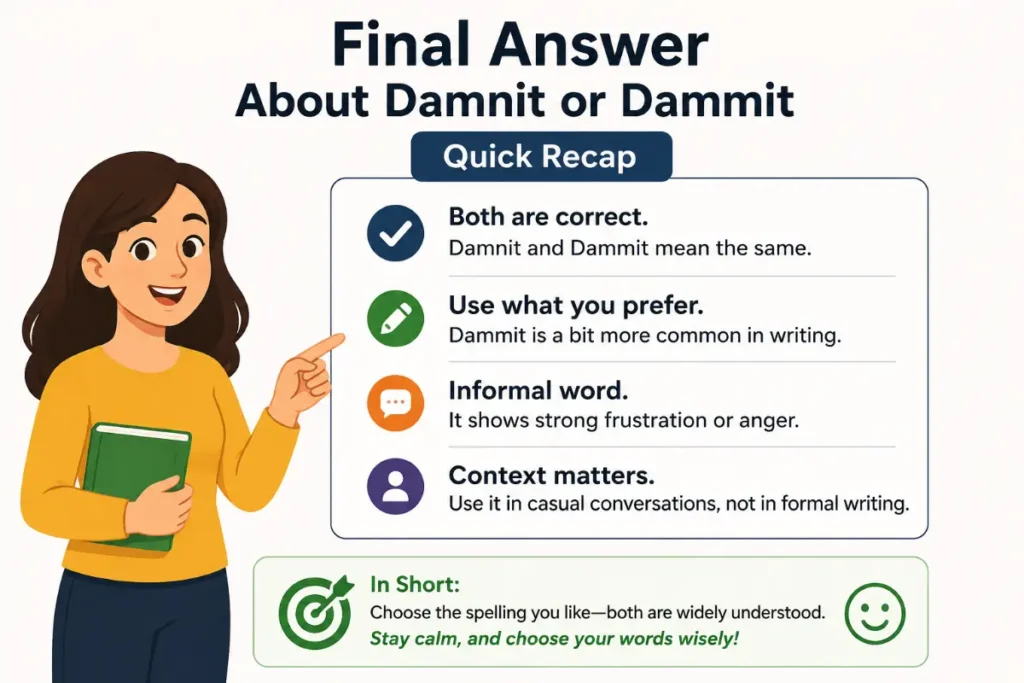
If someone asks which is correct, the best answer is dammit. It is the standard spelling that appears more often in dictionaries, books, and edited writing.
The spelling damnit is also used by many people, especially in casual online conversations and text messages. It carries the same meaning but is less common.
The easiest rule to remember is this: use dammit when you need one-word spelling, avoid both forms in formal writing, and choose polite alternatives whenever the situation calls for respectful language.
Still confused? Compare Transferred or Transfered: Simple Guide to Spelling and Meaning.
Conclusion
The question is much easier than it first seems. Both spellings express frustration, but dammit is the spelling most writers, editors, and dictionaries prefer.
You also learned that the expression comes from the older phrase “damn it.” Over time, people joined the words together, and different spellings appeared in everyday writing.
The one takeaway to remember is simple: When you are unsure between damnit or dammit, choose dammit. It is the clearer and more widely accepted spelling.
Frequently Asked Questions (FAQs)
What does dammit mean in simple words?
It is a short expression people use when they feel frustrated, annoyed, or disappointed.
Which is correct?
Both spellings exist, but dammit is the standard and more common choice.
Why do people get confused?
They sound almost the same when spoken, and both spellings appear online.
Can I use dammit in school writing?
No. It is better to avoid it in formal writing because it is considered a mild swear word.
Is damnit a real word?
Yes. It is an informal spelling that many people use, but it is less common than dammit.
Is “damn it” the same as “dammit”?
Yes. “Damn it” is the original two-word phrase, and “dammit” is the combined form.
What can I say instead of dammit?
You can say “Oh no,” “Oops,” “That’s frustrating,” “Darn,” or “Heck” if you want a more polite expression.
Which spelling should English learners remember?
Remember dammit. It is the spelling you will see most often in books, articles, and edited writing.
