

Many people search for noteable or notable because both words look like they could be correct. The extra e in noteable makes it seem natural. That is why this spelling mistake is so common. If you have ever paused before writing this word you are not alone.
The short answer is simple. Notable is the correct spelling in modern English. Noteable is considered a misspelling in almost every case. You should use notable in school writing business writing emails blogs and everyday conversations.
In this guide you will learn the difference between in very simple English. You will also see easy examples simple tips and the reason so many people make this mistake. By the end you will know which spelling to use with confidence.
Many readers also check Conex or Connex: Simple Grammar and Usage Guide.
Simple Answer in One Look
Notable is the correct spelling.
Noteable is a misspelling and should not be used in normal English writing.
What Noteable or Notable Means in Simple English
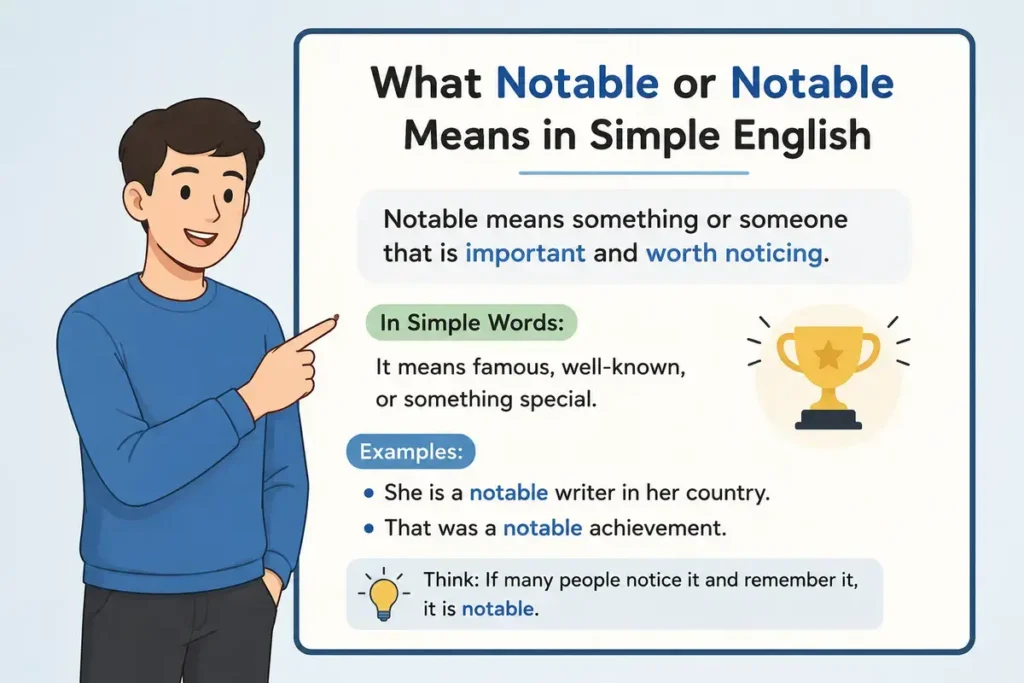
The word notable describes someone or something that is worth noticing. It often means important well known special or impressive. If something stands out from others it can be called notable. Here are a few simple examples.
- She made a notable improvement in math.
- The city has many notable buildings.
- He is a notable scientist.
- There was a notable change in the weather.
- Her speech had a notable effect on the audience.
In every example the word notable shows that something deserves attention because it is different important or memorable. You may think the word should be spelled noteable because it looks like it comes from the word note. That sounds reasonable but English spelling does not always follow simple patterns. The accepted spelling is notable without the extra e.
Simple Meaning You Can Remember
Think of notable as meaning:
- Worth noticing.
- Easy to remember.
- Important.
- Famous.
- Special.
- Different in a good way.
If one of these meanings fits your sentence then notable is probably the right word.
Why People Mix These Words
Many English spelling mistakes happen because people try to follow patterns they already know. That is exactly what happens with both words. People often think like this. “The word note ends with an e. So maybe adding able should keep the e.” That idea works with some words but not with this one. English has many spelling rules but it also has many exceptions.
Another reason is pronunciation. Both words sound almost the same when spoken quickly. Since people cannot hear the spelling they often guess when writing. Typing on phones also causes mistakes. Autocorrect may fix some spelling errors but it does not always catch every mistake. A person may also type too fast and never notice the extra letter. Here are some common situations where people become confused.
- Writing a school essay.
- Sending a work email.
- Creating a blog post.
- Posting on social media.
- Preparing a report.
- Writing a resume.
- Taking an English test.
Many English learners also ask about words because they see many words ending with able. For example:
- Comfortable.
- Reasonable.
- Dependable.
- Valuable.
They expect the same pattern every time. Sadly English is not always that predictable.
Clear Difference Explained Simply
The difference is actually very easy.
| Word | Correct | Meaning | Should You Use It |
|---|---|---|---|
| notable | Yes | Worth noticing or important | Yes |
| noteable | No | Misspelling | No |
You only need to remember one simple rule.
Always write notable.
Never add the extra e.
Quick Visual Trick
Think like this.
❌ noteable
✅ notable
The shorter spelling is the correct one.
Easy Memory Tip
Notice that notable is the spelling you will find in dictionaries newspapers books and trusted websites.
If you ever see noteable it is almost always a spelling mistake.
Which Form Should You Use for Noteable or Notable?
You should always choose notable. This is the standard spelling in both American English and British English. There is no common situation where noteable is preferred. Use notable when talking about:
- Famous people.
- Important events.
- Big changes.
- Strong improvements.
- Special achievements.
- Interesting facts.
- Well known places.
Here are a few examples.
- She made notable progress this year.
- The museum has notable works of art.
- It was a notable success.
- The company achieved notable growth.
- That actor has many notable performances.
Every sentence uses the correct spelling.
A Simple Rule to Remember
Ask yourself one question.
“Am I trying to say something is worth noticing?”
If the answer is yes then write notable.
Do not write noteable.
Easy Real Life Sentences You Can Use
Reading real examples helps you remember spelling faster. Here are some everyday sentences.
- She made a notable difference in the project.
- His grades showed notable improvement.
- That book became notable after winning an award.
- We saw a notable increase in sales.
- The teacher noticed a notable change in my writing.
- This town has several notable landmarks.
- Her kindness made a notable impression on everyone.
- The player made a notable comeback after the injury.
These examples sound natural because they use the correct spelling.
Now compare them with incorrect versions.
❌ She made a noteable difference.
✅ She made a notable difference.
❌ It was a noteable event.
✅ It was a notable event.
The correct spelling always looks cleaner once you become familiar with it.
Where does Words Expression Comes From Simple History
The word notable has been part of English for many centuries. It came into English from Old French. Before that it came from Latin. The original idea was simple. It described something that was worth noticing or marking because it was special or important. Over time English kept the spelling notable.
Even though many people later started writing noteable the standard spelling never changed. Today dictionaries schools publishers and style guides all use notable. That is why you should use it too.
Why the Extra E Never Became Standard
English spelling changed many times over hundreds of years. Some spellings became official while others slowly disappeared.
The version notable became the accepted form because it matched the historical spelling used by writers and printers.
The spelling noteable never became standard English.
That is why you rarely see it in trusted books or professional writing.
Fun Fact
Many English words look like they should have an extra letter but they do not. That is one reason English spelling can feel tricky. The good news is that once you learn notable you will probably never confuse it again.
As you can see the answer is simple. The correct spelling is notable, and it is the form used in modern English everywhere from classrooms to newspapers and professional writing. In the next section, we will go beyond spelling and explore how this word is understood in culture, stories, symbolism, and everyday communication, along with more practical examples that make it even easier to remember.
Many readers also check Bellies vs Bellys: Which One Is Correct in English?.
How Is Understood in Culture and Stories
The word notable is often used to describe people, places, events, or ideas that stand out. Across many cultures, people remember those who do something meaningful. They may help others, make a great discovery, show courage, or create something beautiful. A notable person does not always have to be famous around the world. Someone can be notable in a family, a school, a town, or a workplace.
For example, a teacher who helps hundreds of students may be a notable person in that community. A firefighter who saves lives can also be notable. A scientist who finds a new medicine is notable because of their work. Stories often focus on notable characters because they teach lessons. These characters usually show kindness, honesty, bravery, patience, or wisdom.
In children’s stories, the notable character is often the one who makes the right choice even when it is difficult. In real life, people also become notable because they work hard over many years. The word does not simply mean “famous.” It also means someone or something deserves attention for a good reason. When people search they are usually trying to find the correct spelling before writing about someone important. That is why learning the correct form is useful.
Biblical and Mythological Meaning
The Bible does not use the word notable as a special religious word with one fixed meaning. However, many Bible translations use notable to describe people, events, signs, or days that are remarkable or well known. For example, a notable event may be one that changes history or teaches an important lesson. Many well-known people in the Bible became notable because of their faith, courage, or leadership. Examples include:
- Moses leading his people.
- David showing courage.
- Esther protecting her people.
- Paul spreading his message.
These people became notable because of what they did, not because they wanted fame. In mythology, heroes are also described as notable because they complete great adventures or show unusual strength and wisdom. The idea stays the same. A notable person is remembered because they made a difference. The spelling noteable has no special biblical or mythological meaning. It is simply a spelling mistake.
Symbolism Explained in Simple Words
What Notable Represents
The correct word notable often represents:
- Achievement.
- Respect.
- Success.
- Leadership.
- Positive change.
- Excellence.
- Something worth remembering.
When you call something notable, you are saying it deserves attention for a good reason. It carries a positive feeling.
What Noteable Represents
The spelling noteable does not represent a different meaning. It simply represents a common spelling error. Sometimes it shows that a writer guessed the spelling based on the word note. That happens often because English spelling can be confusing. So the comparison is very simple.
| Word | Represents |
|---|---|
| Notable | Something important, impressive, or worth noticing. |
| Noteable | A spelling mistake that should be corrected. |

Related Words You Should Know about Noteable or Notable
Learning similar words helps you understand even better.
Noticeable
Something that is easy to see or observe.
Example: The stain is noticeable.
Famous
Known by many people.
Example: She is a famous singer.
Remarkable
Very impressive or surprising.
Example: He made remarkable progress.
Memorable
Easy to remember.
Example: It was a memorable vacation.
Important
Having great value or meaning.
Example: This is an important meeting.
Outstanding
Better than most others.
Example: She did an outstanding job.
Significant
Large enough to matter.
Example: There was a significant improvement.
Distinguished
Respected because of success or ability.
Example: He is a distinguished professor.
Well Known
Known by many people or within a group.
Example: It is a well-known restaurant.
Exceptional
Much better than normal.
Example: She has exceptional talent.
These words are often used in similar situations, but notable has its own special meaning of being worth noticing or remembering.
How People Actually Use it in Daily English
Native English speakers almost always use notable. Here are some natural examples you may hear.
- That was a notable improvement from last week.
- She is one of the most notable authors in our town.
- We noticed a notable drop in temperature.
- His speech made a notable impact.
- The team had a notable victory yesterday.
- There was a notable difference after the update.
- This museum has several notable paintings.
- Your writing shows notable progress.
- The company saw notable growth this year.
- It was a notable moment in history.
Notice that every sentence uses notable without the extra e. People do not normally write or say noteable. If they do, editors usually correct it.
Common Mistakes People Make
Many learners make the same spelling mistakes. Here are the most common ones.
Mistake 1
❌ Noteable
✅ Notable
Always remove the extra e.
Mistake 2
Thinking both spellings are accepted.
They are not.
Only notable is correct in modern English.
Mistake 3
Using notable when they really mean noticeable.
These words are similar but different.
Notable means important or worth noticing.
Noticeable means easy to see.
Example:
✅ There was a noticeable stain on the shirt.
✅ She made a notable contribution to science.
Mistake 4
Thinking notable only means famous.
That is not true.
Someone can be notable inside a small community without being famous everywhere.
Mistake 5
Adding extra letters because of similar words.
Many writers think the word comes directly from note.
That is why they write noteable.
Remember this easy rule.
If you mean important or worth noticing, write notable.
Final Teacher Explanation
Imagine I am standing in front of a classroom. A student raises a hand and asks, “Teacher, should I write?” My answer would be very short. Always write notable. That is the correct English spelling. The extra e does not belong there. If you remember only one thing from this lesson, remember this sentence. Notable is correct. Noteable is incorrect.
When you see someone who has done something special, you can describe that person as notable. When something important happens, you can call it a notable event. Someone makes big progress, you can say they made notable progress. The word is easy to use once you know the correct spelling. Reading books, newspapers, and trusted websites will help you see notable again and again.
Soon the correct spelling will feel natural. Every good writer makes spelling mistakes while learning. The goal is not to be perfect the first time. The goal is to learn the correct form and use it with confidence. Now you know the answer and you can avoid this common mistake every time you write.
Need another quick comparison? Read Encode vs Incode: Meaning, Differences, and Examples.
Final Answer About Noteable or Notable
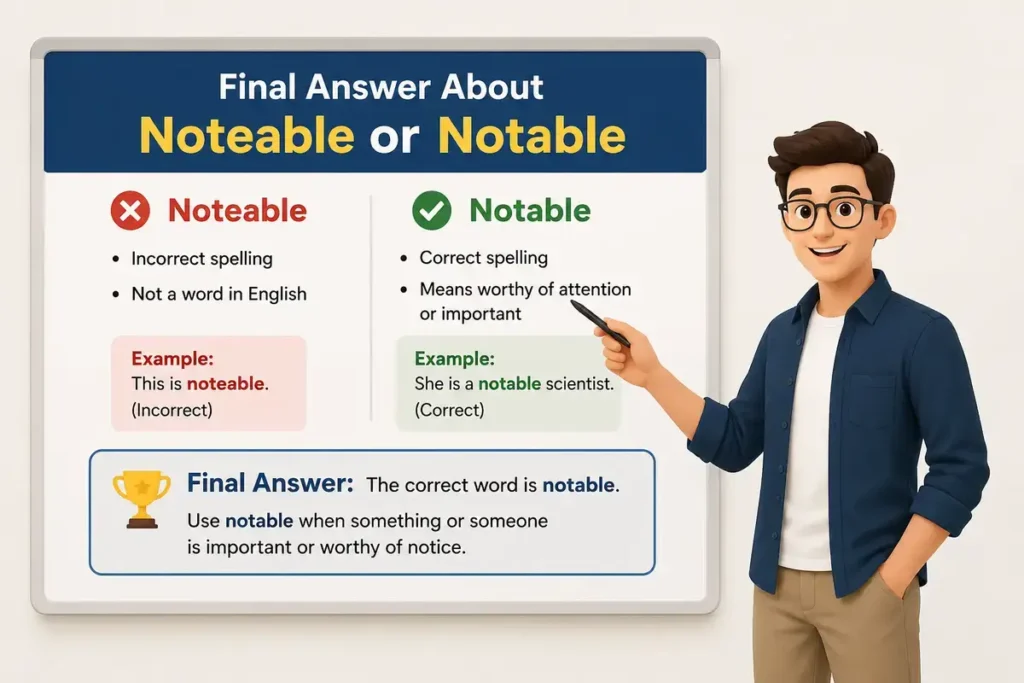
If you are choosing between both words, always choose notable.
It is the correct spelling in American English and British English.
Noteable is a spelling mistake and should not be used in normal writing.
Remember this simple rule.
Important or worth noticing equals notable.
Conclusion
Choosing between words is much easier once you know the simple rule. Notable is the correct spelling in modern English, while noteable is a misspelling that should be avoided. Use notable when you want to describe a person, place, event, or idea that is important, well known, or worth noticing. The more you read and practice, the more natural the correct spelling will become. If you ever stop and wonder which one to write, remember this easy sentence: Always use notable because it is the only correct spelling. This one simple rule will help you write with confidence in school, at work, and in everyday English.
Frequently Asked Questions
Is notable the correct spelling?
Yes. Notable is the correct spelling. Noteable is incorrect.
Is noteable ever correct?
No. Modern English dictionaries and style guides use notable.
What does notable mean in simple words?
It means important, well known, or worth noticing.
Why do people confuse?
Many people think the word should keep the e from note, but English does not spell it that way.
Can I use noteable in school writing?
No. Always use notable in school, work, and professional writing.
Is notable used in both American and British English?
Yes. Both American English and British English use notable.
What is the difference between notable and noticeable?
Notable means important or worth noticing. Noticeable means easy to see or observe.
How can I remember the correct spelling?
Remember this easy sentence: Notable is the only correct spelling. Never add the extra e.
