
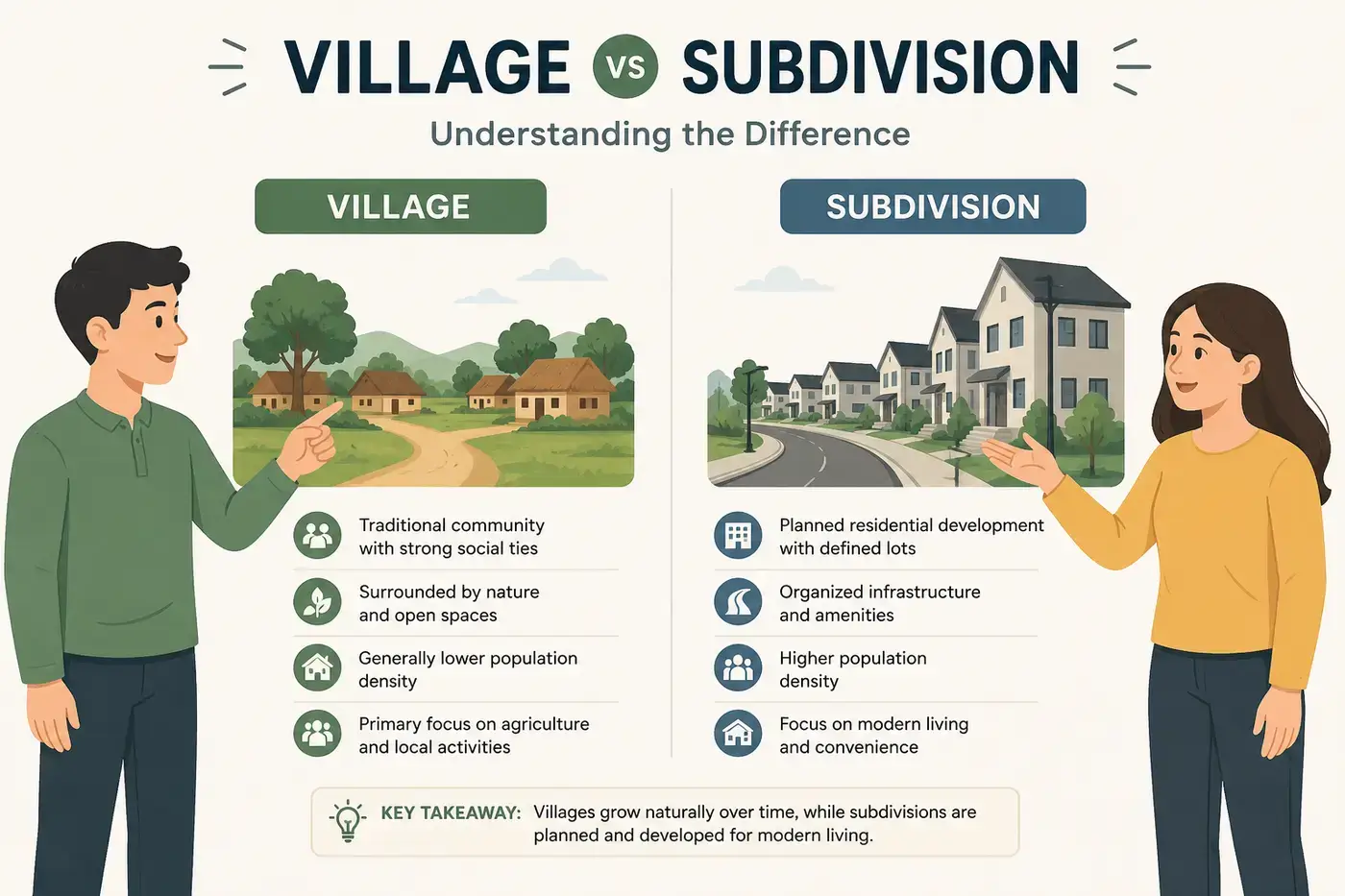
Many people get confused about village vs subdivision because both words describe places where people live. They may look similar at first, but they do not mean the same thing. Knowing the difference helps you speak and write more clearly.
The good news is that learning is easy. Each word has its own meaning, and each is used in different situations. Once you understand a few simple rules, you will know exactly which one fits.
This guide explains in very simple English. You will learn the meanings, the main differences, easy examples, and simple tips that you can remember every day.
Many readers also check Offered vs Offerred: Which Is Correct and How to Use It?.
Simple Answer in One Look About Village vs Subdivision
A village is a small community, often found in the countryside.
A subdivision is a planned neighborhood that developers build, usually near or inside a town or city.
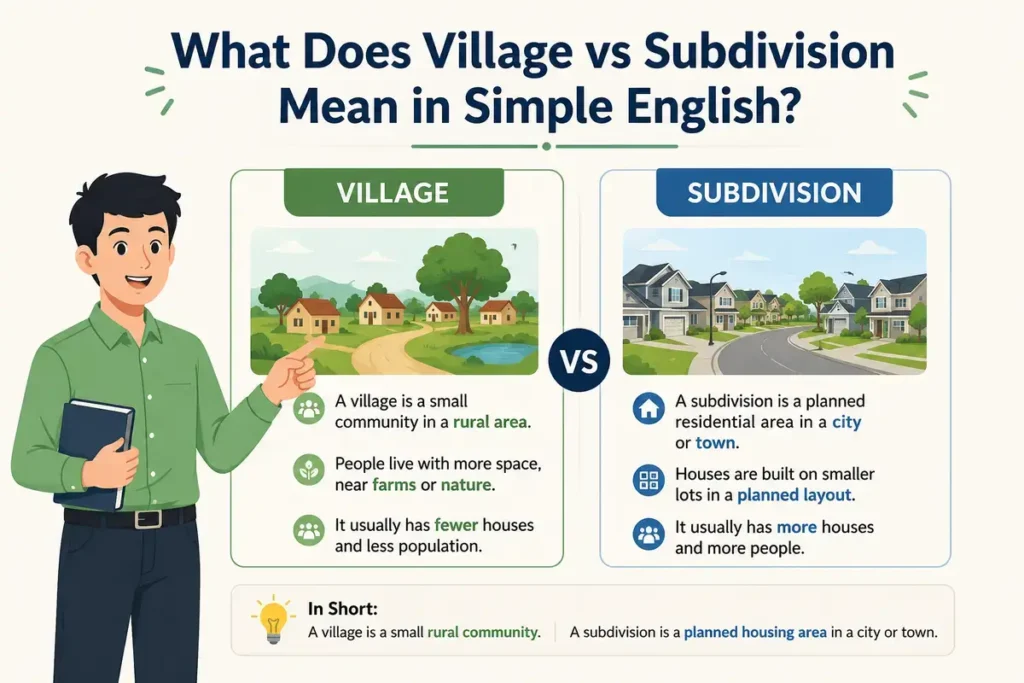
What Does Village vs Subdivision Mean in Simple English?
When people compare they are talking about two different kinds of communities. A village is usually a small place where people have lived for many years. Villages often have homes, schools, stores, parks, and places of worship. Some villages are very old and grew little by little over time.
A subdivision is different. It is a neighborhood that builders plan before they build it. The roads, houses, sidewalks, and parks are designed as one project. Many subdivisions are found around growing cities. Think of it this way.
- A village grows as a community.
- A subdivision is planned as a housing development.
Both are places where families live, but they are created in different ways.
Why Do People Mix Up Village and Subdivision?
Many people use these words as if they mean the same thing because both describe residential areas. Here are some common reasons for the confusion.
Both Have Houses
A village has houses.
A subdivision also has houses.
Because of this, people sometimes think they are the same.
Both Have Families
Children play outside in villages.
Children also play outside in subdivisions.
Both communities can feel friendly.
Both Can Have Parks
Some villages have parks.
Many subdivisions also include parks, playgrounds, or walking paths.
Both Can Feel Quiet
Some villages are peaceful because they are small.
Many subdivisions are also quiet because they are made for families.
Even with these similarities, their history, planning, and location are different.
Clear Difference Explained Simply
The easiest way to understand both words is to compare them side by side.
| Village | Subdivision |
|---|---|
| Usually grows naturally over time. | Planned and built by developers. |
| Often found in rural areas. | Usually found near towns or cities. |
| May be hundreds of years old. | Often newly built. |
| Can include farms and open land. | Mostly made up of homes and streets. |
| May have its own local government. | Usually belongs to a larger city or county. |
Here is another easy way to remember.
Village = Small community.
Subdivision = Planned neighborhood.
Picture It in Your Mind
Imagine driving into the countryside. You pass farms, a small school, a local store, and a group of homes. That is probably a village. Now imagine driving through a neighborhood where every house has a similar design. The streets curve neatly, sidewalks are everywhere, and a sign welcomes you at the entrance. That is probably a subdivision. This simple picture makes much easier to remember.
Which Form Should You Use in Village or Subdivision?
Choosing between these words depends on what you are describing. Use village when talking about a small community that exists as its own place. Examples include:
- a fishing village
- a mountain village
- a farming village
- a historic village
Use subdivision when talking about a planned housing area. Examples include:
- a new subdivision
- a family subdivision
- a residential subdivision
- a housing subdivision
Ask yourself one simple question. Was this community planned and built as one neighborhood? If the answer is yes, use subdivision. If the answer is no and it is simply a small community, use village.
Easy Memory Trick
Remember this sentence.
A village grows. A subdivision is planned.
This one idea will help you choose the correct word almost every time.
Easy Real-Life Sentences You Can Use With Village vs Subdivision
These examples show how the words are used in everyday English.
- My grandparents live in a quiet village.
- A new subdivision is being built outside the city.
- The village has one small grocery store.
- We moved into a beautiful subdivision last year.
- The village holds a summer festival every year.
- Their subdivision has a playground for children.
- Tourists enjoy visiting the old village.
- The subdivision has wide streets and many new homes.
Notice that village talks about the community itself, while subdivision often talks about a planned neighborhood.
Where Does Village and Subdivision Come From? (Simple History)
Understanding the history of these words makes their meanings even clearer. The word village comes from an old French word that meant a group of houses or a small settlement. Over hundreds of years, it became the English word we use today for a small community. The word subdivision is much newer. It comes from two parts.
- Sub means under or part of something larger.
- Division means something that has been separated into parts.
Together, subdivision means a part of a larger piece of land. Builders divide a large piece of land into smaller lots. Next, they carefully plan the subdivision before they build the homes. The history of these words matches how we use them today.
A village develops as a community.
A subdivision begins as a planned land project.
As you can see, understanding about more than learning two definitions. These words also tell us how communities begin and how they grow. In the next section, you will discover how people use these words in different cultures, what they symbolize, common mistakes to avoid, helpful comparisons with similar words, and practical tips that make choosing the right word even easier.
How Is Village vs Subdivision Understood in Culture and Stories?
When people talk about words they are often thinking about more than buildings. These words also bring different feelings and ideas. A village often reminds people of tradition, family, and close friendships. In many stories, everyone knows one another. Neighbors help each other, celebrate together, and solve problems as a community.
A subdivision usually represents modern living. It brings to mind new homes, organized streets, playgrounds, and growing families. Many people think of subdivisions as comfortable places with planned neighborhoods. Neither word is better than the other. They simply describe different kinds of communities.
In books and movies, a village may be shown as peaceful and full of history. A subdivision may be shown as a fresh start where families move to begin a new chapter in life. These ideas are based on culture and storytelling. Real villages and subdivisions can all be unique.
Still confused? Compare Any Time vs Anytime: Which Is Correct and How to Use (2026).
Is There a Biblical or Mythological Meaning for Village and Subdivision?
There is no direct biblical meaning. However, the Bible mentions villages many times. People lived in villages, traveled through villages, and gathered there for work, worship, and daily life. Villages were small communities where people knew each other well. The word subdivision does not appear in the Bible because planned housing developments did not exist in the way they do today.
In mythology, there is also no special meaning for subdivision. So, if you are comparing only the word village has a long history in ancient writings.
Symbolism Explained in Simple Words
People sometimes connect these words with different ideas and emotions.
What Does Village Represent:
A village often represents:
- Community
- Friendship
- Tradition
- Family life
- Peace
- History
- Simple living
When someone says, “It feels like a village,” they usually mean the people are friendly and everyone helps each other. A village often gives people a feeling of belonging.
What Does Subdivision Represent:
A subdivision often represents:
- Growth
- New beginnings
- Modern neighborhoods
- Planned living
- Family homes
- Organization
- Convenience
Many people think of subdivisions as safe neighborhoods where families can enjoy parks, sidewalks, and nearby schools. Both words create positive pictures, but they describe different lifestyles.
Now that you know the basic difference between both words, you can easily understand how people use these words in culture, stories, and everyday life. In addition, each word can create a different feeling about community and living spaces. In the next section, we will look at their deeper meaning, symbolism, and practical use in everyday English.
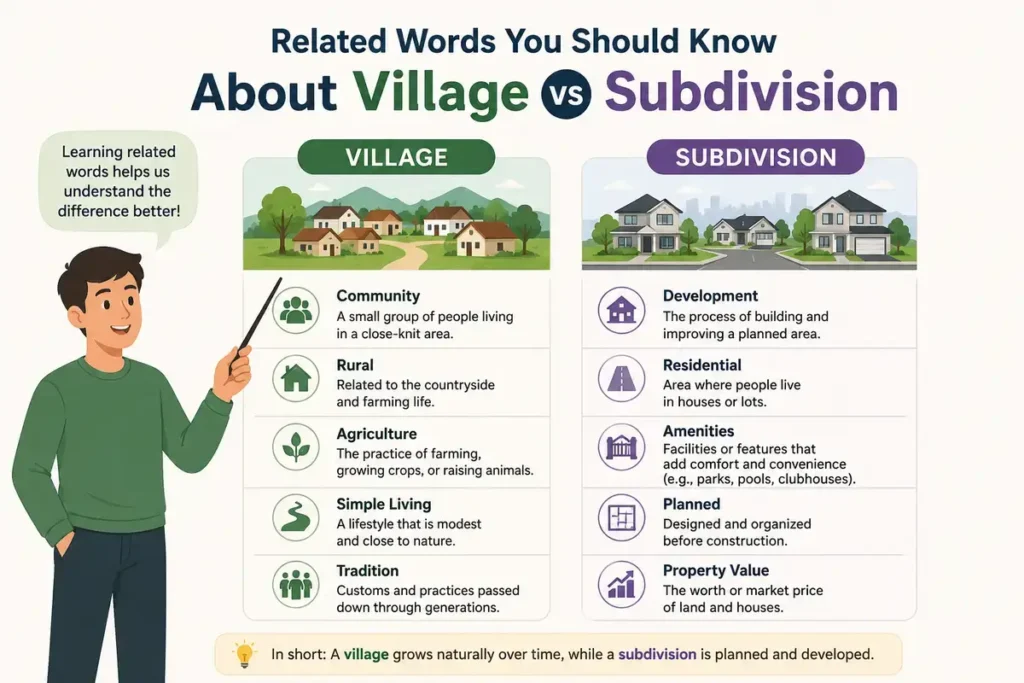
Related Words You Should Know About Village or Subdivision
Learning related words makes even easier to understand.
Community
A group of people living in the same place or sharing common interests.
Neighborhood
An area where people live, usually inside a town or city.
Town
A place that is usually larger than a village but smaller than a city.
City
A large place with many people, businesses, schools, and services.
Hamlet
A very small settlement that is usually smaller than a village.
Residential Area
A place where homes are built and people live.
Housing Development
A group of homes planned and built together. Many subdivisions are housing developments.
Municipality
A town, city, or village that has its own local government.
Settlement
Any place where people live together.
District
A section of a city, town, or region with its own name or purpose.
Knowing these related words helps you choose the right word for different situations.
How Do People Actually Use Village and Subdivision in Daily English?
People use these words naturally depending on where they live. Here are some common examples.
- We grew up in a small village near the river.
- They bought a house in a new subdivision.
- Our village has one elementary school.
- The subdivision has a community swimming pool.
- My uncle moved from the city to a quiet village.
- A new subdivision is opening next spring.
- Visitors love walking through the old village.
- The subdivision has wide sidewalks and bike paths.
- Their village celebrates a harvest festival every year.
- Many young families moved into the subdivision.
Notice that village usually describes a whole community, while subdivision usually describes a planned neighborhood inside a larger area.
Common Mistakes People Make About Village vs Subdivision
Many English learners make the same mistakes. Here are the most common ones.
Mistake 1: Thinking They Mean the Same Thing
❌ They bought a house in a village subdivision.
✅ They bought a house in a subdivision.
Or
✅ They bought a house in a village.
Use only the word that correctly describes the place.
Mistake 2: Calling Every Small Neighborhood a Village
A small neighborhood is not always a village.
If it was planned as a housing development, it is usually a subdivision.
Mistake 3: Calling Every Rural Place a Subdivision
A subdivision is carefully planned.
A rural community that developed naturally is usually a village.
Mistake 4: Forgetting the History
Villages often have long histories.
Subdivisions are usually much newer.
Remembering this difference makes choosing the right word easier.
Mistake 5: Using the Words Without Looking at the Location
Ask yourself:
- Is this a naturally formed community?
- Or is it a planned housing neighborhood?
The answer will usually tell you which word to use.
Final Teacher Explanation About Village and Subdivision
Imagine I am standing in front of a classroom. I would tell my students this. Do not worry if words seems confusing at first. Many people mix these words because both are places where people live. The easiest way to remember them is to think about how the community began.
A village grows naturally. It may have existed for many generations. It often has its own history, traditions, and local identity.
A subdivision is planned before people move in. Builders design the streets, divide the land into lots, and build homes as part of one project.
Neither word is right all the time. Choose the word that matches the place you are describing. If you remember this one simple idea, you will almost always choose the correct word. Village grows naturally. Subdivision is planned. That small rule is the key to understanding.
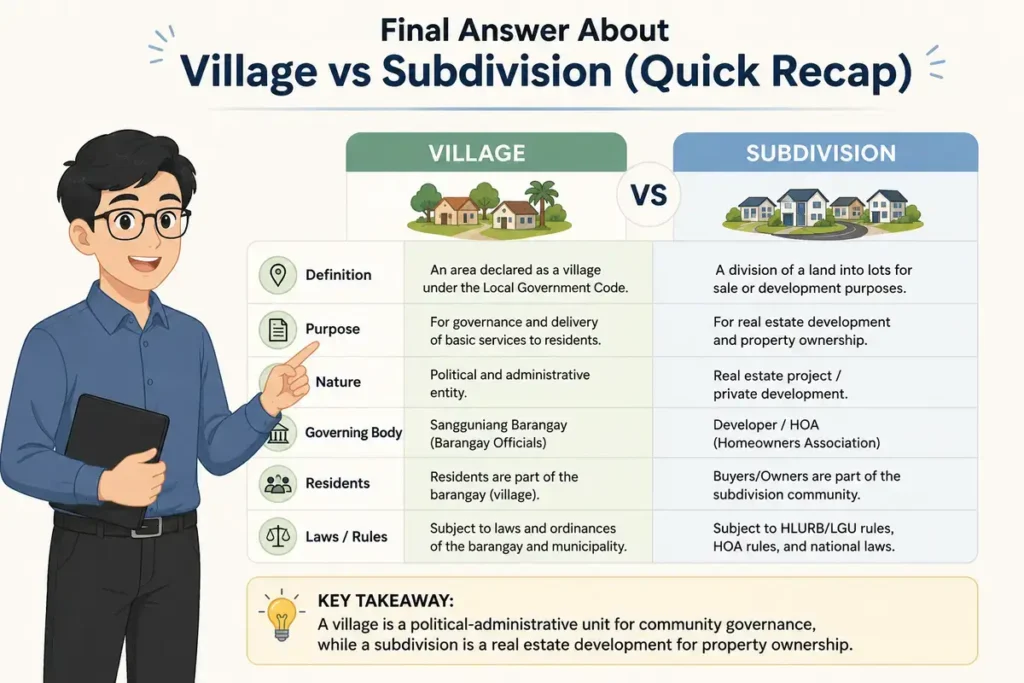
Final Answer About Village vs Subdivision (Quick Recap)
The difference between village vs subdivision is simple.
A village is a small community that often developed naturally over time.
A subdivision is a planned neighborhood built as part of a housing development.
Remember this easy rule: A village grows. A subdivision is planned.
Many readers also check Passtime or Pastime Which Word Is Correct and Why.
Conclusion
Understanding village vs subdivision is easier once you know what each word describes. A village is a small community that often grows naturally and has its own history and traditions. A subdivision is a planned neighborhood designed and built as a housing development. Although both are places where people live, they are not the same. Remember one simple rule: a village grows naturally, while developers plan a subdivision. Then you can choose the correct word with confidence when you speak or write.
Frequently Asked Questions (FAQs)
What does village mean in simple words?
A village is a small community where people live together. It is often smaller than a town.
What does subdivision mean in simple words?
A subdivision is a planned neighborhood where many homes are built on divided pieces of land.
What is the main difference?
A village develops naturally over time, while a subdivision is planned and built by developers.
Is it correct to use village and subdivision the same way?
No. They describe different kinds of communities and should not be used as synonyms.
Why do people confuse?
People confuse them because both are places where families live and both have houses and streets.
Can a subdivision be inside a village?
Yes. In some places, builders can create a new subdivision within or near a village if local planning rules allow it.
Which word should I use in everyday English?
Use village for a small community and subdivision for a planned housing neighborhood.
Is a subdivision bigger than a village?
Not always. A subdivision can be smaller or larger than a village. The main difference is how it was created, not its size.
