
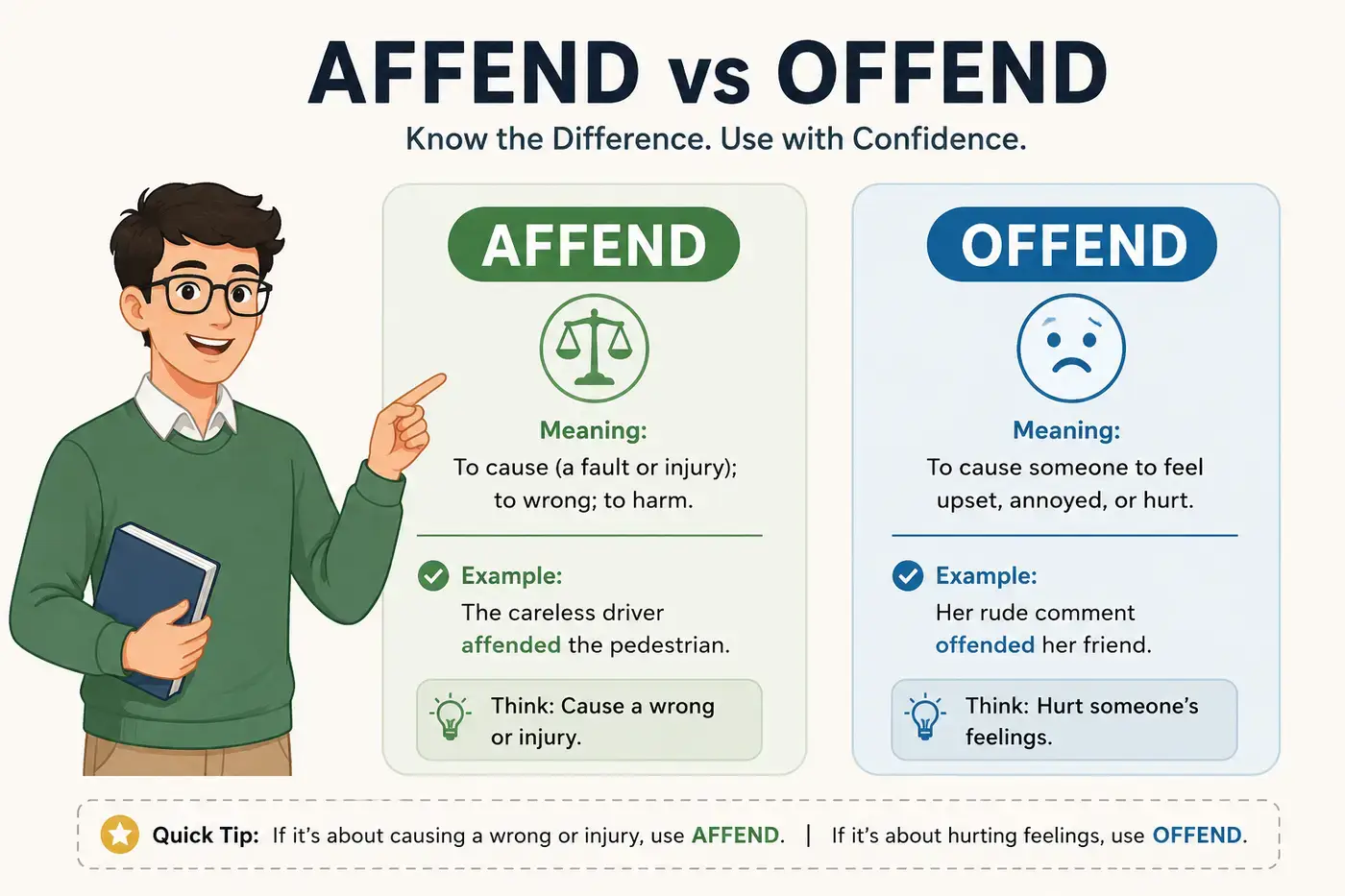
Many English learners search for affend vs offend because the two words look very similar. It is easy to think both words are correct. But only one of them is a real English word used in modern writing and speaking.
If you are confused about both words you are not alone. Many people make this spelling mistake when writing emails, school work, or social media posts. The good news is that the difference is very easy to understand.
This guide explains simple US English. By the end, you will know which word is correct, why people mix them up, and how to use the right spelling with confidence.
Many readers also check Oversight vs Oversite Complete Learning Guide (2026).
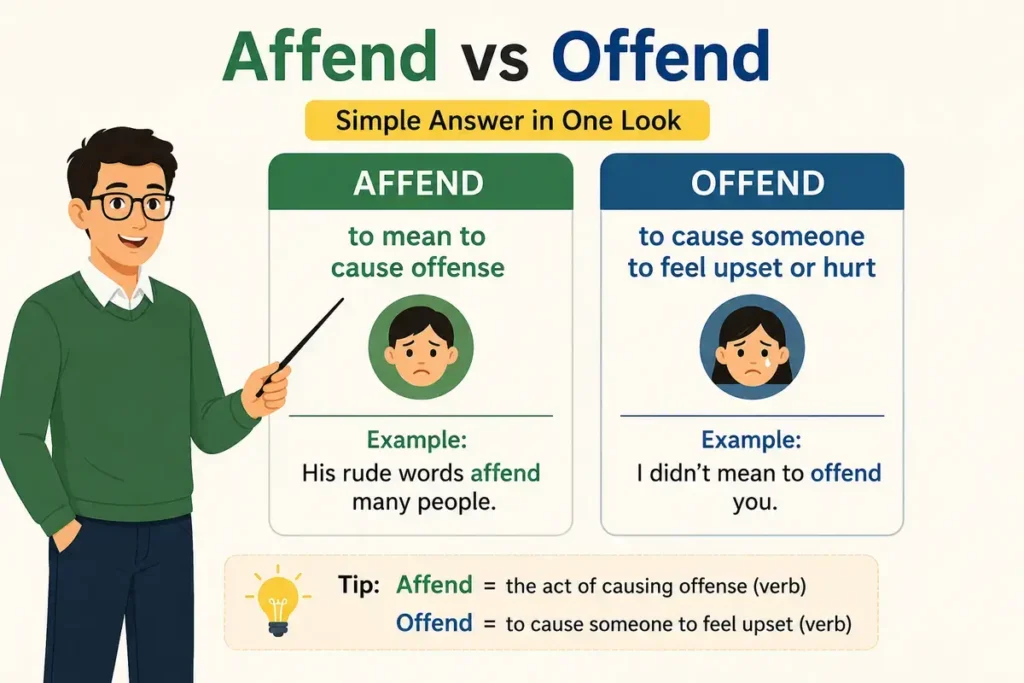
Simple Answer in One Look: Affend vs Offend
Offend is the correct English word.
Affend is not a standard English word. It is a spelling mistake.
If you want to say that someone feels hurt, upset, or insulted by words or actions, always use offend.
Correct: I did not mean to offend you.
Incorrect: I did not mean to affend you.
What Does Affend vs Offend Mean in Simple English?
The easiest way to understand and remember that only offend has a real meaning in everyday English. The word offend means to make someone feel hurt, upset, angry, or insulted. This can happen because of:
- Words
- Actions
- Jokes
- Comments
- Behavior
For example:
“My joke offended my friend.”
This means the joke hurt your friend’s feelings.
Sometimes people offend others without meaning to.
For example:
“I didn’t mean to offend anyone.”
Here, the speaker is saying they were not trying to hurt anyone’s feelings. Now let’s look at affend. The spelling affend is not accepted in modern English dictionaries. It has no standard meaning in everyday English. Most of the time, people write affend by accident when they really mean offend. So whenever you compare remember that only offend belongs in normal English writing.
Why Do People Mix Up Affend vs Offend?
Many people confuse because the words sound similar when spoken quickly. There are several reasons this mistake happens.
The Letters Look Similar
The words have almost the same letters. Compare them:
- affend
- offend
Only the first vowel changes. That tiny change makes many writers think both spellings are correct.
Fast Typing
People often type quickly on phones and computers. Instead of writing offend, they accidentally type affend.
Pronunciation Differences
English accents are different around the world. In some accents, the beginning sound of offend may sound a little unclear, leading learners to guess the spelling.
Learning English as a Second Language
English spelling is not always easy. Many learners expect words to be spelled exactly as they sound. That is why they sometimes write affend instead of offend.
Seeing the Wrong Spelling Online
Sometimes people copy mistakes from social media, comments, or unofficial websites. If they see affend enough times, they may believe it is correct. It is not.
Clear Difference Explained Simply
Here is the easiest way to remember the difference.
| Affend | Offend |
|---|---|
| Not a correct modern English word | Correct English word |
| A spelling mistake | Used every day |
| Not found as a standard dictionary entry | Found in all major dictionaries |
| Should not be used | Always use this spelling |
| Avoid in school and work writing | Correct for speaking and writing |
Think of it like this: When you want to talk about hurting someone’s feelings, there is only one correct choice. That choice is offend.
Quick Memory Trick for Affend vs Offend
Remember this simple sentence:
Offend starts with “O,” and “O” can remind you of “Oops.”
When someone feels hurt by your words, they may say, “Oops, that offended me.” This small trick helps many learners remember the correct spelling.
Which Form Should You Us Affend vs Offend?
The answer is simple.
Always use offend.
Never use affend in normal English writing.
Here are some easy rules.
Use Offend When Someone Feels Hurt
Examples:
- Don’t offend your friends.
- His words offended everyone.
- She was offended by the joke.
Use Offend for Actions Too
People can offend others by what they do, not only by what they say.
Example:
“He offended his teacher by being rude.”
Use Offended for Feelings
Example:
“I felt offended.”
This means your feelings were hurt.
Use Offensive for Things That Cause Offense
Example:
“That comment was offensive.”
The comment hurt people’s feelings.
Never Replace Offend with Affend
Even if you see affend somewhere online, do not copy it.
The correct spelling is always offend.
Easy Real-Life Sentences You Can Use with Affend vs Offend
These simple examples show how offend works in everyday English.
- I never want to offend my family.
- Please tell me if I offend you.
- His words offended many people.
- She apologized because she did not want to offend anyone.
- That joke may offend some people.
- We should speak kindly so we do not offend others.
- He looked offended after hearing the comment.
- I hope my question does not offend you.
Now look at the wrong examples.
❌ I did not affend you.
✅ I did not offend you.
❌ She was affended.
✅ She was offended.
❌ That will affend people.
✅ That will offend people.
Reading both correct and incorrect examples makes the right spelling easier to remember.
Where Does Offend Come From? Simple History Behind Affend vs Offend
The history of offend is actually quite interesting. The word comes from the old Latin word offendere. It meant:
- To strike against
- To upset
- To displease
- To cause trouble
Later, the word entered Old French before becoming part of English hundreds of years ago. Over time, English speakers used offend to describe hurting someone’s feelings, breaking rules, or doing something that causes anger. Today, the meaning is mostly about making someone feel upset or insulted. What about affend? Unlike offend, affend did not become a standard English word.
Sometimes old historical writings used similar spellings because English spelling was not fixed many centuries ago. Modern English dictionaries, schools, and style guides do not accept affend as the correct spelling. That is why today’s English always uses offend. If you remember the history, the choice becomes much easier.
You now know that offend is the real English word, while affend is simply a spelling mistake that many learners make. In the next section, we will look at how this word is used in culture, books, everyday conversations, common expressions, and practical situations so you can use offend naturally and confidently.
How Affend vs Offend Is Understood in Culture and Stories
The idea behind offend appears in many cultures around the world. People have always cared about treating others with kindness and respect. When someone says or does something hurtful, it can offend another person. That feeling is easy to understand because everyone has emotions.
In stories, movies, and books, characters often offend each other by accident. A simple misunderstanding, a rude comment, or a careless joke can create problems between friends or family members. Later, the characters usually apologize, forgive each other, and become close again.
This teaches an important lesson. Words are powerful. A kind word can make someone smile. A hurtful word can offend someone and damage a relationship. When people search they usually want to learn the correct spelling. At the same time, they also learn that choosing kind words helps avoid hurting other people’s feelings. Many cultures also teach people to think before speaking. For example:
- Speak politely.
- Listen carefully.
- Respect different opinions.
- Say sorry if you offend someone.
These simple ideas are understood almost everywhere. The word affend has no cultural meaning because it is not a standard English word. All these ideas belong to the correct word, offend.
Still confused? Compare Feel Or Feal: Which One Is Correct and Easy to Remember.
Biblical and Mythological Meaning of Affend vs Offend
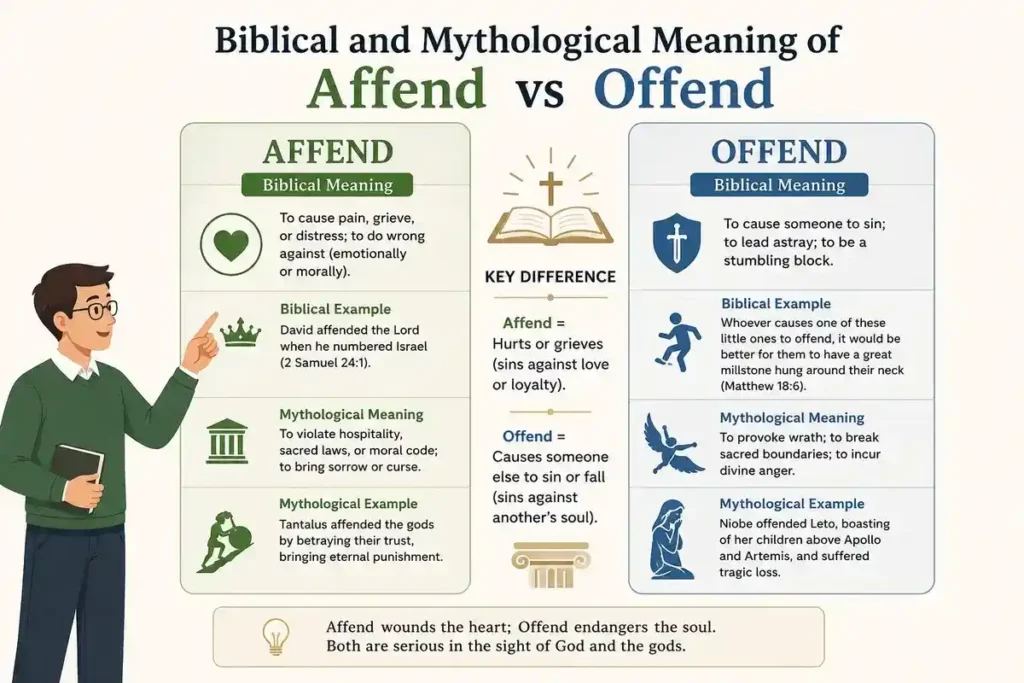
When talking about words only offend has meaning in the Bible and many religious writings. The Bible often talks about words, actions, kindness, forgiveness, and respect. People are encouraged to avoid hurting others with their speech or behavior. For example, believers are taught to:
- Speak with love.
- Avoid causing unnecessary pain.
- Forgive people who hurt them.
- Be careful with their words.
This does not mean people should never disagree. Instead, it teaches that disagreements should be handled with kindness and wisdom. In mythology, heroes and gods sometimes became offended because someone showed disrespect or broke an important rule. These stories remind readers that pride, respect, and forgiveness have always been important parts of human life. The spelling affend does not appear as a meaningful English word in these teachings.
Symbolism Explained in Simple Words
Sometimes words carry ideas beyond their dictionary meaning. Looking at this way makes the difference even clearer.
What Affend Represents
The word affend represents a common spelling mistake. It reminds us that English spelling can sometimes be confusing. Many learners write affend because they hear the sound and guess the spelling. There is nothing wrong with making mistakes while learning. Each mistake is a chance to improve.
What Offend Represents
The word offend represents hurt feelings or emotional pain. It also reminds people to think before speaking. Using respectful language helps build stronger friendships, happier families, and better workplaces. At the same time, the word reminds us that everyone makes mistakes. If you offend someone, a sincere apology can often repair the relationship. This makes offend a word connected with both responsibility and forgiveness.
Related Words You Should Know About Affend vs Offend
Learning related words makes much easier to remember.
Offended
This means someone felt hurt or insulted. Example:
“She felt offended by the comment.”
Offensive
This describes something that may hurt or upset people. Example:
“That joke was offensive.”
Offense
This is the feeling of being hurt or insulted. Example:
“He took offense at my words.”
Apologize
To say sorry after offending someone. Example:
“I apologized for my mistake.”
Respect
Showing kindness and good manners toward others.
Respect helps prevent people from feeling offended.
Insult
A rude word or action that hurts someone’s feelings.
Many insults offend people.
Hurt
To cause emotional or physical pain.
Words can hurt even when there is no physical injury.
Disrespect
Showing little care or politeness toward someone.
Disrespect often offends people.
How People Actually Use Affend vs Offend in Daily English
Native English speakers use offend in many everyday situations. Here are some common examples.
- I hope I didn’t offend you.
- That joke offended my sister.
- Please don’t offend our guests.
- She wasn’t offended by the comment.
- His words offended many people online.
- I never want to offend my parents.
- They apologized after offending their teacher.
- Some people are easily offended.
- We should think before we speak so we don’t offend others.
- I didn’t mean to offend anyone.
Notice something important. Every example uses offend, not affend. That is because affend is not correct English.
Common Mistakes People Make With Affend vs Offend
Many learners make the same mistakes. The good news is that they are easy to fix.
Mistake 1: Writing Affend
❌ I didn’t affend him.
✅ I didn’t offend him.
Always choose offend.
Mistake 2: Thinking Both Spellings Are Correct
Some people believe affend and offend are two different words.
They are not.
Only offend is correct.
Mistake 3: Forgetting the Double “F”
Some learners write:
❌ Ofend
Correct spelling:
✅ Offend
Remember that offend has two f letters.
Mistake 4: Using Offend When You Mean Hurt Physically
The word offend usually means hurting someone’s feelings, not causing physical injury.
Incorrect:
“He offended his arm.”
Correct:
“He hurt his arm.”
Mistake 5: Not Saying Sorry
If you offend someone by accident, a simple apology can make things better. For example:
“I’m sorry. I didn’t mean to offend you.”
That sentence sounds polite and natural.
Final Teacher Explanation of Affend vs Offend
Imagine you are sitting in my English class.
A student asks,
“Teacher, which is correct: affend or offend?”
My answer is always simple.
Use offend.
Never use affend in normal English writing.
Think about the meaning.
If someone feels hurt because of your words or actions, you have offended them. That is the correct word used by native English speakers, teachers, dictionaries, newspapers, and books. Do not worry if you have written affend before.
Almost every English learner makes spelling mistakes. The important thing is learning from them. Here is one easy trick to remember forever. Offend begins with “O.” Think of “Oops!” If your words hurt someone’s feelings, you may say, “Oops! I didn’t mean to offend you.” This simple memory trick helps many students remember the correct spelling every time. The more you read, write, and practice, the easier English spelling becomes.
Final Answer: Affend vs Offend
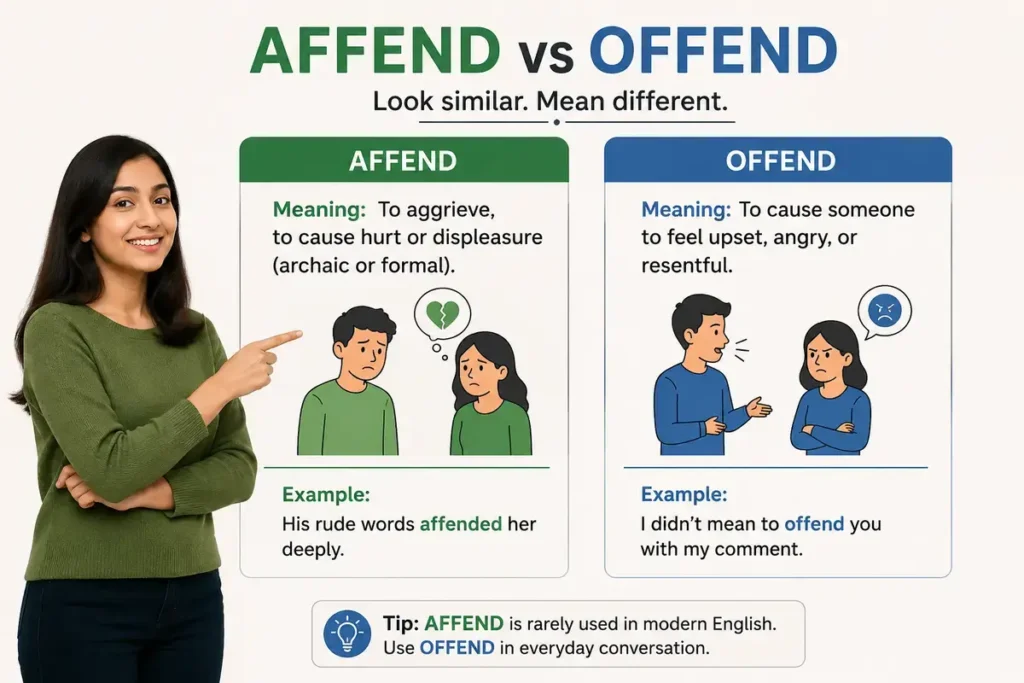
When comparing the answer is very clear.
Offend is the correct English word that means to hurt, upset, or insult someone’s feelings.
Affend is simply a spelling mistake and should not be used in speaking or writing. If you remember only one thing from this lesson, remember to always choose offend.
Many readers also check Different or Diffrent: Easy Guide With Examples (2026).
Conclusion
Learning affend vs offend is easier than it first seems. The only correct spelling in modern English is offend. It means to hurt, upset, or insult someone’s feelings through words or actions. The spelling affend is simply a common mistake and should be avoided in everyday writing, school assignments, emails, and professional communication. By practicing the correct spelling and using the examples in this guide, you can write with more confidence and avoid this common English error.
Frequently Asked Questions
What does offend mean in simple words?
It means to hurt someone’s feelings by your words or actions.
Is affend a real English word?
No. Affend is not a standard English word. Use offend instead.
Which is correct, affend or offend?
Offend is the correct spelling in modern English.
Why do people confuse?
The words look and sound similar, so many learners guess the wrong spelling.
Can I use affend in school or work writing?
No. Always write offend in formal and informal English.
Is offended different from offend?
Yes. Offend is the action. Offended describes the person’s feelings after the action.
Is offensive related to offend?
Yes. Offensive describes words, actions, or behavior that may offend people.
How can I remember the correct spelling?
Think of “Oops! I didn’t mean to offend you.” The “O” in Oops helps you remember offend.
