
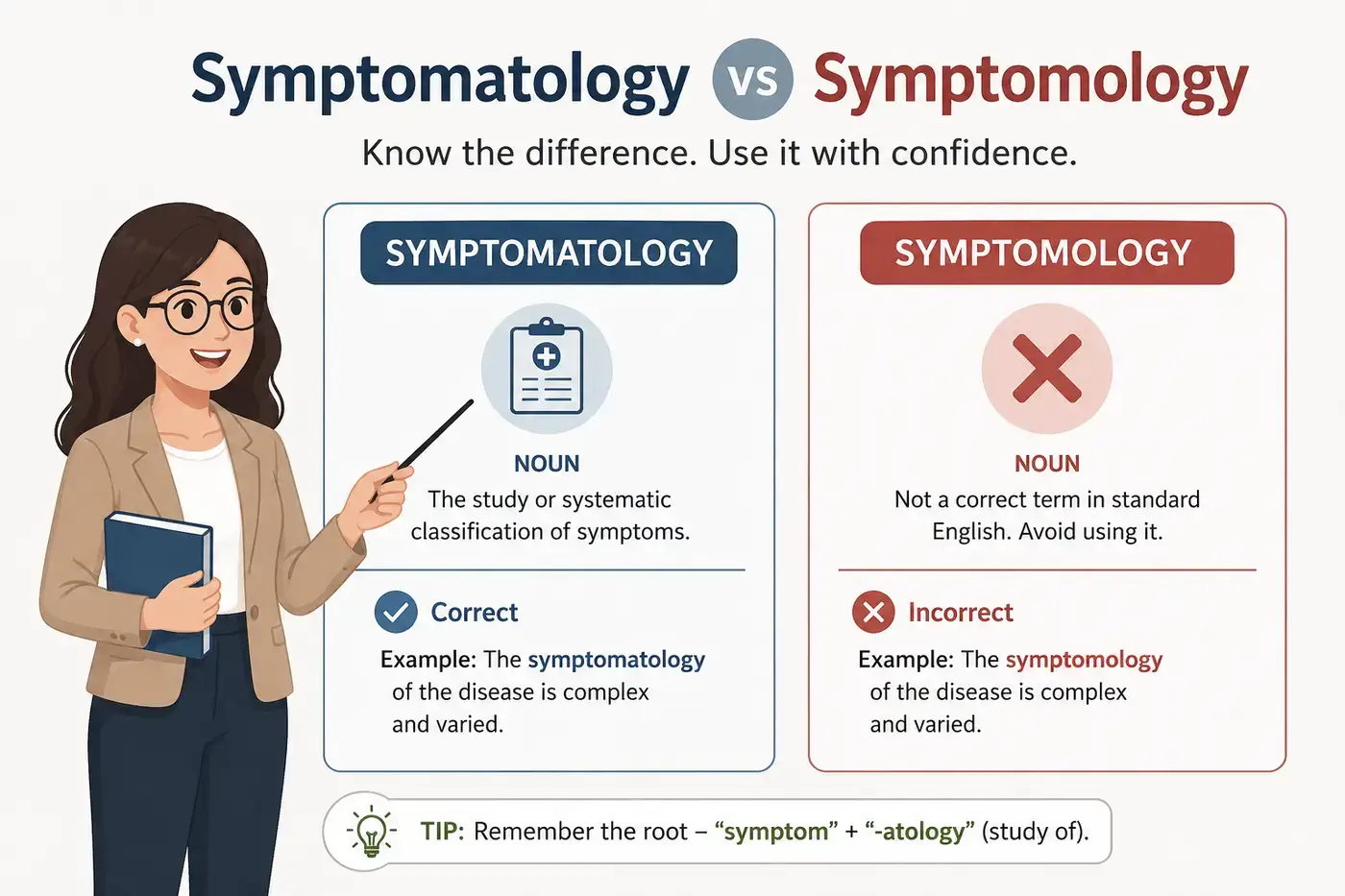
Have you ever wondered about symptomatology vs symptomology? These two words look almost the same, so it is easy to think they both mean the same thing. Many students, writers, and even professionals ask which one is correct and which one should be used in formal writing.
The good news is that the answer is simple. While both words appear in books and online, one is considered the standard term in medicine and science. Knowing the difference can help you write more clearly and avoid common mistakes.
This guide explains in very simple English. You will learn what each word means, why people confuse them, how to use the right one, and see plenty of easy examples you can remember.
Need another quick comparison? Read Loot vs Lute: Ultimate Difference Guide 2026.
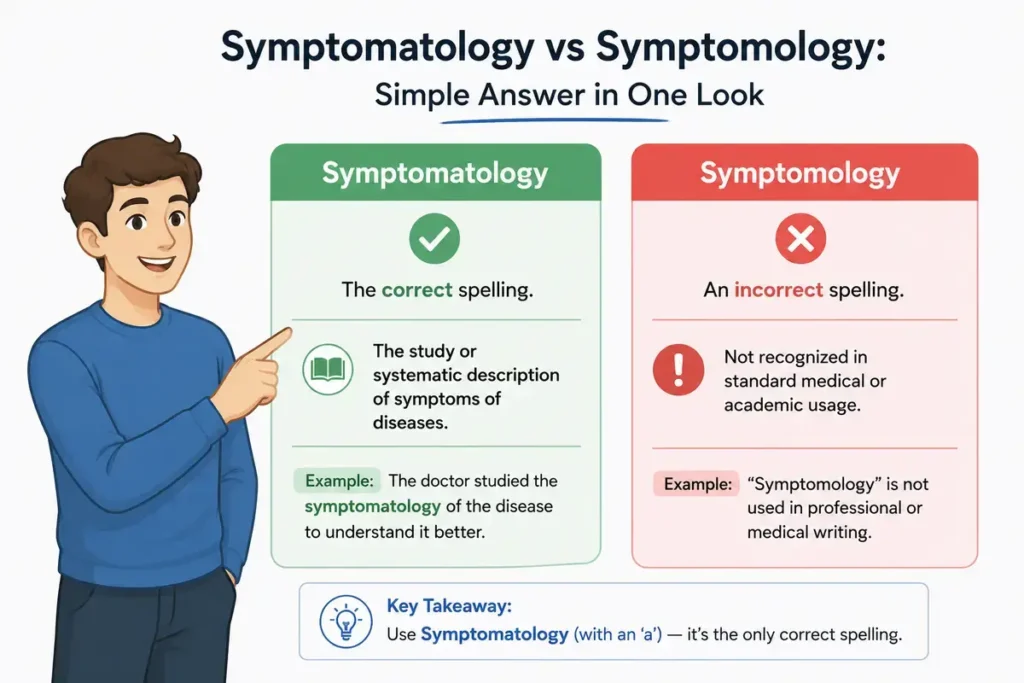
Symptomatology vs Symptomology: Simple Answer in One Look
Symptomatology is the standard and widely accepted word in medicine and academic writing.
Symptomology is sometimes used, but many dictionaries and experts see it as a less common or shortened form.
Quick answer: If you are writing for school, work, research, or healthcare, choose symptomatology.
What Does Symptomatology vs Symptomology Mean in Simple English?
To understand you first need to know what a symptom is. A symptom is something a person feels because of an illness. It could be a headache, a sore throat, dizziness, or stomach pain. Now look at the two words.
What Is Symptomatology?
Symptomatology means the study, collection, or description of symptoms connected with a disease or medical condition. Doctors use this word when they talk about the full group of symptoms that help identify an illness. For example:
- The symptomatology of the flu includes fever, cough, and body aches.
- Doctors studied the symptomatology of the disease before making a diagnosis.
Think of it this way. Symptomatology = all the symptoms together and the study of those symptoms.
What Is Symptomology?
Symptomology is usually used to mean the same thing. However, it is less common in formal medical English. Some dictionaries list it as an alternative spelling or a shortened version, while others recommend avoiding it in professional writing. You may still hear people say:
- The symptomology of the illness is unusual.
Even though many readers will understand it, most medical professionals would write:
- The symptomatology of the illness is unusual.
Why Do People Mix These Words Symptomatology vs Symptomology?
Many people become confused about because the words are almost identical. Only a few letters are different. That makes them easy to mix up while reading or writing. Here are the biggest reasons for the confusion.
Both Words Look Almost the Same
Compare them.
- Symptomatology
- Symptomology
The endings are very similar, so many people do not notice the difference.
Both Are Used to Talk About Symptoms
Both words refer to symptoms of diseases. Because they have nearly the same meaning, people often think they are completely interchangeable.
People Like Shorter Words
English speakers often shorten long words in everyday conversation. Since symptomology is shorter, some people naturally use it without realizing that symptomatology is the preferred medical term.
Online Sources Do Not Always Agree
Some websites use symptomology.
Others use symptomatology.
This can make learners unsure about which word is actually correct.
Similar Medical Words Add to the Confusion
English has many medical words ending in -ology, such as:
- Biology
- Cardiology
- Neurology
- Psychology
Because these words are common, people sometimes assume symptomology follows the same pattern. However, the accepted medical term developed differently, which is why symptomatology remains the standard choice.
Clear Difference Explained Simply
Here is the easiest way to remember the difference.
| Symptomatology | Symptomology |
|---|---|
| Standard medical term | Less common alternative |
| Preferred in research | Sometimes seen in everyday writing |
| Found in textbooks | Less common in textbooks |
| Best choice for formal writing | Better avoided in formal writing |
| Widely accepted | Understood but less preferred |
Another easy way to remember it is this: If you want to sound correct in school, medicine, or professional writing, use symptomatology.
Quick Memory Trick
Think of it like this.
Longer word = official word.
When you see symptomatology, think:
“This is the word doctors usually use.”
Symptomatology vs Symptomology: Which Form Should You Use?
If you are unsure about follow one simple rule.
Use Symptomatology When:
- Writing school assignments
- Writing research papers
- Talking about medicine
- Writing healthcare reports
- Creating educational content
- Writing professional documents
Avoid Symptomology If:
- You want formal English.
- You are writing for doctors or teachers.
- You need standard medical vocabulary.
Although some readers accept symptomology, choosing symptomatology helps you avoid questions about your word choice. Most style guides and medical publications prefer it.
Easy Rule to Remember
When in doubt:
Choose symptomatology.
It is the safer and more accepted option.
Easy Real-Life Sentences You Can Use for Symptomatology vs Symptomology
These examples show how symptomatology naturally fits into everyday and professional English.
- The doctor explained the symptomatology of the disease.
- We studied the symptomatology before starting treatment.
- The symptomatology became worse during the first week.
- Nurses carefully recorded the patient’s symptomatology.
- The report described the symptomatology in simple language.
- Researchers compared the symptomatology of two illnesses.
- Understanding the symptomatology helped doctors find the cause.
- The new illness has different symptomatology from the common cold.
Here are two examples with symptomology.
- Some articles mention the symptomology of the disease.
- Many readers understand symptomology, but symptomatology is usually preferred.
Notice that the meaning stays almost the same, but symptomatology sounds more professional.
Where Does Symptomatology Come From? (Simple History)
Looking at the history of symptomatology vs symptomology helps explain why one word became the standard. The word symptom comes from ancient Greek. It originally meant something that happens or occurs, especially as a sign of illness. Later, medical experts added the ending -atology to create symptomatology. The word came to mean:
- the study of symptoms
- the collection of symptoms
- the description of symptoms seen in a disease
Over many years, doctors, researchers, and medical schools around the world began using symptomatology in textbooks, journals, and professional discussions. At some point, people also started saying and writing symptomology because it sounded shorter and matched many other English words ending in -ology.
Even so, symptomatology remained the accepted standard in medical writing. That is why most healthcare professionals still prefer it today. Understanding this history makes the choice much easier. The longer word is not just longer by chance. It became the traditional medical term through many years of professional use.
As you can see, it is more than just a spelling difference. The history, usage, and level of acceptance all help explain why one form is recommended more often than the other.
In the next section, we will look at how these words are understood in culture, how they appear in different types of writing, common mistakes people make, memory tricks, expert tips, frequently asked questions, and a simple final summary that will help you remember the correct choice every time.
Symptomatology vs Symptomology in Culture and Stories
The discussion about symptomatology vs symptomology is mostly found in medicine, but the idea behind these words appears in many stories and everyday conversations. When people become sick in books or movies, characters often pay attention to symptoms before they know the real illness. A fever, cough, or headache can become an important clue in the story.
Doctors, nurses, and scientists usually describe these clues as part of a disease’s symptomatology. In everyday conversations, most people do not use either word. They simply say:
- “These are the symptoms.”
- “She has flu symptoms.”
- “His symptoms are getting worse.”
However, in medical TV shows, documentaries, and health articles, you are much more likely to hear symptomatology because it is the accepted professional word. The word symptomology may still appear from time to time, especially in casual writing or online discussions, but it is much less common in trusted medical sources.
So, culture teaches us something simple. People usually talk about symptoms in daily life, but healthcare professionals usually talk about symptomatology when describing a disease in detail.

Many readers also check Comming vs Coming: Rule Every Student Needs (2026).
Symptomatology vs Symptomology in the Bible and Mythology
There is no direct use of symptomatology or symptomology in the Bible. These are modern medical words that were created many centuries after biblical times. The Bible does describe many illnesses and physical conditions. For example, people are shown with fever, blindness, skin diseases, weakness, or pain. These descriptions focus on the signs of illness rather than using medical terms.
In mythology, many stories include sickness, healing, and recovery. Ancient healers often looked at a person’s condition before deciding how to help them. Today, doctors would describe that process as studying the person’s symptomatology. So, while the words themselves are not found in religious or mythological texts, the idea of observing symptoms has existed for thousands of years.
Symptomatology vs Symptomology Symbolism Explained in Simple Words
Although it is mainly a language question, people sometimes connect these words with ideas about learning, healing, and understanding illness.
What Symptomatology Represents
Symptomatology often represents:
- Careful observation.
- Medical knowledge.
- Professional healthcare.
- Scientific understanding.
- Accurate diagnosis.
- Organized learning.
Because it is the standard medical word, it often gives a feeling of trust, precision, and expertise.
What Symptomology Represents
Symptomology usually represents:
- Everyday communication.
- Informal language.
- A shortened way of saying the same idea.
- Less formal writing.
Many people understand the word, but it does not carry the same level of professional acceptance. A simple comparison looks like this:
| Symptomatology | Symptomology |
|---|---|
| Professional | Informal |
| Standard medical term | Less common alternative |
| Preferred by experts | Sometimes used by the public |
| Best for formal writing | Better for casual conversation if used at all |
The easiest way to remember this comparison is simple. Symptomatology sounds like the language of medicine. Symptomology sounds like everyday speech.
Related Words You Should Know About Symptomatology vs Symptomology
Learning a few related words makes much easier to understand.
Symptom
A physical or mental sign that someone feels because of an illness. Example:
She has a sore throat as a symptom of her cold.
Sign
Something a doctor can see or measure during an examination. Example:
A high temperature is a common sign of infection.
Diagnosis
The name of the illness after a doctor studies the symptoms and signs. Example:
The doctor made the correct diagnosis.
Condition
A person’s health problem or disease. Example:
His heart condition is improving.
Disease
An illness that affects the body or mind. Example:
Doctors are studying the disease carefully.
Disorder
A medical problem that changes how part of the body works. Example:
The child has a sleep disorder.
Syndrome
A group of symptoms that happen together. Example:
Doctors recognized the syndrome quickly.
Treatment
The care or medicine used to help someone get better. Example:
Early treatment often leads to faster recovery.
How People Actually Use Symptomatology vs Symptomology in Daily English
Most people do not use either word every day. Instead, they usually say symptoms. Still, you may hear symptomatology in hospitals, health articles, or classrooms. Here are some natural examples.
- The doctor explained the symptomatology of the infection.
- The nurse recorded the patient’s symptomatology.
- Researchers compared the symptomatology of both diseases.
- We learned about flu symptomatology in science class.
- The report included detailed symptomatology.
- I saw the word symptomology in an online article.
- My teacher said symptomatology is the preferred medical term.
- The hospital uses symptomatology in its medical reports.
- His symptomatology changed after the new medicine.
- Understanding the symptomatology helped doctors choose the best treatment.
Notice something important. Most casual conversations avoid both words. People simply say:
- What symptoms do you have?
- Her symptoms are getting better.
- He has flu symptoms.
That sounds much more natural in everyday English.
Common Mistakes People Make with Symptomatology vs Symptomology
Many English learners make small mistakes. The good news is that they are easy to fix.
Mistake 1: Thinking Both Words Are Equally Preferred
❌ The report explains the symptomology of the disease.
✅ The report explains the symptomatology of the disease.
For formal writing, choose symptomatology.
Mistake 2: Using the Longer Word in Everyday Conversation
Most people do not normally say:
❌ What is your symptomatology?
Instead, they say:
✅ What symptoms do you have?
Simple language is usually better in everyday speech.
Mistake 3: Thinking Symptomatology Means One Symptom
Some learners think the word refers to a single symptom.
It does not.
It usually refers to the whole group of symptoms or the study of those symptoms.
Mistake 4: Spelling the Word Incorrectly
These long words are easy to misspell.
Read them carefully.
✅ Symptomatology
✅ Symptomology
Checking the spelling before you publish your work is always a good idea.
Mistake 5: Using Fancy Words When Simple Words Work Better
Sometimes writers use long medical words just to sound more professional. In many situations, symptoms is the clearer choice. Compare these.
Professional:
The patient’s symptomatology improved.
Everyday English:
The patient’s symptoms improved.
The second sentence is easier for most readers.
Final Teacher Explanation of Symptomatology vs Symptomology
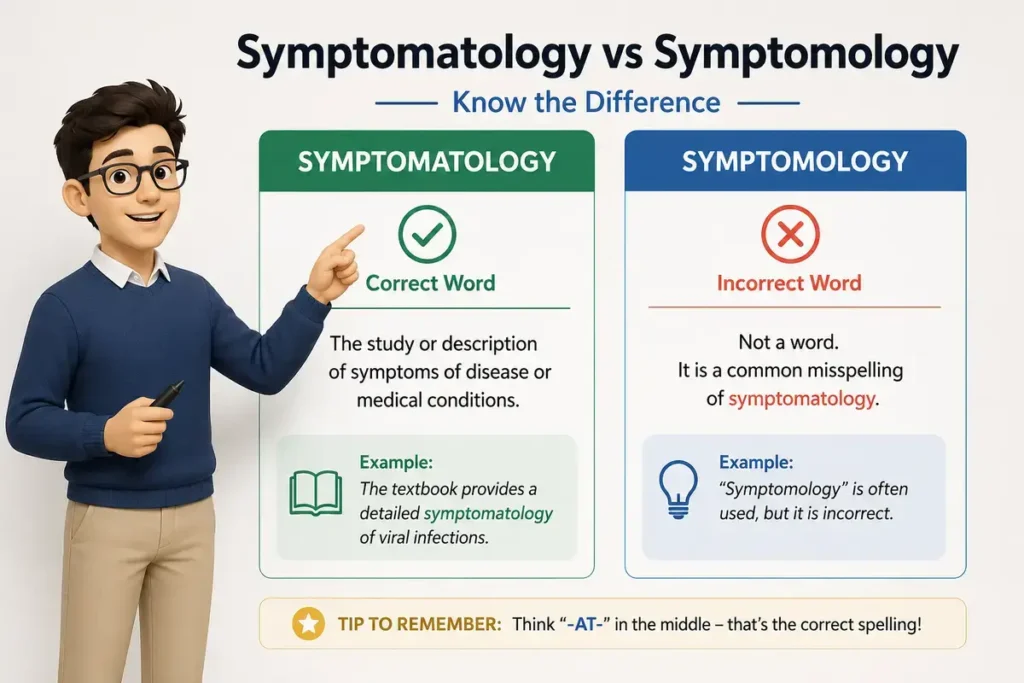
Imagine we are finishing today’s English lesson together. You started by asking about both words. Now you know the answer. Both words talk about symptoms connected with a disease. However, they are not used equally. Symptomatology is the standard medical word. Doctors, researchers, teachers, and healthcare workers usually choose it because it is accepted in professional English.
Symptomology has the same general meaning, but it is much less common and is not the preferred choice in formal writing. If you only remember one rule from this lesson, remember this: When you need one correct word for school, work, medicine, or research, choose symptomatology.
If you are simply talking with friends, you usually do not need either word. Just say symptoms. That is how most native English speakers naturally talk. Learning small differences like this helps your English become more accurate and more natural.
Final Answer About Symptomatology vs Symptomology (Quick Recap)
The difference between is simple.
Symptomatology is the accepted medical and academic term.
Symptomology is a less common alternative that many experts do not recommend for formal writing.
When you are unsure, always choose symptomatology.
You may also want to read What Kind of vs What Kinds of: Explain guide (2026).
Conclusion
Understanding symptomatology vs symptomology is easier than it first appears. Both words refer to symptoms connected with illness, but they are not equally accepted. Symptomatology is the standard term used by doctors, researchers, and educators because it is recognized in formal medical English. Symptomology has the same basic meaning, but it is much less common and is generally avoided in professional writing. If you ever feel unsure, remember this simple rule: use symptomatology for formal situations and simply say symptoms in everyday conversation. This small choice will make your English sound more accurate, natural, and confident.
Frequently Asked Questions
What does symptomatology mean in simple words?
It means the group of symptoms linked to a disease or the study of those symptoms.
Is symptomology a real word?
Yes. It is a real word, but it is much less common than symptomatology and is usually not preferred in formal medical writing.
Which is correct?
Both exist, but symptomatology is the standard and recommended choice.
Why do people confuse?
The words look almost the same and have nearly the same meaning, so many people think they are interchangeable.
Can I use both forms in writing?
You can, but symptomatology is the better choice for school, healthcare, research, and professional writing.
Which word do doctors usually use?
Doctors and medical researchers usually use symptomatology.
Should I use symptomatology in everyday conversation?
Usually not. Most people simply say symptoms because it is shorter and easier to understand.
Is symptomology wrong?
Not exactly. It is understood by many readers, but symptomatology is the preferred word in standard English.
