
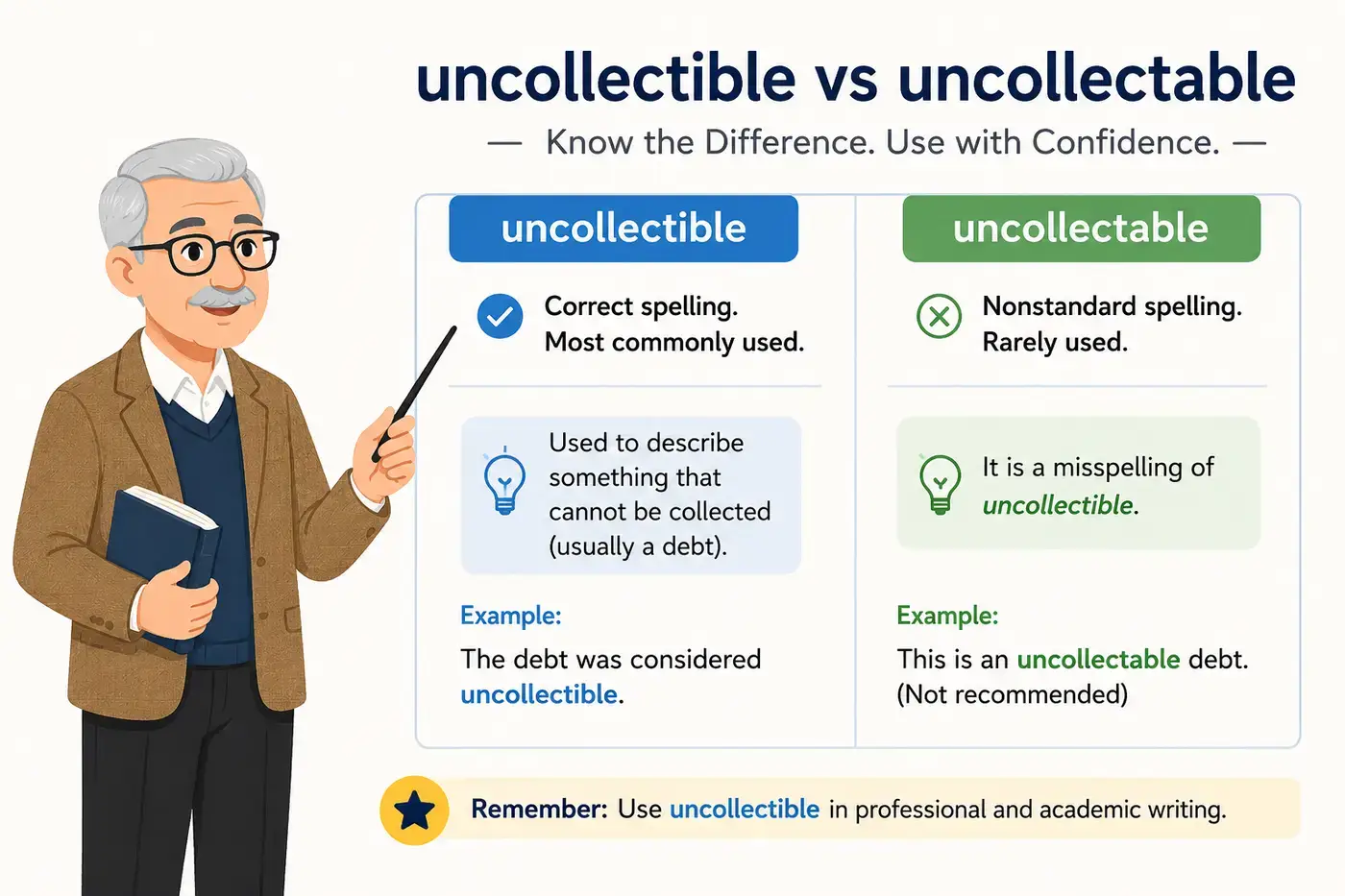
Uncollectible vs uncollectable can be confusing because both words are used in English. They look almost the same, and both describe something that cannot be collected. The main difference is not meaning. The bigger difference is spelling preference and common usage.
In American English, uncollectible is the more common form, especially when talking about money, debts, bills, or accounts that cannot be recovered. For example, a company may describe an unpaid debt as uncollectible.
Uncollectable is also a correct English word. It has the same basic meaning. So, if you are asking which form to use, uncollectible is usually the safer choice for American English, while uncollectable may appear in other varieties and styles of English.
Learn the difference in Immerse vs Emerse: Meaning, Usage, and Correct Word Guide.
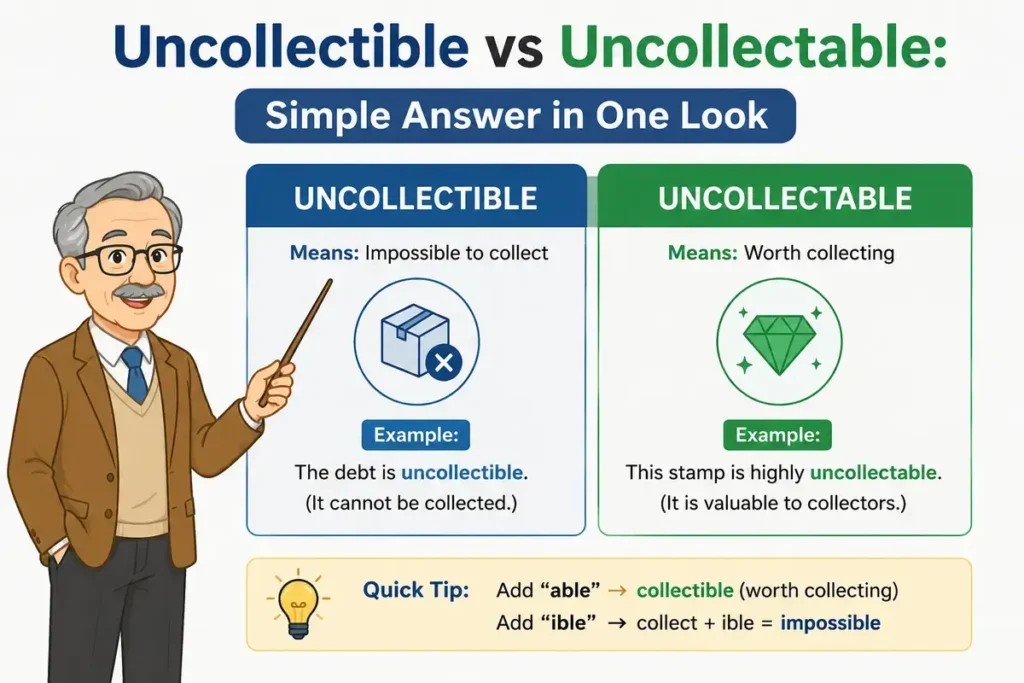
Simple Answer in One Look
Uncollectible and uncollectable both mean “cannot be collected.”
For American English, especially in financial writing, uncollectible is the more common choice.
What Does Uncollectible Mean?
Uncollectible describes something that cannot be collected.
The word is often used for money that a person or business is owed but does not expect to receive.
For example:
The company has an uncollectible debt.
This means the company does not expect to get that money.
You may also see:
- uncollectible debt
- uncollectible account
- uncollectible payment
- uncollectible balance
- uncollectible receivable
These phrases are especially common in business and accounting.
The word can also be understood more generally. If something cannot be gathered, received, or recovered, uncollectible may describe it.
However, financial writing is where the word appears most often.
What Does Uncollectable Mean?
Uncollectable has the same basic meaning.
It describes something that cannot be collected.
For example:
The debt was considered uncollectable.
The sentence means that the debt could not be collected.
The spelling is different because English has both collectable and collectible. Their negative forms are:
- collectable → uncollectable
- collectible → uncollectible
Both forms are found in English.
For American readers, though, uncollectible is generally the more familiar form, particularly when discussing debts or accounts.
Why Do People Mix Up These Words?
The confusion comes from the words collectable and collectible.
Both forms are used in English, so their negative forms can also appear:
collectable → uncollectable
collectible → uncollectible
The two negative forms look almost identical. They also have the same basic meaning.
This makes it easy to wonder whether one spelling is wrong.
It is better to think of them as two accepted forms rather than treating one as a spelling mistake.
For example:
The account is uncollectible.
and
The account is uncollectable.
Both sentences tell us that the account cannot be collected.
The first form is more natural for many American readers.
What Is the Difference Between Uncollectible and Uncollectable?
The main difference is usage and spelling preference, not meaning.
| Word | Meaning | Common American use |
|---|---|---|
| Uncollectible | Cannot be collected | Very common, especially for debts and accounts |
| Uncollectable | Cannot be collected | Correct, but less common in American financial writing |
A simple example makes this clear.
Uncollectible debt
This means a debt that is not expected to be recovered.
Uncollectable debt
This has the same basic meaning.
So, the difference between uncollectible and uncollectable is usually about which form is preferred, not what the sentence means.
Which Form Should You Use?
If you are writing in American English, use uncollectible when you are unsure.
This is especially true for:
- business documents
- accounting reports
- financial articles
- school assignments
- professional writing
- websites written for US readers
For example:
The company reported several uncollectible accounts.
The bank classified the loan as uncollectible.
The accountant recorded the debt as uncollectible.
These sentences use the form that American readers commonly expect.
You can still use uncollectable when it matches the style or variety of English you are following.
The safest rule is simple:
US English → uncollectible
Other English varieties or a specific house style → check the preferred spelling
If you are writing for a particular company, school, publisher, or website, follow its style guide when one is available.
In Financial English
Financial writing is where this spelling choice matters most.
Businesses often have customers who owe them money. Sometimes those customers never pay. After enough time or failed collection attempts, the business may decide that the money is unlikely to be recovered.
That amount may be described as uncollectible.
For example:
The company has $10,000 in uncollectible accounts.
This means the company does not expect to receive that $10,000.
You may also find the phrase uncollectible accounts receivable. This refers to money owed to a business that the business does not expect to collect.
Other common phrases include:
- uncollectible debt
- uncollectible accounts
- uncollectible receivables
- uncollectible balance
- uncollectible invoices
In these financial contexts, uncollectible is the form most American readers will recognize.
Easy Real-Life Sentences You Can Use
Here are some natural examples:
- The bank marked the debt as uncollectible.
- The company has several uncollectible accounts.
- The accountant recorded the balance as uncollectible.
- Some old debts may become uncollectible.
- The business wrote off the uncollectible amount.
- The lender reported an uncollectible loan balance.
- The company reviewed its uncollectible accounts.
- The unpaid bill was considered uncollectable.
The last sentence uses uncollectable, showing that the alternative form can also appear in normal English.
Can You Use Uncollectable in American English?
Yes.
Uncollectable is not automatically wrong in American English.
However, uncollectible is generally the better choice when you want wording that feels natural and familiar in US financial writing.
This distinction is useful because writers sometimes see a less common spelling and assume it must be incorrect.
That is not the case here.
If you write:
The debt is uncollectable.
Most readers will understand the sentence immediately.
If you write:
The debt is uncollectible.
That is also correct, and it is the more familiar choice for many US readers.
Is Uncollectible the Same as Uncollectable?
Yes, in the usual sense.
Both words describe something that cannot be collected.
The difference is mainly the spelling:
uncollectible uses -ible
uncollectable uses -able
This follows the two forms of the positive word:
collectible → uncollectible
collectable → uncollectable
There is no need to give the two words completely different meanings in ordinary use.
What About Collectible and Collectable?
Understanding the positive forms makes the negative forms easier.
Collectible can describe something that people collect, often because it has value or special interest.
For example:
The old baseball card is a valuable collectible.
Collectable can also mean something that can be collected.
For example:
These items are collectable.
Because both collectible and collectable are used, both negative forms exist too.
That gives us this pattern:
| Positive form | Negative form |
|---|---|
| collectible | uncollectible |
| collectable | uncollectable |
This is the simplest way to remember the spelling.
Is Uncollectible More Common Than Uncollectable?
For American English, uncollectible is the more familiar choice, especially in financial contexts.
That is why you will often see phrases such as:
uncollectible accounts
uncollectible receivables
If your audience is mainly in the United States, choosing uncollectible can make your writing sound more natural.
This does not make uncollectable incorrect. It simply means that one form is more commonly expected in this context.
You may also want to read It Is Must vs It Is a Must: Simple English Guide (2026).
A Quick Memory Trick
Use this simple pattern:
Can be collected → collectible
Cannot be collected → uncollectible
And remember:
collectible → uncollectible
If you prefer the -able form:
collectable → uncollectable
For American English, especially with money or debt, remember uncollectible.
Where Does Uncollectible Come From?
The word begins with collect, which means to gather or receive something.
English uses un- to create a negative meaning in many words.
For example:
- happy → unhappy
- clear → unclear
- known → unknown
- collected → uncollected
The same basic idea appears in uncollectible.
The word combines the idea of collecting with the negative prefix un-.
The related forms collectable and collectible developed to describe something that can be collected. Their negative forms describe something that cannot be collected.
You do not need to know the full history of the words to use them correctly. The useful point is that both forms come from the same basic idea.
Final Rule
If you are still unsure, use this rule:
Choose “uncollectible” for American English, especially when talking about money, debts, accounts, or payments.
Use “uncollectable” when that spelling is preferred by the English variety or style you are following.
Both words mean that something cannot be collected.
So:
The debt is uncollectible.
is a natural choice for American English.
And:
The debt is uncollectable.
is also a valid sentence.
The key difference is usage preference, not basic meaning.
Where Does Uncollectible vs Uncollectable Come From? (Simple History)
The word collect comes from Latin through French. It has been part of English for hundreds of years. Later, English added endings like -able and -ible to create adjectives. These endings often mean: Can be done or able to be done. Examples include:
- Readable
- Visible
- Flexible
- Collectible
Over time, English accepted both collectible and collectable. The same happened with uncollectible and uncollectable. As modern English developed, especially in American English, uncollectible became the more popular spelling. That is why most dictionaries, businesses, and professional writers now use it more often. Even so, uncollectable never disappeared completely. It remains a correct alternative spelling.
As English changes over time, some words naturally become more popular than others. It is a good example. In the next section, we will look at how these words appear in culture, professional writing, symbolism, common mistakes, and frequently asked questions so you can understand them even better.
How does Is Understood in Culture and Stories
These words are not common in books, movies, or everyday stories. Still, the idea behind them appears often. Many stories include someone who lends money but never gets it back. In those cases, the money becomes uncollectible. The focus is not on the spelling. The focus is on the lesson. These words often remind people that:
- Not every debt is paid.
- Some losses cannot be fixed.
- Businesses sometimes have to move on.
- Life does not always go as planned.
In business stories, an uncollectible debt may show that a company trusted the wrong customer. In family stories, someone may lend money to a friend who never pays it back. These situations teach lessons about trust, planning, and responsibility. Because uncollectible is more common, you will usually see it in newspapers, business books, and financial reports.
Uncollectible vs Uncollectable in Biblical and Mythological Meaning
There is no direct biblical meaning for uncollectible or uncollectable. The Bible does talk about money, lending, kindness, and forgiveness, but it does not use these exact words. Many Bible stories teach people to:
- Be honest with money.
- Pay what they owe when possible.
- Show kindness to people in need.
- Forgive others when appropriate.
These lessons are about good character rather than spelling. There is also no special mythological meaning connected. These words are practical English words that mainly appear in business and financial writing.
Symbolism Explained in Simple Words
Although these words are mostly used in accounting, they can also have symbolic meanings.
What Uncollectible Represents in
The word uncollectible often represents:
- A loss that cannot be recovered.
- Accepting reality.
- Moving forward after failure.
- Closing one chapter and starting another.
For example, a company may accept that an unpaid bill is uncollectible and stop spending time trying to recover it. Symbolically, it reminds us that not everything can be fixed.
What Uncollectable Represents
The word uncollectable represents the same basic idea because it has the same meaning. It may suggest:
- Something beyond recovery.
- An unsuccessful effort.
- Letting go of the past.
- Accepting what cannot be changed.
The only real difference is spelling. The emotional meaning stays exactly the same.
Related Words You Should Know
Learning related words makes much easier to understand.
Collect
To gather or receive something. Example:
“We collect donations every year.”
Collection
Things that have been gathered together. Example:
“Her stamp collection is very large.”
Collectible
Something that people like to collect because it has value. Example:
“That old baseball card is collectible.”
Collectable
Another accepted spelling of collectible, although it is less common.
Debt
Money that someone owes another person. Example:
“He finally paid his debt.”
Payment
Money given to pay for something. Example:
“The payment arrived today.”
Invoice
A bill asking someone to pay money. Example:
“The customer received the invoice.”
Write Off
To officially accept that money cannot be collected. Example:
“The company wrote off the uncollectible account.”
Outstanding Balance
Money that still has not been paid. Example:
“The outstanding balance is due next week.”
Bad Debt
Money that a business believes will never be paid back. Example:
“The accountant reported several bad debts.”
How People Actually Use Uncollectible vs Uncollectable in Daily English
Most people do not use these words every day. They are much more common in offices, banks, and accounting. Still, you may hear sentences like these:
- The bank marked the loan as uncollectible.
- That unpaid bill became uncollectible last year.
- We finally wrote off the uncollectible account.
- The customer disappeared, so the debt became uncollectible.
- My boss said the invoice was uncollectible.
- The accountant reviewed several uncollectible balances.
- The old report used the spelling uncollectable.
- Both spellings are correct, but I usually write uncollectible.
- Our teacher explained the difference.
- Most style guides recommend uncollectible for modern writing.
Notice that uncollectible appears much more often in everyday business English.
Common Mistakes People Make
Many writers make small mistakes when choosing between these words. Here are the most common ones.
Mistake 1: Thinking Uncollectable Is Wrong
Incorrect thinking:
“Only uncollectible is correct.”
Correct idea:
Both spellings are correct.
Mistake 2: Using Different Spellings in One Article
Example:
“The debt is uncollectible. Later it became uncollectable.”
This is not wrong, but it looks inconsistent.
Better choice:
Pick one spelling and use it throughout your writing.
Mistake 3: Using Collectible Instead of Uncollectible
Incorrect:
“The unpaid loan is collectible.”
Correct:
“The unpaid loan is uncollectible.”
Adding un- completely changes the meaning.
Mistake 4: Forgetting the Audience
If you write for American readers, uncollectible usually feels more natural. If a publisher has its own style guide, follow that guide.
Mistake 5: Believing Longer Words Mean Different Things
Some people think uncollectible and uncollectable have different meanings. They do not. The difference is mainly the preferred spelling.
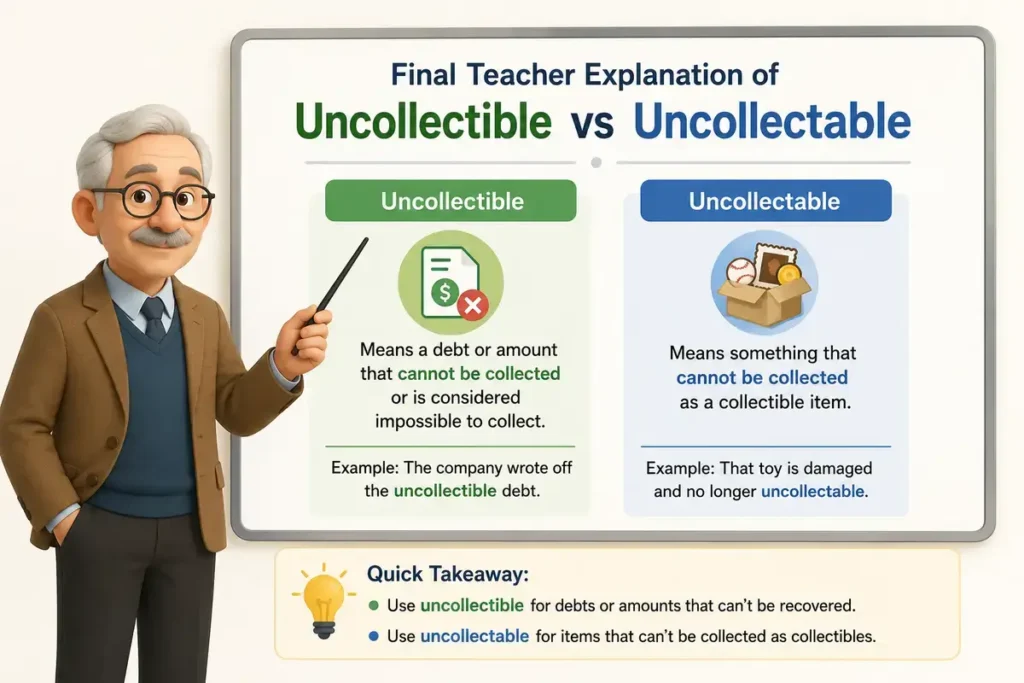
Final Teacher Explanation of Uncollectible vs Uncollectable
Imagine you are sitting in my English class. A student asks, “Teacher, which one should I use?” My answer is simple. Both words are correct. Both mean that something cannot be collected, especially money that someone will probably never pay back. But if you want the spelling that looks most natural in modern American English, choose uncollectible.
It appears more often in business reports, school writing, newspapers, and online articles. If you see uncollectable, do not think it is a mistake. It is simply another accepted spelling. The most important lesson is not to mix the spellings in the same piece of writing unless you have a good reason. Being consistent makes your writing look more professional. Whenever you forget, remember this easy classroom rule: Both are correct. Uncollectible is usually the better choice.
Final Answer (Quick Recap)
Both uncollectible and uncollectable are correct English words. They both mean something cannot be collected, especially unpaid money. The main difference is that uncollectible is much more common, especially in American English. If you are unsure which spelling to choose, uncollectible is usually the safest and most natural option.
Still confused? Compare Kinesthesiology vs Kinesiology: A Simple Guide for Beginners.
Conclusion
The difference between uncollectible and uncollectable is simple once you know the main rule. Both words mean that something cannot be collected. The spelling is different, but the basic meaning stays the same.
For American English, uncollectible is usually the safer choice, especially in financial writing. Uncollectable is also a valid form and may appear in other English varieties and writing styles.
Frequently Asked Questions
What does uncollectible mean in simple words?
It means something cannot be collected, usually money that someone will probably never pay back.
Is uncollectable a real word?
Yes. It is a correct English word, but it is less common than uncollectible.
Which is correct: uncollectible or uncollectable?
Both are correct. Uncollectible is simply used more often, especially in American English.
Why do people confuse?
The words sound the same, have the same meaning, and both appear in dictionaries.
Should I use uncollectible in business writing?
Yes. Most businesses, accountants, and style guides prefer uncollectible.
Can I use both spellings in one article?
It is better not to. Choose one spelling and use it consistently.
Does uncollectible only refer to money?
Most of the time, yes. It usually describes debts, loans, invoices, or payments that cannot be recovered.
Is there any difference in meaning?
No. They mean the same thing. The difference is simply the preferred spelling.
