
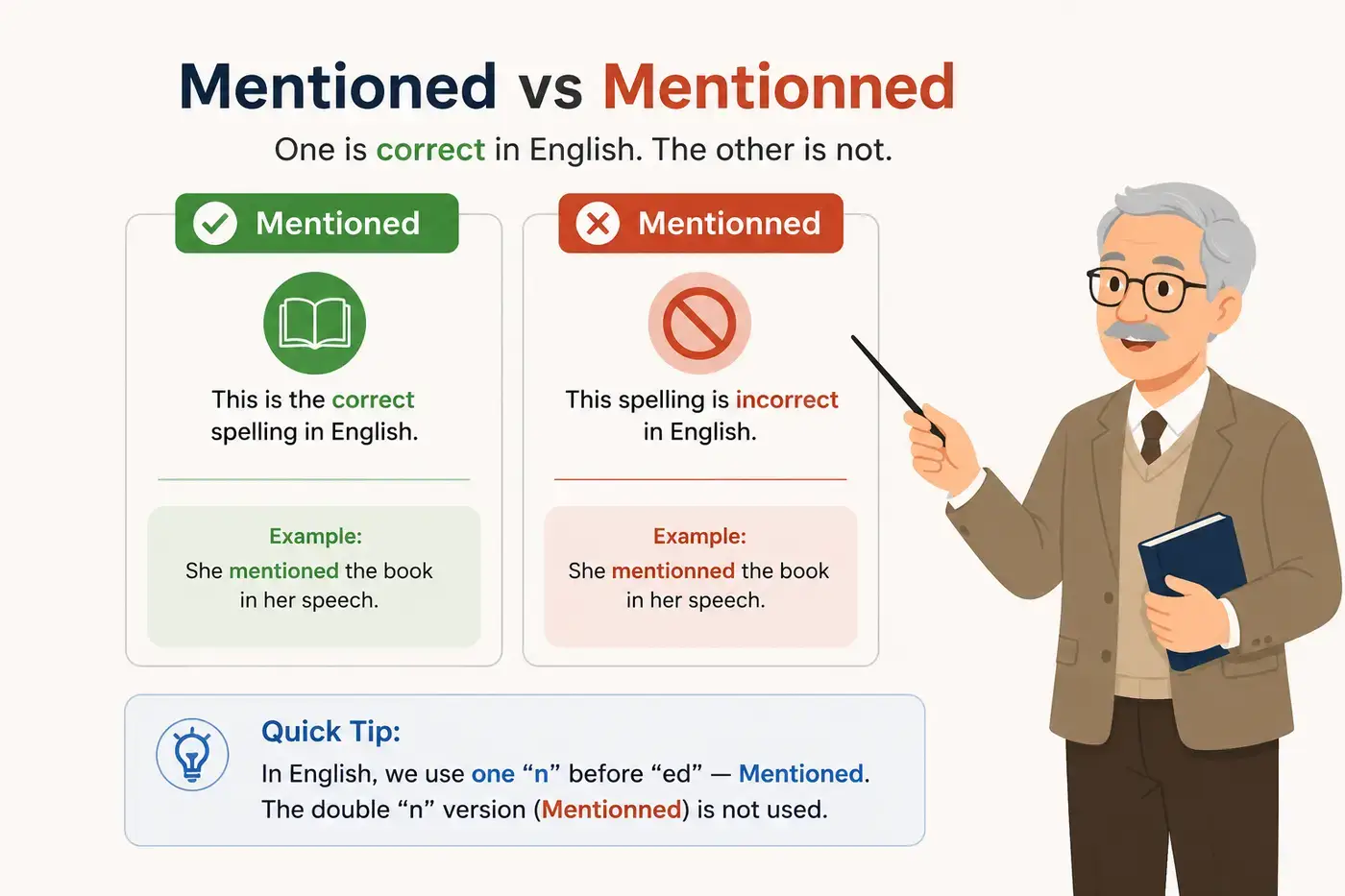
Many English learners get confused about mentioned vs mentionned. The two words look almost the same, but only one is correct. This mistake happens often in writing, emails, homework, and social media posts.
If you are wondering about the difference between mentioned vs mentionned, the answer is simple. Mentioned is the correct English spelling. Mentionned is a misspelling and should not be used.
This guide explains everything in easy words. You will learn which form is correct, why people make this mistake, and how to use the word naturally in everyday English.
You may also want to read Laser or Lazer Meaning, Usage, and Correct Spelling Guide.
Mentioned vs Mentionned: Simple Answer in One Look
Mentioned ✅ = Correct English spelling
Mentionned ❌ = Incorrect spelling
Always write mentioned when you want to say that someone talked about or referred to something.
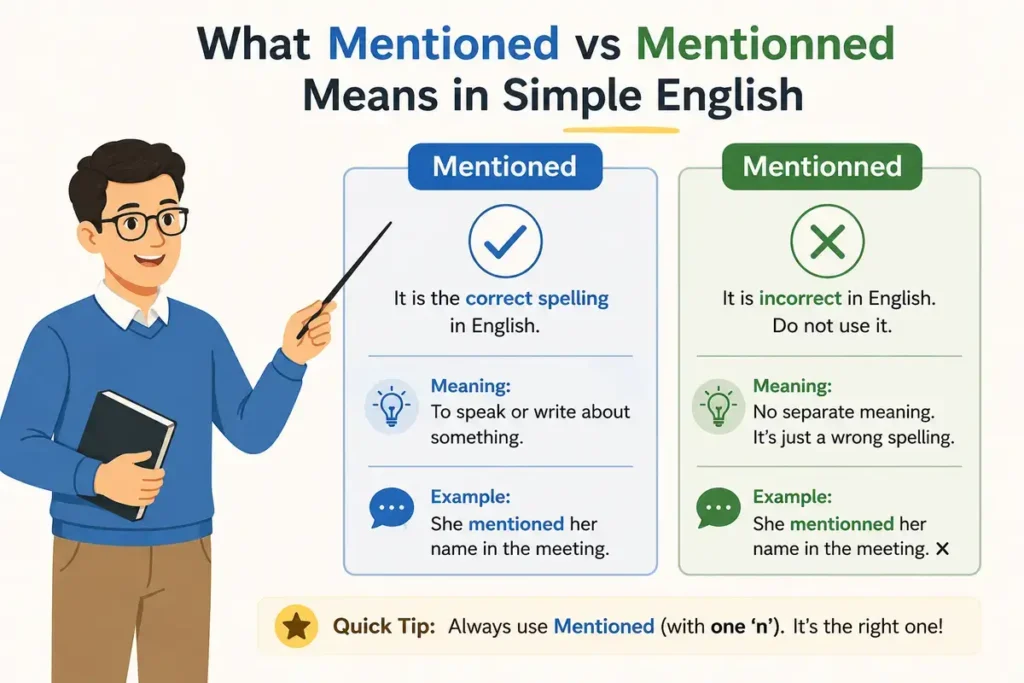
What Mentioned vs Mentionned Means in Simple English
The word mentioned means talked about something briefly or said something without giving many details.
Think of it like this: Someone says one small thing about a topic and then moves on. For example:
She mentioned her new job.
This means she talked about her new job for a short time. Another example:
He mentioned my name during the meeting.
He said your name but did not spend much time talking about you. People use this word every day in conversations, emails, books, news stories, and text messages. Simple meaning:
- say something
- talk about briefly
- refer to something
- bring up a topic
All of these ideas are close to the meaning of mentioned.
Why People Mix These Words Mentioned vs Mentionned
Many people write mentionned because they think every English word needs an extra letter when adding -ed. That is not true. English spelling has different rules, and sometimes those rules are confusing. Here are some common reasons for the mistake.
Reason 1: Double-letter confusion
Words like:
- planned
- stopped
- preferred
have double letters before -ed. So some learners think mention becomes mentionned. It does not.
Reason 2: Influence from French
The French verb mentionner has two “n” letters. People who know French or see French writing sometimes copy that spelling into English. English uses only one “n”:
mention → mentioned
Reason 3: Fast typing
Sometimes people simply type too quickly and add another letter by accident. Spell check usually catches this mistake.
Mentioned vs Mentionned: Clear Difference Explained Simply
| Mentioned | Mentionned |
|---|---|
| ✅ Correct English spelling | ❌ Incorrect English spelling |
| Used in books and schools | Not accepted in standard English |
| Safe for essays and emails | Considered a spelling mistake |
| Found in dictionaries | Not found as a correct English word |
Easy way to remind Mentioned vs Mentionned
Start with:
mention
Now add:
ed
You get:
mentioned
You do not add another n.
Mentioned vs Mentionned: Which Form Should You Use?
Always choose mentioned. Use it when someone:
- talks about something
- refers to an idea
- says a person’s name
- brings up a topic
Correct examples
She mentioned the movie.
They mentioned our teacher.
My friend mentioned your idea yesterday.
The report mentioned safety rules.
The news mentioned heavy rain.
Incorrect examples
She mentionned the movie.
They mentionned our teacher.
My friend mentionned your idea yesterday.
These sentences contain a spelling mistake.
Easy Rule to Remember Mentioned vs Mentionned
If the base word ends with:
mention
just add:
ed
Result:
mentioned
You do not double the last letter.
Simple formula:
mention + ed = mentioned
Easy Real-Life Sentences You Can Use for Mentioned vs Mentionned
Here are some natural examples.
- She mentioned my birthday during dinner.
- He mentioned your name yesterday.
- The teacher mentioned the homework.
- I mentioned the problem to my manager.
- They mentioned a new restaurant near school.
- We mentioned the idea in our meeting.
- My mom mentioned buying milk.
- The book mentioned an old castle.
These are the kinds of sentences native speakers use every day.
Where Mentioned vs Mentionned Comes From (Simple History)
The English word mention comes from an old Latin word that means to speak about or to call to mind. Over many years, it became the English word mention. When English makes it past tense, it simply adds -ed. So:
- mention
- mentions
- mentioning
- mentioned
The spelling stays simple and keeps only one n.
Common Questions About Mentioned vs Mentionned
Is mentionned a real English word?
No. It is a spelling mistake. The correct word is mentioned.
Why do people write mentionned?
People often copy spelling patterns from other words or from French, or they accidentally type an extra n.
Which spelling should I use in school?
Always use mentioned. Teachers and exams expect this spelling.
Which spelling should I use in emails?
Always write mentioned in professional and personal writing.
Is mentionned accepted in dictionaries?
No. Standard English dictionaries use only mentioned.
Similar Word Confusions
Many English learners make mistakes like these:
- traveled vs travelled (depends on US or UK English)
- canceled vs cancelled
- focused vs focussed
- labeled vs labelled
- benefited vs benefitted
But mentioned vs mentionned is different. There is only one correct English spelling:
mentioned.
Synonyms of Mentioned
You can also use words like:
- referred to
- talked about
- brought up
- noted
- stated
- said
- spoke about
- cited
Each has a slightly different meaning, but all are related to mentioned.
Difference Between Mentioned and Mention
People also confuse these forms.
Mention is the base word.
I want to mention your idea.
Mentioned is usually used for the past.
I mentioned your idea yesterday.
Remember:
- mention = present or base form
- mentioned = past form or describing something already referred to
Many readers also check Noteable or Notable: Complete Usage Guide(2026).
Quick Memory Trick for Mentioned vs Mentionned
Think of this simple sentence:
I mentioned it yesterday.
Notice there is only one n before ed.
If you remember this one sentence, you can avoid the mistake every time.
Transition to Deeper Meaning
Now you know the correct spelling and how to use it in everyday English. The next part will go beyond simple spelling and explain how mentioned is understood in stories, culture, daily communication, and common expressions, making the word even easier to remember and use naturally.
How Mentioned vs Mentionned Is Understood in Culture and Stories
Words tell stories. Some words are used every day, while others become part of famous books, movies, and speeches. The word mentioned is one of those common words that quietly appears everywhere.
When someone says, “She mentioned an old friend,” it often creates curiosity. People want to know more. Even though the speaker only says a few words, listeners begin to imagine the whole story. That is why mentioned often works like a small door. It opens the way to a bigger conversation. For example:
“Grandpa mentioned a hidden box in the attic.”
This simple sentence makes people wonder what is inside the box. Writers also use this word to build mystery. Examples:
- The hero mentioned a secret map.
- The teacher mentioned an important lesson.
- The doctor mentioned a new treatment.
- The news reporter mentioned heavy rain.
In each case, the word introduces an idea without explaining everything. The incorrect spelling mentionned has no cultural meaning in English. It is simply a spelling mistake. You will not find it in published books, newspapers, or standard dictionaries. So when comparing mentioned vs mentionned, only mentioned carries real meaning and use in English culture and storytelling.
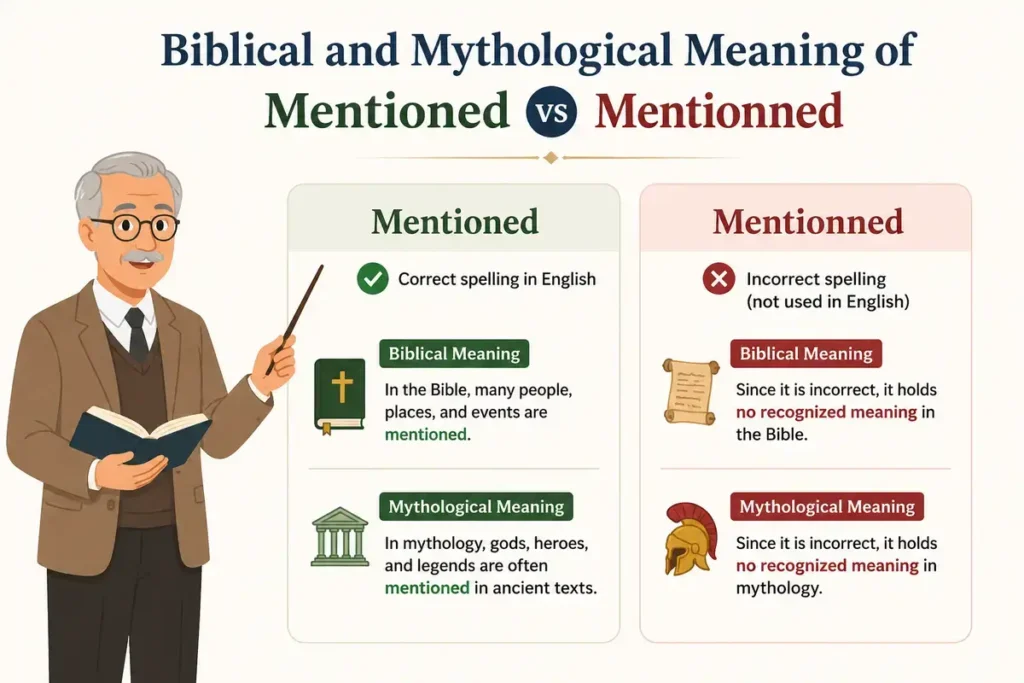
Biblical and Mythological Meaning of Mentioned vs Mentionned
The Bible does not use the modern English word mentioned in a special symbolic way. However, many Bible translations use words like:
- said
- spoke
- declared
- remembered
- mentioned
These words simply show that someone referred to a person, place, or event. Example: A prophet may mention God’s promise before explaining it further.
There is no biblical meaning for mentionned because it is not a correct English word. The same is true in mythology. In Greek, Roman, and other old stories, characters often mention gods, heroes, or magical places before the main events happen. The word helps introduce important ideas, but it does not have its own symbolic meaning. So the answer is simple:
- mentioned is a useful English word found in many translations and stories.
- mentionned has no biblical or mythological use.
Symbolism Mentioned vs Mentionned Explained in Simple Words
What Mentioned Represents
The word mentioned often represents:
- sharing information
- starting a conversation
- remembering someone
- giving a small clue
- opening a new idea
Sometimes one small mention changes everything. Imagine this sentence:
“She mentioned moving to another city.”
That one sentence may start a long discussion about jobs, family, and the future. So the word often symbolizes:
- connection
- memory
- curiosity
- communication
It is a small word with a big job.
What Mentionned Represents
The word mentionned does not represent an English idea. Instead, it reminds us that spelling matters. It shows that:
- typing mistakes happen
- language learners make common errors
- checking your writing is helpful
Simple comparison:
Mentioned
- Correct
- Clear
- Professional
- Trusted
Mentionned
- Incorrect
- Misspelled
- Should be corrected
- Not standard English
Related Words You Should Know About Mentioned vs Mentionned
Mention
The base word. Example:
I want to mention your idea.
Mentioning
Talking about something right now. Example:
She is mentioning the new plan.
Mentions
Used when talking about someone doing it regularly. Example:
He mentions his dog every day.
Referred to
Almost the same meaning. Example:
The teacher referred to the last lesson.
Brought up
A common spoken phrase. Example:
My friend brought up the same question.
Noted
Means someone recognized or recorded something. Example:
The manager noted the mistake.
Stated
Means said something clearly. Example:
The report stated the facts.
Cited
Often used in books and research. Example:
The writer cited several examples.
How People Actually Use Mentioned vs Mentionned in Daily English
People use mentioned every day without thinking about it. Here are natural examples.
At school
Teacher: “Did I mention tomorrow’s quiz?”
Student: “Yes, you did.”
At home
Mom: “Dad mentioned pizza for dinner.”
Child: “That’s great!”
At work
Manager: “Sarah mentioned your project.”
Employee: “I’m happy she liked it.”
With friends
“I mentioned your name yesterday.”
Text message
“You mentioned this movie before.”
Phone call
“My brother mentioned visiting next week.”
Shopping
“The cashier mentioned a discount.”
Travel
“The guide mentioned a beautiful beach nearby.”
Doctor’s office
“The doctor mentioned getting more sleep.”
Meeting
“Someone mentioned a new idea.”
Notice that every example uses mentioned with one “n.”
Common Mistakes People Make with Mentioned vs Mentionned
Mistake 1
❌ She mentionned my name.
✅ She mentioned my name.
Mistake 2
❌ I have mentionned this before.
✅ I have mentioned this before.
Mistake 3
❌ The teacher mentionned homework.
✅ The teacher mentioned homework.
Mistake 4
Adding an extra “n.”
People think:
mention + ned
The correct rule is:
mention + ed = mentioned
Mistake 5
Mixing English and French spelling.
French uses different spelling patterns.
English uses:
mentioned
not
mentionned
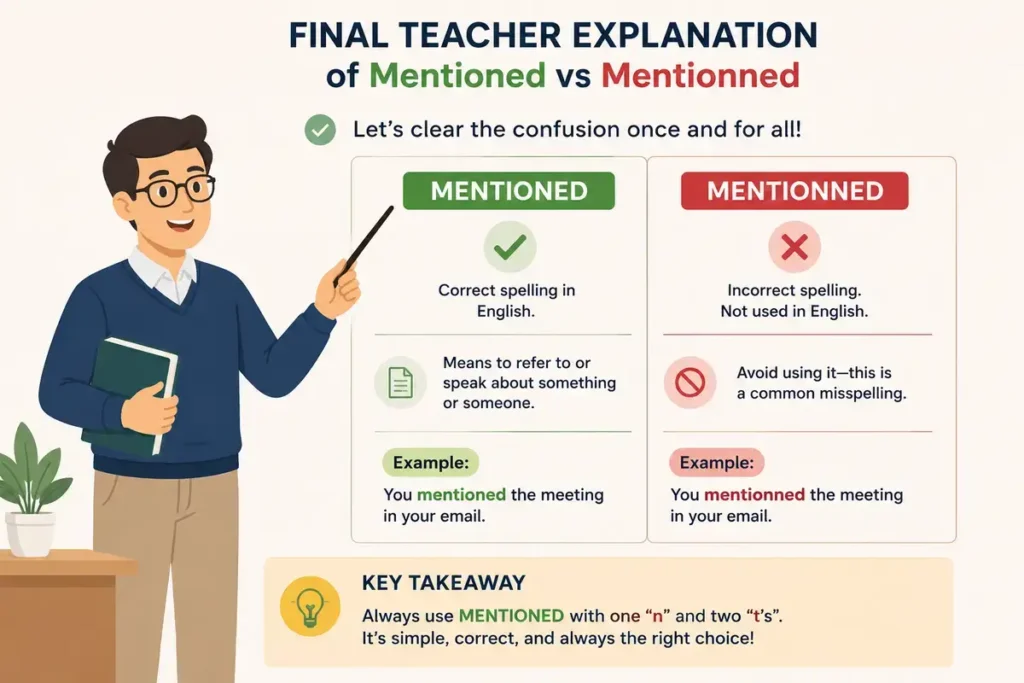
Final Teacher Explanation of Mentioned vs Mentionned
Imagine you are sitting in my classroom. I write two words on the board.
mentioned
mentionned
Then I ask,
“Which one belongs in correct English?”
The answer is easy. Only mentioned is correct. You can use it in:
- school assignments
- emails
- books
- business writing
- text messages
- everyday conversations
The other spelling has an extra letter that English does not need. Here is the easiest rule to remember:
Start with:
mention
Now add:
ed
You get:
mentioned
Nothing else changes. If you remember this one rule, you will almost never make this mistake again. Good writers check small details. Good readers notice correct spelling. And good English learners practice until the right form feels natural.
Final Answer: Mentioned vs Mentionned Quick Recap
When comparing mentioned vs mentionned, the correct English spelling is always mentioned. Use mentioned in every kind of writing and conversation. Mentionned is simply a spelling mistake and should be avoided. Remember this easy rule:
mention + ed = mentioned
For another common grammar confusion, see Developed vs Developped: Easy Guide for English Learners.
Conclusion
Many English spelling mistakes happen because words look similar. The confusion between mentioned vs mentionned is one of the easiest to fix once you know the rule. Always choose mentioned with one n before ed. It is the standard spelling used in schools, books, websites, newspapers, and everyday conversations.
The incorrect form mentionned is not accepted in standard English. Whether you are writing an email, completing homework, posting on social media, or creating professional content, using mentioned will make your writing clear and correct. Practice a few simple sentences every day, and this spelling will soon become a natural habit.
Frequently Asked Questions (FAQs)
What does mentioned mean in simple words?
It means talking about something or someone for a short time.
Is mentioned or mentionned correct?
Mentioned is correct. Mentionned is a spelling mistake.
Why do people write mentionned?
Many people accidentally add an extra “n” or copy spelling patterns from other languages.
Can I use mentionned in formal writing?
No. Always use mentioned in essays, emails, and professional writing.
How do I remember the correct spelling?
Think of this simple rule:
mention + ed = mentioned
Is mentionned found in English dictionaries?
No. Standard English dictionaries only accept mentioned.
Can native English speakers make this mistake?
Yes. Fast typing and spelling habits can cause anyone to add an extra letter.
What is the easiest way to avoid this mistake?
Read the word slowly and remember that mentioned has only one n before ed.
