
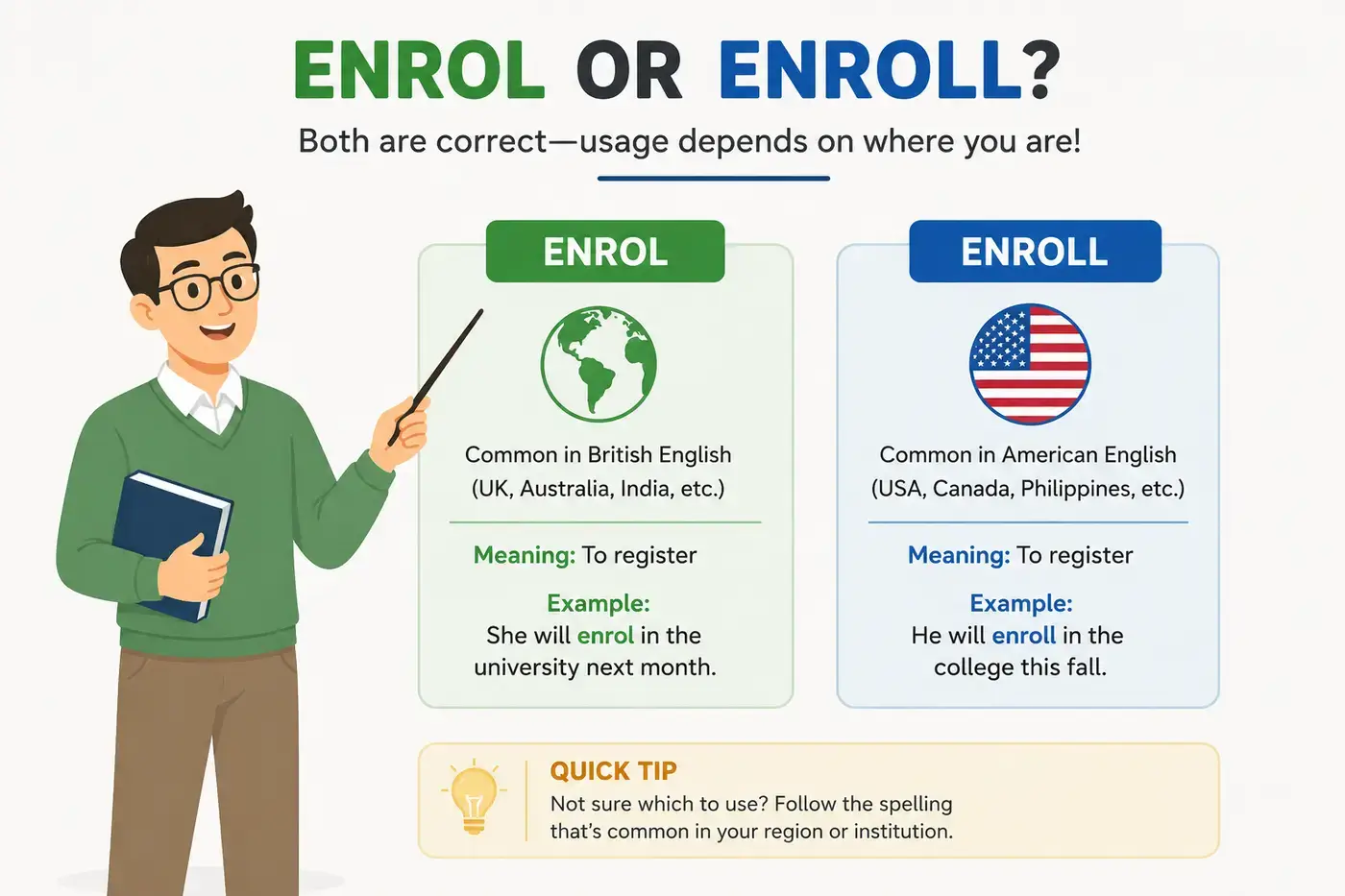
Many English learners get confused about enrol or enroll. The two words look almost the same. They have the same meaning and are both considered correct. That often makes people wonder which spelling they should use.
The good news is that the difference is simple. The spelling you choose mostly depends on the type of English you are writing. One spelling is common in British English, while the other is more common in American English.
If you have ever asked, “Which is correct?” this guide will give you a clear answer. By the end, you will know when to use each spelling and how to avoid mistakes.
Still confused? Compare Extensible vs Extendible: Which One Should You Use? (2026).
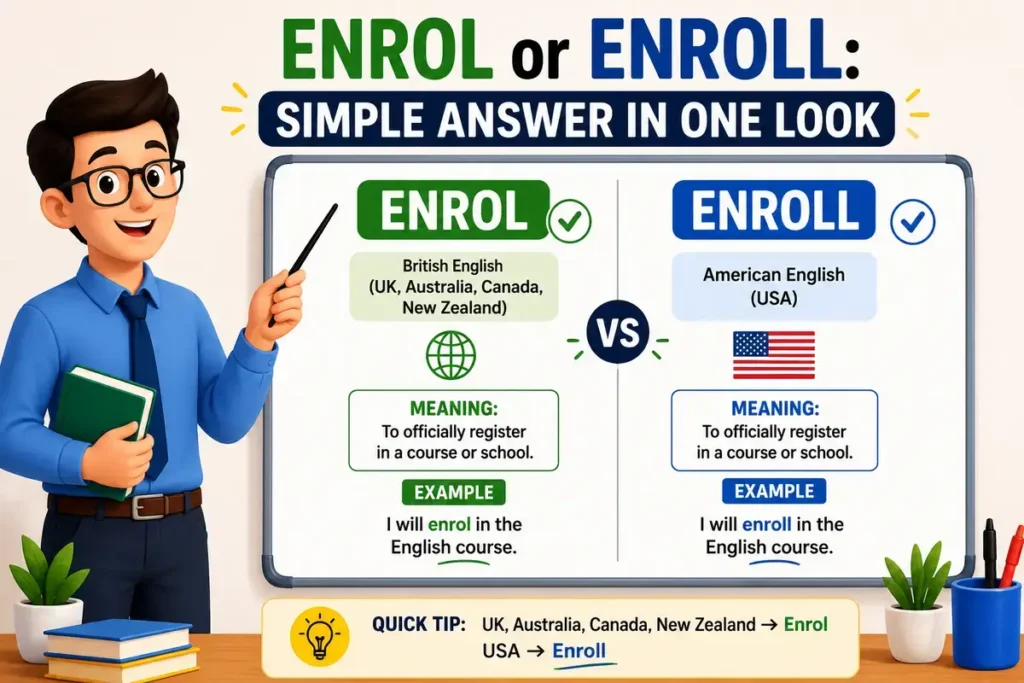
Enrol or Enroll: Simple Answer in One Look
Both spellings are correct.
• Enrol is the preferred spelling in British English.
• Enroll is the preferred spelling in American English.
The meaning stays exactly the same.
What Does Enrol or Enroll Mean in Simple English?
These words mean to officially join something. This could be:
• A course.
• A club.
When you your name is added to a list of people who are taking part in something. For example:
“I want to enroll in a driving course.”
This means you want to officially join the course. Here is another example:
“She plans to enrol at a university next year.”
This means she plans to become a student there.
A Simple Way to Remember the Meaning of Enrol or Enroll
Think of as meaning:
“To sign up.”
Many times, these words can replace the phrase “sign up.” Examples:
• I enrolled in a cooking class.
• I signed up for a cooking class.
The meaning is nearly identical.
Common Situations Where People Use Enrol or Enroll
You may see when talking about:
• Schools.
• Universities.
Whenever someone officially joins, these words can often be used.
Why Do People Mix Enrol or Enroll?
People mix these spellings because English has different spelling systems. American English and British English do not always spell words the same way. For example:
• Color and colour.
• Favorite and favourite.
The meaning stays the same, but the spelling changes.
The Extra “L” Causes Confusion
Many learners notice that one version has one “l” and the other has two. Compare them:
• Enrol
• Enroll
Since both appear in books, websites, and documents, people often think one must be wrong. That is not true. Both spellings are accepted. The difference is mostly regional.
People Read Different Types of English
Today, people read content from all over the world. A student in the United States may read a website from the United Kingdom. A student in Canada may read material from Australia. As a result, both spellings appear online every day. That makes the confusion even more common.
Spell Checkers Can Add More Confusion
Many writing tools follow regional settings. For example:
• An American spell checker may suggest enroll.
• A British spell checker may suggest enrol.
This can make writers think they made a mistake when they actually used a correct spelling.
Enrol or Enroll: Clear Difference Explained Simply
When comparing the meaning does not change. Only the preferred spelling changes.
Enrol or Enroll: Quick Comparison
| Feature | Enrol | Enroll |
|---|---|---|
| Meaning | Join officially | Join officially |
| Correct spelling | Yes | Yes |
| British English | Preferred | Less common |
| American English | Less common | Preferred |
| Pronunciation | Same | Same |
| Meaning changes? | No | No |
Visual Difference
Enrol = One “l”
Enroll = Two “l”s
That is the main difference. Everything else stays the same.
Pronunciation Is Identical
Many learners expect the words to sound different. They do not. Both are pronounced the same way. If someone says the word aloud, you cannot tell which spelling they used. That is another reason people become confused.
Enrol or Enroll: Which Form Should You Use?
The best choice depends on your audience.
Use Enroll for American English
If you are writing for:
• The United States.
• American schools.
Choose enroll. Examples:
• Enroll in a class.
• Enroll today.
These examples look natural to American readers.
Use Enrol for British English
If you are writing for:
• The United Kingdom.
• Australia.
Choose enrol. Examples:
• Enrol in the course.
• Students may enrol online.
These examples follow British spelling conventions.
What About International Writing?
If your audience comes from different countries, either spelling can work. The important thing is consistency. Choose one style and use it throughout the document. Do not switch back and forth. For example:
Correct:
• Enroll in the course today.
• Students can enroll online.
Incorrect:
• Enroll in the course today.
• Students can enrol online.
Mixing spellings can look careless.
Teacher’s Easy Rule
Remember this simple rule:
American English = enroll
British English = enrol
That rule works in most situations.
Enrol or Enroll in Everyday Life
You will often see these words in daily life.
At Schools
Schools regularly ask students. Examples:
• Enroll before classes begin.
• Students must enrol by Friday.
At Colleges and Universities
Higher education institutions use these words constantly. Examples:
• She enrolled in a biology course.
• He plans to enrol next semester.
For Online Learning
Online education has made these words even more common. Examples:
• Enroll in the webinar.
• Enrol in the training program.
For Memberships
Many organizations use these words when someone joins. Examples:
• Enroll in the rewards program.
• Enrol in the membership plan.
In each case, the meaning remains the same.
Easy Real-Life Sentences You Can Use for Enrol or Enroll
Here are simple examples you can use every day.
- I want to enroll in a swimming class.
- She enrolled in a computer course.
- We need to enroll before the deadline.
- My brother enrolled at a local college.
- They enrolled their child in music lessons.
- I plan to enroll in an online program.
- Students can enroll through the website.
- Many people enroll each year.
Here are similar examples using British spelling:
- I want to enrol in a swimming class.
- She enrolled in a computer course.
- We need to enrol before Friday.
- My brother plans to enrol at a university.
- Students can enrol online.
Notice that the meaning never changes.
Common Mistakes People Make using Enrol or Enroll
Mistake 1: Thinking One Spelling Is Wrong
Many learners think only one version is correct. Actually, both are accepted. The choice depends on the type of English you use.
Mistake 2: Mixing Both Spellings
Writers sometimes switch in the same article.
That can look inconsistent.
Pick one style and stick with it.
Mistake 3: Changing the Meaning
Some learners think the spellings have different meanings.
They do not.
Both mean to officially join something.
Where Does Enrol or Enroll Come From? (Simple History)
The word has a long history. It comes from older French and Latin words connected to the idea of placing names on a list or record. Long ago, officials kept written rolls of names. When someone’s name was added to the list, they became officially included. Over time, English developed the verb. The basic meaning stayed the same:
“To enter a person’s name on an official list.”
Today, the word is mostly used for joining schools, courses, organizations, and programs.
Why Did Two Spellings Develop?
As British and American English evolved, some spelling differences appeared.
American English often preferred simplified spelling patterns.
British English sometimes kept older spelling traditions.
This process created many spelling pairs, including:
• Cancelled and canceled.
Even though the spellings differ, the meanings remain identical.
Why Knowing the Difference Matters
Understanding enrol or enroll helps your writing look more natural. Readers notice when spelling matches their language style. Using the preferred spelling for your audience can make your writing feel more professional and easier to read. The key point is simple:
Neither spelling is wrong.
You only need to choose the version that fits your audience.
Learn the difference in Dreamed or Dreamt: Which Is Correct and How to Use (2026).
Transition to the Next Section
Now that you understand the basic difference between enrol or enroll, the next section will look at deeper meanings, cultural usage, symbolism, common expressions, and how these words are understood in different contexts beyond everyday spelling rules.
How Enrol or Enroll Is Understood in Culture and Stories
The words are often connected with growth, learning, and new beginnings. When a person enrolls in something, they are usually starting a new journey. That journey may be a school course, a training program, or a new skill. Because of this, the word often carries a positive feeling. In many stories, a character enrolls in a school, academy, or special program before an important change happens in their life. For example:
• A student enrolls in college and discovers a new future.
• A young athlete enrolls in a sports academy and follows a dream.
In these situations, enrolling is more than joining something. It represents taking a step forward. Many cultures also view education as a path to opportunity. That is why words like are often linked to hope, success, and personal growth.
Why the Word Feels Positive
Most people enroll because they want something better. They may want:
• More knowledge.
• Better job opportunities.
This gives the word a positive and encouraging feeling.
Biblical and Mythological Meaning of Enrol or Enroll
The words does not have a special biblical meaning. They are mainly modern administrative words used for joining schools, programs, and organizations. However, the idea behind the word can be connected to themes found in many religious stories. For example, religious texts often talk about:
• Joining a community.
• Becoming part of a group.
These ideas are similar to the basic because both involve becoming an official part of something. In mythology, heroes often begin a journey after being accepted into a special group, school, or order. While the exact word enroll may not appear, the idea of joining and beginning a new path is common. So the word itself has no special religious meaning, but its core idea appears in many stories throughout history.
Symbolism Enrol or Enroll Explained in Simple Words
What Enrol Represents
The spelling enrol is usually connected with British English. Symbolically, it can represent:
• Starting something new.
• Becoming part of a community.
When someone chooses to enrol, they are often making a decision about their future. The action suggests commitment and progress.
What Enroll Represents
The spelling enroll is usually connected with American English. Its symbolic meaning is exactly the same. It can represent:
• New opportunities.
• Education.
The spelling changes, but the message stays the same. Both words symbolize joining, learning, and moving forward.
Simple Comparison
Enrol = British spelling of joining something.
Enroll = American spelling of joining something.
Meaning = Exactly the same.
Symbolism = Exactly the same.
Only the spelling changes.
Related Words You Should Know About Enrol or Enroll
Learning related words can make English easier.
Enrollment
The process of joining a school, program, or organization. Example:
“School enrollment increased this year.”
Enrolment
The British spelling of enrollment. Example:
“University enrolment opened in June.”
Register
To officially sign up for something. Example:
“I registered for the class yesterday.”
Sign Up
A common everyday phrase that means to join. Example:
“I signed up for swimming lessons.”
Admission
Permission to enter a school or program. Example:
“She received admission to the college.”
Applicant
A person who applies to join something. Example:
“He is an applicant for the training program.”
Student
A person who has already enrolled in a school or course. Example:
“Every student must attend orientation.”
Membership
Official participation in a group. Example:
“Membership requires annual payment.”
These related words often appear alongside.
How People Actually Use Enrol or Enroll in Daily English
People use these words in many everyday situations. Here are some natural examples.
At School
“I need to enroll before classes start.”
At College
“My sister enrolled in a nursing program.”
Online Learning
“I enrolled in an online English course.”
Sports
“He enrolled in a soccer academy.”
Work Training
“Our company enrolled us in a safety course.”
Health Programs
“She enrolled in a fitness program.”
Community Activities
“They enrolled their son in music lessons.”
Children’s Classes
“We enrolled our daughter in dance classes.”
Membership Programs
“I enrolled in the store’s rewards program.”
Personal Growth
“I’m planning to enroll in a photography class.”
These examples show how common the word is in daily life. Most of the time, it simply means officially joining something.
Common Mistakes People Make With Enrol or Enroll
Mistake 1: Thinking One Spelling Is Wrong
Many learners believe only one spelling is correct.
Correction:
Both spellings are correct.
Use enrol for British English and enroll for American English.
Mistake 2: Mixing Both Spellings
Example:
❌ Students can enroll today. Please enrol before Friday.
Correction:
✔ Students can enroll today. Please enroll before Friday.
OR
✔ Students can enrol today. Please enrol before Friday.
Choose one style and keep it throughout your writing.
Mistake 3: Using the Wrong Regional Style
Example:
A British university brochure using only American spelling may look unusual to British readers.
Correction:
Match the spelling to your audience.
Mistake 4: Confusing Enroll With Register
These words are similar but not always identical. Register often means signing up. Enroll often means officially becoming part of the course or program. Many situations allow either word, but context matters.
Mistake 5: Misspelling the Word
Common incorrect forms include:
❌ Enrole
❌ Inroll
Correct forms:
✔ Enrol
✔ Enroll
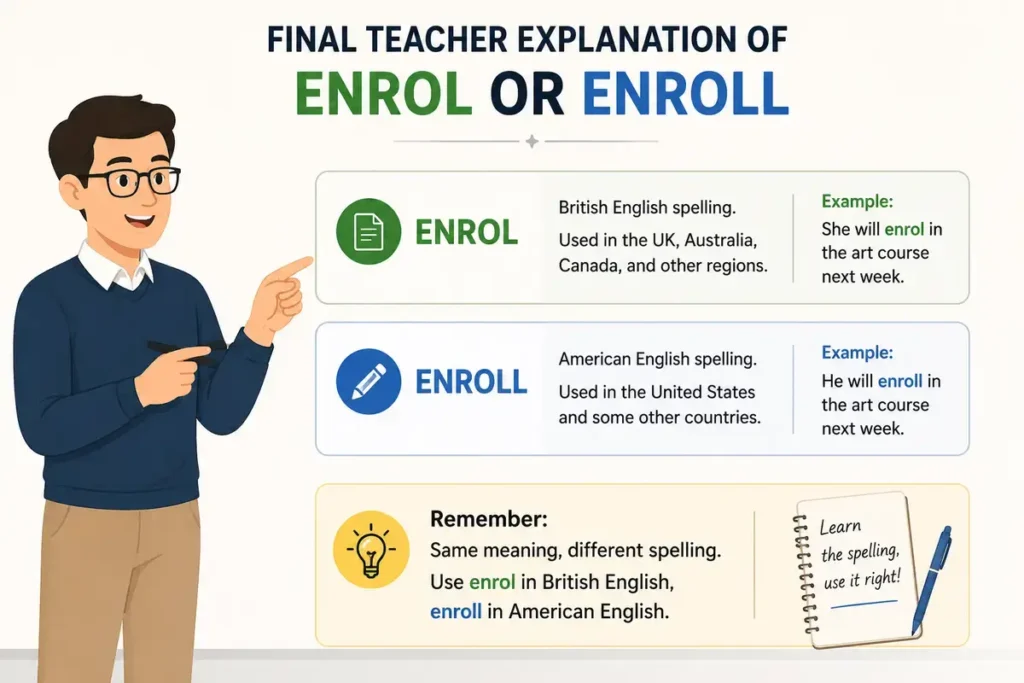
Final Teacher Explanation of Enrol or Enroll
Imagine you are sitting in my classroom and asking one final question:
“Teacher, which is correct?”
My answer would be simple. Both are correct. Neither spelling is wrong. The only real difference is location. If you are writing American English, use enroll. If you are writing British English, use enrol. The meaning never changes. Both words mean to officially join a school, course, program, organization, or activity. That is the key idea to remember.
Do not spend too much time worrying about which spelling is better. Instead, focus on using the correct style for your audience and staying consistent throughout your writing. If you remember that one simple rule, you will use these words correctly almost every time.
Final Answer: Enrol or Enroll
Both are correct spellings.
Enrol is preferred in British English.
Enroll is preferred in American English.
The meaning is exactly the same. Choose the spelling that matches your audience and use it consistently.
A related grammar guide is Tear vs Tare: Powerful Grammar Tips for (Guide 2026).
Conclusion
The confusion is very common because both spellings are correct. The difference is not about meaning. It is about regional spelling preferences. Use enroll when writing for an American audience. Use enrol when writing for a British audience. Both mean to officially join a school, course, program, organization, or activity. The easiest rule to remember is simple: American English prefers enroll, while British English prefers enrol. Once you know that, the choice becomes easy.
Frequently Asked Questions About Enrol or Enroll
Is correct?
Both are correct. Enrol is British English, and enroll is American English.
What does mean?
It means to officially join a school, course, program, group, or organization.
Should I use in American English?
Use enroll in American English.
Should I use in British English?
Use enrol in British English.
Why do people get confused?
People see both spellings online and think one must be wrong. In reality, both are accepted.
Can I use both forms in the same article?
It is better not to. Choose one spelling style and stay consistent.
Is the pronunciation different?
No. Both words are pronounced the same way.
Is enroll more common than enrol?
Globally, enroll is often seen more because of American English content online. However, enrol remains standard in British English.
