
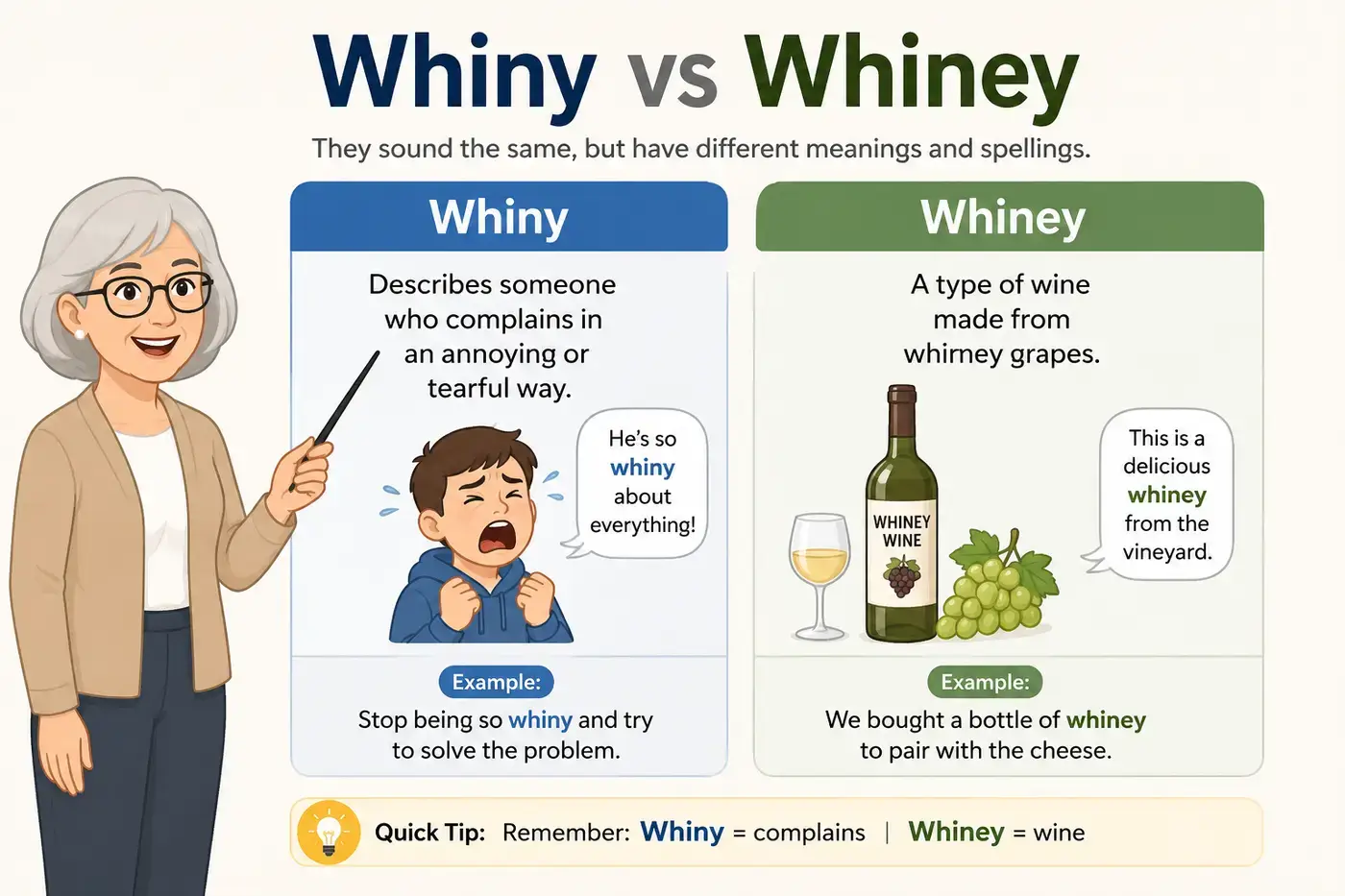
Many people get confused about whiny vs whiney because both spellings appear online, in books, and in everyday writing. At first glance, they look almost identical. That makes many writers wonder which version is correct.
If you have searched for whiny vs whiney, the short answer is simple. Both spellings exist, but one is much more common in modern English. Most dictionaries and style guides prefer “whiny.”
Knowing the difference between whiny vs whiney can help you write with more confidence. It can also help you avoid spelling mistakes in school, work, and everyday communication.
Still confused? Compare Zeroes Or Zeros: Which Is Correct Simple Answer (2026).
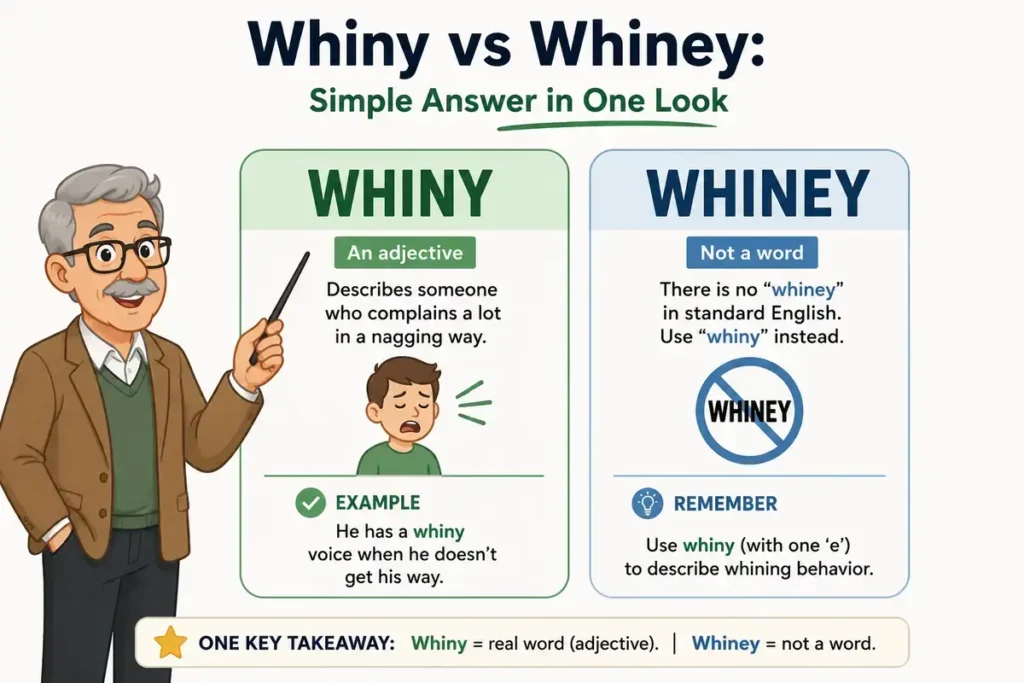
Whiny vs Whiney: Simple Answer in One Look
When comparing whiny vs whiney, both spellings are accepted. However, “whiny” is the preferred and more common spelling in modern English.
What Does Whiny vs Whiney Mean in Simple English?
The words whiny and whiney have the same meaning. They describe someone who complains too much or speaks in an annoying complaining voice. A whiny person often finds something to complain about even when the problem is small. For example:
- A child may be whiny because they are tired.
- A student may sound whiny after getting extra homework.
- A worker may seem whiny if they complain about every task.
The word can describe a person’s voice, attitude, or behavior.
What Does a Whiny Voice Sound Like?
A whiny voice often sounds:
- Complaining
- Annoyed
- Unhappy
- Irritated
- Needy
Example:
“Stop using that whiny voice and tell me what is wrong.”
Here, the speaker is asking someone to stop sounding like they are complaining.
Can Adults Be Whiny?
Yes. The word is not only used for children. Adults can also be described as whiny when they complain too much. Example:
“My coworker gets whiny whenever the schedule changes.”
The meaning is the same.
Is Whiny Always Negative?
Usually, yes. Most people use the word as criticism. Calling someone whiny suggests that they complain more than necessary. Because of this, you should be careful when using the word.
Why Do People Mix These Words Whiny vs Whiney?
The confusion between whiny vs whiney happens because both spellings have been used for many years. People often learn one version from reading and another version from hearing the word spoken. Since both spellings look reasonable, many writers assume both are equally common.
The Base Word Creates Confusion
The adjective comes from the verb “whine.”
When people add a word ending to “whine,” they may create:
- Whiny
- Whiney
Both seem logical because the original word is “whine.”
This makes the spelling choice less obvious.
Different Sources Use Different Spellings
Some older books and websites use “whiney.”
Many modern dictionaries and editors prefer “whiny.”
As a result, learners may see both forms and become unsure.
The Words Sound Exactly the Same
Pronunciation does not help much. Both words are pronounced the same way. When listening to someone speak, you cannot tell which spelling they would use in writing. That is another reason people mix them up.
Whiny vs Whiney: Clear Difference Explained Simply
When comparing whiny vs whiney, the meaning does not change. The main difference is spelling preference.
Quick Comparison
| Feature | Whiny | Whiney |
|---|---|---|
| Meaning | Complaining too much | Complaining too much |
| Correct spelling | Yes | Yes |
| Common today | Very common | Less common |
| Preferred by many editors | Yes | Usually no |
| Best choice for most writing | Yes | Sometimes |
Easy Way to Remember
Think about modern English writing. Most newspapers, blogs, websites, and books use:
Whiny
That makes it the safer choice.
Does the Meaning Change?
No. Look at these sentences:
- He has a whiny voice.
- He has a whiney voice.
Both sentences mean exactly the same thing. Only the spelling changes.
Which Form Should You Use in Whiny vs Whiney?
For most situations, use “whiny.” It is the spelling that most readers expect. It is also the version found more often in current English writing.
Use Whiny for School and Work
If you are writing:
- Essays
- Reports
- Emails
- Articles
- Blog posts
- Professional documents
Choose “whiny.”
It will look more familiar to readers.
Is Whiney Wrong?
No.
Whiney is not considered wrong. It is simply less common. Some writers still use it, and some dictionaries list it as a variant spelling.
The Safest Rule
If you are unsure, use:
Whiny
That choice works almost everywhere.
Teacher’s Simple Rule
Remember this: Both spellings are correct, but whiny is the standard choice in modern English. That rule will help you avoid confusion.
Whiny vs Whiney in Everyday Situations
Understanding the word becomes easier when you see it in real life.
At Home
Parents sometimes use the word when children complain repeatedly. Example:
“The kids were getting whiny because they were hungry.”
At School
Students may become whiny when they dislike an assignment. Example:
“The class became whiny after hearing about the extra project.”
At Work
Adults can also be described this way. Example:
“Nobody likes a whiny employee who complains every day.”
In Friendships
Friends may use the word jokingly. Example:
“You sound a little whiny today.”
The tone may be playful or serious depending on the situation.
Easy Real-Life Sentences You Can Use for Whiny vs Whiney
Here are simple examples using the preferred spelling.
- The child became whiny before bedtime.
- My brother gets whiny when he is tired.
- She used a whiny voice to ask for help.
- The customer sounded whiny on the phone.
- I do not like whiny complaints.
- He became whiny after losing the game.
- The dog made a whiny sound at the door.
- They were feeling whiny because of the long wait.
Examples with the alternative spelling:
- The child became whiney before bedtime.
- My brother gets whiney when he is tired.
- She used a whiney voice during the conversation.
The meaning remains exactly the same.
Common Phrases Related to Whiny
You may hear expressions such as:
- Whiny voice
- Whiny attitude
- Whiny complaint
- Whiny behavior
- Stop being whiny
- Sounding whiny
These phrases are very common in everyday English. They usually describe someone who complains too much.
Where Does This Word Come From? (Simple History)
The words whiny and whiney come from the verb “whine.”
The verb “whine” has been used in English for hundreds of years.
It originally described making a long, unhappy sound. Over time, people started using it for complaining. For example:
- Dogs can whine.
- Children can whine.
- Adults can whine.
Eventually, English speakers created adjectives from the verb. These adjectives became:
- Whiny
- Whiney
Both developed from the same root word.
Why Did Whiny Become More Popular?
Language often changes over time. One spelling sometimes becomes more common than another. That is what happened here.
Writers, editors, and publishers gradually favored “whiny.”
As a result, modern readers see it much more often.
Why Do Both Spellings Still Exist?
English keeps many older spelling variations alive.Even after one version becomes more popular, the older version may continue appearing in books, articles, and personal writing. That is why both spellings still exist today.
Is Whiny More Common Than Whiney?
Yes.
Whiny is far more common in modern English. If you read:
- News articles
- Online blogs
- School materials
- Magazines
- Business writing
You will usually see “whiny.”
This does not mean “whiney” is incorrect.
It simply means that one spelling has become the standard choice for most writers.
A related grammar guide is Scarey or Scary: Common Mistakes Explained Simply Today.
Transition to Deeper Meaning and Usage
Now that you understand the basic difference between whiny vs whiney, the next section will go deeper. You will learn how this word is understood in culture, stories, symbolism, everyday communication, and common social situations so you can fully understand how and when people use it.
How Is Whiny vs Whiney Understood in Culture and Stories?
When people hear the words whiny or whiney, they usually think about someone who complains a lot. In many stories, movies, and TV shows, a whiny character is often shown as someone who is unhappy with everything around them. For example:
- A child who complains about dinner.
- A student who complains about homework.
- A character who always finds something wrong.
These characters are usually not the heroes of the story. Why? Because most cultures admire people who stay positive during difficult times. That does not mean people should never complain. Everyone complains sometimes. The difference is balance. A person who speaks up about a real problem is often respected. A person who complains about everything may be seen as whiny.
How Parents Use the Word
Parents often use this word when talking to children. Examples:
- “Don’t be whiny.”
- “Use your normal voice.”
- “Tell me what is wrong without whining.”
In these situations, the word teaches children to communicate calmly.
How the Word Appears in Movies
Movies often include a whiny character for humor. The character may:
- Complain constantly.
- Avoid responsibility.
- Expect special treatment.
These behaviors create funny or frustrating situations for viewers. Because of this, the word has become strongly connected with complaining behavior.
What Is the Biblical and Mythological Meaning of Whiny vs Whiney?
There is no direct biblical meaning for whiny or whiney. The words themselves do not appear as important religious terms. However, many religious stories discuss attitudes that sound similar to whining. For example, stories often teach:
- Patience
- Gratitude
- Self-control
- Faith during hard times
When people constantly complain, many religious teachings encourage them to focus on solutions instead.
A Simple Biblical Connection
In several Bible stories, people complain during difficult situations. The lesson is usually not about never speaking up. Instead, the lesson is about avoiding endless complaining without trust or gratitude.
A Simple Mythological Connection
In myths from different cultures, heroes are usually brave and determined. Characters who complain too much are rarely shown as role models. Because of this, whining is often connected with weakness or frustration in storytelling. The spelling does not matter here. Both whiny and whiney carry the same idea.
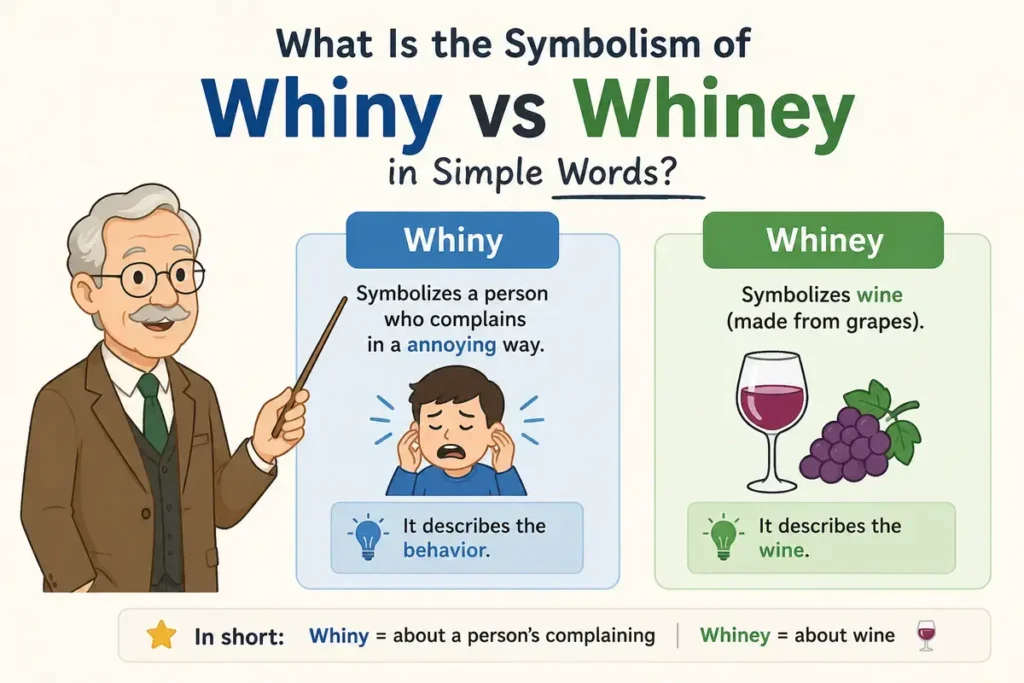
What Is the Symbolism of Whiny vs Whiney in Simple Words?
People sometimes connect words with ideas and emotions. When discussing whiny vs whiney, the symbolism is about behavior rather than spelling.
What One Version Represents in Whiny vs Whiney
The spelling “whiny” often represents:
- Complaining
- Frustration
- Dissatisfaction
- Emotional reactions
- Lack of patience
Since it is the more common spelling, most readers immediately understand these meanings. A whiny character often symbolizes someone struggling to handle problems calmly.
What the Other Version Represents in Whiny vs Whiney
The spelling “whiney” represents exactly the same ideas. It may symbolize:
- Complaining behavior
- Unhappiness
- Irritation
- Constant criticism
The emotional meaning does not change. The only difference is spelling preference. That is why most discussions about whiny vs whiney focus on spelling rather than meaning.
Related Words You Should Know About Whiny vs Whiney
Learning related words can help you understand the meaning more clearly.
Complain
To express dissatisfaction about something. Example:
“He likes to complain about the weather.”
Grumble
To complain quietly. Example:
“She grumbled about the long line.”
Moan
To complain in a sad or annoyed way. Example:
“They moaned about the extra work.”
Fuss
To show unnecessary worry or complaint. Example:
“Stop fussing about small problems.”
Nag
To complain or remind someone repeatedly. Example:
“My brother nags me about cleaning my room.”
Irritated
Feeling annoyed. Example:
“He sounded irritated after waiting so long.”
Negative
Focused mainly on problems. Example:
“She had a negative attitude.”
Complainer
A person who complains frequently. Example:
“Nobody wants to be known as a complainer.”
How Do People Actually Use Whiny vs Whiney in Daily English?
Most people use “whiny” in casual conversation. You will hear it in homes, schools, workplaces, and online discussions. Here are some real-life examples.
Everyday Examples of Whiny vs Whiney
- “You’re getting a little whiny today.”
- “The kids became whiny after the long trip.”
- “Stop using that whiny voice.”
- “He sounded whiny when he talked about work.”
- “I don’t want to sound whiny, but this line is really long.”
- “My dog gets whiny when it wants attention.”
- “The customer seemed whiny during the call.”
- “She became whiny because she was tired.”
- “The movie character was funny but very whiny.”
- “Nobody likes a whiny attitude.”
Spoken English vs Written English
In spoken English, nobody can hear the spelling. They only hear the sound. In writing, most people choose “whiny” because it is the more familiar spelling. That is why you will see it much more often online and in print.
Common Mistakes People Make With Whiny vs Whiney
Many learners make small mistakes when using these words. The good news is that they are easy to fix.
Mistake 1: Thinking Whiney Is Always Wrong
Many people believe only “whiny” is correct.
Correction:
Whiney is accepted, but it is less common.
Mistake 2: Using Both Spellings in the Same Article
Some writers switch between whiny and whiney.
Correction:
Choose one spelling and stay consistent.
For most writing, choose “whiny.”
Mistake 3: Thinking the Meaning Changes
Some learners think each spelling has a different definition.
Correction:
The meaning stays exactly the same. Only the spelling changes.
Mistake 4: Using the Word for Every Complaint
Not every complaint is whiny.
Correction:
People can express concerns politely without sounding whiny.
Mistake 5: Confusing Whiny With Crying
These words are related but not identical.
Correction:
Someone can be whiny without crying.
Someone can cry without being whiny.
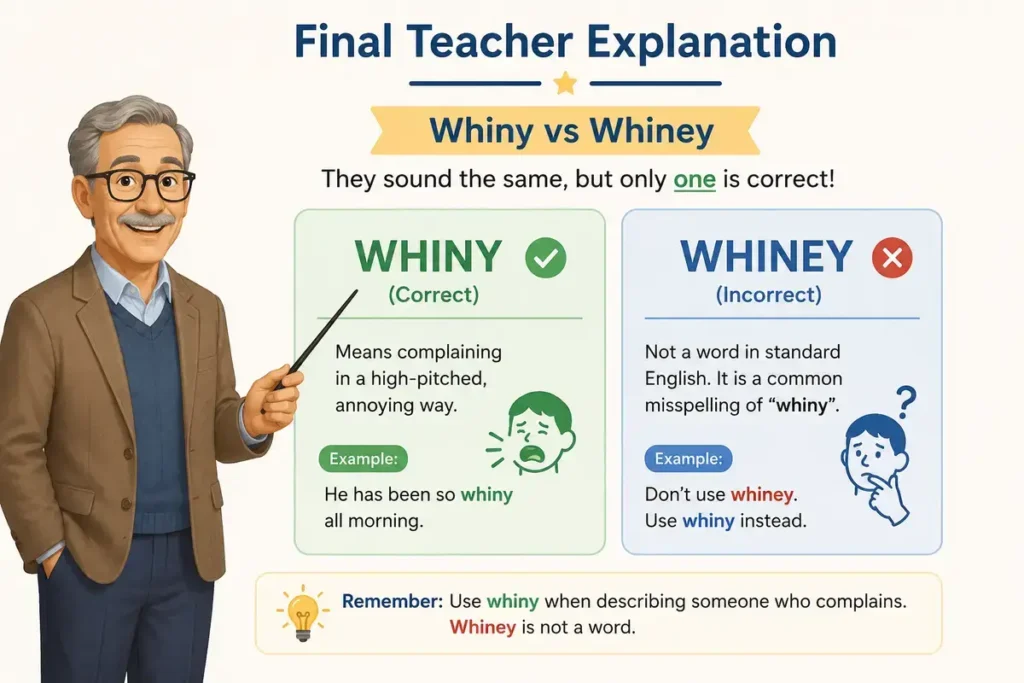
Final Teacher Explanation of Whiny vs Whiney
Imagine you are sitting in a classroom and asking me which spelling you should use. My answer would be simple. Both words mean the same thing. Both describe someone who complains a lot or speaks in a complaining way. However, one spelling is clearly more popular today.
That spelling is “whiny.”
If you are writing:
- School assignments
- Blog posts
- Emails
- Business documents
- Social media content
Use “whiny.”
Most readers expect that spelling. You do not need to worry if you see “whiney.” It is not wrong. It is simply less common. The easiest rule to remember is this: When comparing whiny vs whiney, choose “whiny” unless you have a specific reason to use the alternative spelling. That simple rule will help you almost every time.
Final Answer: Quick Recap of Whiny vs Whiney
Both whiny and whiney are correct spellings. They have the same meaning.
“Whiny” is much more common and is the best choice for most writing.
If you are unsure, use “whiny.”
You may also want to read Shakey or Shaky Discover the Correct Choice 2026.
Conclusion
The debate about whiny vs whiney is mostly about spelling, not meaning. Both words describe someone who complains too much or speaks in a complaining way. The meanings are identical. The main difference is that “whiny” has become the preferred spelling in modern English. If you want the safest and most widely accepted choice, use “whiny.” It is the spelling most readers recognize immediately, and it works well in school, business, and everyday writing.
Frequently Asked Questions (FAQs)
Is whiny or whiney correct?
Both are correct, but whiny is much more common in modern English.
Which spelling should I use in school writing?
Use whiny. Most teachers and editors prefer this spelling.
Do whiny and whiney have different meanings?
No. They mean exactly the same thing.
Why do people get confused between whiny vs whiney?
Both spellings exist, and they sound exactly the same when spoken.
Is whiney considered wrong?
No. It is an accepted spelling, but it is less common.
What does whiny mean in simple words?
It means complaining too much or speaking in a complaining way.
Can adults be called whiny?
Yes. The word can describe both children and adults.
Is whiny a negative word?
Usually yes. It often suggests that someone complains more than necessary.
