
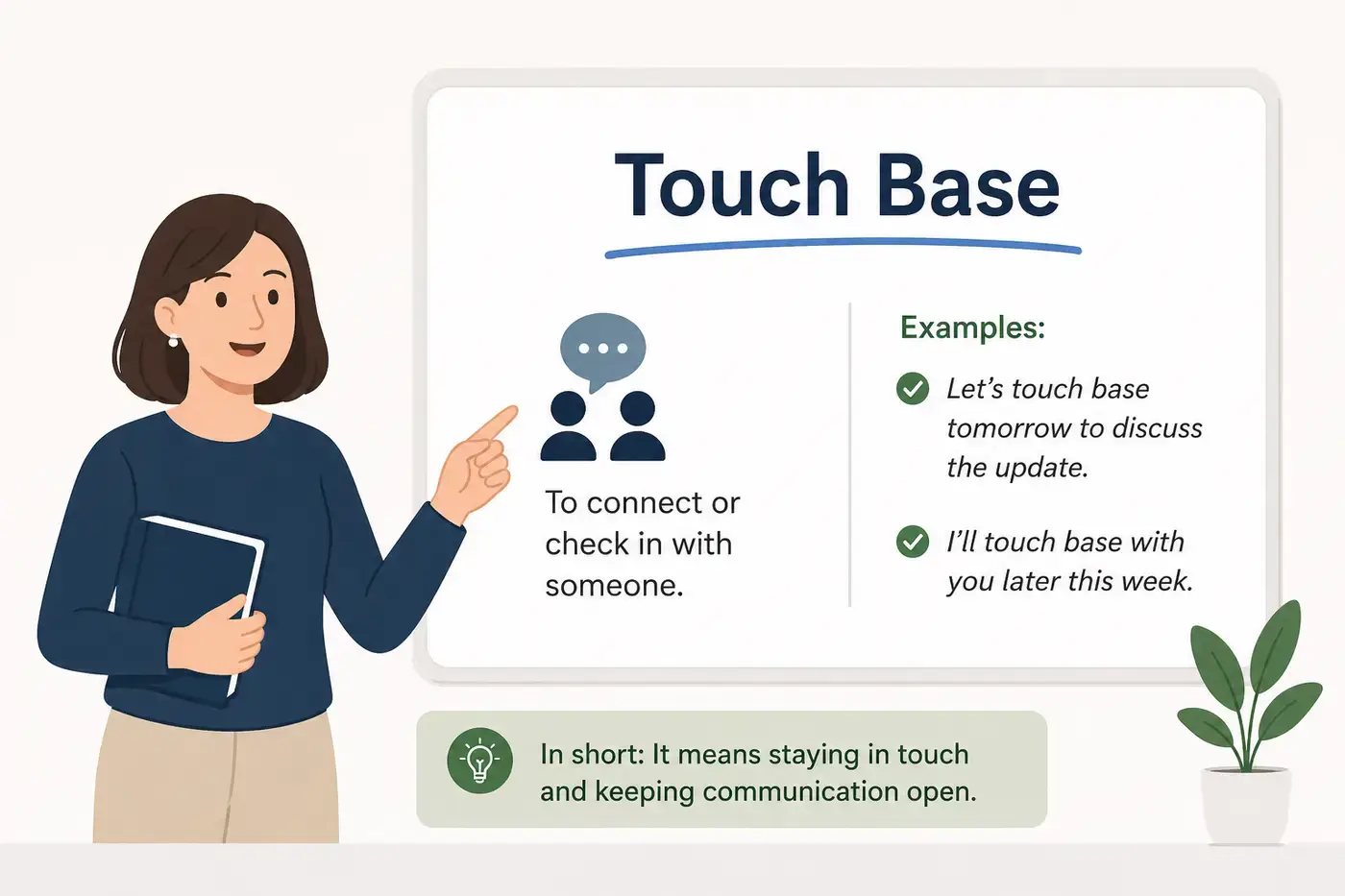
Many people get confused about whether they should write “touchbase” or “touch base.” You may see both forms online, in emails, or at work. That makes it hard to know which one is correct.
If you are searching for the difference between touchbase or touch base, the short answer is simple. In most cases, “touch base” is the correct form. It is a common English expression that means to make contact with someone, check in, or have a short conversation.
Understanding touchbase or touch base can help you write more clearly in emails, messages, and professional communication. Once you know the simple rule, the choice becomes easy.
Need another quick comparison? Read Receiver vs Reciever: Complete English Guide 2026.
Simple Answer in One Look
When comparing touchbase or touch base, the correct expression is usually:
• Touch base ✔️
• Touchbase ✖️
Use “touch base” when you mean to contact someone or check in with them.
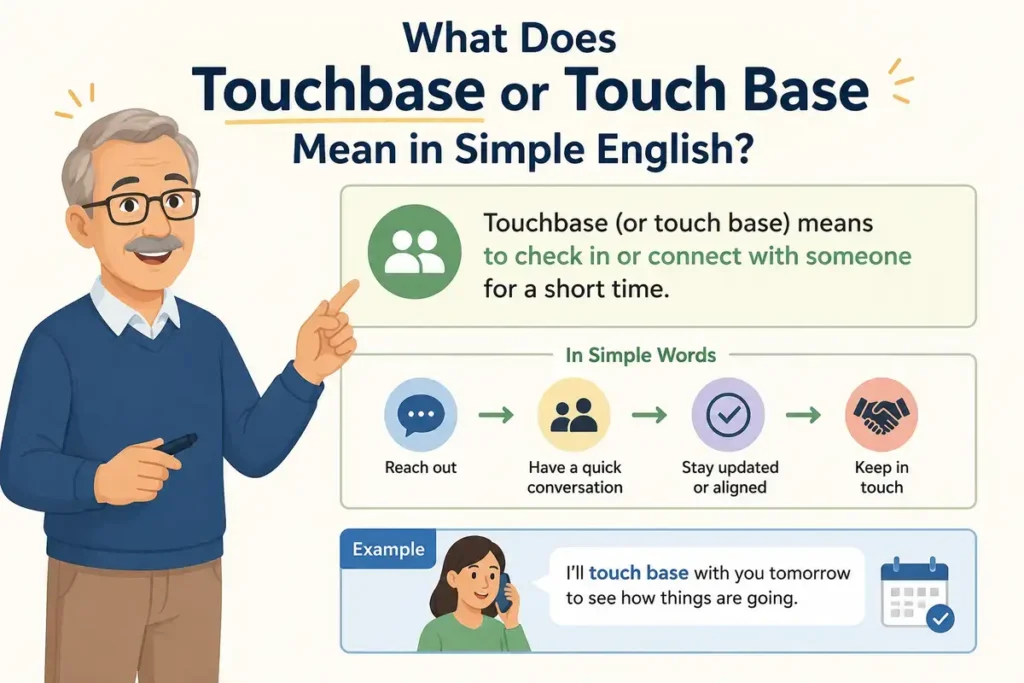
What Does Touchbase or Touch Base Mean in Simple English?
The phrase “touch base” means to briefly connect with someone. It usually means:
• Check in.
• Talk for a short time.
• Share updates.
• Make sure everyone is on the same page.
Think of it as a quick conversation rather than a long meeting. For example:
“Let’s touch base tomorrow.”
This means:
“Let’s talk tomorrow and see how things are going.”
Touch Base Means Making Contact
People use “touch base” when they want to reconnect. Examples:
• A manager talks with a team member.
• Two friends check in after a few weeks.
• A customer contacts a business.
• A teacher speaks with a parent.
In each case, someone is making contact with another person.
Touch Base Does Not Mean Physical Touch
This is a common misunderstanding. The phrase is not about touching something with your hand. Instead, it means communicating with someone. For example:
“I’ll touch base with you later.”
The speaker means:
“I’ll contact you later.”
Common Meanings of Touch Base
The phrase can mean:
• Check in.
• Catch up.
• Connect.
• Reach out.
• Follow up.
• Talk briefly.
These phrases are often used in similar situations.
Why Do People Mix These Words?
People mix up touchbase or touch base because English sometimes turns phrases into single words. For example:
• Notebook
• Football
• Bedroom
Since many English words are combined into one word, some people assume “touchbase” should also be one word. But that is not how this expression is normally written.
It Sounds Like One Word
When people speak quickly, “touch base” sounds connected. You may hear:
“Let’s touchbase next week.”
Because the words blend together in speech, some people write them as one word. That creates confusion.
Business Communication Adds to the Confusion
The phrase appears often in workplaces. People see it in:
• Emails
• Team chats
• Meeting notes
• Business messages
After seeing it many times, some writers accidentally combine the words into one.
Autocorrect Does Not Always Help
Some writing tools may not flag “touchbase.” As a result, people continue using it without realizing that “touch base” is the standard form.
Clear Difference Explained Simply
When looking at touchbase or touch base, the biggest difference is correctness.
Quick Comparison
| Feature | Touchbase | Touch Base |
|---|---|---|
| Standard English | No | Yes |
| Common business phrase | No | Yes |
| Means check in or connect | Intended meaning | Yes |
| Recommended in writing | No | Yes |
| Used in professional emails | Rarely | Very often |
Easy Way to Remember
Think of the phrase as two separate words.
Touch + Base
If you remember the two parts, you will usually spell it correctly.
Visual Example
Correct:
• Let’s touch base tomorrow.
• We should touch base next week.
• I’ll touch base after the meeting.
Incorrect:
• Let’s touchbase tomorrow.
• We should touchbase next week.
Keeping the words separate is the safest choice.
Touchbase or Touch Base in Business Writing
Many people first learn this expression at work. Managers often say:
“Let’s touch base next Monday.”
This simply means:
“Let’s have a quick conversation next Monday.”
The phrase helps people discuss plans, projects, and updates.
Why Professionals Use Touch Base
It sounds friendly and simple. Instead of saying:
“Let’s schedule a brief communication session.”
Most people simply say:
“Let’s touch base.”
The meaning is clear and natural.
Is Touch Base Too Formal?
No. It sits between formal and casual English. You can use it with:
• Coworkers
• Managers
• Clients
• Business partners
That flexibility makes it popular.
Which Form Should You Use?
If you are deciding between touchbase or touch base, choose “touch base.” This is the form recognized by dictionaries, style guides, and professional writers.
Use Touch Base in Emails
Examples:
“Can we touch base this afternoon?”
“Let’s touch base after the presentation.”
“I’m hoping to touch base next week.”
These examples sound natural and professional.
Use Touch Base in Messages
The phrase also works well in text messages and chat apps. Example:
“Just wanted to touch base and see how you’re doing.”
This sounds friendly and warm.
Avoid Touchbase
Even if you have seen it written as one word, it is usually best to avoid it.
Using “touch base” helps your writing look more polished.
Teacher’s Rule
Remember this simple rule: If you mean “contact someone” or “check in,” write “touch base” as two words. That rule works almost every time.
Touchbase or Touch Base as Different Parts of a Sentence
The phrase usually acts like an action. Examples:
• I will touch base tomorrow.
• We need to touch base soon.
• They touched base after the event.
• She is touching base with the client.
Notice that “base” stays separate from “touch.”
Different Forms You May See
Present:
• I touch base every Friday.
Past:
• We touched base yesterday.
Future:
• I’ll touch base next week.
Continuous:
• She is touching base with the team now.
The phrase remains two words throughout these forms.
Easy Real-Life Sentences You Can Use
Here are some examples you can use right away.
- Let’s touch base tomorrow morning.
- I need to touch base with my teacher.
- We touched base before the project started.
- I’ll touch base after lunch.
- Can we touch base next week?
- She touched base with the customer yesterday.
- Our team touches base every Friday.
- They will touch base after the conference.
These examples sound natural in everyday English.
Common Situations Where People Say Touch Base
You will hear this phrase in many situations.
At Work
“Let’s touch base after the meeting.”
At School
“I’ll touch base with the teacher tomorrow.”
Between Friends
“Let’s touch base this weekend.”
During Projects
“We should touch base before making a decision.”
In each example, people are checking in with each other.
Where Does Touch Base Come From? (Simple History)
The phrase comes from baseball. In baseball, players run around the field and touch the bases. Touching a base shows that the player has reached a certain point safely. Over time, English speakers borrowed this idea. Instead of physically touching a base, people began using the phrase to mean making contact with someone.
How the Meaning Changed
Originally:
• Touch a base in baseball.
Later:
• Make contact with a person.
Today:
• Have a short conversation or check in.
This change is common in English. Many expressions begin in sports and later become everyday phrases.
Why the Baseball Connection Matters
The original image is simple. A player briefly reaches a base before moving forward. In the same way, people briefly connect with each other before continuing their work or activities. That idea helped the phrase become popular.
Common Mistakes With Touchbase or Touch Base
Many writers make these mistakes:
Writing It as One Word
Incorrect:
• Let’s touchbase tomorrow.
Correct:
• Let’s touch base tomorrow.
Using It for Physical Touch
Incorrect:
• He touched base with his hand.
The phrase is usually about communication, not physical contact.
Making It More Complicated Than Necessary
Instead of using long phrases, simple English often works best. Example:
“Let’s touch base later.”
This is clear and natural.
Similar Phrases to Touch Base
If you want variety in your writing, you can use:
• Check in.
• Catch up.
• Reach out.
• Connect.
• Follow up.
• Get in touch.
Examples:
“Let’s check in tomorrow.”
“Let’s catch up next week.”
“I’ll reach out later.”
These phrases have similar meanings.
Learn the difference in Maintained vs Maintenanced: Correct Word and Guide.
Quick Memory Trick for Touchbase or Touch Base
Ask yourself one question:
“Am I talking about contacting someone?”
If the answer is yes, write:
Touch base
Two words.
Think about baseball.
A player touches a base. The words stay separate. That simple image helps many people remember the correct form.
Transition to Deeper Meaning and Cultural Understanding
Now you know the basic difference between touchbase or touch base, why the phrase is written as two words, and how it is used in everyday English. In the next section, we will look at its deeper meaning, cultural use, symbolism, common workplace habits, and how this expression became such a popular part of modern communication.
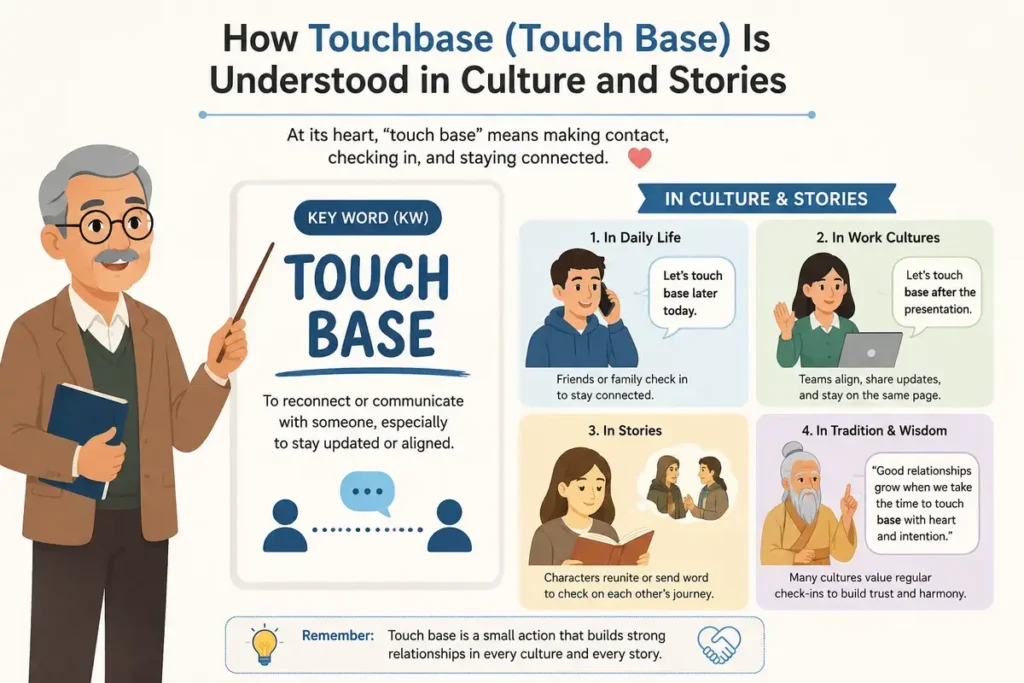
How Touchbase or Touch Base Is Understood in Culture and Stories
When people hear the phrase “touch base,” they usually think about communication and connection. In many cultures, staying connected with others is seen as a good thing. Friends check on friends. Families stay in contact. Coworkers share updates. The phrase “touch base” fits this idea perfectly. When someone says:
“Let’s touch base later.”
They are really saying:
“Let’s stay connected.”
That simple message has helped the phrase become popular in everyday English. In stories, movies, and television shows, characters often touch base with each other after an important event. For example:
• A detective touches base with a partner after finding a clue.
• A coach touches base with players before a big game.
• A friend touches base after hearing important news.
The phrase often shows teamwork, support, and communication. People rarely use it when they want a long conversation. Instead, it suggests a quick connection before moving forward. That simple idea is why the phrase remains common in modern English.
Biblical and Mythological Meaning of Touchbase or Touch Base
The phrase “touch base” does not come from the Bible. It also does not come from mythology. As explained earlier, its roots are connected to baseball. Still, the idea behind the phrase can be found in many religious and cultural stories. People often communicate, check on each other, and share guidance. For example:
• Teachers check on students.
• Leaders check on followers.
• Friends encourage one another.
These actions are similar to the modern meaning of “touch base.” The phrase itself is not biblical, but the idea of staying connected appears in many traditions around the world.
Symbolism Explained in Simple Words
What Touch Base Represents
The correct form, “touch base,” represents connection. It symbolizes:
• Communication.
• Teamwork.
• Cooperation.
• Friendship.
• Staying informed.
• Moving forward together.
When someone says:
“Let’s touch base.”
They often want to strengthen a connection. The phrase can also symbolize responsibility. People use it when they want to make sure everyone understands the plan. In workplaces, schools, and families, this type of communication helps people work together.
What Touchbase Represents
“Touchbase” as one word does not carry a different meaning. Most people simply see it as a spelling mistake or a nonstandard version of the phrase. If readers notice it, they usually understand what the writer means. However, it may look less professional. That is why most writers choose “touch base.”
Touchbase or Touch Base Symbolism Comparison
| Form | Symbolic Meaning |
|---|---|
| Touch Base | Communication, connection, teamwork |
| Touchbase | Usually seen as a spelling variation or mistake |
The meaning remains the same, but the standard form creates a stronger impression of clear and careful writing.
Related Words You Should Know About Touchbase or Touch Base
Learning related words can help you understand the phrase even better.
Check In
This means contacting someone to see how things are going. Example:
“I’ll check in tomorrow.”
Catch Up
This means talking after some time apart. Example:
“We need to catch up this weekend.”
Connect
This means making contact with another person. Example:
“Let’s connect next week.”
Follow Up
This means contacting someone after an earlier discussion. Example:
“I’ll follow up with an email.”
Reach Out
This means making contact, often to help or communicate. Example:
“I’ll reach out later today.”
Get In Touch
This means communicating with someone. Example:
“Please get in touch when you arrive.”
Contact
This is one of the most direct alternatives. Example:
“I’ll contact you tomorrow.”
All of these phrases share a similar idea: communicating with another person.
How People Actually Use Touchbase or Touch Base in Daily English
Many learners understand the definition but still wonder how native speakers use it. Here are real-life examples.
At Work
“Let’s touch base after the meeting.”
During a Project
“We should touch base before making a final decision.”
Between Friends
“I wanted to touch base and see how you’re doing.”
At School
“I’ll touch base with my teacher tomorrow.”
During Travel
“Touch base when you get there safely.”
Between Family Members
“Mom likes us to touch base every weekend.”
After an Interview
“I’ll touch base with the company next week.”
Before an Event
“Let’s touch base on Friday to confirm the plans.”
During Teamwork
“The group touches base every Monday morning.”
After a Problem
“I wanted to touch base and make sure everything is okay.” Notice something important. In all of these examples, people are connecting briefly. The phrase rarely suggests a long conversation. It usually means a quick update or short discussion.
Common Mistakes People Make With Touchbase or Touch Base
Many English learners make the same mistakes. The good news is that they are easy to fix.
Mistake 1: Writing Touchbase as One Word
Incorrect:
“Let’s touchbase tomorrow.”
Correct:
“Let’s touch base tomorrow.”
Always keep the words separate.
Mistake 2: Thinking It Means Physical Touch
Some learners imagine someone touching an object.
That is not the usual meaning.
Correct meaning:
“Let’s communicate.”
Mistake 3: Using It for Long Meetings
A person might say:
“We’ll have a four-hour meeting and touch base.”
The phrase usually suggests a shorter connection.
A quick check-in fits the expression better.
Mistake 4: Using It Too Often
Some business emails repeat the phrase many times. Example:
“I wanted to touch base. Let’s touch base tomorrow so we can touch base again next week.”
This sounds repetitive. Try alternatives such as:
• Check in.
• Connect.
• Follow up.
• Reach out.
Mistake 5: Forgetting the Context
The phrase works best when communication is the goal. It should not be used when no contact is happening.
Easy Correction Rule
Ask yourself:
“Am I talking about communicating with someone?”
If yes, “touch base” is probably the correct phrase.
Why Touch Base Remains Popular
English changes over time. Some phrases disappear. Others stay popular for many years. “Touch base” has lasted because it is:
• Short.
• Friendly.
• Easy to understand.
• Useful in many situations.
People can use it with:
• Friends.
• Family.
• Teachers.
• Students.
• Managers.
• Customers.
Very few expressions work in so many situations. That flexibility helps explain why the phrase continues to be used every day.
Final Teacher Explanation of Touchbase or Touch Base
Imagine you are sitting in a classroom and a student asks:
“Should I write touchbase or touch base?”
My answer would be simple. Write “touch base.” It is the standard form used by most writers, teachers, businesses, and editors. The phrase means to contact someone, check in, or have a brief conversation. It comes from baseball, where players touch bases while moving around the field.
Over time, English speakers borrowed the expression and gave it a new meaning related to communication. The most important thing to remember is this: Keep the words separate. If you can remember that one rule, you will avoid the most common mistake people make with this phrase.
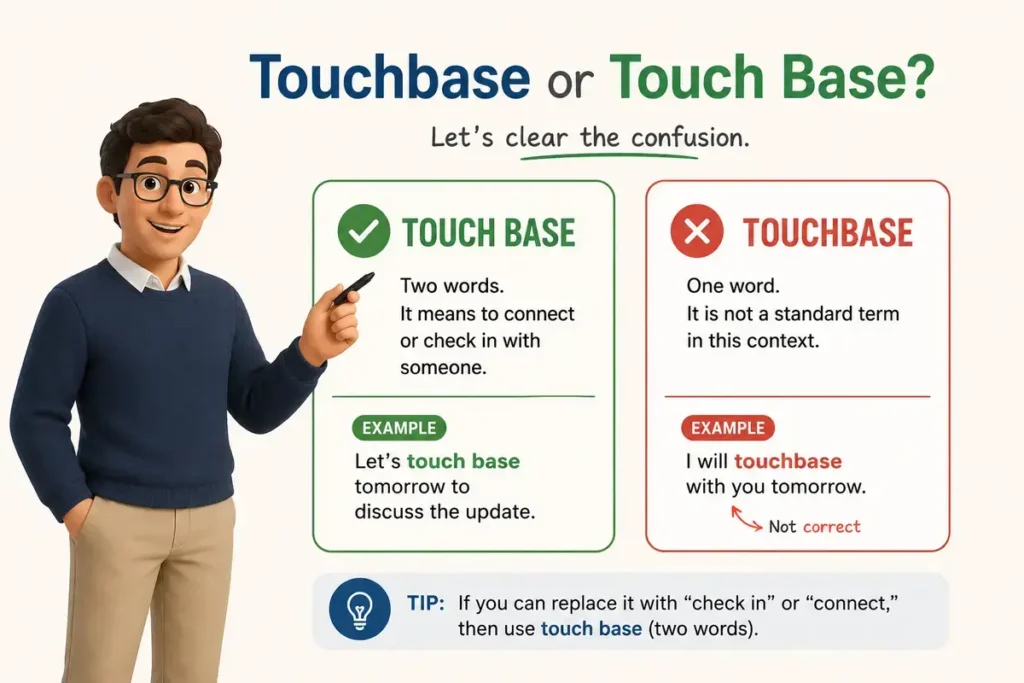
Final Answer: Touchbase or Touch Base?
When comparing touchbase or touch base, the correct choice is usually “touch base.”
Use “touch base” when you mean to check in, connect, or briefly communicate with someone.
Avoid writing “touchbase” as one word in professional or formal writing.
Many readers also check Busing or Bussing: Which Spelling Is Correct?.
Conclusion
The confusion between touchbase or touch base is easy to solve. The correct and widely accepted form is “touch base.” It means to connect, check in, or briefly communicate with someone. While “touchbase” may appear occasionally, it is not the standard spelling. If you want clear, professional, and natural English, choose “touch base” and keep the two words separate
Frequently Asked Questions (FAQs)
Is touchbase or touch base correct?
“Touch base” is the standard and correct form. “Touchbase” is generally considered nonstandard.
What does touch base mean in simple words?
It means to contact someone, check in, or have a short conversation.
Why do people write touchbase as one word?
Because the phrase sounds connected when spoken quickly, some people mistakenly combine the words.
Can I use touch base in emails?
Yes. It is very common in professional emails and workplace communication.
Is touch base formal or casual?
It is somewhere in the middle. It works in both professional and friendly conversations.
Where does touch base come from?
The phrase comes from baseball, where players touch bases while running around the field.
Can I replace touch base with another phrase?
Yes. You can use check in, connect, follow up, reach out, or get in touch.
Should students use touch base in writing?
Yes, if they are talking about contacting someone or checking in with another person.
