
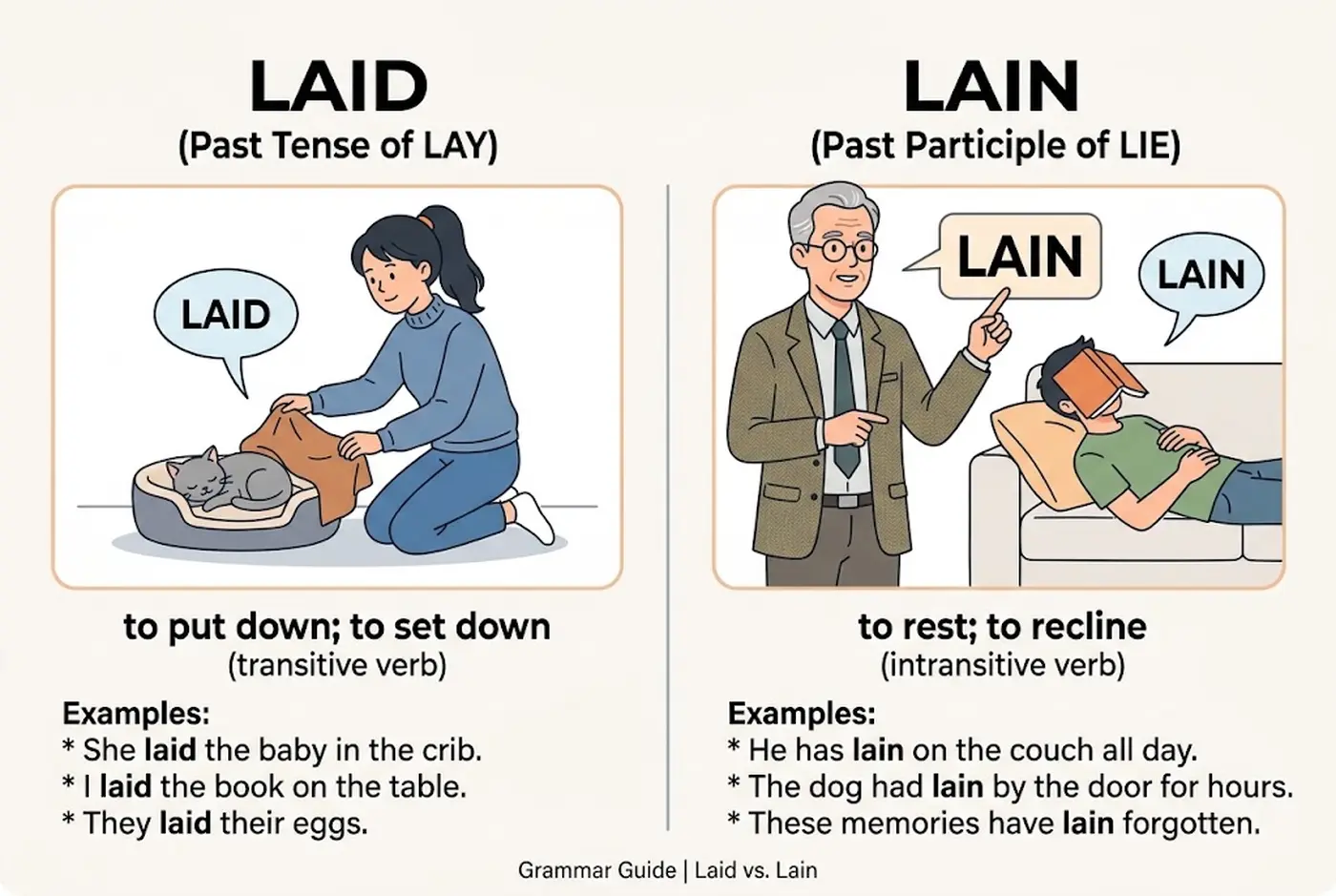
Have you ever stopped while writing and wondered, “Should I write?” You’re not alone. Laid or Layed is a common English spelling question, especially when talking about putting something somewhere, resting something down, or describing what happened in the past.
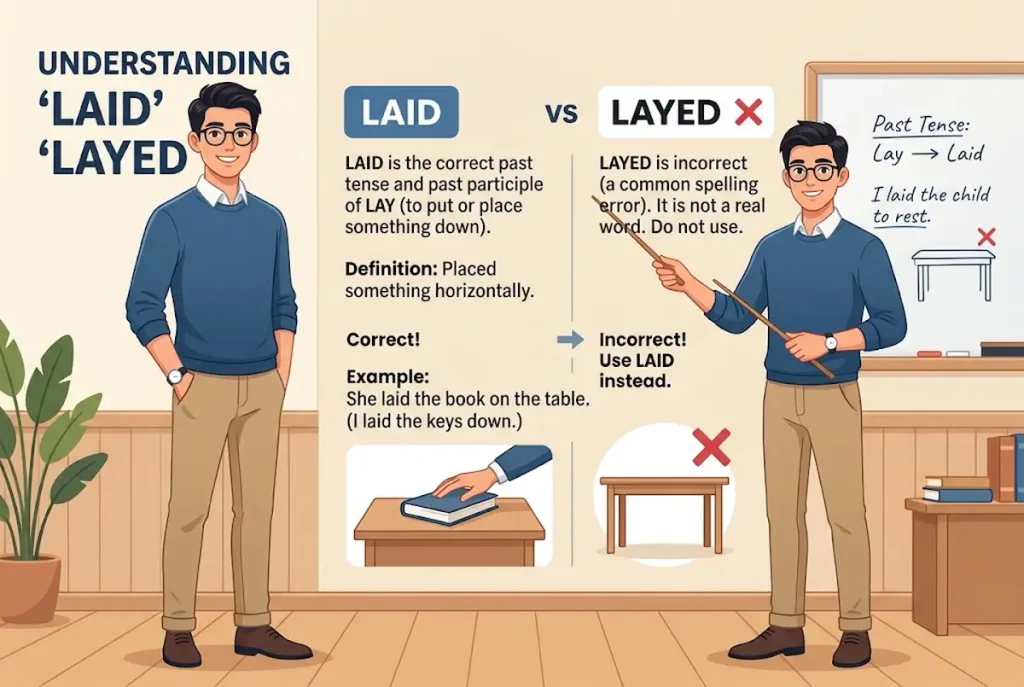
The correct word in standard English is usually laid. For example, you can say, “She laid the book on the table.” You normally should not write, “She layed the book on the table.” The form layed is not the standard past tense of lay.
The confusion happens because English has several similar words, including lay, lie, laid, and lain. They look and sound related, but they do different jobs. Once you learn one simple rule, the difference between words become much easier to understand.
A related grammar guide is Macaroon vs Macaron Explained: Meaning and Examples.
Simple Answer in One Look
Laid is the correct standard English word. Layed is generally incorrect when you mean the past tense of the verb lay. Use laid when someone puts something down.
- I laid the keys on the desk.
- She laid the baby in the crib.
- He laid his jacket on the chair.
What Laid or Layed Means in Simple English
Let’s make this very easy. The word lay means to put something or someone in a particular place. It usually has an object after it.
For example:
- I lay the phone on the table.
- She lays the clothes on the bed.
- He laid the book on the desk.
The past form is laid. So, if you are talking about something that already happened, use laid.
For example:
Present: I lay the keys on the table.
Past: I laid the keys on the table.
Future: I will lay the keys on the table.
Notice something helpful here. It is the correct past form of lay. This is why both words can confuse learners. Many English verbs form their past tense by adding ed. For example:
- walk → walked
- clean → cleaned
- open → opened
- call → called
Because of this pattern, someone may naturally think:
lay + ed = layed
But English has many irregular verbs. Their past forms do not follow the simple ed rule.
In a Simple Example
Imagine you are putting your phone on a table.
You can say:
I laid my phone on the table.
You should not normally say:
I layed my phone on the table.
The first sentence is correct in standard English.
Now imagine that you are doing it right now:
I am laying my phone on the table.
The forms can look confusing, but the basic pattern is:
lay → laid → laying
Why People Mix These Words Laid and Layed
The biggest reason people confuse words that lay sounds like several other English words. There is also the verb lie.
The difference is simple:
Lay means to put something down.
Lie means to rest or be in a flat position.
Compare these sentences:
I lay the book on the table.
Here, I am putting the book somewhere. I lie on the bed. Here, I am resting myself on the bed. The past forms make things even more confusing:
Lay → laid
Lie → lay
So you might see:
- I lay the book down every night.
- Yesterday, I laid the book down.
- I lie on the couch after work.
- Yesterday, I lay on the couch.
This is one reason learners sometimes write layed. They see lay and assume its past form must be layed. But the correct form is laid.
A Quick Memory Trick
Here is an easy classroom trick:
Lay needs something.
Think:
Lay the book.
Lay the clothes.
The thing being put somewhere comes after lay.
Then remember:
Past of lay = laid.
So:
Lay → laid
Not:
Lay → layed
This small rule can save you from many common mistakes.
Clear Difference Explained Simply
Here is the easiest way to see the difference between words.
| Word | Is it standard? | Basic use | Example |
|---|---|---|---|
| Laid | Yes | Past form of lay | She laid the book down. |
| Layed | No, in standard English | Usually an incorrect form of laid | She layed the book down. |
| Lay | Yes | Put something down | I lay the keys here. |
| Laying | Yes | Putting something down | He is laying the clothes out. |
The key point is simple:
Laid is correct. Layed is usually not correct.
Laid Means Something Was Put Somewhere
When you use laid, something is being placed somewhere.
For example:
She laid the papers on the desk.
The papers were placed on the desk.
He laid his coat on the bed.
The coat was placed on the bed.
I laid the keys beside the door.
The keys were placed beside the door.
In each sentence, something is being put in a certain place.
Layed Is Not the Normal Past Form
Many people write layed because they think they are following a normal English pattern.
They might write:
Yesterday, I layed the book on the table.
But the correct sentence is:
Yesterday, I laid the book on the table.
This is the answer you should remember when someone asks both words. There are rare uses of layed in specialized or dialectal contexts, but it is not the normal standard English past form of lay. For everyday writing, schoolwork, work emails, and general communication, use laid.
Which Form Should You Use?
The easiest rule is this:
If you mean “put something down” and you are talking about the past, use laid.
For example:
I laid my bag on the floor.
She laid the blanket on the grass.
We laid the books on the table.
He laid the baby in the crib.
Do not change words.
If you are talking about the present, use lay or laying, depending on the sentence.
For example:
I lay the papers on the desk every morning.
I am laying the papers on the desk now.
The pattern is:
Today: I lay the book down.
Right now: I am laying the book down.
Yesterday: I laid the book down.
What About Lie?
This is where many students get stuck.
Remember this simple idea:
Lay = put something down.
Lie = rest yourself down.
Look at these examples:
I laid the baby on the bed.
Someone put the baby on the bed.
The baby lay on the bed.
The baby rested on the bed.
The first sentence uses laid because someone is placing the baby somewhere.
The second uses lay because the baby is resting.
You do not need to memorize every grammar rule at once. Start with the main idea: lay usually acts on something, while lie describes someone or something resting.
Easy Real Life Sentences You Can Use
Here are some natural examples that you can use in everyday English.
- I laid my keys on the kitchen counter.
- She laid the clothes on the bed.
- He laid his phone beside his laptop.
- We laid the books on the table.
- Mom laid the baby in the crib.
- I laid the blanket on the grass.
- She laid the flowers on the table.
- He laid his jacket over the chair.
These sentences all show the same basic idea. Something is being placed somewhere.
You can also change the time.
Present: I lay the book on the desk.
Past: I laid the book on the desk.
Present action: I am laying the book on the desk.
Future: I will lay the book on the desk.
This pattern is much more useful than simply memorizing one spelling.
Where Laid or Layed Word Comes From
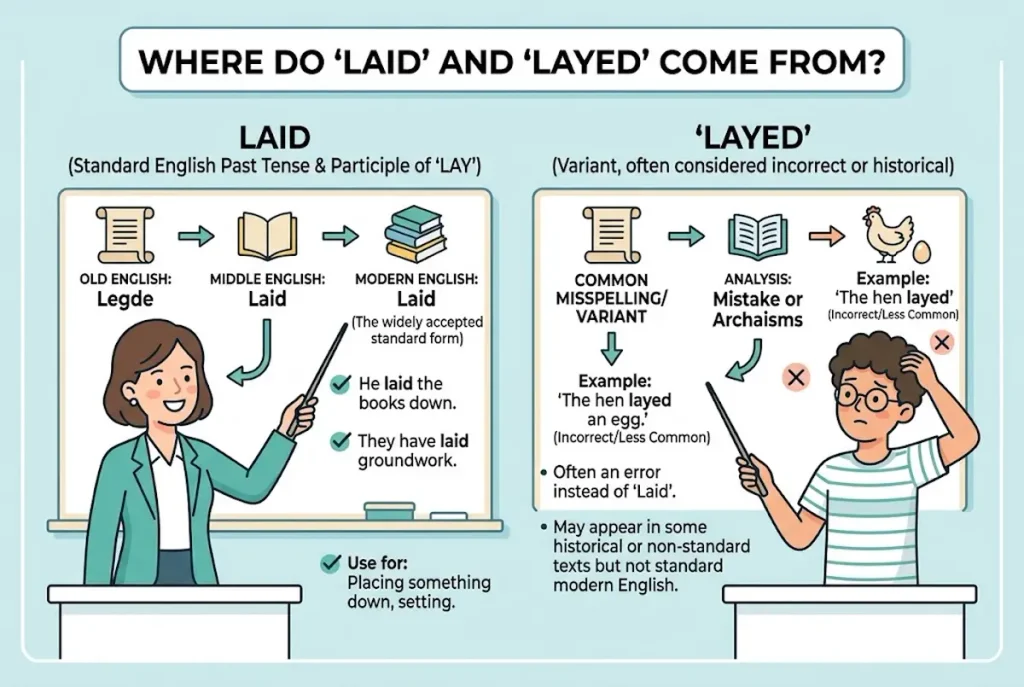
The word laid comes from the older English verb lay. It has been used in English for many centuries. English developed from several older languages, including forms of Germanic languages spoken by early English speakers. Over time, many verbs developed special past forms instead of simply adding ed.
That is why English has forms such as:
- go → went
- see → saw
- take → took
- lay → laid
These forms may not always look predictable, but they are part of normal English.
The word laid has remained the standard past form of lay. The form layed may seem logical because many verbs take ed, but it is not the normal standard form you should use in everyday English. So if you are writing a school assignment, an article, a message, or a professional sentence, remember:
Lay becomes laid in the past.
A Simple Way to Remember Laid vs Layed
Think about this sentence:
I laid it down.
That sentence can help you remember the correct form.
If you can replace the action with the idea “put it down,” you probably need laid when talking about the past.
For example:
I laid the book down.
Ask yourself:
“Did I put the book down?”
Yes.
So laid is correct.
Another example:
She laid the blanket on the floor.
Ask:
“Did she put the blanket on the floor?”
Yes.
So laid is correct.
This simple test works well for everyday situations.
The main mistake is adding ed to lay and creating layed. English does not always work that way. Some verbs have special past forms, and lay → laid is one of them.
The Most Common Mistake
A very common mistake looks like this:
Incorrect: I layed the book on the desk.
Correct: I laid the book on the desk.
Another example:
Incorrect: She layed the baby on the bed.
Correct: She laid the baby on the bed.
And:
Incorrect: He layed his clothes on the chair.
Correct: He laid his clothes on the chair.
The mistake is easy to understand. The writer sees lay and adds ed. But the correct past form has a different spelling.
Instead, remember:
The past form of lay is laid.
Still confused? Compare Bailer or Baler: Difference Explained Simply 2026 Guide.
A Quick Classroom Test
Try these sentences yourself.
- Yesterday, I ___ my phone on the table.
- She ___ the book beside her computer.
- He ___ the blanket on the floor.
- We ___ the flowers on the table.
The answer to all four is laid.
So the completed sentences are:
Yesterday, I laid my phone on the table.
She laid the book beside her computer.
He laid the blanket on the floor.
We laid the flowers on the table.
If you can remember this pattern, you already understand the main answer to words. There is still more to learn, though. The words lay, lie, laid, lain, and laying can appear in different situations. Understanding those forms will help you avoid mistakes in conversations, school writing, work messages, and everyday English.
That deeper meaning also helps explain why this small word pair causes so much confusion. In the next section, we can look at the different forms, common expressions, cultural and symbolic uses, related words, frequent mistakes, and a final teacher friendly rule that makes easy to remember.ct spelling.
In Culture and Stories
The words may look similar, but only one is used in standard English. In books, stories, newspapers, and school writing, you will almost always see laid. Writers use laid to describe placing something somewhere or putting something down carefully. For example:
- She laid the letter on the table.
- The farmer laid fresh straw in the barn.
The spelling layed rarely appears in normal English. When it does, it is usually a typing mistake or a misunderstanding. That is why learning the correct form helps your writing look more natural and professional.
Biblical and Mythological Meaning
The word laid appears many times in older religious writings and historical stories. For example, people may lay stones, lay gifts before someone, or lay a child in a safe place. These uses simply mean “to place something.” The spelling layed is not used in these traditional texts. So if you are writing about biblical events or ancient stories, laid is the correct choice.
Symbolism Explained in Simple Words
What Laid Represents
The word laid often represents:
- placing something with care
- building something new
- preparing for the future
- creating a strong beginning
Examples include:
- laid the foundation
- laid the first stone
- laid flowers on a grave
These actions often symbolize respect, planning, or kindness.
What Layed Represents
The word layed does not carry its own symbolic meaning because it is not the standard spelling. In most cases, it simply represents a spelling mistake. That is why careful writers avoid using it.
Related Words You Should Know
Lay
To put something down. Example:
- Please lay the book on the desk.
Lie
To rest in a flat position. Example:
- I want to lie on the sofa.
Placed
Means put in a certain location. Example:
- She placed the cup on the shelf.
Set
Means to put something somewhere. Example:
- He set the bag on the floor.
Positioned
Means arranged in a certain place. Example:
- The chairs were positioned near the window.
Arranged
Means organized carefully. Example:
- She arranged the flowers beautifully.
These words help you describe similar actions without confusion.
In Daily English
Here are simple examples of how people use laid.
- I laid my phone on the table.
- She laid the baby in bed.
- We laid fresh towels in the bathroom.
- The hen laid two eggs today.
- He laid his keys beside the door.
- They laid new carpet last week.
- My father laid the tools on the bench.
- The workers laid concrete this morning.
- She laid her hand on my shoulder.
- We laid blankets on the grass.
You should avoid writing layed in these sentences.
Common Mistakes People Make
Mistake 1: Writing layed instead of laid
Wrong:
- She layed the book on the desk.
Correct:
- She laid the book on the desk.
Mistake 2: Thinking all verbs simply add -ed
Many verbs do. But lay is different. Its correct past tense is laid.
Mistake 3: Confusing lay and lie
These two verbs have different meanings.
- Lay means to put something somewhere.
- Lie means to rest.
Learning this difference makes writing easier.
Mistake 4: Using layed in school or business writing
Teachers and editors usually mark layed as incorrect. Choose laid instead.
Mistake 5: Believing layed is another accepted spelling
In standard English, it is not. The correct spelling is laid.

Final Teacher Explanation of Laid or Layed
Imagine you ask me in class, “Should I write?” My answer is very simple. Always choose laid when you need the past tense of lay. The spelling layed is almost always wrong in everyday English. Remember this easy rule:
- lay → laid
If you keep that pattern in mind, you will avoid one of the most common spelling mistakes in English.
Final Answer (Quick Recap)
When comparing always choose laid.
It is the correct spelling used by dictionaries, teachers, and professional writers.
Avoid layed because it is usually a spelling mistake.
A related grammar guide is Loose vs Lose: Simple Powerful Grammar Guide (2026).
Conclusion
The question has a clear answer. Laid is the correct spelling and the proper past tense of lay. Layed is generally considered incorrect in standard English writing. Use laid in school assignments, business documents, emails, and everyday communication to make your English accurate and natural.
Frequently Asked Questions (FAQs)
Which is correct?
Laid is correct. Layed is generally incorrect in standard English.
Why do people write layed?
Many people think every verb simply adds -ed, but lay is an irregular verb.
What is the past tense of lay?
The correct past tense is laid.
Can I use layed in school writing?
No. It is better to use laid.
Is layed in the dictionary?
Some dictionaries mention it only in very rare technical uses, but for normal English writing, laid is the correct form.
How can I remember the right spelling?
Remember this simple pattern:
pay → paid
lay → laid
Does laid mean the same as placed?
Often yes. It usually means to put something down carefully.
Is laid used in both American and British English?
Yes. Both American and British English use laid.
