
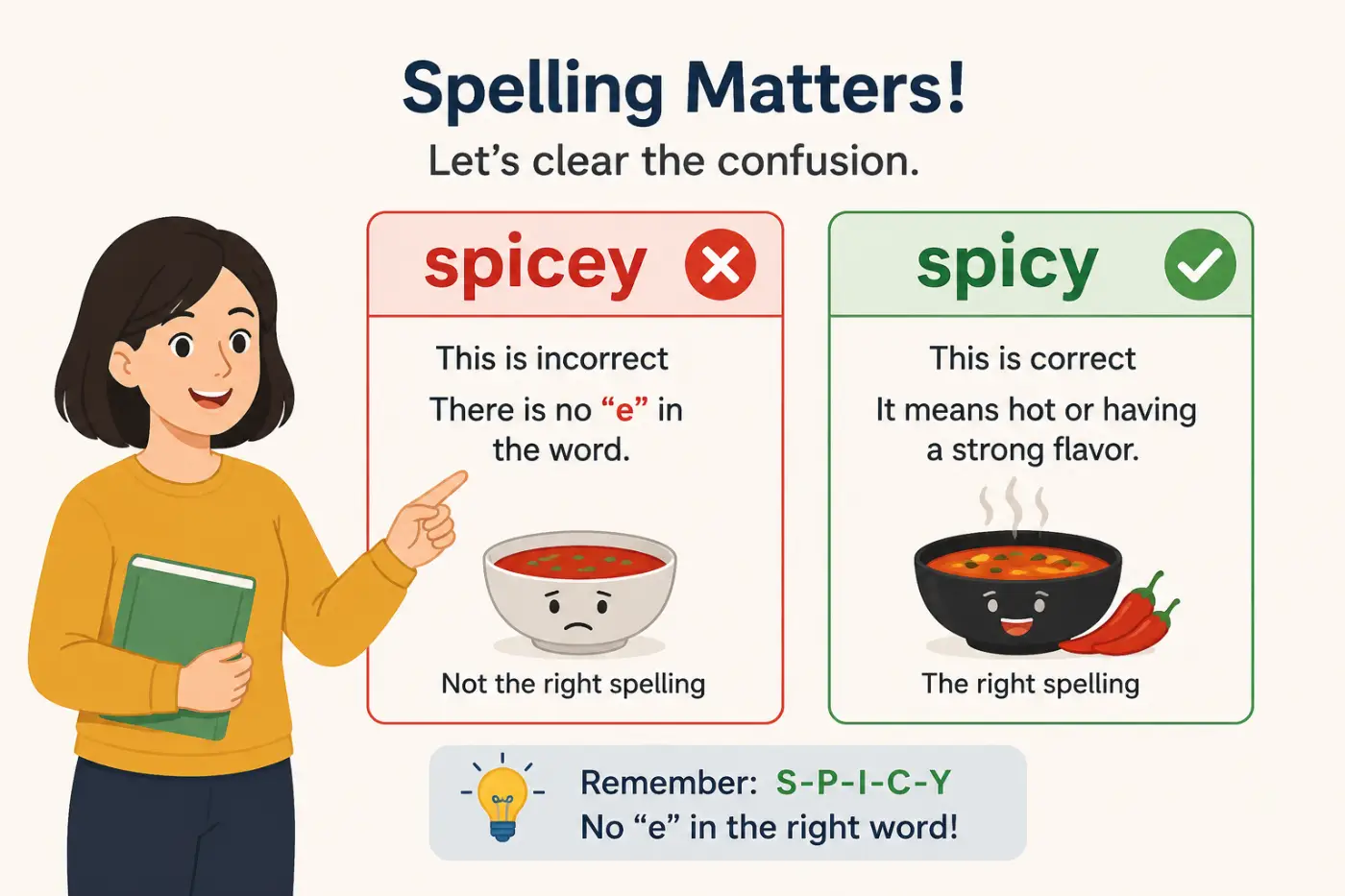
Many people search for spicey vs spicy because both words look like they could be correct. You may see both spellings online, in social media posts, or even in comments. That makes the choice confusing. The good news is that the answer is simple.
When you compare, only spicy is the correct standard English spelling. Spicey is a common misspelling. If you are writing for school, work, a blog, or social media, you should use spicy.
This guide explains the difference in very simple words. You will learn the meaning of spicy, why people write spicey, and how to use the correct spelling with confidence in everyday English.
Many readers also check Rug vs Rag Meaning Difference and Correct Usage Guide.
Simple Answer In One Look
When comparing spicey vs spicy, spicy is correct.
Spicey is not the standard English spelling. Use spicy in all normal writing.
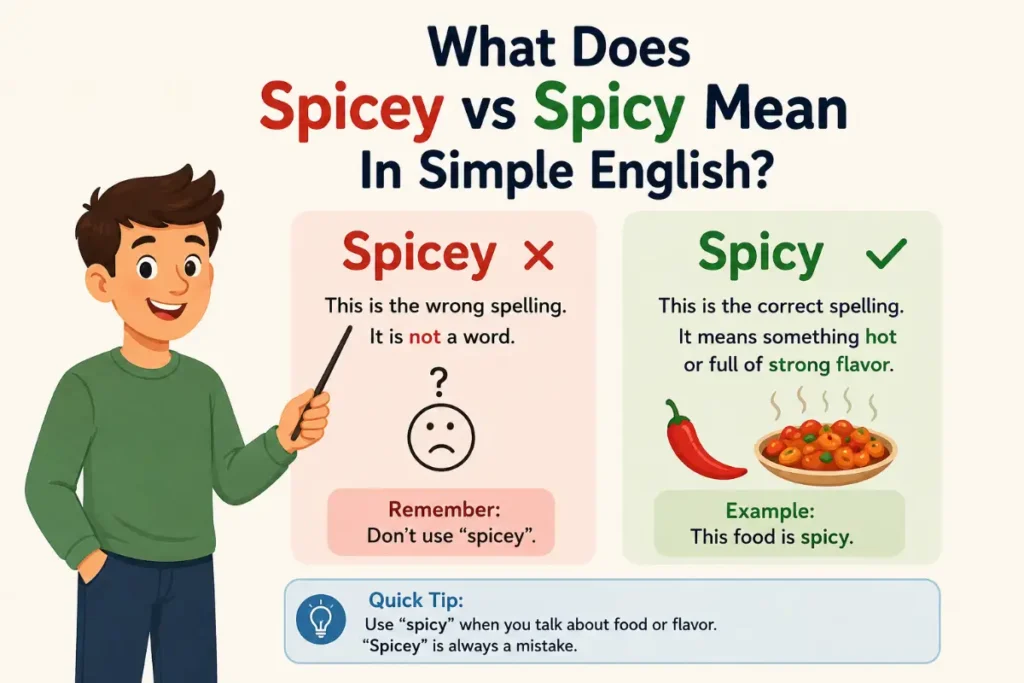
What Does Spicey vs Spicy Mean In Simple English?
The easiest way to understand both words because it is to remember that they do not have equal status.
Spicy is a real English word. It describes food that has a hot, strong, or flavorful taste because of spices such as chili, black pepper, or curry. It can also describe something exciting, bold, or a little shocking.
Spicey is usually a spelling mistake. Most dictionaries do not accept it as the correct form.
Think of it like this.
- Food with lots of chili is spicy.
- A funny story with exciting details can also be spicy.
- Spicey should normally be changed to spicy.
Here are some simple examples.
- This soup is very spicy.
- I like spicy chicken.
- She made a spicy salsa.
- The book has some spicy jokes.
- That news started a spicy debate online.
In each sentence, spicy is the correct spelling.
Why Do People Mix These Words?
Many English learners wonder about words because the spelling does not seem obvious. The base word is spice. When people add a sound that feels like “ee,” they sometimes think they should keep the e and write spicey. That feels natural, but English does not work that way here. The correct adjective is spicy, not spicey.
Here are a few reasons people become confused.
- The word starts with spice.
- Many English words keep the final e before adding another ending.
- Social media posts often contain spelling mistakes.
- Some websites copy incorrect spellings.
- Fast typing leads to errors.
Imagine someone writing quickly.
“I love spicey noodles.”
The sentence sounds fine when spoken, but the spelling is wrong.
The correct sentence is:
“I love spicy noodles.”
This is one reason the question appears so often in online searches.
Clear Difference Explained Simply
Here is an easy comparison.
| Spicey | Spicy |
|---|---|
| Common misspelling | Correct spelling |
| Not accepted in standard English | Accepted by dictionaries |
| Avoid in formal writing | Use everywhere |
| May appear online by mistake | Used by native speakers and publishers |
| Should be corrected | Always the better choice |
A simple rule to remember is this:
- Spicy = Correct
- Spicey = Incorrect
That one rule will help you avoid mistakes.
Which Form Should You Use Spicey or Spicy?
If you are choosing between words, always pick spicy.
Use it when talking about:
- Food with strong spices.
- Hot sauces.
- Mexican food.
- Indian food.
- Thai food.
- Exciting stories.
- Bold opinions.
- Fun conversations.
Examples:
- This curry is spicy.
- The wings are too spicy for me.
- I enjoy spicy chips.
- Their conversation became spicy.
- That movie has some spicy humor.
There is almost never a reason to write spicey.
Even if you see it somewhere, treat it as a spelling mistake.
How To Remember The Correct Spelling
Many students ask how they can stop writing spicey.
Here is an easy trick.
Look at the ending.
The correct word ends with:
icy
Spicy
Not:
icey
Spicey
You can remember it with this short sentence:
Spicy food makes your mouth feel hot.
Notice that the word is always spicy.
Another memory trick is to think about other common adjectives.
- Juicy
- Icy
- Spicy
These words all end with y, not ey.
Reading the correct spelling several times helps your brain remember it naturally.
Easy Real Life Sentences You Can Use
These examples show the correct way to use spicy.
- I love spicy noodles.
- This pizza is too spicy for my little brother.
- She cooked spicy chicken for dinner.
- My dad likes spicy tacos.
- The soup became spicy after adding chili.
- We ordered spicy fries.
- That TV show has some spicy jokes.
- The sauce is spicy but delicious.
Now look at these incorrect examples.
- I like spicey food.
- She made spicey soup.
- These chips are spicey.
Each sentence should use spicy instead.
Correct versions:
- I like spicy food.
- She made spicy soup.
- These chips are spicy.
Common Situations Where People Use Spicy
The word spicy appears in many parts of daily life.
Talking About Food
This is the most common use.
Examples:
- Spicy noodles
- Spicy chicken
- Spicy ramen
- Spicy tacos
- Spicy wings
- Spicy curry
- Spicy salsa
- Spicy soup
Talking About Snacks
Many snack packages use the word.
Examples:
- Spicy chips
- Spicy popcorn
- Spicy peanuts
Talking About Stories
Sometimes spicy means exciting or full of surprising details.
Examples:
- That book is spicy.
- The movie gets spicy near the end.
- They shared some spicy gossip.
Here the word does not mean hot food.
It means exciting, bold, or dramatic.
Talking About Conversations
People sometimes say:
- We had a spicy discussion.
- The debate became spicy.
This means the conversation became lively or intense.
Common Mistakes People Make Spicey and Spicy
Here are mistakes that many learners make.
Mistake One
Writing:
Spicey
Correct:
Spicy
Mistake Two
Thinking both spellings are acceptable.
Only spicy is accepted in standard English.
Mistake Three
Copying the wrong spelling from social media.
Many online posts contain typing mistakes.
Always check a trusted dictionary if you are unsure.
Mistake Four
Keeping the e from spice.
Although the base word is spice, the adjective changes to spicy.
That is simply the accepted spelling.
Does Spicey Ever Count As Correct?
In normal English writing, the answer is no.
You might occasionally see spicey used:
- In old internet posts.
- As a typing mistake.
- In usernames.
- As part of a brand name.
A company or product can choose any spelling it wants for branding.
That does not change standard English.
For everyday writing, always choose spicy.
Learn the difference in Signer or Signor: What’s the Difference (2026 Guide)?.
Where This Word Comes From Simple History
The word spicy comes from the noun spice. A spice is a dried plant part that adds flavor or heat to food. People have used spices for thousands of years. Black pepper, cinnamon, cloves, ginger, turmeric, and chili became valuable because they made food taste better and last longer.
As English grew, speakers created the adjective spicy to describe food that contains spices or has a hot flavor. Over time, the word also gained another meaning. People started using spicy for things that are exciting, bold, dramatic, or a little shocking.
That is why someone can talk about:
- spicy food
- spicy news
- spicy humor
- spicy gossip
The spelling has remained spicy throughout modern standard English. As you can see, the answer to word has stayed the same. Spicy is the accepted spelling, while spicey is simply a common error.
Understanding this small spelling difference also helps you notice how English words can develop new meanings over time. In the next section, we will look beyond spelling and explore how spicy is used in culture, stories, symbolism, and everyday expressions, along with related words, common sayings, and practical tips for using it naturally.
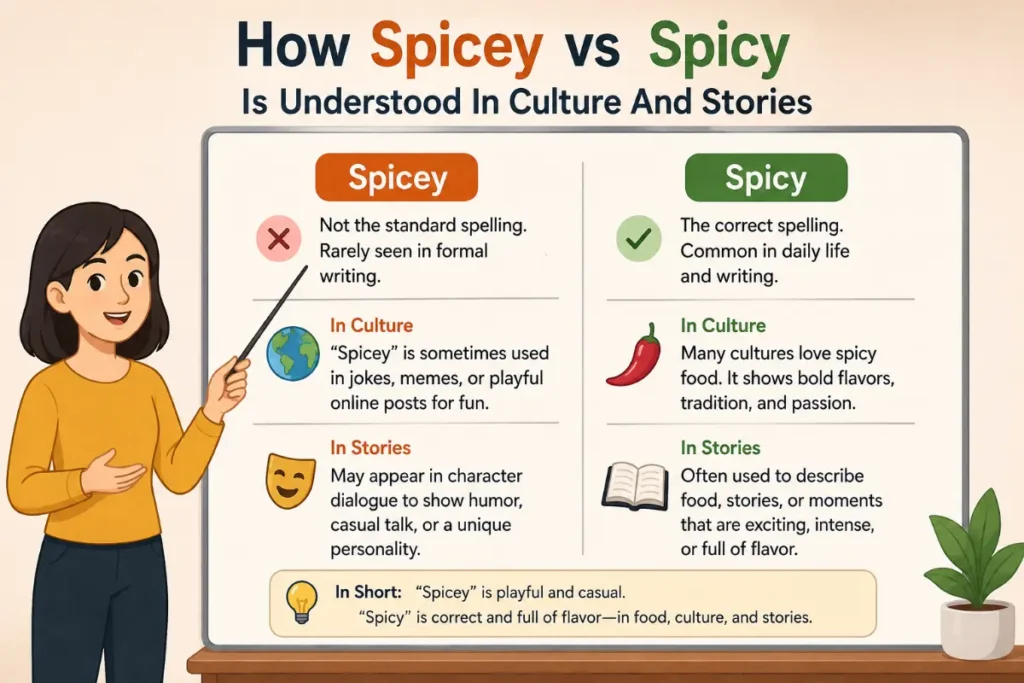
How Spicey vs Spicy Is Understood In Culture And Stories
When people think about both words, the spelling question is simple. Only spicy is correct. The meaning of spicy, however, has grown over time. It is no longer used only for food.
Around the world, spicy food is often linked with adventure, warmth, and strong flavors. Many families enjoy recipes that use peppers, garlic, ginger, or other spices. Because of this, the word spicy often brings happy thoughts about home cooking and family meals.
People also use spicy when talking about stories, movies, or conversations. In these cases, the word does not mean hot food. Instead, it means something exciting, bold, surprising, or full of drama.
For example:
- That movie has a spicy ending.
- Their conversation became spicy.
- The book has some spicy scenes.
- The interview included a few spicy questions.
These examples show how one simple word can have different meanings depending on the situation.
You may also hear someone jokingly say:
“This chat is getting spicy.”
They usually mean the conversation has become more exciting, playful, or intense.
Because this meaning is so common, learning the correct spelling helps you understand both everyday conversations and online posts.
Biblical And Mythological Meaning Of Spicey or Spicy
There is no special Biblical meaning connected to words because spicey is not a standard English word. The word spicy itself is also not used as an important Biblical term. However, the Bible often mentions spices instead of spicy. Spices were valuable gifts and were used for cooking, perfume, worship, and honoring important people.
Because spices were precious, they often represented:
- Honor
- Care
- Beauty
- Richness
- Celebration
In mythology, there is no famous symbol connected directly with the word spicy. Still, spices appear in many old stories because they were rare and valuable items traded across different lands. So, while spicy has no special religious or mythological meaning, the idea of spices has been important in many cultures for thousands of years.
Symbolism Explained In Simple Words
What Spicy Represents
The correct word spicy often represents strong feelings or experiences.
It may stand for:
- Energy
- Excitement
- Adventure
- Bold choices
- Strong personality
- Fun conversations
- Colorful food
When someone says life is getting spicy, they usually mean life has become more interesting.
When someone says a meal is spicy, they mean it has a hot or rich flavor.
The meaning depends on the situation, but the spelling stays the same.
What Spicey Represents
When people compare words, the word spicey does not carry its own meaning.
Instead, it usually represents:
- A spelling mistake
- A typing error
- Confusion about English spelling
Sometimes a business or online username may choose Spicey as a creative name. That is a branding choice, not a standard English spelling.
For normal writing, school assignments, emails, and articles, you should always choose spicy.
Related Words You Should Know Spicey and Spicy
Learning related words makes English easier.
Spice
A spice is a plant product that adds flavor or smell to food. Example:
Add some spice to the soup.
Spices
This is the plural form of spice. Example:
The recipe uses many spices.
Spiciness
This noun describes how hot or flavorful food is. Example:
I like the spiciness of this curry.
Seasoning
Seasoning means ingredients added to improve flavor. Example:
The seasoning tastes great.
Flavor
Flavor is the overall taste of food. Example:
This sauce has a rich flavor.
Hot
Hot may describe temperature or spicy food. Example:
The soup is hot.
Mild
Mild means not very spicy. Example:
Please give me the mild salsa.
Chili
Chili is a pepper that makes food spicy. Example:
This chili is very hot.
Pepper
Pepper is one of the most common spices. Example:
Add black pepper before serving.
Savory
Savory describes rich food that is not sweet. Example:
I enjoy savory snacks.
Knowing these related words helps you speak more naturally when talking about food.
How People Actually Use It In Daily English
Most native English speakers never use spicey in normal writing. They always choose spicy.
Here are real examples you may hear every day.
- I love spicy tacos.
- This chicken is too spicy for me.
- Can you make it less spicy?
- We ordered spicy noodles for dinner.
- My brother enjoys spicy snacks.
- That movie has some spicy jokes.
- Their interview became spicy after the last question.
- This salsa is perfectly spicy.
- She likes spicy wings with extra sauce.
- That online discussion became surprisingly spicy.
These examples show that spicy works for both food and exciting situations.
Common Mistakes People Make Spicey or Spicy
Many learners make the same spelling mistakes.
Mistake One
Writing:
Spicey
Correct:
Spicy
Mistake Two
Thinking both spellings are accepted.
Correction:
Only spicy is correct in standard English.
Mistake Three
Copying social media spelling.
Correction:
Many online posts contain typing mistakes. Always check a trusted dictionary.
Mistake Four
Keeping the final e from spice.
Correction:
The adjective changes to spicy.
Mistake Five
Using spicy only for food.
Correction:
The word can also describe exciting conversations, stories, jokes, or news.
Final Teacher Explanation
Now you know the answer about both words.
The rule is very easy to remember.
Spicy is the correct English spelling.
Spicey is usually a spelling mistake.
Whenever you write about hot food, bold flavors, exciting stories, funny jokes, or lively conversations, choose spicy.
If you see spicey, treat it as an error unless it is part of a company name or another creative brand.
Good English does not mean using difficult words. It means choosing the correct words with confidence. Once you remember this simple rule, you will probably never make this spelling mistake again.
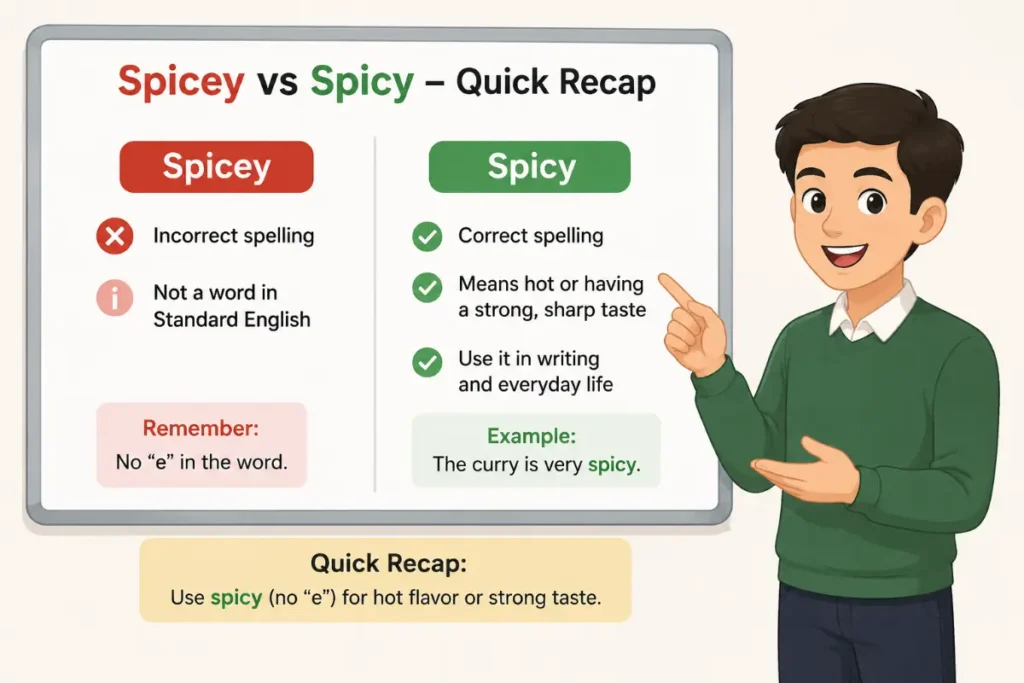
Final Answer About Spicey vs Spicy Quick Recap
If someone asks about words, the answer is short and clear. Spicy is the only correct spelling in standard English. Spicey is a common misspelling that should be avoided in school, work, emails, blogs, and everyday writing.
The word spicy usually describes food with strong or hot flavors. It can also describe something exciting, bold, dramatic, or surprising. Native English speakers use spicy naturally in both meanings.
The easiest way to remember the difference is this:
Always write spicy. Never write spicey in normal English.
Many readers also check Shinning or Shining: Correct Usage Masterclass Guide 2026.
Conclusion
The question is common because both spellings look possible at first. After learning the rule, the choice becomes very easy. Spicy is the correct spelling, while spicey is simply a common mistake.
You can now use spicy with confidence when talking about food, conversations, stories, or anything exciting. This small spelling change makes your English look more accurate and more natural.
The easiest takeaway is simple. When you see spicey vs spicy, always choose spicy.
Frequently Asked Questions FAQs
What does spicy mean in simple words?
Spicy means food with strong or hot flavors. It can also mean something exciting or bold.
Is spicey or spicy correct?
Spicy is correct. Spicey is a common spelling mistake.
Why do people confuse?
People see the word spice and think the adjective should keep the final e. English changes the spelling to spicy.
Can I use spicey in formal writing?
No. Use spicy in essays, emails, reports, and all standard English writing.
Can spicy describe something besides food?
Yes. It can describe exciting stories, lively conversations, bold humor, or surprising news.
Is spicy used in American English?
Yes. Spicy is the standard spelling in both American and British English.
How can I remember the correct spelling?
Remember this simple rule: Spicy is always correct. Spicey is not.
Is spicey ever correct?
Only if it is part of a brand name, username, or another creative title. In normal English, use spicy.
