
Many English learners ask about arised or arose because both words look possible. They seem like different forms of the same verb. That is why this question comes up so often in school writing and everyday conversations.
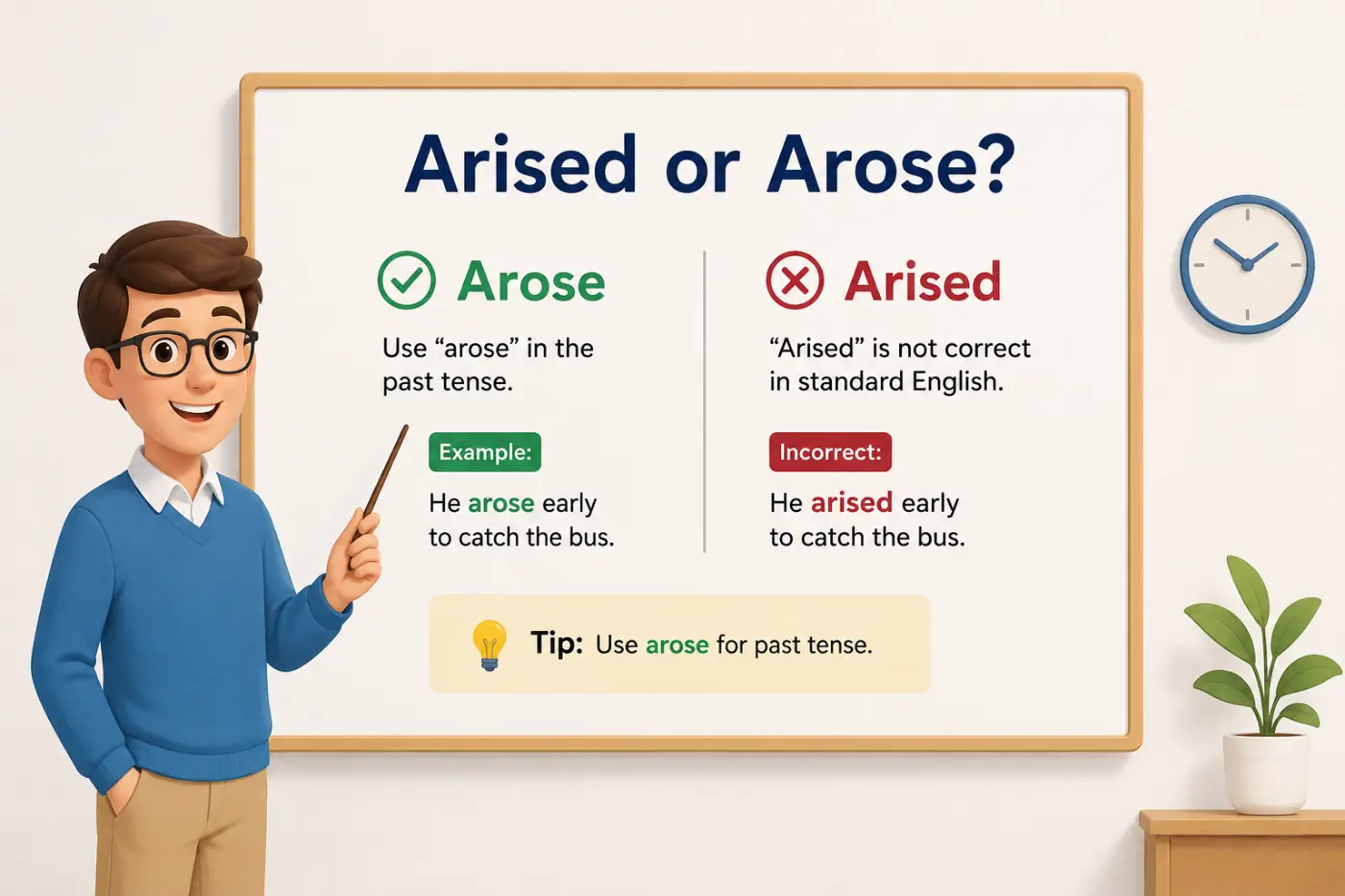
The short answer is simple. Arose is the correct past tense of arise. Arised is not accepted in standard English. If you want to talk about something that happened in the past you should use arose.
This guide explains in very simple English. You will learn the meaning of each word why people confuse them how to use the correct form and how to avoid common mistakes.
Many readers also check Rug vs Rag Meaning Difference and Correct Usage Guide.
Simple Answer in One Look
Arose is correct.
Arised is not a standard English word.
Example:
- A problem arose during the meeting.
- A question arose after the lesson.
- Not: A problem arised during the meeting.
What Arised or Arose Means in Simple English
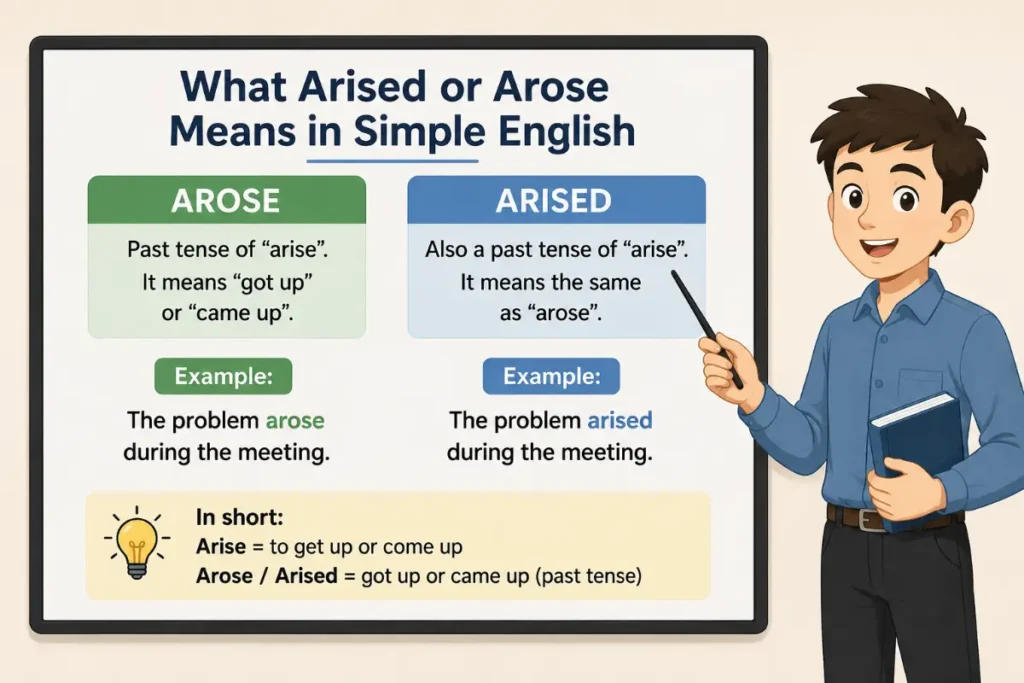
To understand both words you first need to know the base word arise. The word arise means something begins happens or appears. It often talks about problems questions ideas chances or situations that come up.
Think of it like this.
Something was not there before.
Then it suddenly appeared.
That means it arose.
Here are some easy examples.
- A new idea arose during class.
- A problem arose at work.
- A question arose after the movie.
- An opportunity arose last week.
In all these examples something started or appeared.
Now look at the verb forms.
- Present: arise
- Past: arose
- Past participle: arisen
These are the correct forms.
There is no standard verb form called arised.
That is why English teachers dictionaries and grammar books all recommend arose.
Why People Mix These Words Arised vs Arose
Many learners become confused about words because English has many regular verbs.
Most regular verbs simply add ed.
For example.
- walk → walked
- clean → cleaned
- open → opened
- start → started
After seeing so many words like these many people think every verb follows the same rule.
So they naturally guess.
- arise → arised
It sounds logical.
But English also has many irregular verbs.
These verbs change in different ways.
For example.
- begin → began
- drink → drank
- sing → sang
- write → wrote
- arise → arose
These verbs do not add ed.
They change their spelling instead.
Another reason for the confusion is that people hear the word arise more often than arose. Since they know the base word they simply add ed without checking. This happens with many other irregular verbs too.
For example.
Some learners say:
- bringed instead of brought
- buyed instead of bought
- catched instead of caught
- goed instead of went
These forms sound natural to learners but they are not correct in standard English.
The same thing happens with arised.
Clear Difference Explained Simply
When comparing words remember one easy rule.
| Word | Correct | When to Use |
|---|---|---|
| arise | Yes | Present tense |
| arose | Yes | Past tense |
| arisen | Yes | Used with has have had |
| arised | No | Not standard English |
Think about this simple timeline.
Now
- Problems arise.
Yesterday
- Problems arose.
Before now
- Problems have arisen.
Wrong
- Problems arised.
Here is another quick comparison.
Correct
- A problem arose yesterday.
- Questions arose after class.
- New challenges have arisen.
Incorrect
- A problem arised yesterday.
- Questions arised after class.
- New challenges have arised.
The correct choice is always arose for the simple past.
Which Form Should You Use Arised and Arose
If you are talking about something that happened in the past use arose.
Examples
- A mistake arose during the test.
- A new issue arose this morning.
- A disagreement arose between friends.
- An opportunity arose last year.
If you are talking about something happening now use arise.
Examples
- Problems arise every day.
- Questions arise in every class.
- Good ideas arise from practice.
If you use has have or had use arisen.
Examples
- Many questions have arisen.
- A serious problem has arisen.
- Several issues had arisen before the meeting.
Never replace these forms with arised.
That form is not accepted in normal English writing speaking exams or business communication.
Here is an easy memory trick.
Present
Arise
Past
Arose
Perfect
Arisen
Never use arised.
Easy Real Life Sentences You Can Use
These everyday examples will help you remember the correct form.
- A problem arose during lunch.
- A question arose in science class.
- A new idea arose while we were talking.
- An opportunity arose after graduation.
- Trouble arose because nobody checked the schedule.
- A misunderstanding arose between the neighbors.
- A chance arose to travel abroad.
- A small issue arose before the game started.
Now compare them with incorrect sentences.
Wrong
- A problem arised during lunch.
Correct
- A problem arose during lunch.
Wrong
- A question arised yesterday.
Correct
- A question arose yesterday.
Reading these correct examples several times makes the pattern easy to remember.
Where Arised vs Arose Word Expression Comes From Simple History
The verb arise has been part of English for hundreds of years. It comes from very old English words that meant to get up or to stand up. Over time the meaning became wider. People started using it for ideas questions problems and situations that appeared or began. That is why today you hear sentences like these.
- A problem arose.
- An idea arose.
- A question arose.
Since arise is an old irregular verb it kept its old past tense form arose instead of changing to arised.
Many old English verbs work the same way.
For example.
- ride became rode
- drive became drove
- write became wrote
- rise became rose
- arise became arose
These older patterns stayed in modern English even though many newer verbs simply add ed.
That is why arose remains the correct form today.
As you can see the choice between words are actually very simple once you know the verb pattern. In the next section you will learn how this word is understood in stories culture everyday communication common expressions and real life situations. You will also see common mistakes learners make and easy ways to remember the correct form forever.
How Is Understood in Culture and Stories
When people tell stories they often talk about something unexpected. A hero may face a new problem. A family may find a new hope. A village may discover a secret. In these situations English speakers usually say that something arose.
For example:
- A great challenge arose before the hero.
- A new friendship arose during the journey.
- Hope arose after many difficult days.
The word arose gives the feeling that something suddenly appeared. It could be good or bad. The sentence does not tell us if the event is happy or sad. It simply tells us that it began.
You will see this word in books newspapers speeches and movies because it sounds natural and clear. Writers use it when they want to explain how a situation started. You will not normally see arised in published books or trusted news articles because it is not a standard English word.
For another common grammar confusion, see Apposed vs Opposed: Different Meaning and Usage (2026).
Biblical and Mythological Meaning of Arised or Arose
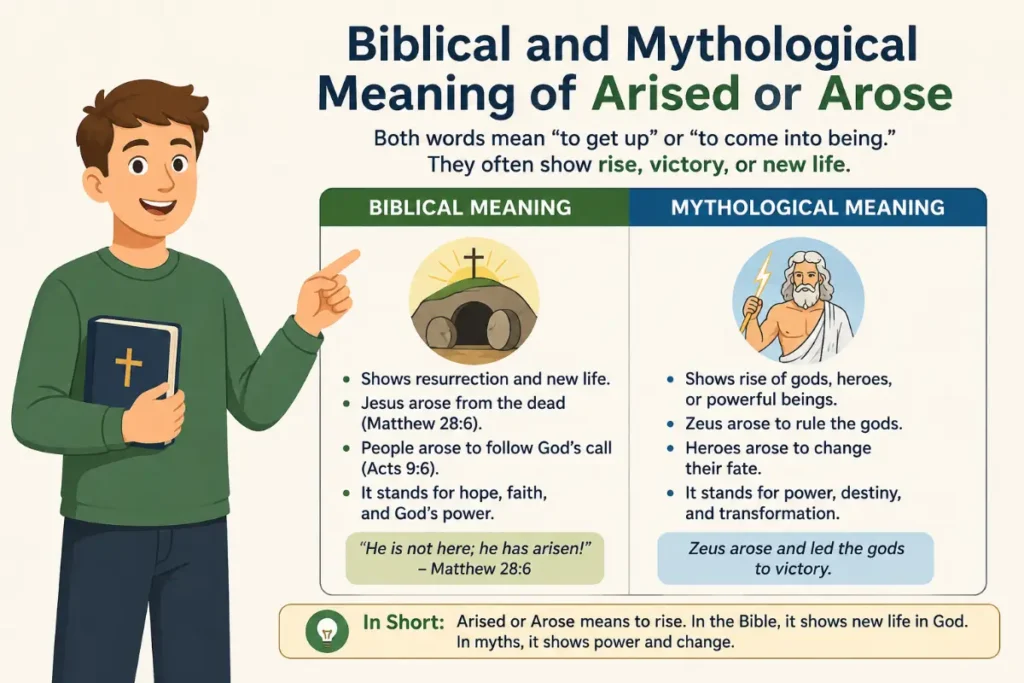
The Bible often uses the verb arise. It usually means to stand up move forward or begin an important action. For example people are told to arise and follow God’s plan. In these places the word gives the idea of action courage and a new beginning. When talking about past events many Bible translations use arose.
Examples include sentences like these.
- Moses arose early in the morning.
- A leader arose among the people.
These examples show the correct past tense.
In myths and old stories people also use arose when describing a king a hero a monster or a great event that appeared.
For example:
- A powerful king arose.
- A terrible storm arose.
- A brave warrior arose to protect the village.
Again you will not find arised in standard Bible translations or well known mythology books.
Symbolism Explained in Simple Words
What Arose Represents
The word arose often represents a beginning.
It can describe:
- A new opportunity.
- A new challenge.
- A fresh idea.
- Hope after trouble.
- Change that suddenly appears.
Sometimes the change is positive.
- A solution arose after many meetings.
Sometimes it is negative.
- A serious problem arose during the trip.
The word itself is neutral. It simply tells us something started.
What Arised Represents
When people compare they sometimes think both words carry different meanings. In fact they do not. Arised does not represent a different idea. It is simply a nonstandard form that many learners create because they expect every verb to end with ed in the past tense. So the comparison is easy.
- Arose represents correct English.
- Arised represents a common learner mistake.
Remember this simple sentence.
Correct English uses arose.
Related Words You Should Know
Here are some useful words related.
Arise
This is the present form. It means something begins or appears. Example:
Problems arise every year.
Arisen
This is the past participle. Example:
Many questions have arisen.
Rise
This means to move upward or stand up. Example:
The sun rises every morning.
Rose
This is the past tense of rise. Example:
The balloon rose into the sky.
Rising
This means going up or increasing. Example:
Food prices are rising.
Begin
This means to start something. Example:
The class begins at nine.
Start
This is another common word that means begin. Example:
The meeting started early.
Appear
This means to become visible or to come into view. Example:
A rainbow appeared after the rain.
Develop
This means to grow or slowly happen. Example:
A problem developed over time.
Learning these related words makes it easier to remember when to use arose.
How People Actually Use Arised and Arose in Daily English
Most native English speakers naturally use arose when talking about something that happened in the past.
Here are some everyday examples.
- A problem arose at work this morning.
- A question arose during the meeting.
- A misunderstanding arose between friends.
- A great opportunity arose last month.
- A small issue arose after dinner.
- A disagreement arose about the plan.
- A funny idea arose while we were driving.
- A new challenge arose at school.
- A concern arose after the report.
- A chance arose that nobody expected.
These examples sound natural in conversations emails school writing and business English.
Common Mistakes People Make
Many learners make the same mistakes. The good news is they are easy to fix.
Mistake 1
Wrong:
A problem arised yesterday.
Correct:
A problem arose yesterday.
Mistake 2
Wrong:
Many questions have arose.
Correct:
Many questions have arisen.
Remember that have goes with arisen not arose.
Mistake 3
Wrong:
Problems arised every day.
Correct:
Problems arise every day.
This sentence talks about something that happens regularly so use the present form arise.
Mistake 4
Wrong:
The idea has arose.
Correct:
The idea has arisen.
Again use arisen after has.
Mistake 5
Wrong:
She arised early.
Correct:
She arose early.
A simple memory rule can help.
- Present = arise
- Past = arose
- Perfect = arisen
There is never a need to write arised.
Final Teacher Explanation about Arised vs Arose
Imagine you are sitting in an English classroom.
A student asks if arised is correct because many verbs end with ed.
The answer is no.
English has two kinds of verbs.
Some are regular.
They simply add ed.
Others are irregular.
They change their spelling.
The verb arise belongs to the irregular group.
That is why the past tense becomes arose.
When you remember this one pattern you will avoid the mistake for the rest of your life.
Keep this small chart in your mind.
- Arise means happening now.
- Arose means it happened in the past.
- Arisen is used after has have or had.
Whenever you wonder about words choose arose for the past tense.
That choice will be correct in school exams business writing books emails and everyday conversations.
Final Answer About Arised or Arose Quick Recap
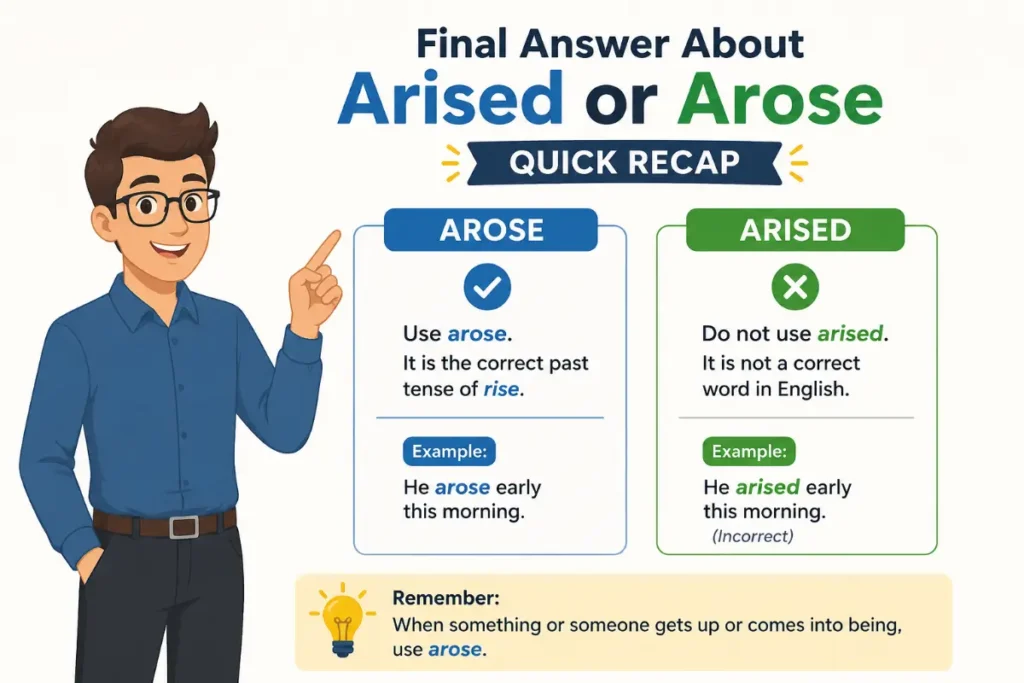
If someone asks which is correct between words the answer is simple. Arose is the correct past tense of arise. Arised is not accepted in standard English. Remember the complete verb forms. Arise is the present form. Arose is the past tense. Arisen is the past participle used with has have and had.
The easiest way to remember this is to think about other irregular verbs like write wrote written or drive drove driven. The verb arise follows the same kind of pattern.
A related grammar guide is Feel Or Feal: Which One Is Correct and Easy to Remember.
Conclusion
After reading this guide you no longer need to wonder about words. The correct answer is always arose when you are talking about the simple past. If you use has have or had then use arisen instead.
Many learners make this mistake because they expect every past tense verb to end with ed. That is a normal guess but English has many irregular verbs. Arise is one of them.
The easiest takeaway is this. Arise today. Arose yesterday. Arisen before now. Never use arised.
Frequently Asked Questions
What does mean in simple words?
The question compares two forms of the verb arise. Only arose is the correct past tense in standard English.
Which is correct?
Arose is correct. Arised is not accepted in standard English.
When should I use arose?
Use arose when something happened in the past.
Example: A problem arose yesterday.
Why do people get confused?
Many people think every past tense verb ends with ed. Since arise is an irregular verb its past tense is arose.
Can I use arised in formal writing?
No. Use arose instead because it is the correct standard English form.
What is the past participle of arise?
The past participle is arisen.
Example: Several questions have arisen.
Is arose used in everyday English?
Yes. Native English speakers use arose in conversations books news reports and business writing.
How can I remember the correct forms?
Remember this pattern.
Arise = present. Arose = past. Arisen = past participle.
