
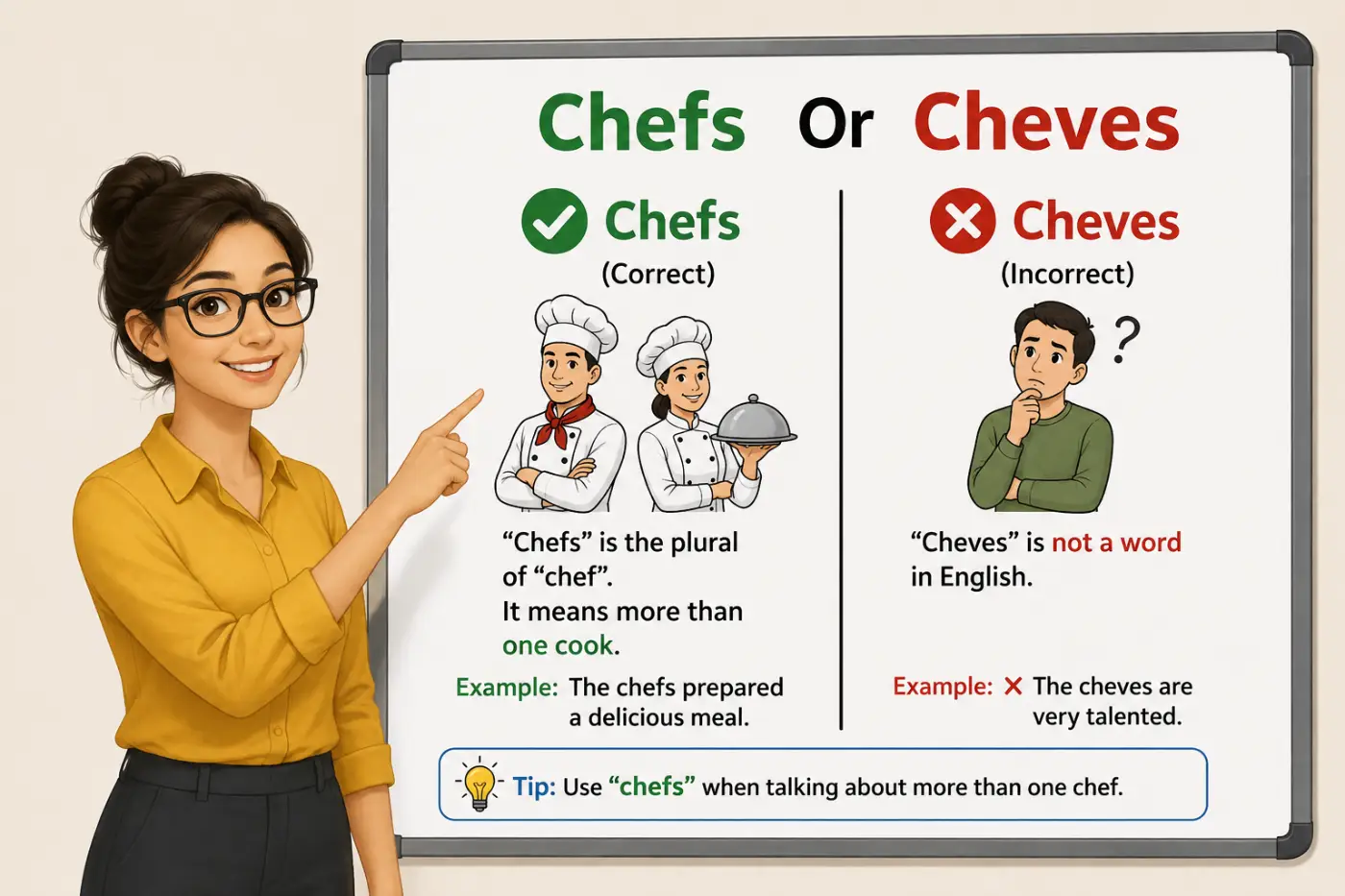
Many people search for chefs or cheves because they are not sure which word is correct. The confusion usually happens after seeing other English words that change from f to ves in the plural, such as leaf → leaves or wolf → wolves. That makes some learners wonder if chef becomes cheves.
The simple answer is easy. The correct plural of chef is chefs. The word cheves is not a standard English word and should not be used as the plural of chef. If you are writing or speaking English, always choose chefs.
This guide explains in very simple English. You will learn the correct spelling, why people get confused, how to remember the right form, and how to use the word with confidence in everyday conversations.
Learn the difference in Naive vs Nieve Explained With Easy Examples.
Simple Answer in One Look
Chefs is correct.
Cheves is incorrect.
Use chef for one person and chefs for two or more people.
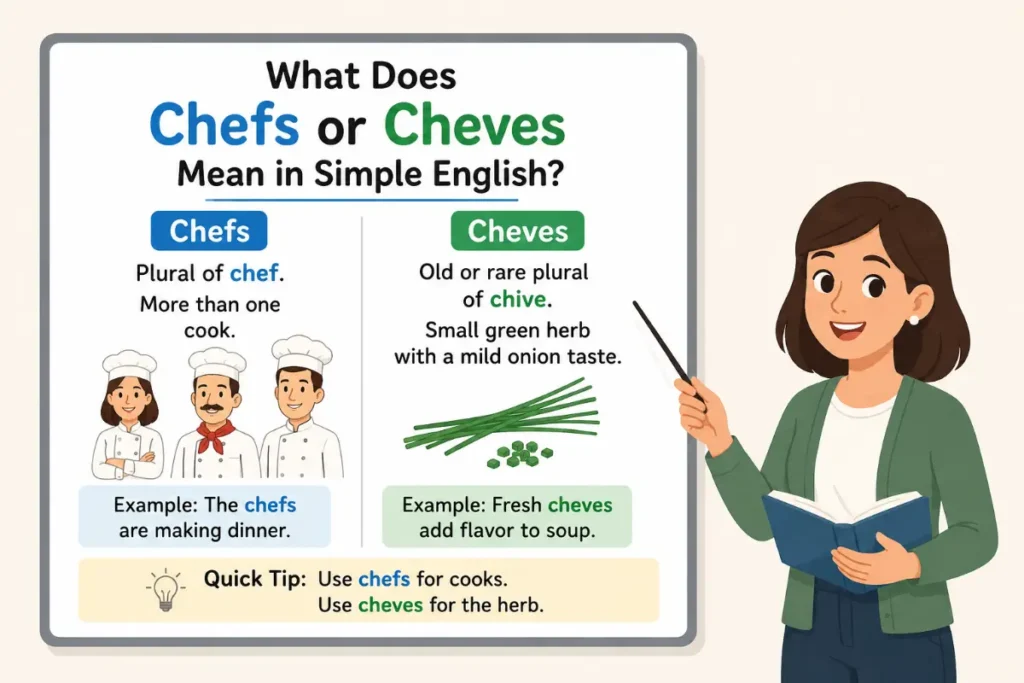
What Does Chefs Or Cheves Mean in Simple English?
Before learning the difference, you should know what a chef is. A chef is a professional cook. A chef works in a restaurant, hotel, bakery, cruise ship, or another place where food is prepared. Chefs usually have special training and know how to cook many kinds of meals.
Examples:
- The chef made fresh bread.
- Our chef prepared a healthy dinner.
- The restaurant has three talented chefs.
When you talk about more than one chef, you simply add s.
- One chef
- Two chefs
- Five chefs
You never change the f into ves.
Why People Mix These Words Chefs and Cheves
The confusion about both words comes from a common English spelling pattern. Many English nouns ending in f change to ves when they become plural.
For example:
- leaf → leaves
- wolf → wolves
- calf → calves
- shelf → shelves
- knife → knives
After learning these words, many students think every word ending in f follows the same rule.
That is not true.
Some words ending in f simply add s.
Examples include:
- chef → chefs
- roof → roofs
- chief → chiefs
- belief → beliefs
- proof → proofs
- cliff → cliffs
- safe → safes
English has different spelling patterns because many words came from different languages over hundreds of years.
That is why chef keeps its f and becomes chefs.
Clear Difference Explained Simply
Here is an easy comparison.
| Word | Correct? | Meaning |
|---|---|---|
| chef | Yes | One professional cook |
| chefs | Yes | More than one professional cook |
| cheves | No | Not a standard English word |
Think of it this way.
One teacher becomes teachers.
One doctor becomes doctors.
One chef becomes chefs.
The pattern is exactly the same.
There is no reason to change f into ves.
Quick Memory Trick
Remember this sentence:
A chef simply adds S.
If you remember that one line, you will probably never write cheves again.
Which Form Should You Use?
If you mean one person, write:
chef
Examples:
- The chef is preparing dinner.
- Our chef loves Italian food.
If you mean two or more people, write:
chefs
Examples:
- The chefs worked together.
- Famous chefs shared their recipes.
- Many chefs joined the cooking contest.
Never write:
- cheves prepared dinner.
- several cheves worked here.
Those forms are incorrect in modern English.
A Simple Rule
If the word is chef, add s.
Nothing else changes.
Easy Real Life Sentences You Can Use Chefs vs Cheves
Here are simple examples you can copy into your own speaking and writing.
- The chefs prepared lunch for everyone.
- My uncle is a chef at a big hotel.
- Famous chefs often appear on cooking shows.
- The chefs worked as one team.
- Our school invited local chefs to teach cooking.
- Many chefs enjoy creating new recipes.
- The chef smiled after everyone loved the meal.
- Young chefs practice every day to improve.
Common Mistakes People Make
Many learners make small spelling mistakes because they remember other plural rules.
Wrong:
- Two cheves work here.
Correct:
- Two chefs work here.
Wrong:
- Three cheves entered the contest.
Correct:
- Three chefs entered the contest.
Wrong:
- The cheves cooked dinner.
Correct:
- The chefs cooked dinner.
Reading correct examples often helps you remember the right spelling.
Why Doesn’t Chef Become Cheves?
This is a question many students ask.
English has several plural patterns.
Some words ending in f change to ves.
Some do not.
The word chef belongs to the group that simply adds s.
That is the spelling accepted by dictionaries, schools, publishers, and English teachers.
You do not need to memorize every rule right away.
Just remember that chef follows the easy pattern.
- chef → chefs
Words That Follow the Same Pattern
Learning similar words makes the rule easier to remember.
These words also add s.
- chief → chiefs
- roof → roofs
- belief → beliefs
- proof → proofs
- safe → safes
- reef → reefs
- cliff → cliffs
- dwarf → dwarfs (though dwarves is also accepted in some contexts)
Notice that several common English words ending in f do not change to ves.
Words That Do Change to VES
To avoid confusion, compare them with words that really do change.
- leaf → leaves
- wolf → wolves
- knife → knives
- wife → wives
- shelf → shelves
- life → lives
- loaf → loaves
- calf → calves
Seeing both groups together helps you understand why both words causes confusion.
How Native English Speakers Use It
Native speakers always say:
- talented chefs
- professional chefs
- famous chefs
- experienced chefs
- skilled chefs
You will almost never hear cheves because it is not standard English.
Books, newspapers, cooking magazines, restaurant websites, and television programs all use chefs.
Is Cheves Ever Correct?
For normal English, no.
If you are talking about professional cooks, the correct plural is always chefs.
Sometimes unusual words appear as family names, place names, or invented names in stories, but that does not change the English plural of chef.
For everyday English, school writing, exams, business writing, and conversation, use chefs.
Need another quick comparison? Read Signer or Signor: What’s the Difference (2026 Guide)?.
Easy Quiz
Choose the correct answer.
- The ______ prepared dinner.
- Our ______ made fresh soup.
- Famous ______ appeared on television.
- The restaurant hired two ______.
- Which spelling is correct?
Answer: chefs
Easy Practice
Fill in the blanks.
- The ______ cooked delicious pasta.
- My brother wants to become a ______.
- Skilled ______ learn new recipes every year.
- The hotel employs many ______.
Answers:
- chefs
- chef
- chefs
- chefs
Tips to Remember Forever
Use these simple ideas.
- One chef.
- Two chefs.
- Add only s.
- Never change f to ves.
- Think of chief → chiefs because both words follow the same pattern.
The more you read and write chefs, the more natural it becomes.
As you continue learning English, you will also discover that spelling patterns often have interesting histories. Some words changed over time, while others kept their original forms. In the next section, we will look at the history of chef, how it became part of English, how people use it in different cultures, related words, common mistakes, and a final teacher’s summary that makes the rule even easier to remember.
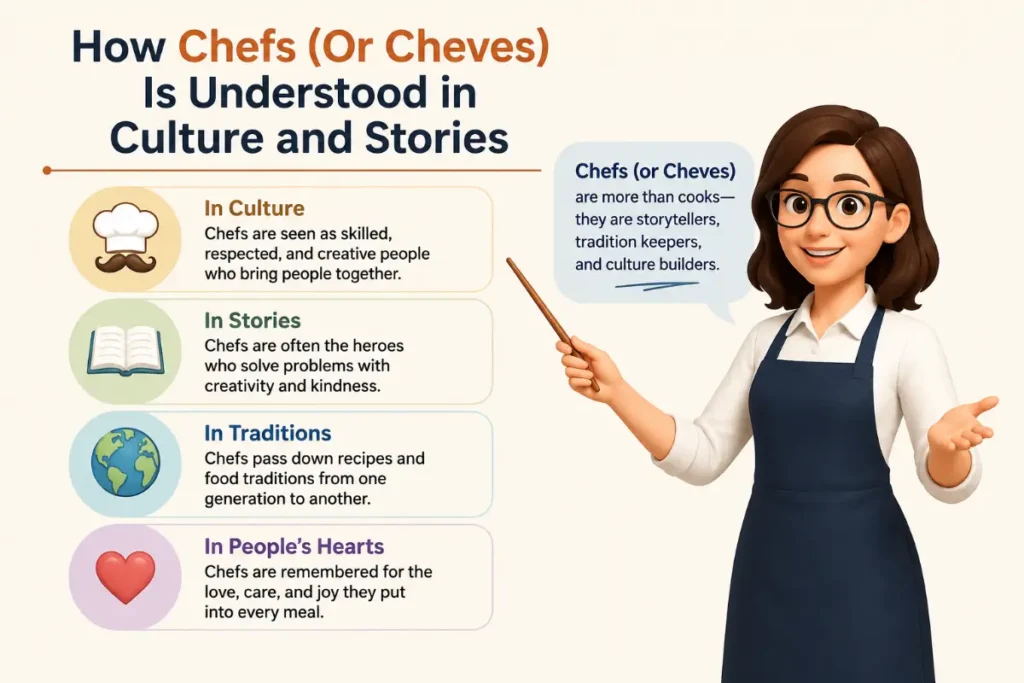
How Chefs Or Cheves Is Understood in Culture and Stories
The word chef is more than the name of a person who cooks. Around the world, a chef often represents skill, care, and creativity. Many people see chefs as artists because they turn simple ingredients into delicious meals. In movies, books, and television shows, chefs are often shown as hardworking people. They spend many hours learning recipes and practicing new cooking methods.
Their success usually comes from patience and practice. Many cooking competitions have also made chefs famous. Viewers enjoy watching talented chefs solve problems, work under pressure, and create beautiful dishes. These stories teach that success comes from learning and never giving up. Families also respect chefs because food brings people together.
Birthday parties, weddings, holidays, and family dinners often become special because of the work that chefs do. When you think about chefs or cheves, remember that only chefs is used when talking about these skilled cooks.
Biblical and Mythological Meaning of Chefs vs Cheves
The word chef does not have a special meaning in the Bible. The Bible talks about people who prepared food, baked bread, or served meals. However, it does not use the modern English word chef. The word also has no well-known meaning in mythology.
Even though many old stories include cooks or royal kitchens, they do not connect the word chef with any special symbol or myth. So, if someone asks about words in the Bible or mythology, the simple answer is that neither word has a special religious or mythical meaning.
Symbolism Explained in Simple Words
What Chefs Represents
The word chefs represents knowledge, practice, and service.
Chefs help feed people every day. They often stand for hard work, teamwork, kindness, and creativity.
Many people also connect chefs with family meals, celebrations, and happy memories.
When someone becomes a chef, it usually shows they have learned an important skill through training and experience.
What Cheves Represents
The word cheves does not represent anything in standard English.
It is not the correct plural of chef.
People usually write cheves because they remember words like leaves or wolves. It is simply a spelling mistake, not another English word.
That is why chefs represents the correct English word, while cheves represents a common learner error.
Related Words You Should Know
Here are some useful words related.
Chef
A professional cook who prepares meals.
Chefs
More than one professional cook.
Cook
Someone who prepares food. A cook may work at home or in a restaurant.
Head Chef
The main chef who manages the kitchen.
Sous Chef
The second-in-command who helps the head chef.
Pastry Chef
A chef who makes cakes, bread, cookies, and desserts.
Recipe
A set of instructions for preparing food.
Kitchen
The place where food is cooked.
Restaurant
A business where people buy meals.
Cuisine
A style of cooking from a country or region.
Menu
A list of food and drinks available to order.
Learning these words will make it easier to understand conversations about cooking and restaurants.
How People Actually Use Chefs and Cheves in Daily English
Native English speakers always use chefs when talking about more than one chef.
Here are some natural examples.
- The chefs prepared dinner before the guests arrived.
- Famous chefs often share cooking tips online.
- Our local restaurant has three excellent chefs.
- Many young chefs dream of opening their own restaurants.
- The chefs worked together to prepare the wedding meal.
- Television chefs inspire many people to cook at home.
- The hotel hired two new chefs this month.
- Experienced chefs can prepare meals very quickly.
- Several chefs entered the cooking competition.
- The chefs smiled after everyone enjoyed the food.
Notice that every sentence uses chefs. None of them use cheves because it is not correct English.
Common Mistakes People Make
Many learners make the same spelling mistakes.
Mistake:
The cheves made wonderful desserts.
Correct:
The chefs made wonderful desserts.
Mistake:
Three cheves work in this kitchen.
Correct:
Three chefs work in this kitchen.
Another common mistake is trying to apply one spelling rule to every word ending in f.
Some words become ves.
Some words simply add s.
The word chef belongs to the second group.
A good way to remember this is to compare it with chief.
Chief becomes chiefs.
Chef becomes chefs.
Both words follow the same easy pattern.
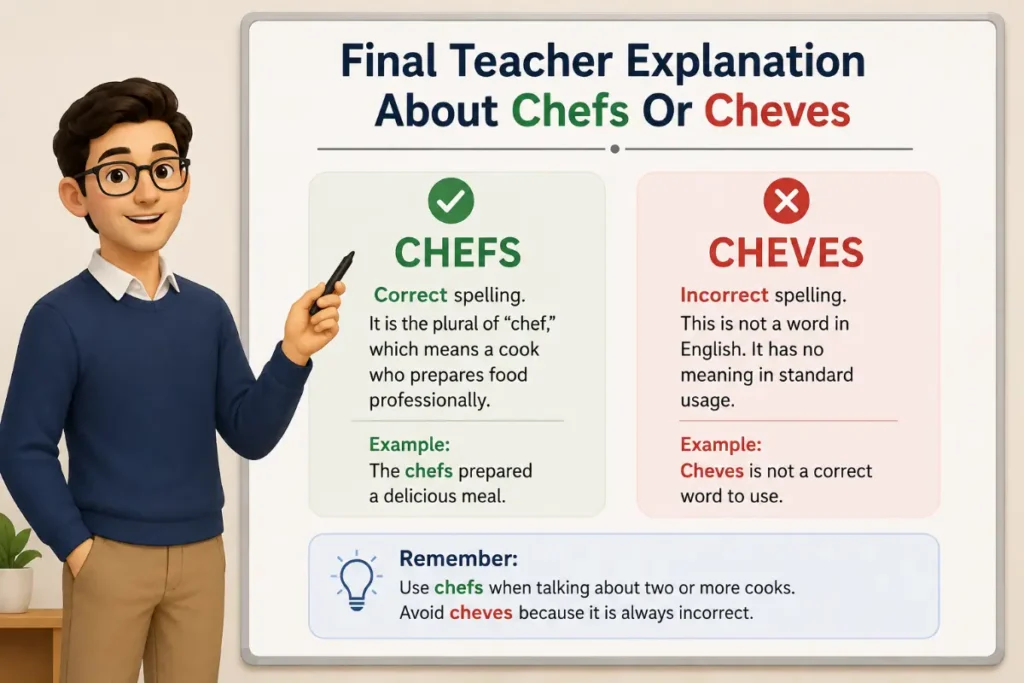
Final Teacher Explanation About Chefs Or Cheves
Imagine you are sitting in my English class.
You ask me, “Should I write?”
My answer is simple.
Always write chefs.
The word cheves is not the correct plural of chef.
Many students become confused because English has words like knife, wolf, and leaf. Those words change to ves. The word chef does not.
You only need one easy rule.
One chef.
Two chefs.
That rule works every time.
If you remember this simple pattern and read it often, you will naturally use the correct spelling in school, at work, and in everyday conversations.
Final Answer About Chefs vs Cheves (Quick Recap)
Many English learners search because they notice that some English words ending in f change to ves. That makes the question understandable, but the answer is very simple.
The correct plural of chef is chefs. The spelling cheves is not standard English and should not be used in normal writing or speaking. Dictionaries, teachers, newspapers, and native English speakers all use chefs.
The easiest way to remember this rule is to think of another similar word. Just as chief becomes chiefs, chef becomes chefs. Simply add s and keep the f.
You may also want to read Any Time vs Anytime: Which Is Correct and How to Use (2026).
Conclusion
Now you know the complete answer. The correct word is chefs because the noun chef forms its plural by adding s. The spelling cheves is a common mistake and is not accepted in standard English.
The best way to remember this rule is to read and use the correct spelling in everyday sentences. The more often you see chefs, the easier it becomes to remember.
Keep this simple takeaway in mind: One chef. Two chefs. Never cheves.
Frequently Asked Questions
What is the correct plural of chef?
The correct plural is chefs. Simply add s to chef.
Which is correct?
Chefs is correct. Cheves is not a standard English word.
Why do people write cheves?
People often confuse it with words like leaf and wolf, which change to ves in the plural.
Can I use cheves in school writing?
No. Always use chefs in school, work, and everyday English.
Does chef always become chefs?
Yes. The plural of chef is always chefs.
Is chef an English word?
The word came into English from French, but it is now a normal English word used around the world.
How can I remember the correct spelling?
Remember this easy sentence: One chef. Two chefs.
Do native English speakers say chefs?
Yes. Native English speakers always use chefs when talking about more than one chef.
