
Many people ask coachs or coaches when they need to write about more than one coach. This is a very common spelling question. The good news is that the answer is simple once you know the rule.
If you have ever paused while writing an email, a school paper, or a social media post because you were unsure about words, you are not alone. Many English learners and even native speakers make this mistake because English plural rules can look confusing at first.
This guide will explain the difference in very simple English. You will learn which spelling is correct, why the mistake happens, how to remember the rule, and how to use the correct word in real life.
Learn the difference in Preform vs Perform: Common Mistakes You Must Avoid (2026).
Simple Answer In One Look.
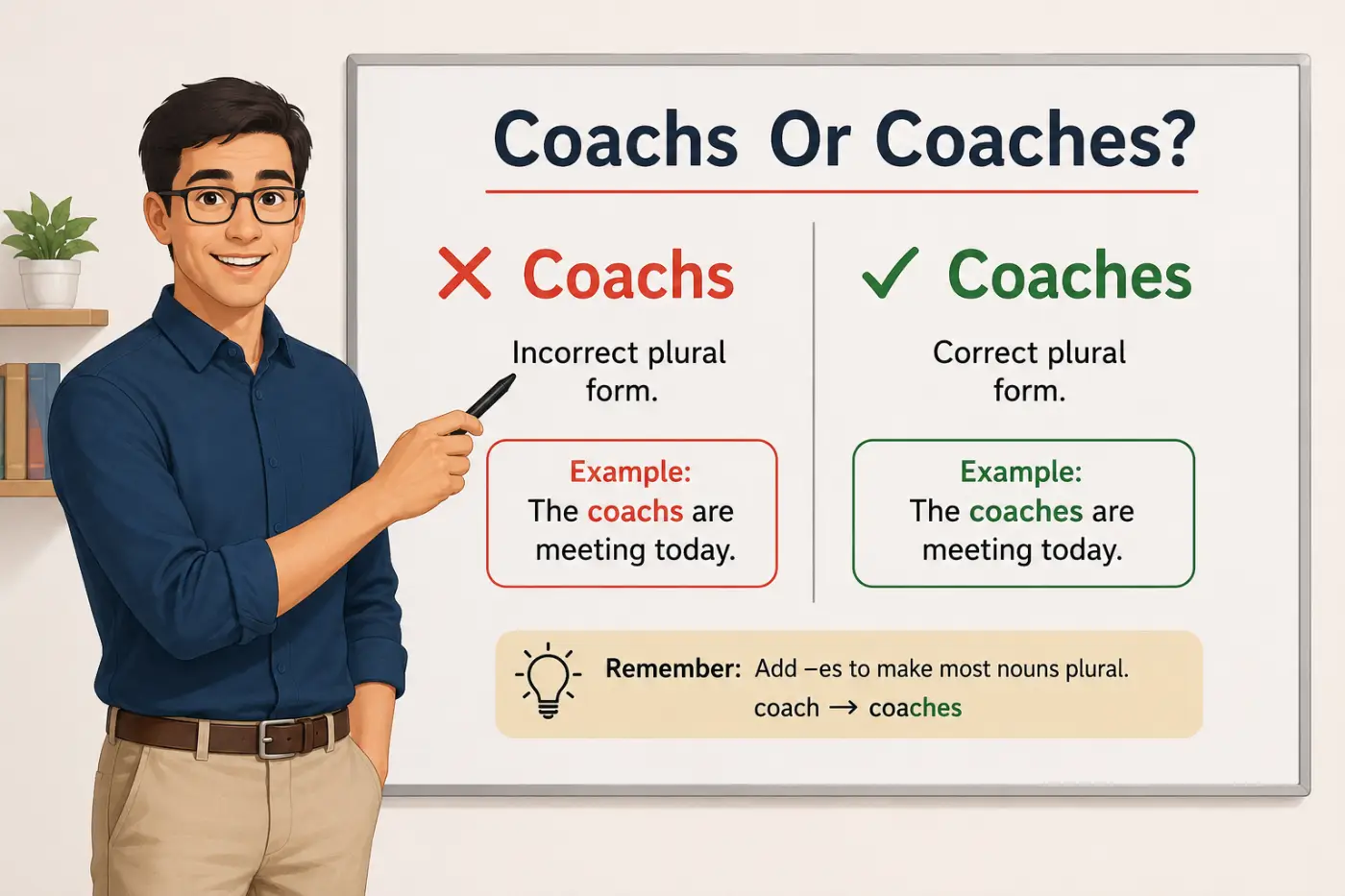
The correct plural form is coaches.
Coachs is not a correct English word.
If you are talking about more than one coach, always write coaches.
Examples:
- One coach.
- Two coaches.
- Our coaches helped us win.
- The school hired new coaches.
What Coachs or Coaches Means In Simple English.
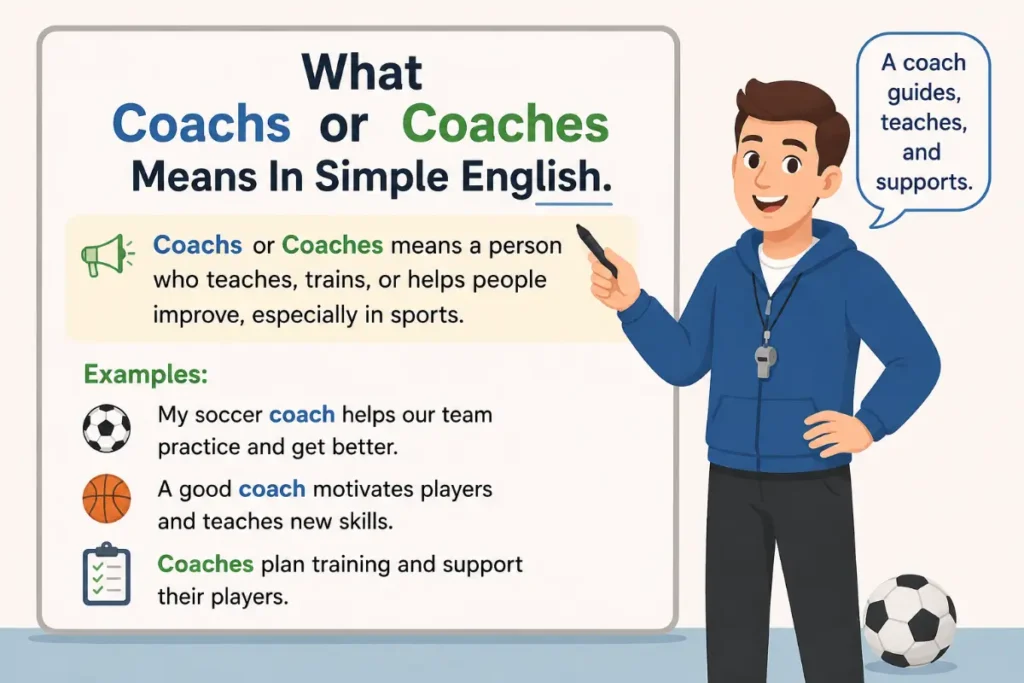
A coach is a person who teaches, trains, or guides someone to improve a skill.
A coach can help people in many areas.
For example:
- A football coach teaches players how to play better.
- A life coach helps people reach personal goals.
- A fitness coach creates workout plans.
- A business coach gives advice to company owners.
- A writing coach helps students become better writers.
When there is more than one coach, the correct word is coaches.
Think of it this way.
- One coach.
- Two coaches.
- Many coaches.
The word coachs is never correct in standard English.
Why People Mix These Words Coachs or Coaches
Many learners become confused because English has different ways to make plural nouns.
Most nouns simply add s.
Examples:
- Book → Books.
- Car → Cars.
- Chair → Chairs.
Because of this rule, some people naturally think:
- Coach → Coachs.
That looks logical, but English has another rule.
Words that end in ch usually add es, not just s.
That is why the correct spelling becomes:
- Coach → Coaches.
This same pattern appears in many common English words.
Examples:
- Church → Churches.
- Match → Matches.
- Watch → Watches.
- Bench → Benches.
- Branch → Branches.
Since coach ends with ch, it follows the same pattern.
Another reason people write coachs is fast typing. When people type quickly, they may forget to add es. Spell check often catches this mistake, but it is still good to know the rule yourself.
Clear Difference Explained Simply.
Here is the easiest way to remember the difference.
| Word | Correct? | Meaning |
|---|---|---|
| Coach | ✅ Yes | One person who trains or teaches. |
| Coaches | ✅ Yes | More than one coach. |
| Coachs | ❌ No | Incorrect spelling. |
You can also remember this simple comparison.
- One coach.
- Two coaches.
- Many coaches.
- Never write coachs.
Another easy memory trick is this.
If a word ends with ch, think about adding es.
Examples:
- Beach → Beaches.
- Branch → Branches.
- Match → Matches.
- Coach → Coaches.
This simple pattern works almost every time.
Which Form Should You Use Coachs or Coaches?
Always choose coaches when you mean more than one coach.
Use coach when you mean only one person.
Simple rule:
- One person equals coach.
- More than one person equals coaches.
Never use coachs because it is not accepted in English dictionaries or standard writing.
Here are a few examples.
Correct:
- The coaches planned today’s practice.
- Our coaches encouraged every player.
- The team thanked its coaches.
- Three coaches attended the meeting.
- The new coaches arrived early.
Incorrect:
- The coachs planned today’s practice.
- Our coachs helped the team.
- School coachs met yesterday.
Easy Real Life Sentences You Can Use.
Here are simple examples that you can use every day.
- Our coaches helped us prepare for the game.
- The school hired two new coaches.
- Good coaches always support their players.
- The coaches stayed after practice.
- My coaches taught me to never give up.
- All the coaches attended the meeting.
- Experienced coaches know how to motivate people.
- The players thanked their coaches after winning.
Notice that every sentence uses coaches because it refers to more than one coach.
Here are a few examples with the singular form.
- My coach is very patient.
- The coach explained the rules.
- Every coach wants the team to improve.
- Our coach arrived early.
- She thanked her coach after the competition.
Reading these examples several times makes the correct spelling easy to remember.
Where Coachs or Coaches Word Comes From Simple History.
The word coach has an interesting history. Hundreds of years ago, the word first meant a large horse drawn carriage that carried people from one place to another. Later, people began using coach for someone who carries another person toward success instead of carrying them in a vehicle.
That is why a coach helps someone move forward in sports, school, work, music, business, and many other parts of life. As English developed, the plural followed the normal spelling rule for words ending in ch.
So:
- Coach became coaches.
The spelling coachs never became part of standard English.
Today, coaches is used around the world in schools, sports teams, businesses, and everyday conversations.
As English spread to different countries, the spelling stayed the same because it follows a common English plural rule that learners can apply to many other words ending in ch. Knowing this history also makes the word easier to remember. A coach helps people move toward success, and more than one coach becomes coaches. Learning the reason behind the spelling often helps students avoid making the same mistake again.
Now that you understand the basic difference between both words, the next part will go beyond simple spelling. You will learn how people use the word in culture, common expressions, real conversations, related words, frequent mistakes, and practical situations so you can use coaches with confidence in everyday English.
How Is Understood In Culture And Stories.
The word coach is more than a job title. In many stories and real life, a coach is someone who helps others grow. A coach teaches, encourages, and supports people when they face challenges. In sports stories, coaches often help a team believe in itself. The players may lose many games at first, but a good coach keeps teaching and cheering them on. That is why coaches are often seen as leaders who never give up.
In school stories, a coach can help students build confidence. A debate coach, music coach, or drama coach teaches skills and helps students do their best. Many movies also show coaches as caring people. They help young people become stronger, kinder, and more responsible. Sometimes the biggest lesson is not about winning. It is about teamwork, respect, and hard work.
People also use the word coach outside sports. A life coach, business coach, or career coach helps people reach their goals. This shows that coaching is about guidance in many parts of life. When we talk about more than one person doing this job, the correct word is coaches. Even in stories and everyday conversations, coachs is never the correct spelling.
Still confused? Compare Having vs Having Had: Simple Meaning Difference Uses (2026).
Biblical And Mythological Meaning Of Coachs Or Coaches.
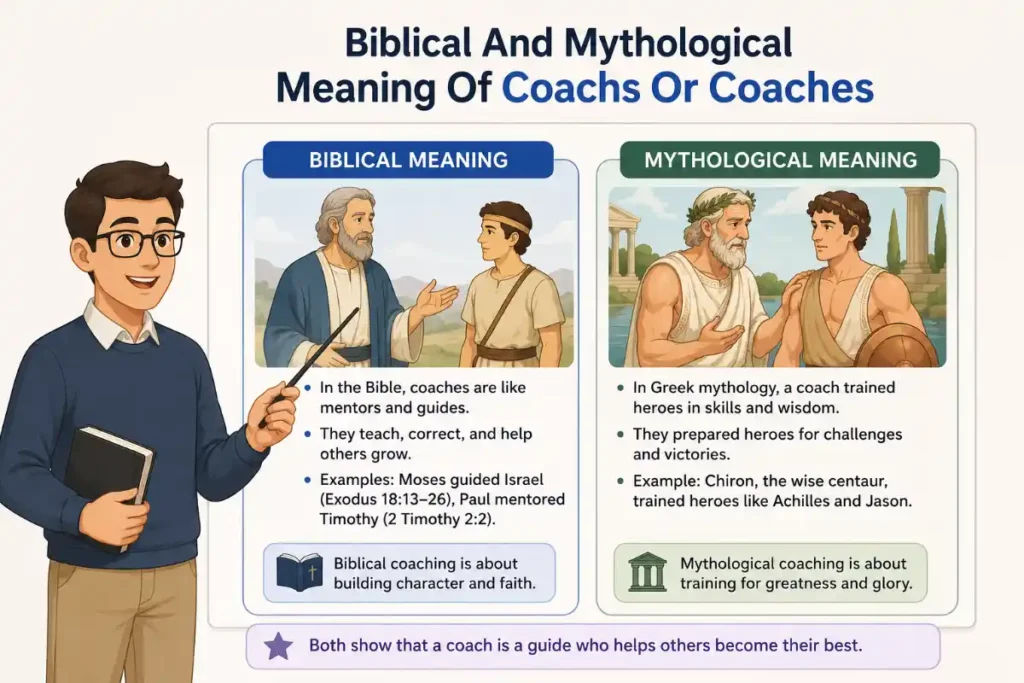
The word coach does not appear in the Bible because it is a modern English word. However, the Bible talks about teachers, leaders, shepherds, and guides. These people helped others learn, grow, and make wise choices. In a simple way, they played a role that is similar to what many coaches do today.
There is also no famous mythological meaning connected to the word coach. Ancient myths usually speak about heroes, kings, gods, and wise mentors instead. Even though the word has no direct biblical or mythological meaning, many people see coaches as symbols of guidance, patience, and encouragement. Remember that the plural is always coaches, not coachs.
Symbolism Explained In Simple Words.
What Coach Represents.
The word coach represents one person who teaches, guides, and supports others.
People often connect a coach with:
- Leadership.
- Encouragement.
- Learning.
- Teamwork.
- Growth.
- Confidence.
- Success through practice.
A coach reminds us that learning takes time and that improvement happens step by step.
What Coaches Represents.
The word coaches represents a group of people who guide and teach others.
When you hear coaches, you may think about:
- A whole sports staff.
- Many teachers working together.
- Different experts helping students.
- Team support.
- Shared knowledge.
- Different ideas and experiences.
The only difference between coach and coaches is the number of people.
- Coach means one person.
- Coaches means more than one person.
- Coachs does not represent anything because it is not a correct English word.
Related Words You Should Know.
Here are some useful words that are connected with coach.
- Trainer
A trainer teaches people specific skills, especially in sports or fitness. - Instructor
An instructor gives lessons and explains how to do something. - Teacher
A teacher helps students learn subjects in school or other places. - Mentor
A mentor shares experience and gives personal guidance. - Guide
A guide shows someone the right direction or helps them understand something. - Leader
A leader helps a group work together toward a goal. - Captain
A captain leads a sports team during games. - Player
A player is the person who learns from the coach and plays the game. - Practice
Practice means doing something again and again to improve. - Team
A team is a group of people working together toward the same goal.
Knowing these related words helps you understand how coach and coaches are used in different situations.
How People Actually Use It In Daily English.
People almost always use coach or coaches in normal conversations. Here are some natural examples.
- Our coaches are always ready to help.
- The coaches planned tomorrow’s practice.
- My coach gave me useful advice.
- The school invited new coaches this year.
- All the coaches met before the tournament.
- She thanked her coach after the race.
- The coaches encouraged every player.
- Good coaches listen as much as they teach.
- We asked our coaches for extra practice.
- The coaches celebrated with the team after the win.
Notice that every sentence with more than one coach uses coaches.
You will not see coachs in good books, newspapers, or professional writing because it is not correct.
Common Mistakes People Make Coachs or Coaches
Many learners make the same spelling mistakes. Here are the most common ones.
Mistake 1
Wrong: Three coachs joined the school.
Correct: Three coaches joined the school.
The word ends in ch, so add es.
Mistake 2
Wrong: Our coaches is very kind.
Correct: Our coach is very kind.
Use coach when talking about one person.
Mistake 3
Wrong: Every coaches helped us.
Correct: Every coach helped us.
The word every is followed by a singular noun.
Mistake 4
Wrong: One of the coachs spoke first.
Correct: One of the coaches spoke first.
The phrase one of the is followed by a plural noun.
Mistake 5
Wrong: The coach teach us every day.
Correct: The coach teaches us every day.
Make sure the verb matches the singular subject.
A simple way to avoid mistakes is to remember one easy rule.
If the word ends in ch, the plural usually ends in es.
Final Teacher Explanation
Think about standing in a classroom.
I write two words on the board.
Coachs
Coaches
Then I ask which one is correct.
The answer is always coaches.
Why?
Because the word coach ends with ch. English usually adds es to words that end this way.
So remember this simple pattern.
- Coach → Coaches.
- Match → Matches.
- Church → Churches.
- Watch → Watches.
If you remember this one rule, you will avoid this mistake every time.
You do not need to memorize long grammar rules. Just remember that words ending in ch usually take es in the plural.
That is the easiest way to remember the answer to both words.
Final Answer About Coachs Or Coaches Quick Recap.
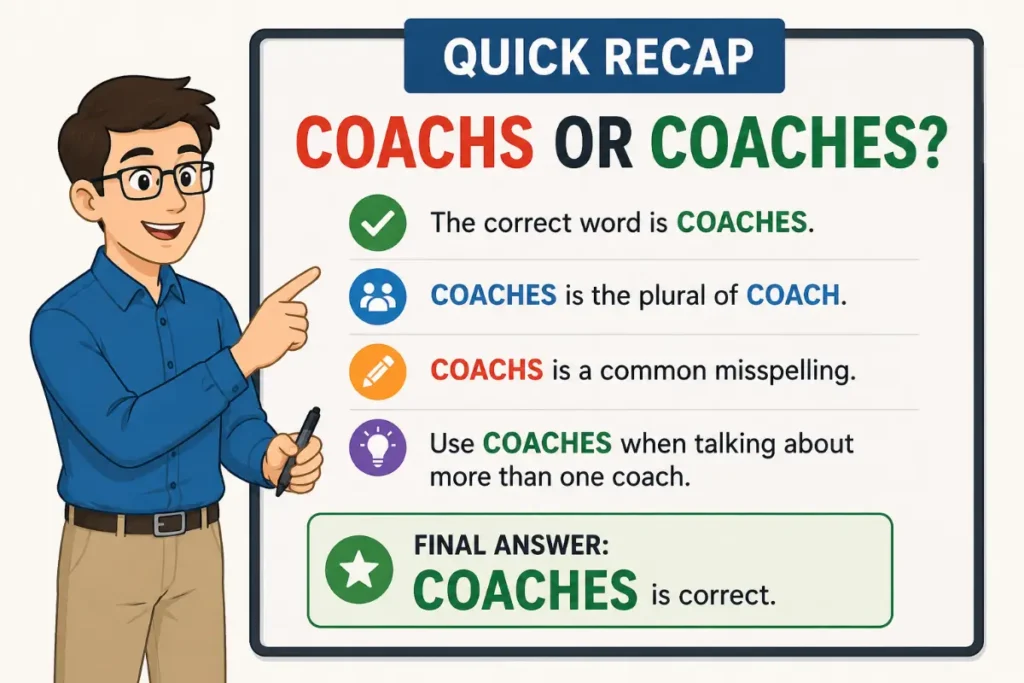
If someone asks, the correct answer is coaches. Use coach when talking about one person. Use coaches when talking about two or more people. Never write coachs because it is not a correct English spelling.
The next time you write about sports, school, fitness, business, or any other kind of coaching, you can feel confident using coaches. This simple rule will help you write clear and correct English every time.
Need another quick comparison? Read Dutchess vs Duchess: What Is the Difference?.
Conclusion.
Many people become confused about words, but the answer is actually very easy. The correct plural form is coaches. The spelling coachs is incorrect and should not be used in standard English.
A good way to remember this rule is to look at the ending of the word. Since coach ends with ch, you add es to make it plural. This is the same pattern used with many other English words.
The easiest takeaway is this: One coach. Two coaches. Never coachs.
Frequently Asked Questions FAQs.
Which is correct?
Coaches is correct. Coachs is an incorrect spelling.
Why is coachs wrong?
The word coach ends with ch, so its plural is made by adding es, giving coaches.
When should I use coaches?
Use coaches when you are talking about two or more coaches.
Can I ever write coachs?
No. Coachs is not accepted in standard English.
What is the singular form of coaches?
The singular form is coach.
Is coaches used for sports only?
No. Coaches can refer to sports coaches, life coaches, business coaches, fitness coaches, music coaches, and many others.
How can I remember the correct spelling?
Remember this simple rule: words ending in ch usually add es in the plural. So coach becomes coaches.
Is coaches correct in formal writing?
Yes. Coaches is the correct spelling for school work, business writing, books, emails, and everyday English.
