
Many English learners get confused about better than or better then because the two words look almost the same. They sound similar too. That is why many people type or say the wrong one without noticing.
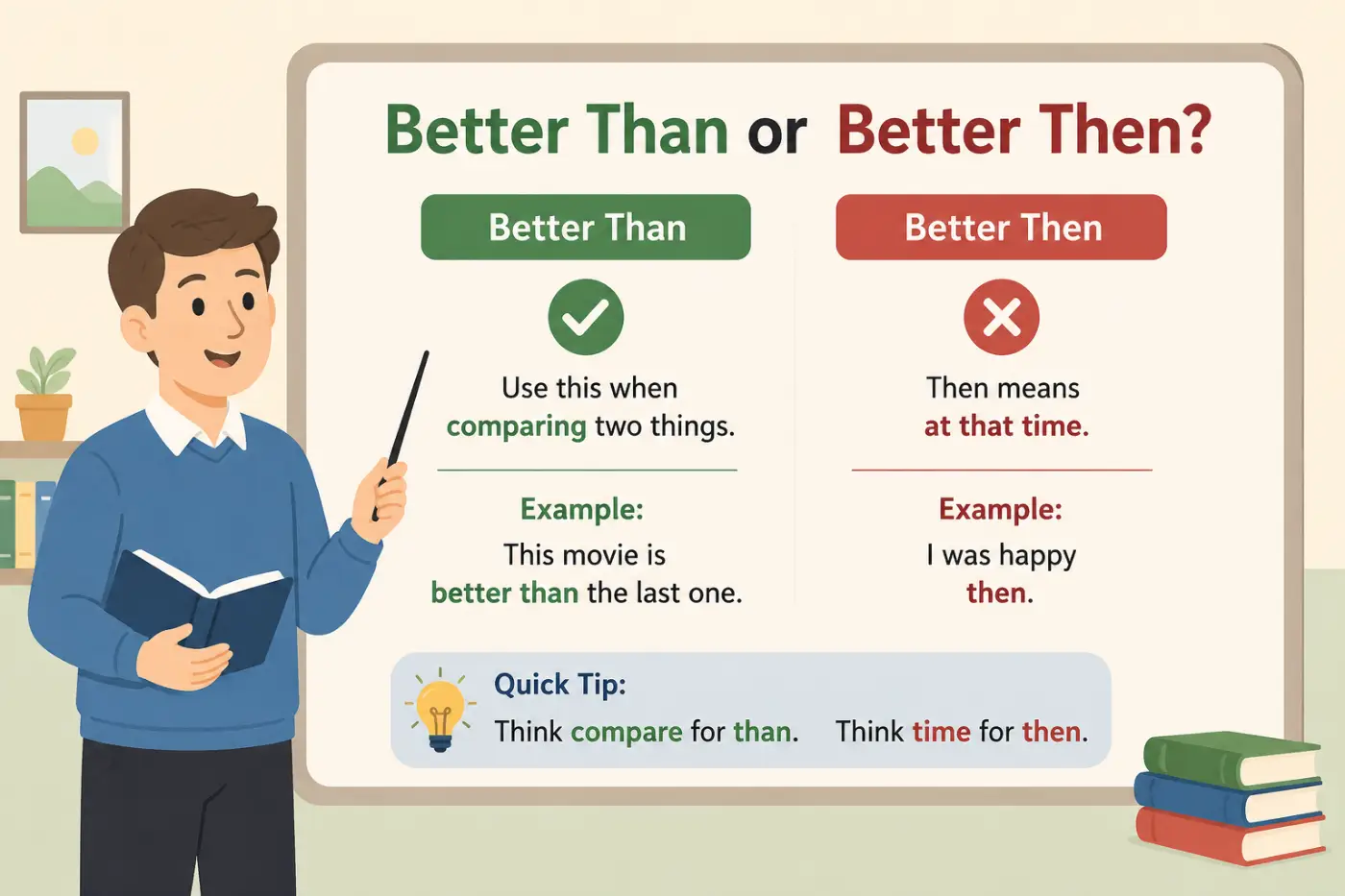
The simple answer is this. Better than is correct when you compare two people things ideas or actions. Better then is usually wrong in comparisons. The word then is mainly used for time or the next step in a series of events.
If you have ever wondered about words and you are not alone. This is one of the most common English mistakes. After reading this guide you will know the difference and use the correct form with confidence.
Many readers also check It Is Must vs It Is a Must: Simple English Guide (2026).
Simple Answer in One Look
Better than is correct when you compare two things.
Better then is only correct if you are talking about time or what happens next. It is not correct for normal comparisons.
Examples:
- She is better than me.
- This phone is better than my old one.
- We finished dinner and then watched a movie.
What Does Better Than or Better Then Mean in Simple English
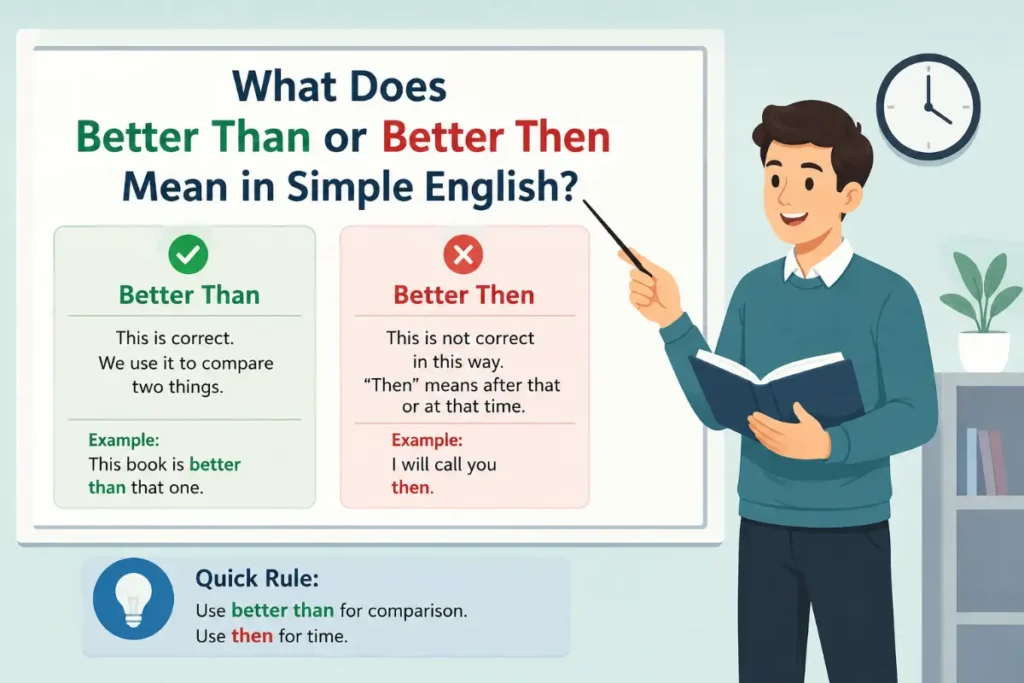
Think of the word better as a way to show that one thing is stronger nicer faster easier or more useful than another. When you compare two things you always need the word than. For example:
- My new bike is better than my old bike.
- Reading is better than watching TV all day.
- This road is better than the other one.
The word than helps connect the two things being compared.
Now think about then. The word then has nothing to do with comparison. It talks about time or the next action. For example:
- We ate lunch then we went home.
- Finish your homework then play outside.
- She smiled then walked away.
A simple trick is this.
If you are comparing use than.
If you are talking about time use then.
That one small idea will help you avoid this mistake almost every time.
Why Do People Mix These Words Better Than or Better Then
Many people confuse these words because they look alike. Here are the biggest reasons.
They Sound Very Similar
In fast speech than and then can sound almost the same. Many people cannot hear the difference clearly. Example:
- This book is better than that one.
Some people hear then instead of than because the sounds are close.
Both Words Are Very Common
You see both words every day.
You read:
- Better than.
- Then we left.
Since both words appear often it is easy to choose the wrong one while writing.
Fast Typing Causes Mistakes
People often type quickly on phones and computers. Instead of writing:
- better than
they accidentally write:
- better then
This happens even to native English speakers.
Spell Check Does Not Always Help
Both than and then are real English words. Because of that many spelling checkers do not mark the mistake. Example:
- She is better then me.
The spelling is correct but the grammar is not.
Students Remember the Wrong Pattern
If someone sees better then many times online they may think it is correct.
Sadly the internet contains many writing mistakes.
Always check trusted English sources when you are unsure.
Clear Difference Explained Simply
The easiest way to remember the difference is to ask yourself one question.
Am I comparing something or talking about time?
If you are comparing use than.
If you are talking about time use then.
Here is a simple comparison.
| Better Than | Better Then |
|---|---|
| Used for comparisons. | Used for time or the next step. |
| Correct after the word better. | Usually wrong after the word better. |
| Shows one thing is stronger or nicer. | Shows what happens next. |
| She sings better than me. | We ate then we left. |
Look at these examples.
Correct:
- Summer is better than winter.
- Coffee is better than soda.
- Your answer is better than mine.
Correct with then:
- We finished class then we went home.
- Brush your teeth then go to bed.
- First read the book then answer the questions.
Incorrect:
- Summer is better then winter.
- Coffee is better then soda.
- Your answer is better then mine.
In each incorrect sentence the comparison needs than instead of then.
Better Than or Better Then Which Form Should You Use
The rule is very easy. Use better than every time you compare two things. Examples:
- This hotel is better than the last one.
- My brother is better than me at soccer.
- Water is better than soda for your health.
- This movie is better than the first one.
- Her idea is better than mine.
Use then only when you mean after that or next.
Examples:
- Finish your meal then have dessert.
- We visited the museum then went shopping.
- He called me then sent a message.
Here is another memory trick.
Than equals compare.
Then equals time.
Many students remember it like this.
- Compare equals than.
- Time equals then.
That simple rule works almost every time.
Easy Real Life Sentences You Can Use
These everyday examples will help you remember the correct form.
- This pizza tastes better than the frozen one.
- My dog runs faster than yours.
- She is better than me at math.
- Walking is better than driving for short trips.
- I like tea better than coffee.
- Finish your work then take a break.
- We cleaned the house then watched a movie.
- He locked the door then got into the car.
Read these sentences aloud.
Notice that every comparison uses than.
Every action that happens next uses then.
Where Better Than or Better Then Comes From Simple History
The word than has been part of English for hundreds of years. It has always been used to compare people things and ideas. The word then also has a long history. It comes from old English words that referred to time or what happened next. Over many years both words kept their own jobs.
- Than became the comparison word.
- Then stayed the time word.
Their spelling became similar but their meanings stayed different. That is why English learners still mix them up today. Even many native speakers accidentally type better then because both words are familiar and only one letter is different. The good news is that once you remember the simple rule the mistake becomes much easier to avoid. If you see the word better and you are comparing two things your choice should almost always be than.
As you continue learning English you will notice many other word pairs that look alike but have different meanings. In the next section you will learn how is used in everyday culture common expressions daily conversations and common mistakes. You will also discover helpful memory tips related words and easy ways to make this rule stick for life.
How Is Understood in Culture and Stories
The idea of comparing things is part of everyday life. People compare food, sports, movies, schools, jobs, and even ideas. That is why the phrase better than appears in books, songs, movies, TV shows, and daily conversations.
For example, a parent may say:
- Reading is better than watching TV all day.
A coach may say:
- Practice is better than making excuses.
A teacher may tell students:
- Learning from mistakes is better than giving up.
These examples show that better than helps people explain why one choice is stronger or more helpful than another. The word then has a different job in stories. It helps move a story forward by showing the next event. For example:
- The boy found a map. Then he followed the trail.
- She finished her homework. Then she played outside.
Notice that then tells the order of events. It does not compare anything.
When you hear better than, think about making a comparison.
When you hear then, think about what happens next.
A related grammar guide is Combatting or Combating: Which Spelling Is Correct?.
Better Than or Better Then Biblical and Mythological Meaning
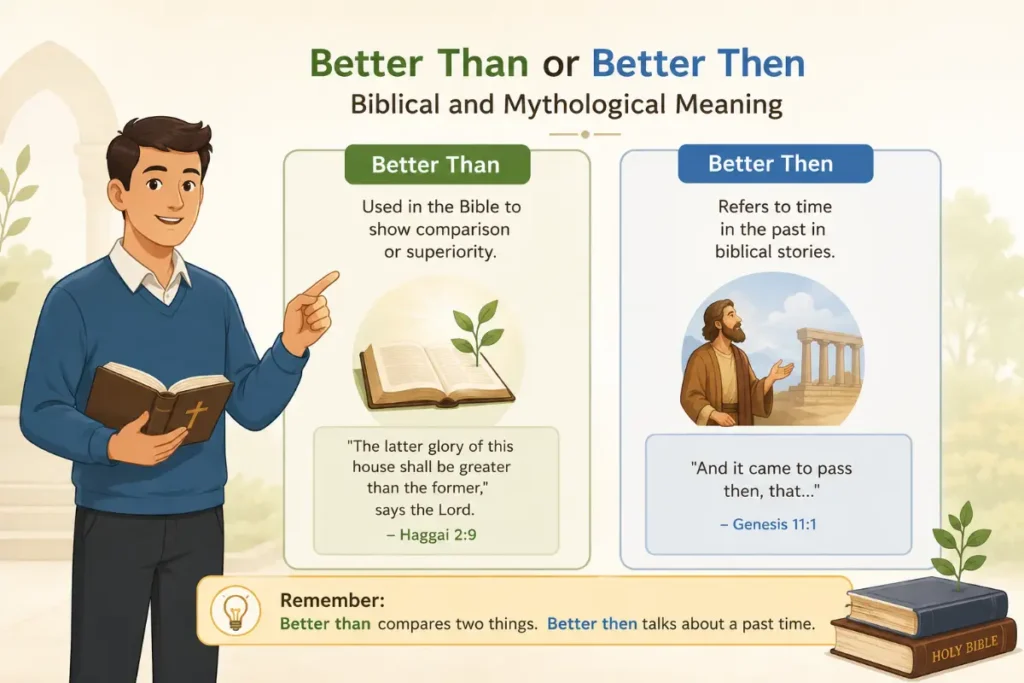
There is no special biblical or mythological rule about both words. The difference comes from English grammar, not religion or mythology. Still, many Bible translations use better than because they compare wisdom, kindness, peace, or love. For example, many verses compare one good thing with another by using the idea of better than. The word then is also found in many Bible stories. It simply shows the next event.
For example:
- The people prayed. Then they continued their journey.
So the meanings stay the same.
- Better than compares.
- Then shows time or the next step.
Symbolism Explained in Simple Words
What Better Than Represents
The phrase better than represents comparison, improvement, growth, and choice. People use it when they want to show that one thing has more value or works better than another. For example:
- Kind words are better than angry words.
- Hard work is better than giving up.
It often reminds people to choose wisely and keep improving.
What Better Then Represents
The phrase better then usually represents a writing mistake when someone wants to compare two things. The word then itself represents time, order, and progress. Examples include:
- Eat breakfast then leave for school.
- Finish your work then relax.
It tells readers what happens after something else.
The easiest way to remember this is simple.
- Than means comparison.
- Then means time.
Better Than or Better Then Related Words You Should Know
Here are some helpful words and expressions that are closely related.
Than
Used to compare two people, places, ideas, or things. Example:
- Cats are quieter than dogs.
Then
Shows what happens next or refers to a time. Example:
- We packed our bags then left.
Better
Means of higher quality or more useful. Example:
- This chair is better.
Best
Means the highest level among all choices. Example:
- She is the best player on the team.
Worse
Means lower in quality than something else. Example:
- Today’s weather is worse than yesterday’s.
Worst
Means the lowest or poorest of all. Example:
- That was the worst movie I have seen.
More Than
Used when comparing a larger amount or greater number. Example:
- I have more than twenty books.
Less Than
Used when comparing a smaller amount. Example:
- The trip took less than one hour.
Rather Than
Shows one choice instead of another. Example:
- I would walk rather than drive.
How People Actually Use Better Than or Better Then in Daily English
You will hear better than almost every day because people compare things all the time. Here are some natural examples.
- This coffee tastes better than the one I had yesterday.
- My sister cooks better than I do.
- Walking is better than sitting all day.
- This phone is better than my old one.
- Your idea sounds better than mine.
- I would rather study than fail the test.
- Finish your dinner then you can have dessert.
- We visited the park then went shopping.
- He called me then sent an email.
- First save your work then close the computer.
Notice something important.
Every comparison uses than.
Every sequence of actions uses then.
Common Mistakes People Make
Many learners make the same mistakes. The good news is that they are easy to fix.
Mistake One
Incorrect:
- She is better then me.
Correct:
- She is better than me.
Reason:
You are comparing two people.
Mistake Two
Incorrect:
- This pizza is better then that one.
Correct:
- This pizza is better than that one.
Reason:
You are comparing two pizzas.
Mistake Three
Incorrect:
- Better then never.
Correct:
- Better late than never.
Reason:
The saying compares being late with never doing something.
Mistake Four
Incorrect:
- Finish your homework than play games.
Correct:
- Finish your homework then play games.
Reason:
The sentence talks about what happens next.
Mistake Five
Incorrect:
- We ate than watched a movie.
Correct:
- We ate then watched a movie.
Reason:
The sentence describes the order of events.
A simple memory trick can help.
Ask yourself one question.
Am I comparing something?
If the answer is yes, use than.
If the answer is no and you are talking about time, use then.
Final Teacher Explanation of Better Than or Better Then
Imagine you are sitting in an English classroom. I write two words on the board.
Than
Then
Now I ask one simple question. “Are we comparing something?” If your answer is yes, always choose than. If I ask what happened after lunch, after school, or after dinner, your answer should use then because you are talking about time. You do not need to remember long grammar rules. Just remember two easy ideas.
- Compare equals than.
- Time equals then.
That small trick will help you write correct English in school, at work, and in daily life. The more you read and practice, the easier this becomes.
Soon you will notice the difference without even thinking about it.
Better Than or Better Then Final Answer Quick Recap
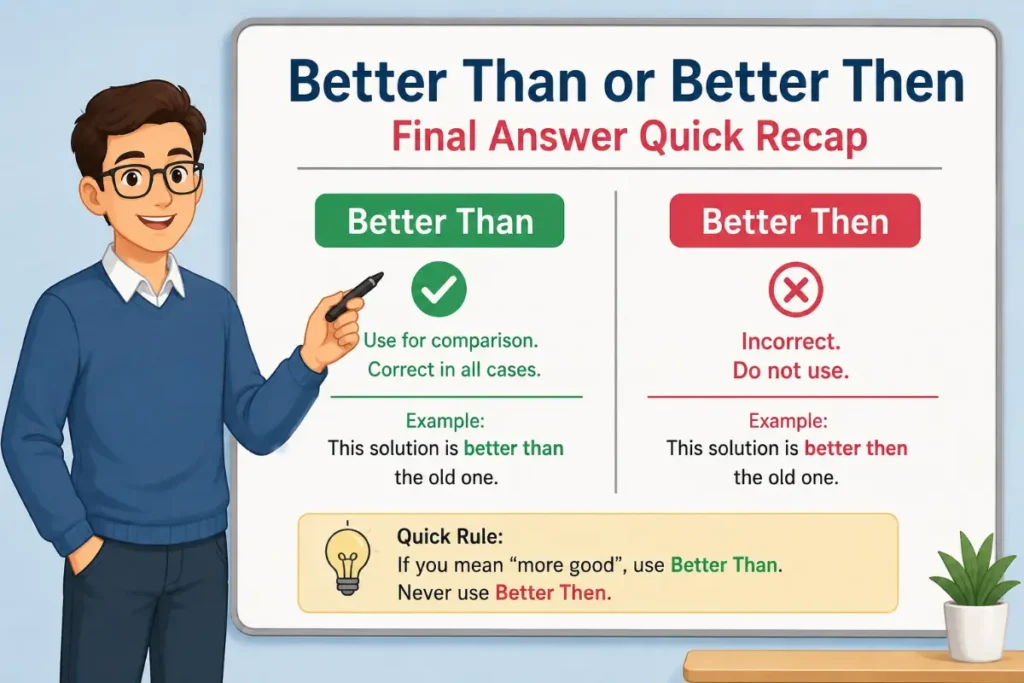
If someone asks you about words, the answer is very simple. Use better than when comparing two people, things, places, or ideas. This is the correct expression in standard English. It is the form you should use in school, business writing, emails, and everyday conversations.
Use then only when talking about time or the next event. It is not the correct word after better in a comparison. Remember this easy rule. Than compares. Then tells time. Once you learn this simple difference, you will avoid one of the most common English writing mistakes.
You may also want to read Courtesy vs Curtesy: Easy Guide for Students and Writers.
Conclusion
Many English learners struggle with both words because the words look and sound alike. The good news is that the rule is very easy. Use better than for comparisons and use then when talking about time or the next step.
Keep asking yourself one simple question before you write. Am I comparing two things or talking about what happens next? Your answer will tell you which word to choose.
The easiest takeaway is this. Better than compares. Then tells time. Remember that one sentence, and you will use these words correctly with confidence.
Frequently Asked Questions (FAQs)
What does better than mean in simple words?
It means one thing is higher, stronger, nicer, or more useful when compared with another.
Is better then ever correct?
Not for comparisons. Use better than when comparing. Use then only for time or the next event.
Why do people confuse?
The words look alike and sound very similar, so many people accidentally choose the wrong one.
When should I use than?
Use than whenever you compare two people, things, places, or ideas.
When should I use then?
Use then to show time, order, or what happens next.
Can I use better then in formal writing?
No. If you are making a comparison, better than is the correct form in formal and informal writing.
What is an easy trick to remember the difference?
Remember this sentence. Than compares. Then tells time.
Is better than used in everyday English?
Yes. It is one of the most common comparison phrases in spoken and written English.
