
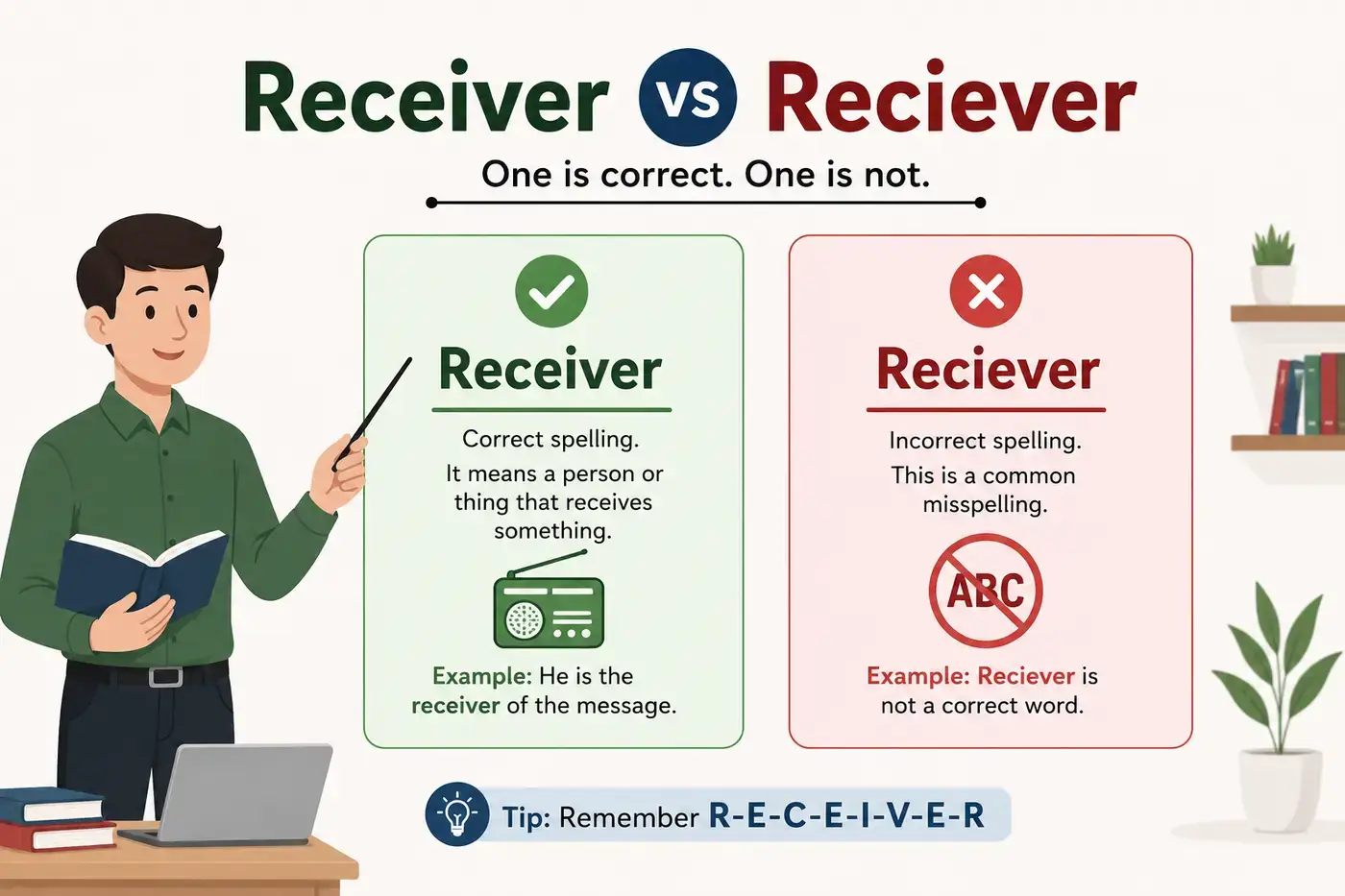
If you have ever typed receiver vs reciever, you are not alone. Many English learners and even native speakers stop and wonder which spelling is correct. The two words look almost the same. Only two letters change places. That tiny change causes a lot of confusion.
The short answer is simple. Receiver is the correct spelling. Reciever is a spelling mistake. You should always write receiver in school work, emails, business writing, and everyday English. Once you learn one easy spelling rule, this word becomes much easier to remember.
This guide will explain in the easiest way possible. You will learn the correct spelling, why people mix them up, how to remember the right form, and how to use the word naturally in real life.
Learn the difference in Seal vs Seel: Which Spelling Should You Choose.
Simple Answer in One Look
Receiver is the correct spelling.
Reciever is incorrect and should not be used.
If you are asking words, always choose receiver.
What Does Receiver Mean In Simple English?
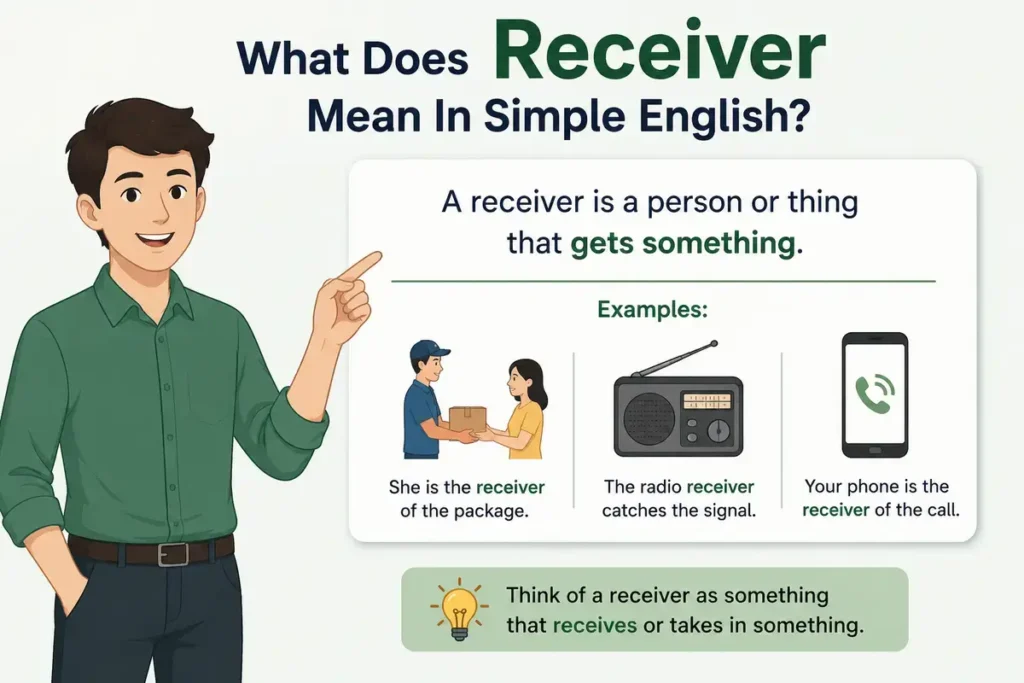
A receiver is a person or thing that gets or accepts something. Think of it this way. If someone sends something, another person receives it. The person who gets it is the receiver. Here are some simple examples.
- Emma was the receiver of the birthday gift.
- My phone is the receiver of the text message.
- The football receiver caught the pass.
- The radio receiver picked up the signal.
- The package receiver signed for the delivery.
The word can describe people, machines, or devices. The meaning changes a little depending on the situation, but the main idea stays the same. A receiver always gets something. That something could be:
- A message.
- A phone call.
- A gift.
- A football pass.
- A radio signal.
- Money.
- An email.
This simple idea makes the word easy to understand.
Why People Mix These Words Receiver vs Reciever
The confusion between both words happens because English spelling is not always easy. Many people remember the saying: I before E except after C. This helps in many words, but it does not work perfectly every time. The word receive follows this rule because the letters ei come after the letter c.
Since receiver comes from receive, it keeps the same spelling. People often make the mistake because they hear the word instead of seeing it written. When you say receiver, the middle sounds almost the same in both spellings. That makes it easy to type the wrong version.
Here are a few common situations.
Typing Too Fast
Someone writes quickly.
They accidentally switch the letters.
Receiver becomes reciever.
Trusting Sound Instead Of Spelling
English has many words that sound clear but are spelled differently than expected.
People guess the spelling from the sound.
Sometimes the guess is wrong.
Forgetting The Base Word
Many people forget that receiver comes from receive.
If you remember receive, the spelling becomes much easier.
Seeing The Wrong Spelling Online
The internet has many spelling mistakes.
Someone may copy the wrong version without noticing.
That mistake then spreads to more people.
Small Letter Changes Are Easy To Miss
Our eyes often skip over small details.
The letters ie and ei look very similar.
That makes the error harder to notice.
Clear Difference Explained Simply
The difference between is very easy.
| Receiver | Reciever |
|---|---|
| Correct spelling. | Incorrect spelling. |
| Used in dictionaries. | Not accepted in standard English. |
| Safe for school and work. | Considered a spelling error. |
| Comes from the word receive. | Does not follow the correct spelling. |
Here is another simple comparison.
Receiver
- Correct English spelling.
- Used by teachers.
- Used in books.
- Used in newspapers.
- Used in professional writing.
Reciever
- Wrong spelling.
- Common typing mistake.
- Should be corrected.
- Not accepted in formal writing.
- Avoid using it.
Whenever you compare words, the answer never changes.
Only receiver is correct.
Which Form Should You Use?
You should always use receiver. There is no situation where reciever is the correct choice. Here is an easy trick. Start with the word receive. Now add r at the end.
Receive → Receiver
Notice that the letters ei stay together. They never become ie. You can also remember this simple sentence. If you receive something, you are the receiver. Since both words come from the same root, they share the same spelling. That one sentence helps many students remember the correct form for years.
Easy Memory Trick For Receiver
Many students like memory tricks because they are simple.
Try this one.
Receive has EI. Receiver also has EI.
Repeat it a few times.
Receive.
Receiver.
Both use ei.
Another easy trick is this.
Imagine someone receiving a letter.
The word receive is written on the envelope.
The person opening the envelope is the receiver.
Both words keep the same letters.
Once you picture that image, the spelling becomes much easier to remember.
Easy Real Life Sentences You Can Use Receiver vs Reciever
These examples show how receiver appears in everyday English.
- My brother was the receiver of the award.
- She is the receiver of today’s package.
- The football receiver caught the ball.
- The radio receiver stopped working yesterday.
- Please write the receiver’s name on the box.
- The receiver answered the phone quickly.
- The email reached the receiver within seconds.
- Every receiver must sign before getting the package.
Now look at the wrong examples.
❌ She is the reciever of the gift.
✅ She is the receiver of the gift.
❌ Please check the reciever address.
✅ Please check the receiver address.
The corrected version is always the one you should use.
Common Places You Will See The Word Receiver
The word appears in many parts of daily life.
Mail And Packages
The receiver gets the package.
The sender mails it.
The receiver accepts it.
Phones
A phone receiver was the part you held to your ear on older telephones.
Even though modern phones are different, people still know the word.
Sports
In American football, a receiver catches passes from the quarterback.
This is one of the most common sports uses of the word.
Electronics
Many electronic devices are called receivers. For example:
- TV receiver.
- Radio receiver.
- GPS receiver.
- Satellite receiver.
Each one receives signals.
Business
Companies often talk about the receiver of payments, goods, or documents.
The meaning stays the same.
Someone receives something.
Where Receiver vs Reciever Word Comes From Simple History
The word receiver has been used in English for hundreds of years. It comes from the verb receive. The word receive entered English through French, and its older roots go back to Latin. The basic meaning has stayed almost the same over time. It has always been connected with getting, accepting, or taking something that another person gives. As English grew, the ending er was added. This ending often means a person or thing that does an action. For example:
- Teach becomes teacher.
- Build becomes builder.
- Farm becomes farmer.
- Receive becomes receiver.
This pattern makes the word easy to understand. A receiver is simply someone or something that receives. The spelling has also stayed the same for a very long time. That is why dictionaries, schools, publishers, and businesses all use receiver instead of reciever.
Now you know the basic answer to words and how to use the correct spelling with confidence. In the next section, we will look beyond spelling and explore how the word receiver is understood in everyday culture, different fields, common expressions, symbolism, and practical English so you can use it naturally in almost any situation.
Learn the difference in Inbalance or Imbalance: Correct Spelling With Examples.
How Is Understood In Culture And Stories
The idea behind a receiver appears in many stories, movies, and everyday conversations. A receiver is usually someone who accepts help, love, kindness, news, or even a challenge. The word often reminds people that life is not only about giving. Sometimes, we also need to receive. For example, a child receives a gift from a parent. A friend receives support during a hard time. A student receives praise after working hard. In each case, the receiver is the person who accepts something from someone else.
Many stories also teach that receiving with gratitude is just as valuable as giving with kindness. A thankful receiver makes a gift feel even more special. In sports stories, a receiver is often the player who catches the winning pass. That player may become the hero because they were ready when the moment arrived.
In technology, a receiver quietly does its job by picking up signals. People may not notice it, but without a receiver, communication would not work. No matter where you see the word, the main idea stays the same. A receiver gets something that another person or device sends.
Receiver vs Reciever In Biblical And Mythological Meaning
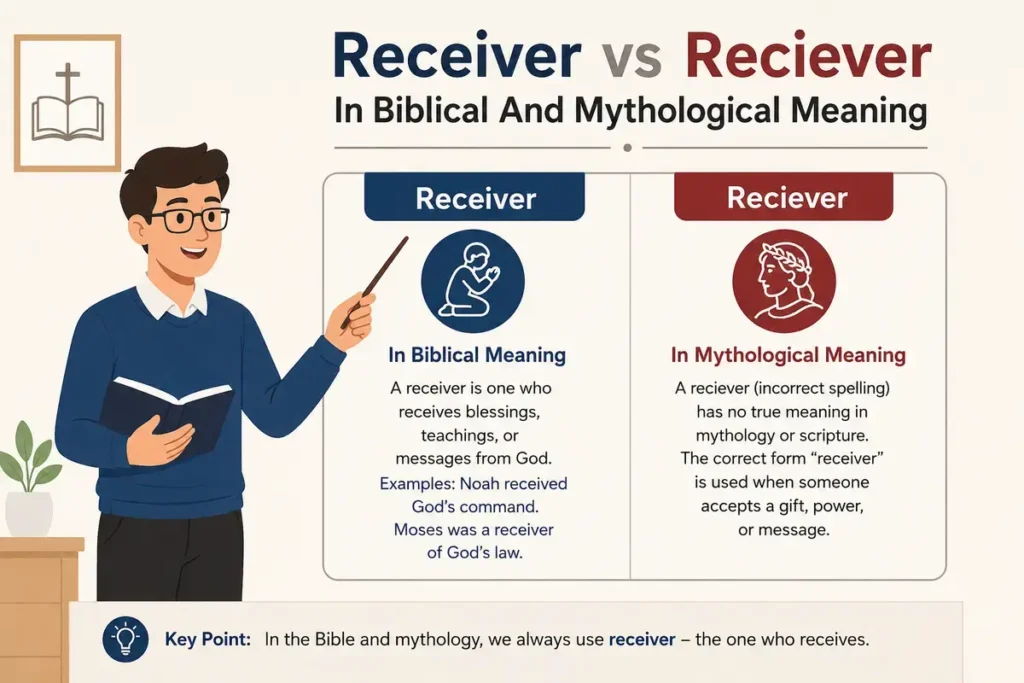
The word receiver itself does not have a special Biblical meaning. However, the idea of receiving appears many times in the Bible.
People receive blessings.
People receive forgiveness.
These examples show that receiving is often connected with faith, kindness, and gratitude. In many ancient stories and myths, heroes receive gifts, magical tools, or special advice before beginning an important journey. These gifts help them succeed. The spelling reciever has no Biblical, historical, or mythological meaning because it is simply a spelling mistake.
Symbolism Explained In Simple Words
What Receiver Represents
The word receiver represents correctness, learning, and clear communication. It also represents someone who is open to learning new things. A receiver can symbolize:
- Acceptance.
- Learning.
- Listening.
- Opportunity.
- Gratitude.
- Communication.
- Success.
People often say that good listeners are good receivers because they accept ideas before giving their own opinions.
What Reciever Represents
The word reciever does not have its own meaning. Instead, it represents a simple spelling mistake. It often happens because:
- Someone types too quickly.
- Someone forgets the spelling rule.
- Someone copies another mistake.
- Someone relies only on pronunciation.
Unlike receiver, it carries no special cultural meaning because it is not a correct English word.
Related Words You Should Know About Receiver vs Reciever
Learning related words makes much easier to remember.
Receive
The action of getting something.
Example: I receive emails every morning.
Reception
The act of receiving someone or something.
Example: We received a warm reception at the hotel.
Recipient
A person who receives something.
Example: Sarah was the recipient of the scholarship.
Sender
The person who sends something.
Example: Please write the sender’s address clearly.
Delivery
The act of bringing something to another person.
Example: Your delivery arrived this afternoon.
Accept
To willingly receive something.
Example: He accepted the invitation.
Collect
To receive or gather something.
Example: Please collect your package before noon.
Transfer
To send something from one place to another.
Example: The bank transferred the money today.
Signal
Information sent from one place to another.
Example: My phone has a strong signal.
Message
Information shared between people.
Example: I received your message yesterday.
How People Actually Use It In Daily English
Most people never say words during normal conversations. They simply use the correct word, receiver.
Here are common real-life examples.
- Please write the receiver’s name on the package.
- The receiver signed for the delivery.
- My radio receiver stopped working.
- The football receiver caught every pass.
- She became the receiver of the company award.
- The receiver answered the phone right away.
- Check that the receiver’s address is correct.
- The GPS receiver found our location quickly.
- Every receiver must show identification.
- The email reached the receiver in seconds.
These examples show that receiver fits naturally into many everyday situations.
Common Mistakes People Make With Receiver vs Reciever
Many spelling mistakes happen because English has words that look very similar.
Here are the most common errors.
Mistake One
❌ Reciever
✅ Receiver
Always keep the letters ei together after the letter c.
Mistake Two
❌ The reciever signed the package.
✅ The receiver signed the package.
Remember that receiver comes from receive.
Mistake Three
❌ Mixing receive and receiver spellings.
✅ Both words keep the same middle letters.
Receive.
Receiver.
Mistake Four
❌ Trusting spell check without learning the rule.
✅ Learn the spelling pattern so you can recognize the correct word yourself.
Mistake Five
❌ Copying incorrect spelling from social media.
✅ Check a trusted dictionary or proofread your writing before sending it.
A simple spelling check can prevent these mistakes.
Final Teacher Explanation
Imagine you are sitting in a classroom, and I write two words on the board.
Receiver.
Reciever.
Then I ask which one is correct.
The answer is always receiver.
The easiest way to remember this is to think about the word receive.
If you can spell receive correctly, you already know how to spell receiver.
Just add the letters at the end.
Receive becomes receiver.
You never change the order of the letters ei.
Many students worry because the two spellings look almost the same.
That is normal.
Almost everyone makes this mistake at least once.
The good news is that once you connect receiver with receive, the confusion usually disappears.
Every time you write emails, school assignments, reports, or messages, choose receiver.
Leave reciever behind because it is simply a spelling error.
Final Answer About Receiver vs Reciever Quick Recap
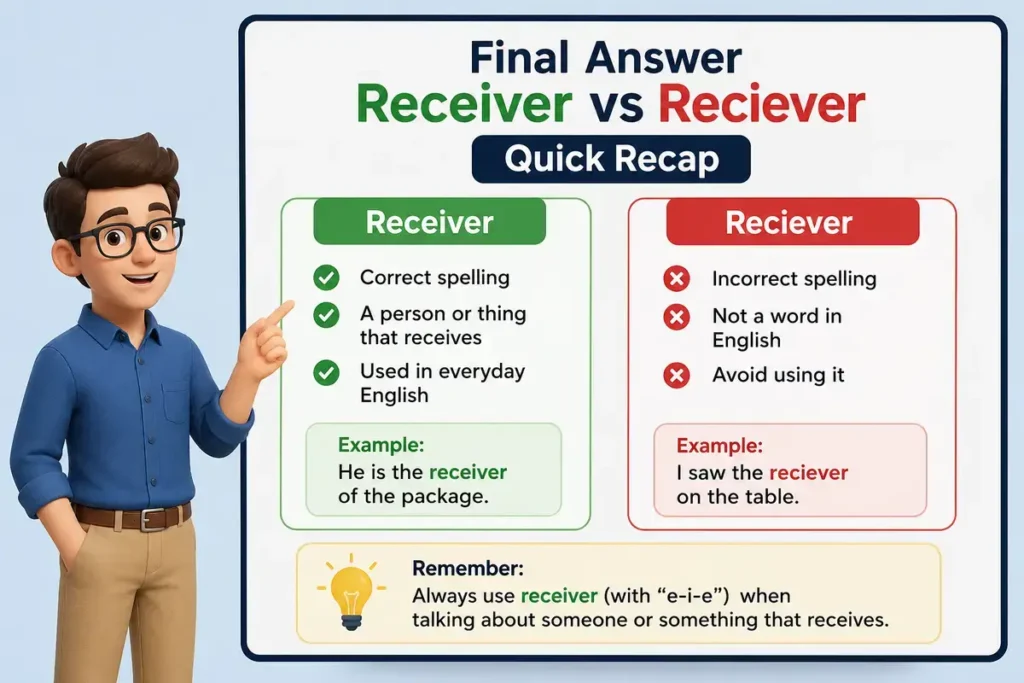
If someone asks about both words, the answer is clear. Only receiver is the correct English spelling. It comes from the verb receive and follows the same spelling pattern. The word reciever is not accepted in standard English and should not be used in school, business, or everyday writing.
A simple memory trick makes this easy. If you receive something, you are the receiver. Both words keep the letters ei together. Remember that one connection, and you will spell the word correctly every time.
Good spelling helps people understand your writing quickly. Using the correct form also makes your emails, essays, job applications, and messages look more professional and trustworthy.
For another common grammar confusion, see Aerial vs Arial: Learn The Right Word complete guide (2026).
Conclusion
Understanding is simple once you remember one key idea. The correct spelling is always receiver because it comes from the word receive. The spelling reciever is only a common mistake and should be avoided in your writing.
Whenever you talk about a person, device, or system that gets something, use receiver. Keep the letters ei together, and you will remember the correct spelling easily. Good spelling makes your English clearer, more professional, and easier for others to understand.
Frequently Asked Questions
What does receiver mean in simple words?
A receiver is a person or thing that gets something, such as a gift, message, signal, or package.
Is receiver or reciever correct?
Receiver is the correct spelling. Reciever is a spelling mistake.
Why do people confuse?
The words sound almost the same, and many people accidentally switch the letters while typing or writing.
Can I use reciever in formal writing?
No. Always use receiver in school work, business documents, and professional writing.
How can I remember the correct spelling?
Think of the word receive. Receiver keeps the same letters in the middle. Just add the ending.
Is receiver used only for people?
No. Receiver can also describe machines and devices like radio receivers, TV receivers, and GPS receivers.
Does receiver have different meanings?
Yes. The exact meaning depends on the situation, but it always refers to someone or something that receives.
Is reciever found in dictionaries?
No. Standard English dictionaries list only receiver because it is the correct spelling.
