
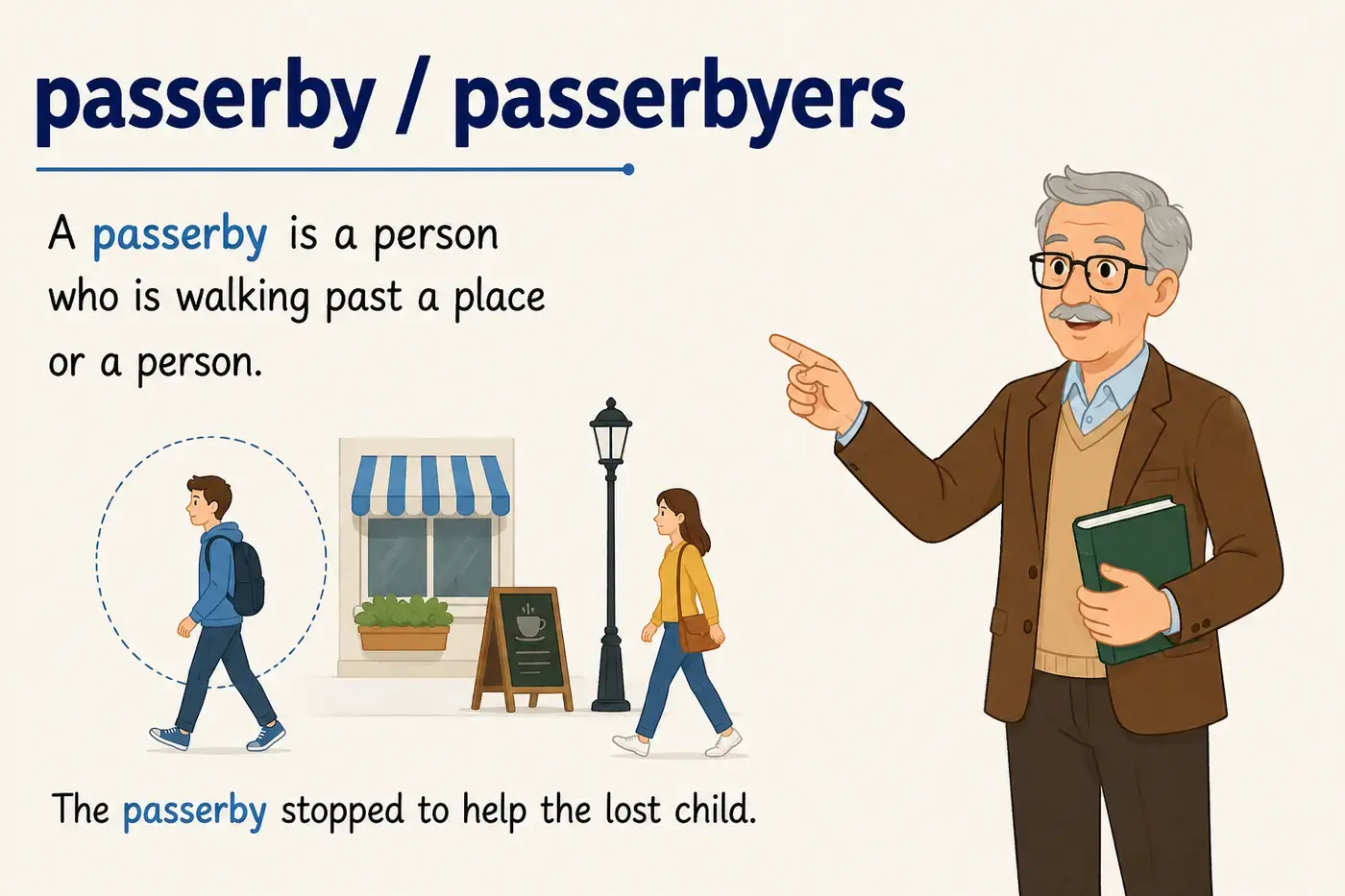
Many English learners get confused about passerby or passerbyers. Both words may look possible, but only one follows standard English rules. This mistake is common because many English words add s or ers to make a plural. That is not what happens here.
If you have ever wondered about both words, you are in the right place. This guide explains everything in very simple English. By the end, you will know which form is correct, why people make this mistake, and how to use the right word with confidence.
You will also see easy examples, simple tips, and a clear explanation that feels like a classroom lesson. No confusing grammar terms. Just plain English that anyone can understand.
Still confused? Compare Feel Or Feal: Which One Is Correct and Easy to Remember.
Simple Answer in One Look
Passerby is the singular form.
Passersby is the correct plural form.
Passerbyers is not a correct English word.
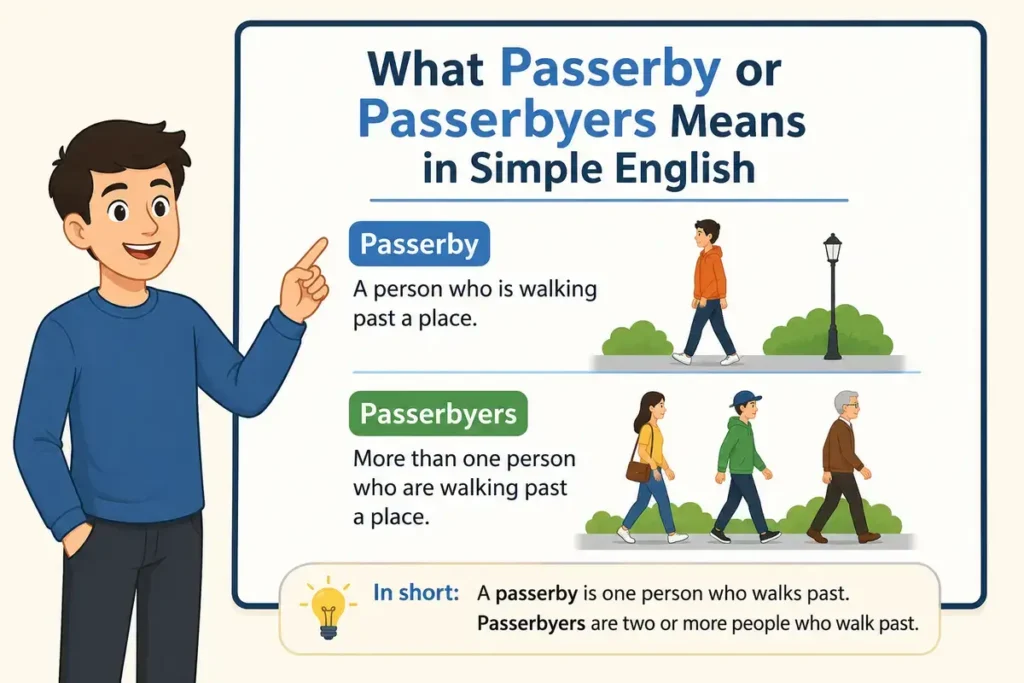
What Passerby or Passerbyers Means in Simple English
A passerby is a person who is walking past a place. The person is not stopping for long. They simply pass by. For example:
- A passerby helped the lost child.
- One passerby called the police.
- A friendly passerby smiled at us.
Think about someone walking down the street. They notice something, then keep walking. That person is a passerby. If there is more than one person, the word changes.
You do not say passerbyers.
You say passersby.
For example:
- Several passersby watched the parade.
- Many passersby stopped to listen to the music.
- The accident was seen by dozens of passersby.
The word may look unusual because English has a few special words that do not make plurals in the normal way.
Why People Mix These Words Passerby or Passerbyers
Many people write passerbyers because they follow a pattern that works with many other English words. Look at these examples.
- Teacher → Teachers
- Player → Players
- Runner → Runners
- Driver → Drivers
After seeing these words, it feels natural to think:
- Passerby → Passerbyers
But English does not work that way here.
The word passerby is actually made of two parts.
- Passer
- By
The main noun is passer.
The word by only tells how the person is moving.
Because of this, the plural changes the first part.
That gives us:
- Passer → Passers
- By stays the same.
So the correct plural becomes:
Passersby
This pattern surprises many learners because it is different from most everyday words. Another reason people get confused is that they rarely hear this word in daily conversation. Many people simply say:
- People walking by
- People passing by
- Someone passing by
Since passerby is less common, learners often guess the plural instead of learning it.
That guess leads to passerbyers, which is incorrect.
Clear Difference Explained Simply
Here is the easiest way to remember the difference.
| Word | Correct? | Meaning |
|---|---|---|
| Passerby | ✅ Yes | One person passing by |
| Passersby | ✅ Yes | More than one person passing by |
| Passerbyers | ❌ No | Not a real English word |
Another easy comparison:
Singular
- One passerby saw the fire.
Plural
- Several passersby saw the fire.
Wrong
- Several passerbyers saw the fire.
Remember this simple rule.
The s goes on passer, not on by.
Think of it like this.
Passer is the person.
By is only part of the expression.
So only the main noun changes.
Quick Memory Trick
Imagine five people walking past your house.
They are all passers.
They are passing by.
So together they become:
Passersby
Not passerbyers.
Which Form Should You Use?
The answer is simple.
Use passerby when talking about one person. Examples:
- One passerby offered help.
- A passerby found my wallet.
- The passerby smiled at us.
Use passersby when talking about more than one person. Examples:
- Several passersby stopped.
- Many passersby watched the show.
- Hundreds of passersby filled the street.
Never use passerbyers.
You may see it on social media or in casual writing because people make mistakes. That does not make it correct. Standard English dictionaries and style guides use only:
- Passerby
- Passersby
These are the forms you should use in school, work, writing, and everyday English.
Easy Real Life Sentences You Can Use for Passerby or Passerbyers
Here are simple examples you can copy into your own speaking and writing.
- A passerby helped the old man cross the road.
- One passerby found my lost phone.
- The passerby waved at us.
- Several passersby stopped to watch the street performer.
- Many passersby enjoyed the music.
- Two passersby called for help after the accident.
- Friendly passersby smiled at the children.
- The police spoke with nearby passersby.
Notice something.
Every sentence uses either passerby or passersby.
None of them use passerbyers because that word is not correct.
Conversation Examples
Sarah: Who found the wallet?
Mike: A passerby found it.
Anna: Did anyone see the accident?
David: Yes. Several passersby saw everything.
Teacher: Is “passerbyers” correct?
Student: No. The correct plural is “passersby.”
Practicing small conversations like these helps you remember the right form naturally.
Where These Words Expression Comes From Simple History
The word passerby has been part of English for a long time. It comes from the idea of someone who passes by a place. Long ago, English speakers often joined two words together to create new words. Someone who passed by became a passerby. Over time, this became a standard English word. The plural also followed an older English pattern. Instead of changing the last word, English changed the main noun. That is why we say:
- Passerby
- Passersby
The same pattern appears in a few other English words. For example:
- Mother in law → Mothers in law
- Attorney general → Attorneys general
These words may seem strange at first. But once you know the pattern, they become much easier to remember. English keeps many older word forms because people have used them for hundreds of years. That is why passersby remains the correct plural instead of the newer sounding passerbyers.
As you keep learning English, you will find that some words follow regular rules while a few keep older patterns. Knowing the reason behind them makes these words much easier to remember. In the next section, we will go deeper into how passerby is used in culture, books, everyday life, common mistakes, memory tricks, and expert tips so you can use it naturally with confidence.
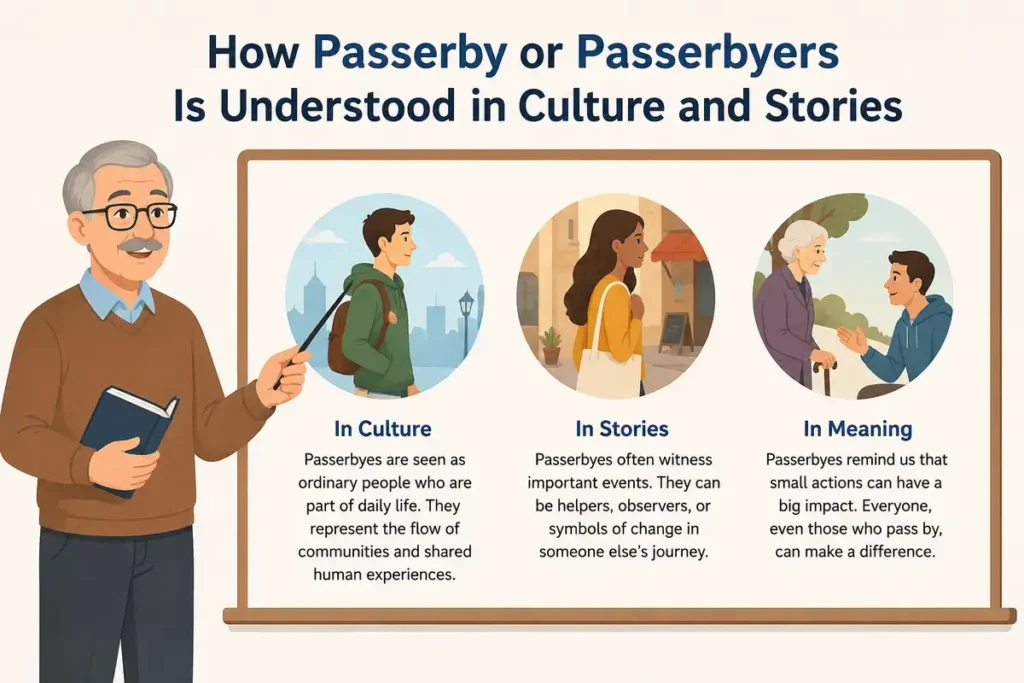
How Passerby or Passerbyers Is Understood in Culture and Stories
The word passerby often appears in stories, movies, news reports, and real life. It describes someone who is nearby but is not part of the main event. A passerby may notice something important, help someone in need, or simply keep walking. Many stories begin because a passerby sees something unusual. For example:
- A passerby finds a lost puppy.
- A passerby hears someone calling for help.
- A passerby discovers a missing wallet.
- A passerby reports a fire.
These small actions can change a story completely. In books and movies, a passerby often represents an ordinary person. They are not a hero at first. Still, they sometimes become important because they choose to help. That teaches a simple lesson. Anyone can make a difference. Even someone who is just passing by can help another person. In everyday culture, people also respect kind passersby. News stories often say things like:
“Several passersby helped after the accident.”
This reminds us that strangers can show kindness, courage, and care. The word itself does not describe someone’s job, age, or background. It only tells us that the person happened to be passing that place. That is why the word is common in newspapers, safety reports, police reports, and community stories.
Many readers also check Distress vs Duress: Meaning and Real-Life Examples.
Biblical and Mythological Meaning
The Bible does not use the modern English word passerby exactly as we use it today. However, many Bible stories talk about people passing by. One famous example is the story of the Good Samaritan. Several people passed by someone who needed help. Some ignored him. One person stopped and helped. The lesson is simple. Do not ignore people who need kindness. Help when you can.
That idea is still connected with the word passerby today. In mythology, there is no special meaning for the word itself. Many old stories simply include travelers or strangers who pass through towns and villages. Sometimes these visitors bring good news. Sometimes they teach an important lesson. The word itself has no religious meaning. Its meaning depends on the story where it is used.
Symbolism Explained in Simple Words
What Passerby Represents
A passerby often represents:
- An ordinary person.
- A stranger.
- A witness.
- A chance meeting.
- Someone who can choose kindness.
- Someone who notices something important.
A passerby reminds us that even small actions matter.
Helping someone for just a few minutes can change their whole day.
What Passerbyers Represents
The word passerbyers does not represent anything because it is not a correct English word. People sometimes create it because they think every plural should end with ers or s. Standard English does not recognize this form.
Instead, the correct plural is:
Passersby
Remember this simple comparison.
| Word | Meaning |
|---|---|
| Passerby | One person passing by |
| Passersby | More than one person passing by |
| Passerbyers | Incorrect English |
Related Words You Should Know
Learning related words makes English easier.
Passing by
Moving past a place without stopping. Example:
“We were just passing by.”
Stranger
A person you do not know. Example:
“A stranger helped me.”
Witness
Someone who sees an event happen. Example:
“The witness spoke to the police.”
Pedestrian
A person walking on a road or sidewalk. Example:
“The pedestrian crossed safely.”
Traveler
Someone going from one place to another. Example:
“The traveler asked for directions.”
Visitor
A person who comes to a place for a short time. Example:
“The visitor enjoyed the museum.”
Onlooker
Someone watching an event. Example:
“Many onlookers watched the parade.”
Bystander
Someone standing nearby who sees something happen. Example:
“A bystander called for help.”
These words are similar, but each has a slightly different meaning.
How People Actually Use Passerby or Passerbyers in Daily English
People almost always use passerby or passersby in situations involving streets, parks, stores, schools, or public places. Here are real examples.
- A passerby returned my lost wallet.
- Several passersby watched the fireworks.
- One passerby helped carry the heavy box.
- The police asked nearby passersby what they saw.
- Many passersby stopped to take pictures.
- A friendly passerby gave us directions.
- Passersby enjoyed listening to the street musician.
- A passerby found the missing dog.
- Several passersby helped clean the park after the event.
- The little girl smiled at every passerby.
Notice something important. Native English speakers never say:
“Several passerbyers…”
Instead they say:
“Several passersby…”
That is the correct form in speaking and writing.
Common Mistakes People Make
This word causes a few common mistakes.
Mistake 1
Incorrect:
There were many passerbyers.
Correct:
There were many passersby.
Mistake 2
Incorrect:
A passersby helped me.
Correct:
A passerby helped me.
Remember:
One person equals passerby.
Many people equal passersby.
Mistake 3
Incorrect:
The passerby’s were watching.
Correct:
The passersby were watching.
Do not add an apostrophe just to make a plural.
Mistake 4
Incorrect:
The passersbys stopped.
Correct:
The passersby stopped.
Do not put an extra s after by.
Mistake 5
Incorrect:
Passerbyers called the police.
Correct:
Passersby called the police.
Always remember that the plural changes the first part of the word.
Easy Memory Tip
Think about this sentence:
“The passers walked by.”
Now join the words together.
Passers + by
Passersby
That simple trick helps many students remember the correct plural.
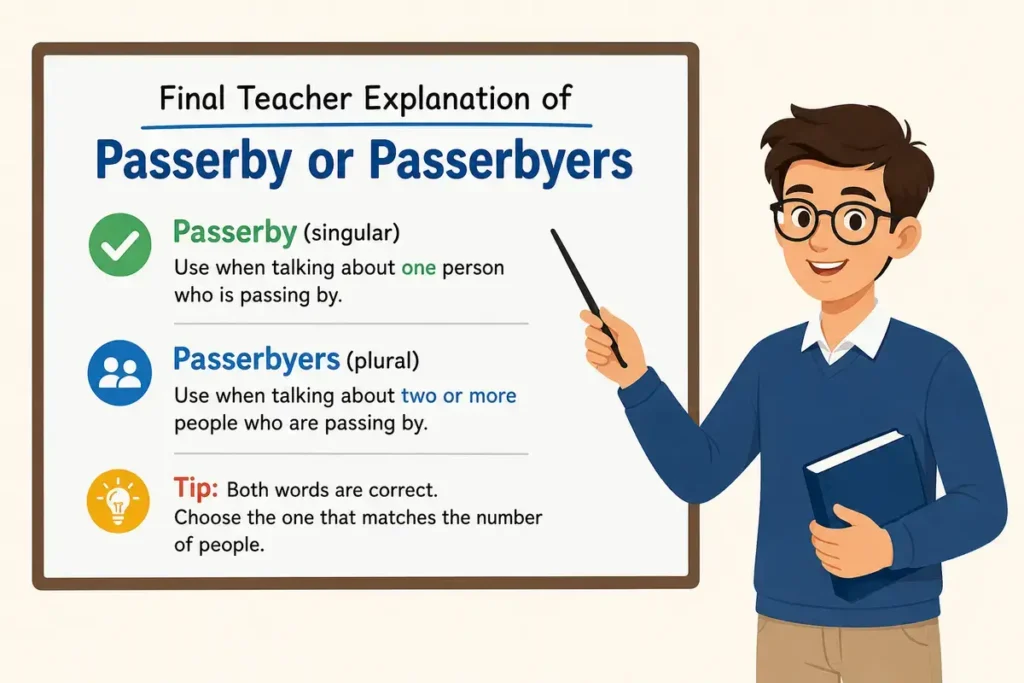
Final Teacher Explanation of Passerby or Passerbyers
Imagine we are finishing today’s English class. A student asks, “Teacher, should I write?” My answer is simple.
Never write passerbyers.
It is not a standard English word. If you are talking about one person, write:
Passerby
If you are talking about more than one person, write:
Passersby
This word is different because English changes the main noun instead of the last part. You do not need to memorize difficult grammar rules. Just remember one easy pattern.
One person.
Passerby.
Many people.
Passersby.
Practice saying these two words a few times. Soon they will sound completely natural. Whenever you read newspapers, books, or good English websites, you will notice that professional writers always use these correct forms. The more you read them, the easier they become.
Final Answer About Passerby or Passerbyers
If you are choosing between words the correct choice is easy.
Use passerby for one person.
Use passersby for more than one person.
Never use passerbyers because it is not correct English.
Remember this simple rule, and you will always use the word correctly.
Need another quick comparison? Read Bailer or Baler: Difference Explained Simply 2026 Guide.
Conclusion
Many learners wonder about words, but the answer is simple once you know the pattern. A passerby is one person who is passing by, while passersby is the correct plural form. The word passerbyers is not standard English and should be avoided. By remembering this easy rule and practicing with real examples, you can use these words naturally and confidently in both speaking and writing.
Frequently Asked Questions
What does passerby mean in simple words?
A passerby is a person who is walking past a place without staying there.
Is passerbyers a real English word?
No. Passerbyers is not a correct English word. The correct plural is passersby.
Which is correct, passerby or passersby?
Both are correct. Passerby is singular, and passersby is plural.
Why do people say passerbyers?
People think the word follows a normal plural pattern, but this word has a special plural form.
Can I use passerby in formal writing?
Yes. Passerby is correct in school writing, business writing, newspapers, and books.
What is the plural of passerby?
The correct plural is passersby.
Is passersby used in everyday English?
Yes. Native English speakers use passersby in news reports, conversations, and everyday writing.
How can I remember the correct plural?
Think of the phrase “passers by.” Then combine the words into one: passersby.
