

Many people get confused about busyness vs business because the two words look almost the same. They both come from the word busy, but they do not mean the same thing. One word talks about being occupied with many tasks, while the other usually means work, trade, or a company.
If you have ever wondered which spelling is correct, you are not alone. This guide explains in very simple English. By the end, you will know what each word means, when to use it, and how to avoid this common mistake.
Many English learners and even native speakers mix these words because they sound similar. A small spelling change creates a completely different meaning. Once you understand the difference, choosing the correct word becomes easy.
Still confused? Compare Any Time vs Anytime: Which Is Correct and How to Use (2026).
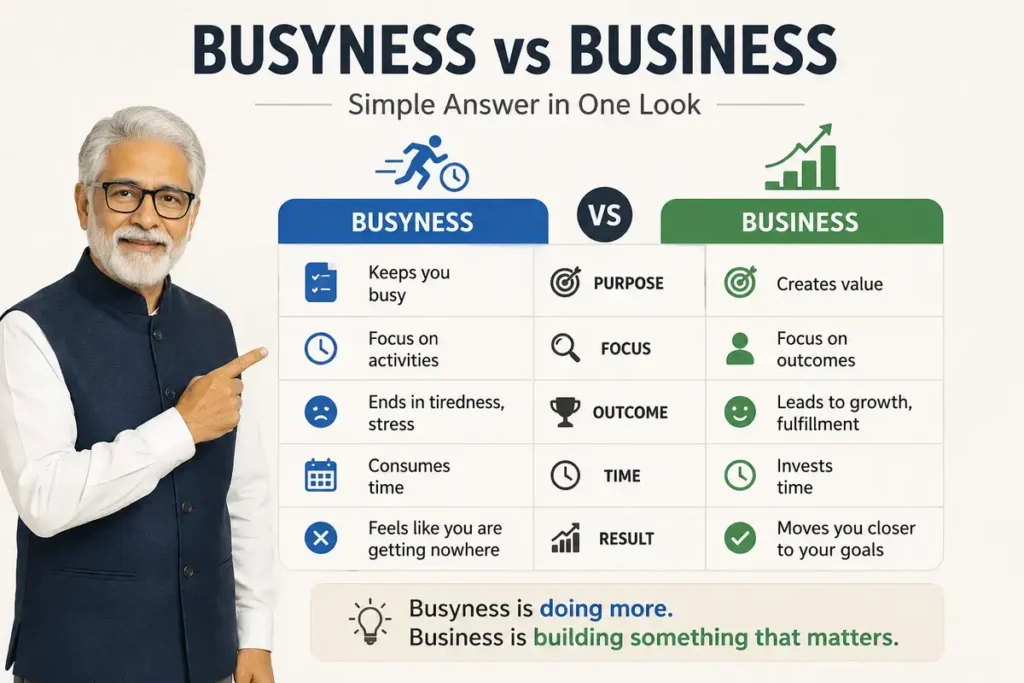
Simple Answer in One Look About Busyness vs Business
Business is the word you will use most of the time. It means work, trade, a company, or something that concerns someone.
Busyness means the state of being busy. It describes having many things to do.
Quick tip: If you are talking about work or a company, use business. If you are talking about having a full schedule, use busyness.
What Does Busyness and Business Mean in Simple English?
Understanding these words is much easier when you look at them one at a time.
What Does Busyness Mean?
Busyness means being busy. It describes a time when someone has many jobs, activities, or responsibilities. Think about a student during final exams. The student has homework, projects, and tests every day. That is busyness. Examples:
- Her busyness kept her from watching TV.
- The holiday season brought a lot of busyness.
- I enjoy the busyness of city life.
Notice that busyness talks about the condition of being busy. It does not mean a company or work in general.
What Does Business Mean?
Business has several common meanings. It can mean:
- A company.
- Buying and selling goods or services.
- Work or a job.
- Something that concerns a person.
Examples:
- She owns a small business.
- My father travels for business.
- That is none of your business.
- The restaurant is a family business.
This word is much more common than busyness in everyday English.
Why People Mix Busyness or Business
Many people confuse these words because they have almost the same spelling. Here are the biggest reasons.
Both Start with the Same Word
Both words come from busy.
Because they begin with the same letters, many people think they have similar meanings.
They Sound Similar
When people speak quickly, the words may sound alike, especially for English learners.
One Word Is Much More Common
You see business everywhere.
You see business schools.
Since business appears so often, some people accidentally use it when they really mean busyness.
The Spellings Are Tricky
Look carefully.
- Busy → Busyness
- Busy → Business
The endings are different.
One ends with -ness.
The other ends with -ness only in sound, not in spelling.
That small difference causes many spelling mistakes.
Clear Difference Explained Simply
Here is an easy comparison.
| Busyness | Business |
|---|---|
| Means being busy | Means work, trade, or a company |
| Describes a condition | Describes work or commercial activity |
| Less common | Very common |
| Comes from busy + ness | Developed into its own word over time |
| Talks about having many tasks | Talks about jobs, companies, or work |
You can also remember it this way.
Busyness = being busy.
Business = work or company.
That simple idea will help you choose the right word most of the time.
Busyness vs Business in Daily Life
Imagine two friends talking.
Friend A says:
“I couldn’t answer your call because of my busyness.”
Friend B says:
“I was traveling for business.”
The first friend talks about having too many things to do.
The second friend talks about work. The meanings are completely different.
Busyness vs Business With Easy Memory Trick
Ask yourself one question.
Am I talking about work or a company?
If yes, use business.
If not, ask another question.
Am I talking about being very busy?
If yes, use busyness.
This simple trick works in most situations.
Which Form Should You Use in Busyness or Business?
Most of the time, you should use business because it is much more common.
Use business when you mean:
- Work.
- A company.
- Trade.
- Your job.
- Something that concerns someone.
Examples:
- He started a new business.
- She has business experience.
- They discussed business plans.
- Mind your own business.
Use busyness when you mean:
- Having a lot to do.
- A busy schedule.
- Constant activity.
Examples:
- The busyness of the office was exciting.
- I enjoy the busyness before the holidays.
- Her busyness made her tired.
Can You Replace One with the Other?
No. These words are not interchangeable.
Incorrect:
The business of raising three children keeps her tired.
Correct:
The busyness of raising three children keeps her tired.
Incorrect:
He owns a successful busyness.
Correct:
He owns a successful business.
Changing the word changes the meaning.
Easy Real-Life Sentences You Can Use With Busyness and Business
Here are simple examples you can copy into your own speaking and writing.
- The busyness of school makes me tired.
- Our family owns a small business.
- I enjoy the busyness of the city.
- She traveled for business last week.
- The morning busyness ended before lunch.
- His business is growing every year.
- My busyness kept me away from social media.
- They opened a new business downtown.
Practice reading these sentences aloud. Hearing the words in context makes them easier to remember.
Where Does Busyness vs Business Come From? Simple History
Both words began with the adjective busy, but they followed different paths.
Where Busyness Came From
The word busyness was created by adding -ness to busy. The ending -ness often turns an describing word into a noun. For example:
- Kind → Kindness
- Happy → Happiness
- Dark → Darkness
- Busy → Busyness
So busyness simply means “the state of being busy.”
Where Business Came From
The history of business is a little different. Long ago, the word developed from the idea of being busy with work or important tasks. Over many years, its meaning changed. Instead of simply meaning “being busy,” it came to mean work, trade, occupation, and commercial activity. That is why business now has its own meaning and is much more common than busyness.
Although the two words share the same root, they are no longer used in the same way. A person may have a lot of busyness, but that does not mean they own a business. Likewise, someone can own a successful business without feeling much busyness if they have a good team helping them.
As you continue reading, you will see how is used in culture, writing, everyday conversations, and common English expressions. You will also learn easy memory tricks, common mistakes, and practical tips that make choosing the correct word feel natural.
How Busyness vs Business Is Understood in Culture and Stories
The difference between is not just about spelling. These words also carry different ideas in everyday life and in many stories. People often talk about busyness when life feels full of activities. A busy parent, a student during exam week, or a worker with many tasks may all experience busyness. It can be exciting, but it can also be tiring.
Business is usually connected with work, money, jobs, and helping customers. In stories, the business owner is often shown as someone who works hard to build something valuable. Many books and movies show characters who struggle to balance both. For example:
- A shop owner may have a successful business.
- At the same time, the busyness of running that business may leave little free time.
This shows that the two words are connected, but they are never the same. In everyday culture, people also remind each other that staying busy is not always the same as making progress. Someone may have a lot of busyness but still not finish the most important work. That is why many teachers and leaders encourage people to focus on meaningful work instead of staying busy all the time.
Need another quick comparison? Read Time Slot vs Timeslot: Easy Guide With Simple Examples (2026).
Biblical and Mythological Meaning of Busyness and Business
The Bible does not use the modern word busyness very often, but it often talks about people becoming too busy with daily life. Many Bible stories teach the importance of making time for faith, family, and kindness instead of becoming lost in endless work.
One well-known example is the story of Martha and Mary. Martha spent much of her time working and serving guests, while Mary sat and listened to Jesus. The story reminds readers that life is about more than constant activity. This does not mean work is wrong.
The Bible also speaks positively about honest business, fair trade, and hard work. People are encouraged to work honestly, treat others fairly, and avoid cheating. There is no special mythological meaning for either word. In myths from different cultures, traders, shopkeepers, and workers often appear, but the words themselves are modern English words rather than mythological symbols. So, the simple lesson is this:
- Busyness reminds us not to let activity control our lives.
- Business reminds us to work honestly and responsibly.
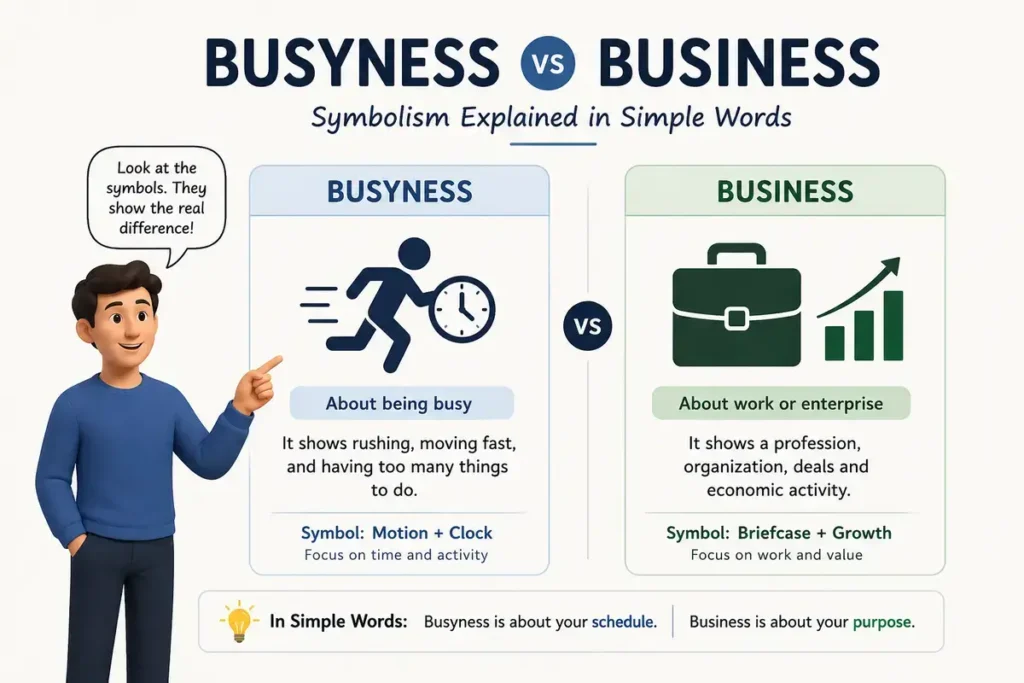
Symbolism Explained in Simple Words
What Busyness Represents
When people hear busyness, they often think about:
- A full schedule.
- Constant movement.
- Hard work.
- Responsibility.
- Little free time.
- Stress if life becomes too crowded.
Sometimes busyness feels positive because it means you have goals and important things to do. Other times it reminds people to slow down and rest.
What Business Represents
Business often represents:
- Work.
- Opportunity.
- Success.
- Building something valuable.
- Helping customers.
- Earning money.
- Responsibility.
Many people dream of starting their own business because it represents independence and growth. So the emotional meaning is different.
- Busyness is about activity.
- Business is about work or trade.
Remember this simple sentence:
You can have a successful business without constant busyness, and you can have endless busyness without owning a business.
Related Words You Should Know About Busyness or Business
Learning related words makes the difference between words even easier.
Busy
Having many things to do. Example:
“I am busy this afternoon.”
Occupied
Already doing something. Example:
“She is occupied with homework.”
Activity
Something people are doing. Example:
“The park is full of activity.”
Work
Tasks you do for your job or school. Example:
“I have a lot of work today.”
Company
A business that sells products or services. Example:
“He works for a large company.”
Trade
Buying and selling goods or services. Example:
“International trade helps many countries.”
Occupation
A person’s job.
Example: “Teaching is her occupation.”
Career
Your long-term working life.
Example:
“He wants a career in medicine.”
Enterprise
A business project or company.
Example:
“The new enterprise created many jobs.”
Productivity
Getting useful work done. Example:
“Good planning improves productivity.”
These words appear often when people talk about work, jobs, and daily life.
How People Actually Use Busyness and Business in Daily English
Native English speakers use these words in different situations. Here are common examples.
- “The holiday busyness starts every November.”
- “She owns a small family business.”
- “Business has been slow this month.”
- “The busyness of moving to a new house made everyone tired.”
- “I’m traveling for business next week.”
- “The office is full of busyness before the meeting.”
- “Mind your own business.”
- “His online business is growing quickly.”
- “The morning busyness disappeared after lunch.”
- “Running a business takes patience.”
Notice something interesting. You probably hear business every day.You hear busyness much less often because people often say:
- I’m busy.
- Life is busy.
- Things are busy.
Instead of using the noun busyness. That is perfectly normal in modern English.
Common Mistakes People Make With Busyness or Business
Many learners make the same mistakes. Here are the most common ones.
Mistake 1: Using Business When Talking About Being Busy
Incorrect:
“The business of school makes me tired.”
Correct:
“The busyness of school makes me tired.”
Mistake 2: Using Busyness for a Company
Incorrect:
“My father owns a busyness.”
Correct:
“My father owns a business.”
Mistake 3: Thinking the Words Mean the Same Thing
They do not.
Busyness means the condition of being busy.
Business means work, trade, or a company.
Mistake 4: Misspelling Business
Many people spell it like this:
- buisness
- bussiness
- busines
The correct spelling is always:
business
Mistake 5: Using Busyness Too Often
Even though busyness is a real word, native speakers usually say:
- Life is busy.
- I’ve been busy.
- Things are busy.
Instead of saying:
“My busyness…”
Knowing this helps your English sound more natural.
Final Teacher Explanation About Busyness vs Business
Think of these words as two different boxes. The first box is called busyness. Everything inside that box is about having many things to do. It describes your schedule, your activities, and your daily life.
The second box is called business. Everything inside that box is about work, companies, jobs, trade, and earning money. Even though both words started with busy, they have different meanings today. Here is the easiest rule to remember. Ask yourself one question. Am I talking about work, a company, or trade? If the answer is yes, use business.
If not, ask another question. Am I talking about having a very full schedule? If yes, use busyness. This simple trick will help you choose the correct word almost every time. The more you read and hear these words in real conversations, the easier they become.
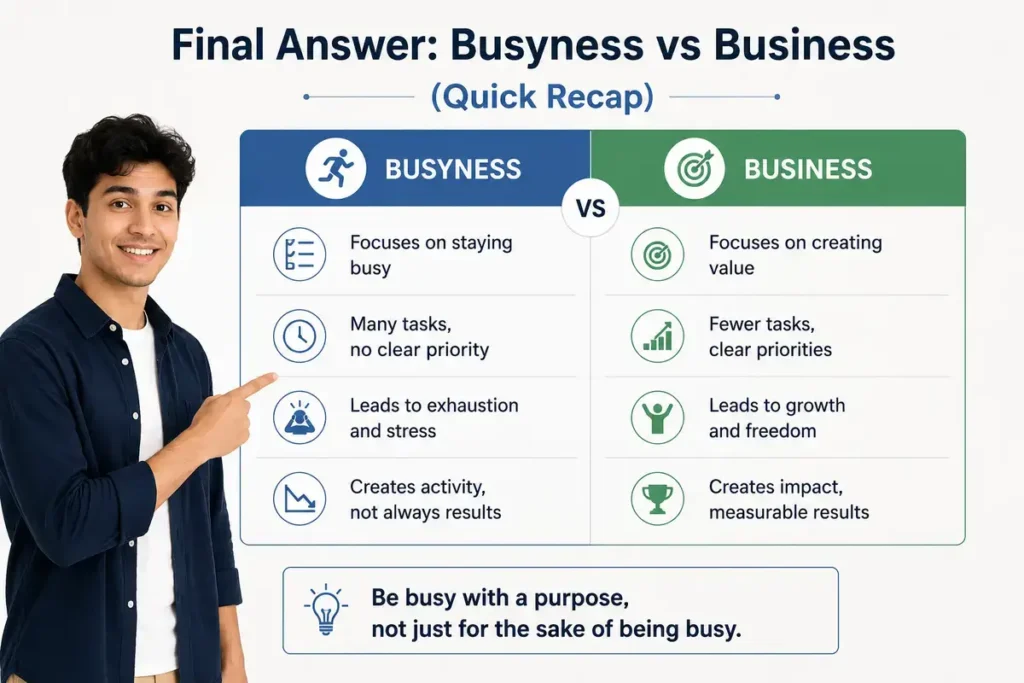
Final Answer About Busyness vs Business (Quick Recap)
The difference between words are simple.
Busyness means the state of being busy and having many things to do.
Business means work, trade, a company, or something that concerns someone.
Busyness = being busy. Business = work or company.
Need another quick comparison? Read Passerby or Passerbyers Which Word Is Correct (Guide 2026).
Conclusion
Understanding busyness vs business becomes easy once you know what each word represents. Although they share the same root word, they serve different purposes in English. Busyness describes the state of having many tasks or activities, while business refers to work, trade, a company, or something that concerns someone. Whenever you write or speak, ask yourself if you are talking about a busy schedule or about work. That one question will help you choose the correct word with confidence every time.
Frequently Asked Questions (FAQs)
What does busyness mean in simple words?
It means being busy or having many things to do.
What does business mean?
It usually means work, trade, a company, or someone’s job.
Which is correct: busyness or business?
Both are correct, but they have different meanings. Choose the one that matches your sentence.
Why do people confuse?
They look similar, sound similar, and both come from the word busy.
Can I use busyness and business in the same sentence?
Yes. For example: “The busyness of running a business can be exhausting.”
Is busyness a real English word?
Yes. It is a correct noun that means the state of being busy.
Which word is more common?
Business is much more common in everyday English than busyness.
How can I remember the difference?
Remember this simple trick: Busyness is about being busy. Business is about work, trade, or a company.
