
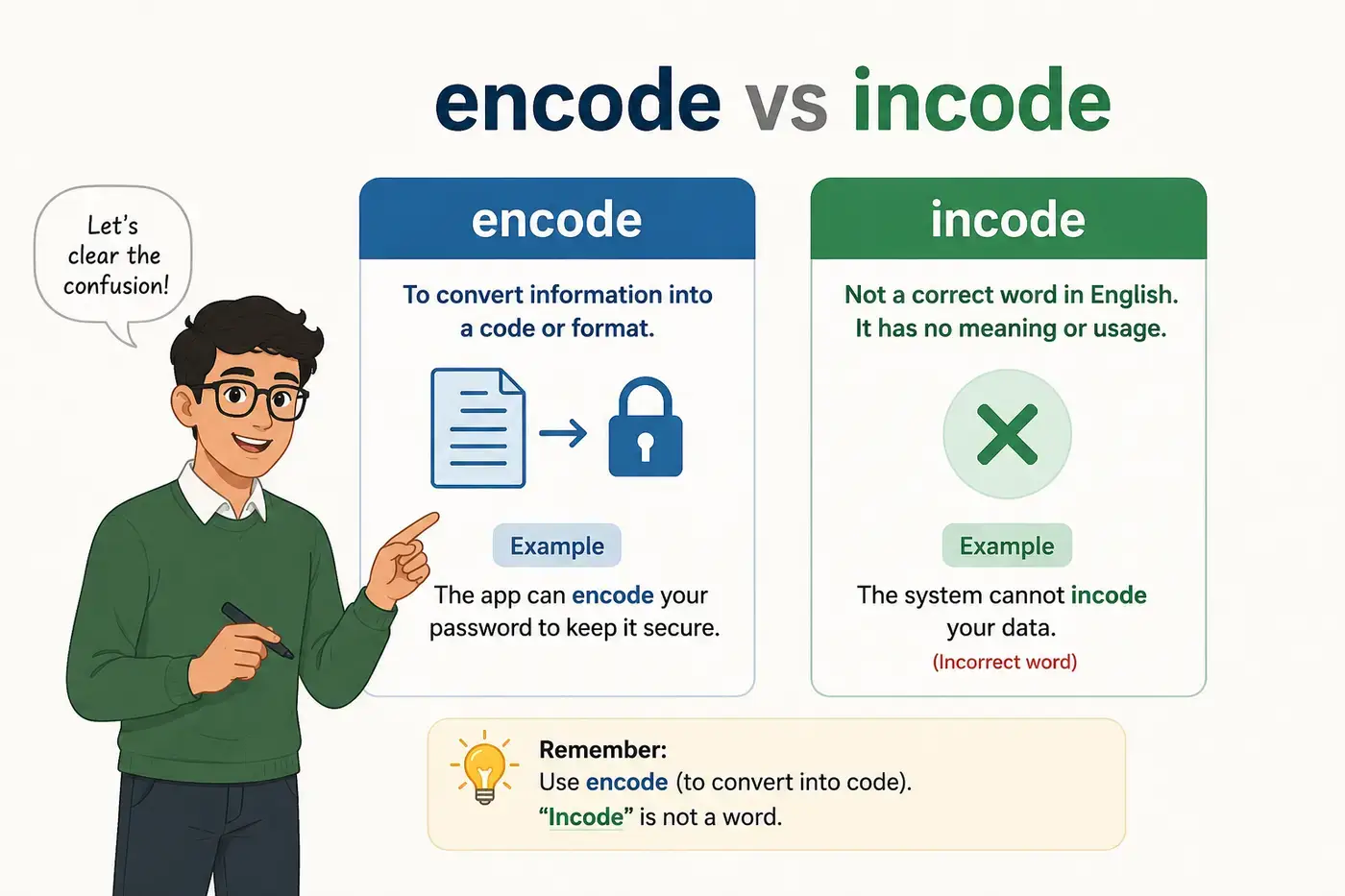
Many English learners become confused about encode vs incode because both words look very similar. One appears in books, websites, and dictionaries, while the other sometimes appears online by mistake. If you are wondering which one is correct, the short answer is simple: encode is the correct English word, while incode is not accepted in standard English.
This guide explains in very simple English. You will learn what each word means, why people confuse them, when to use the correct spelling, and how to avoid this common mistake. By the end, you will feel confident using encode in everyday writing and speaking.
Whether you are a student, writer, programmer, or someone learning English, this lesson will help you understand the difference in a clear and easy way.
A related grammar guide is Dutchess vs Duchess: What Is the Difference?.
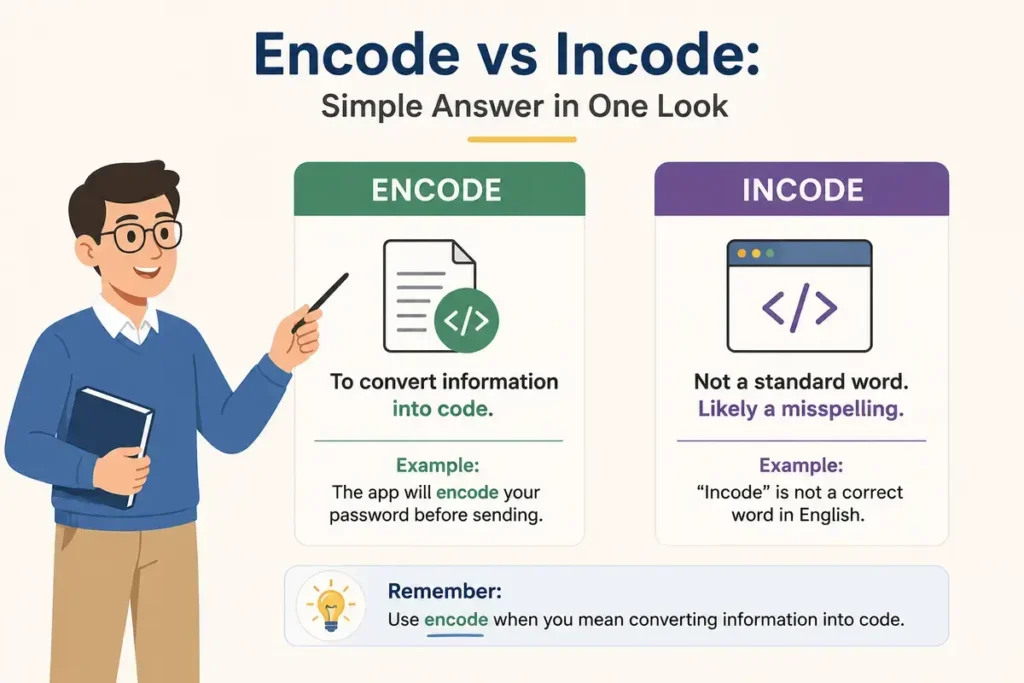
Encode vs Incode: Simple Answer in One Look
Encode is the correct English word.
Incode is not a standard English word and should not replace encode.
What Encode vs Incode Means in Simple English
Think about sending a secret message to a friend. Before you send it, you change the message into a special form so only the right person can understand it. This action is called encoding. The word encode means to change information into another form or code.
People also use encode when talking about computers, videos, music files, and digital information. A computer can encode data so another program can read or store it. The word incode does not have this meaning in standard English. It is usually a spelling mistake.
Simple meaning of encode
Encode means to change something into a code or another form so it can be stored, sent, or understood by a system.
Easy examples
- Please encode the file before sending it.
- The app can encode videos quickly.
- Scientists encode information in different ways.
- Computers encode data every day.
In all of these examples, encode is the correct word.
Why People Mix These Words
Many people write incode because the two words sound similar. Here are the most common reasons for the confusion.
The beginning sounds alike
The first sound in encode can be hard to hear clearly. Some learners think they hear “in” instead of “en.”
Fast typing
Sometimes people type quickly and accidentally write incode instead of encode.
Auto-correct mistakes
Some phones or keyboards may not catch the mistake, especially if another language is being used.
Learning English as a second language
English spelling is not always easy. Many words have similar sounds but different spellings.
Seeing the mistake online
A spelling mistake can spread when people copy it from websites, comments, or social media.
Encode vs Incode: Clear Difference Explained Simply
Here is the easiest way to remember the difference.
Encode
- Correct English word
- Found in dictionaries
- Used in writing and speaking
- Used in technology, science, communication, and everyday English
- Means to change information into another form
Incode
- Not a standard English word
- Usually a spelling mistake
- Should not replace encode
- Not accepted in formal writing
Quick comparison
| Word | Correct? | Meaning |
|---|---|---|
| Encode | ✅ Yes | Change information into a code or another form |
| Incode | ❌ No | Not a standard English word |
A simple memory trick is this:
Think of “encode” as entering a code. Both begin with “en.”
Which Form Should You Use?
Always choose encode when you want to talk about changing information into another form.
Use encode in:
- School writing
- Emails
- Computer programming
- Technology articles
- Research papers
- Everyday English
Do not replace it with incode.
Easy rule
If you are talking about data, messages, videos, sounds, files, or information changing into another format, the correct word is encode.
Easy Real-Life Sentences You Can Use for Encode vs Incode
These simple examples show the correct way to use encode.
- Please encode this file before you upload it.
- The program can encode videos in a few minutes.
- We need to encode the message for safety.
- My computer will encode the music automatically.
- The teacher explained how to encode information.
- The phone can encode the picture before sharing it.
- Engineers encode data every day.
- I learned how to encode a simple message.
Notice that none of these sentences use incode because it is not the correct English word.
Where Encode vs Incode Words Comes From (Simple History)
The word encode has been used in English for many years. It is built from two parts.
- En- means “put into” or “make.”
- Code means a system of symbols, numbers, or letters that carry information.
When these two parts come together, encode means to put something into a coded form. As computers became common, the word became even more popular. Today, people use it in technology, science, medicine, communication, and many other fields. The spelling incode did not become a standard English word. It is mostly seen as a typing or spelling error.
Common Questions About Encode vs Incode
Is “incode” a real English word?
No.
In standard English, incode is not accepted as the correct spelling for the meaning “change into code.”
Which word should I use in school?
Always use encode.
Teachers, dictionaries, and grammar guides recognize encode.
Can I use “incode” in formal writing?
No.
Formal writing should always use encode.
Why do I sometimes see “incode” online?
Most of the time, it is simply a spelling mistake made by writers or users typing quickly.
Common Mistakes to Avoid
Many learners make small mistakes when writing about coding or data. Avoid these examples.
❌ Please incode the file.
✅ Please encode the file.
❌ The software incodes the video.
✅ The software encodes the video.
❌ We need an incoded message.
✅ We need an encoded message.
Notice that encoded is also built from the correct word encode.
Simple Memory Trick
Remember this sentence:
Encode enters information into a code.
Both encode and enter begin with en.
This small trick helps many students remember the correct spelling. Another easy trick is this: If you can find the word in a good English dictionary, it is probably correct. You will find encode, but not incode with the same meaning.
Everyday Situations Where You Hear “Encode”
The word encode appears in many places. You may hear it when people talk about:
- Computers
- Phone apps
- Video editing
- Audio files
- QR codes
- Secret messages
- Online security
- Digital storage
In all of these situations, encode is the correct word.
Learn the difference in Finaly or Finally: Which Spelling Is Correct?.
Quick Summary
Here is everything in one place.
- Encode is the correct English word.
- It means to change information into a code or another form.
- Incode is not standard English.
- Most uses of incode are spelling mistakes.
- Use encode in school, work, technology, and everyday writing.
- Remember: Encode enters information into a code.
Transition to the Next Section
Now that you understand the basic difference between encode vs incode, the next section will explain the deeper meaning, everyday uses, cultural ideas, related words, common learning mistakes, and other helpful tips that make this word even easier to remember and use correctly.
Encode vs Incode: How This Word Is Understood in Culture and Stories
The words we use often tell us something about the world around us. When people compare words only one of these words has a real place in English.
The word encode is connected with communication, learning, and technology. People use it when talking about changing information into another form so it can be stored, shared, or understood. Today, you can hear this word in schools, offices, computer labs, and even at home. Many people think of encode when they hear about:
- Computers saving files
- Secret messages
- QR codes
- Online security
- Video and audio files
- Mobile apps
- Computer programming
As technology has become part of daily life, the word encode has become more common. The spelling incode does not have the same cultural meaning because it is not a standard English word. Most people simply see it as a typing or spelling mistake. If you use encode, your writing looks clear and correct. If you use incode, readers may think you made an error.
Biblical and Mythological Meaning of Encode vs Incode
The word encode does not appear in the Bible because it is a modern English word. It became popular many years after the Bible was written. Still, the idea behind the word has existed for a very long time.
In the Bible, people sometimes received messages through dreams, symbols, visions, or special writings. These messages were not called “encoded,” but they often needed careful understanding. In many myths and ancient stories, people also used:
- Secret signs
- Hidden symbols
- Special messages
- Magical writings
- Ancient codes
These stories show that people have always wanted ways to protect or hide important information. The word incode has no known biblical meaning or mythological meaning. So, when writing or speaking English, always choose encode.
Symbolism Explained in Simple Words
Encode vs Incode: What Encode Represents
The word encode often stands for:
- Knowledge
- Learning
- Clear communication
- Technology
- Security
- Smart thinking
- Sharing information safely
When people hear encode, they often think about changing information carefully so it can be understood later. It is a word connected with order, planning, and communication.
Encode vs Incode: What Incode Represents
The spelling incode does not have its own symbolic meaning. Instead, people usually connect it with:
- A spelling mistake
- A typing error
- Confusion while learning English
- Mixing up similar-looking words
That is why teachers and editors always recommend using encode instead. In simple words:
- Encode represents correct communication.
- Incode represents a common spelling mistake.
Related Words You Should Know about Encode vs Incode
Learning similar words helps you remember the correct spelling.
Code
A system of letters, numbers, or symbols used to share information.
Example: We solved the secret code.
Decode
To change coded information back into normal language.
Example: The computer can decode the message.
Encoded
Information that has already been changed into another form.
Example: The encoded file was ready to send.
Encoding
The process of changing information into another form.
Example: Video encoding takes only a few minutes.
Encoder
A person or machine that performs encoding.
Example: The encoder changed the video format.
Encrypt
To protect information by changing it into a secret form. Encryption is mainly used for safety and privacy.
Cipher
A special type of secret code. This word is common in history books and mystery stories.
Data
Facts or information stored on a computer. Many computers encode data every second.
How People Actually Use Encode vs Incode in Daily English
Here are some natural examples you may hear every day.
- Please encode the document before sending it.
- This app can encode videos very quickly.
- My phone encodes pictures automatically.
- We need to encode the information first.
- The software encoded the file in seconds.
- The teacher showed us how to encode a simple message.
- Engineers encode data every day.
- The program can encode thousands of files.
- Please learn how to encode QR codes.
- The computer encoded everything correctly.
Notice that every example uses encode. You should never replace it with incode in standard English.
Encode vs Incode: Common Mistakes People Make
Many English learners make the same mistakes, but they are easy to fix.
Writing “incode” instead of “encode”
❌ Please incode this file.
✅ Please encode this file.
Thinking Both Words Are Correct
Some people believe both spellings are acceptable.
They are not.
Only encode is correct in standard English.
Copying Incorrect Spellings from the Internet
Sometimes you may see incode on websites, blogs, or social media. That does not make it correct. Always check a trusted dictionary when you are unsure.
Using “incode” in School or Work
Teachers, editors, and employers expect correct spelling.
Always write encode.
Using Incorrect Word Forms
Correct forms include:
- encode
- encoded
- encoding
- encoder
Do not write:
- incode
- incoded
- incoding
These forms are not accepted in standard English.
Encode vs Incode: Final Teacher Explanation
Imagine you are sitting in an English classroom. I write two words on the board.
Encode
Incode
Then I ask the class, “Which one should we use?” The answer is easy. Always choose encode. It appears in dictionaries, books, schools, workplaces, and computer programs. It means changing information into another form or code.
The spelling incode may look similar, but it is not accepted in standard English. If you remember one simple rule, remember this: Encode is correct. Incode is incorrect. That one rule will help you write better English every time.
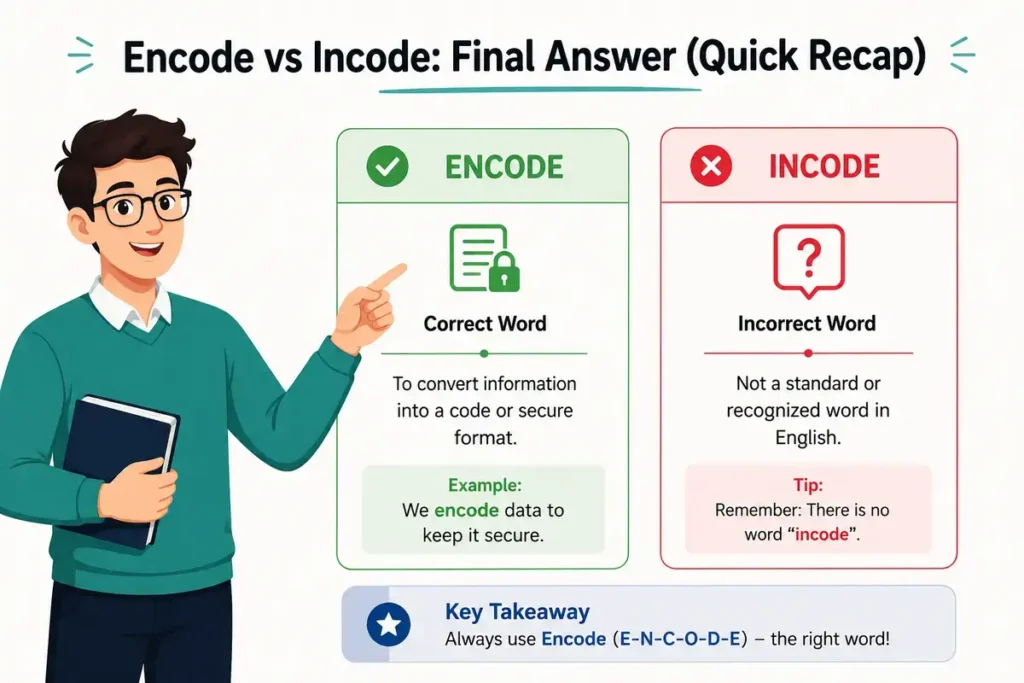
Encode vs Incode: Final Answer (Quick Recap)
When comparing both words always use encode.
It is the correct English word for changing information into another form or code.
Incode is not a standard English word and is usually a spelling mistake.
If you mean “change into a code,” the correct spelling is always encode.
A related grammar guide is Suing or Sueing Explained With Easy Rules and Examples.
Conclusion
Understanding encode vs incode is actually very simple once you know the basic rule. Encode is the correct English word. It means to change information into a code or another form so it can be stored, shared, or understood. Incode is not a standard English word and is usually just a spelling mistake.
Whenever you write about computers, data, messages, videos, audio files, or coding, always choose encode. Using the correct spelling will make your writing clearer, more professional, and easier for others to understand.
A simple way to remember it is: If you mean “change into a code,” always write “encode.” Keeping this one rule in mind will help you avoid mistakes and use the word with confidence in school, at work, and in everyday English.
Frequently Asked Questions (FAQs)
What does encode mean in simple words?
It means changing information into another form or code so it can be stored, shared, or understood.
Is incode a real English word?
No. It is not accepted in standard English and is usually a spelling mistake.
Which is correct, encode or incode?
Encode is the correct spelling.
Why do people confuse?
They sound similar, and many people make typing or spelling mistakes.
Can I use incode in formal writing?
No. Always use encode in school, work, emails, and professional writing.
Is encode used in computer programming?
Yes. Programmers use encode when changing data, text, images, audio, or video into another format.
Is encode the same as encrypt?
No. Encode changes information into another form, while encrypt protects information from unauthorized users.
How can I remember the correct spelling?
Remember this easy sentence:
“Encode enters information into a code.”
Both encode and enter begin with en, making the correct spelling easier to remember.
