
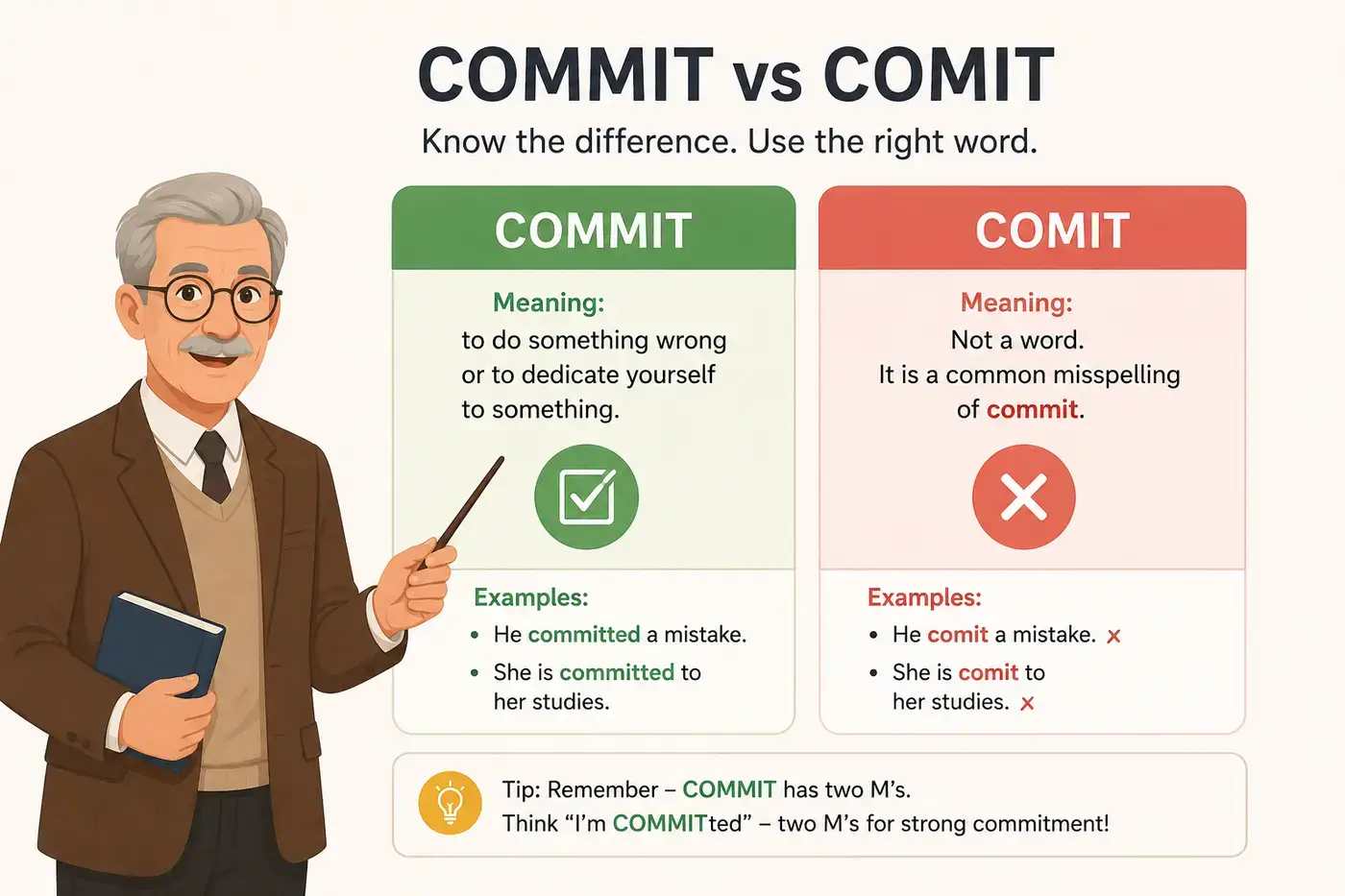
Many English learners search for commit vs comit because the two words look almost the same. It is easy to wonder if both spellings are correct. The good news is that the answer is simple. Only one spelling is accepted in standard English.
If you have ever typed comit and seen a red spelling line, you are not alone. Many people forget that commit has two m letters. This small spelling mistake happens often because English spelling is not always easy.
In this guide, you will learn the difference and why people confuse them, how to remember the correct spelling, and how to use commit correctly in everyday English.
A related grammar guide is Seal vs Seel: Which Spelling Should You Choose.
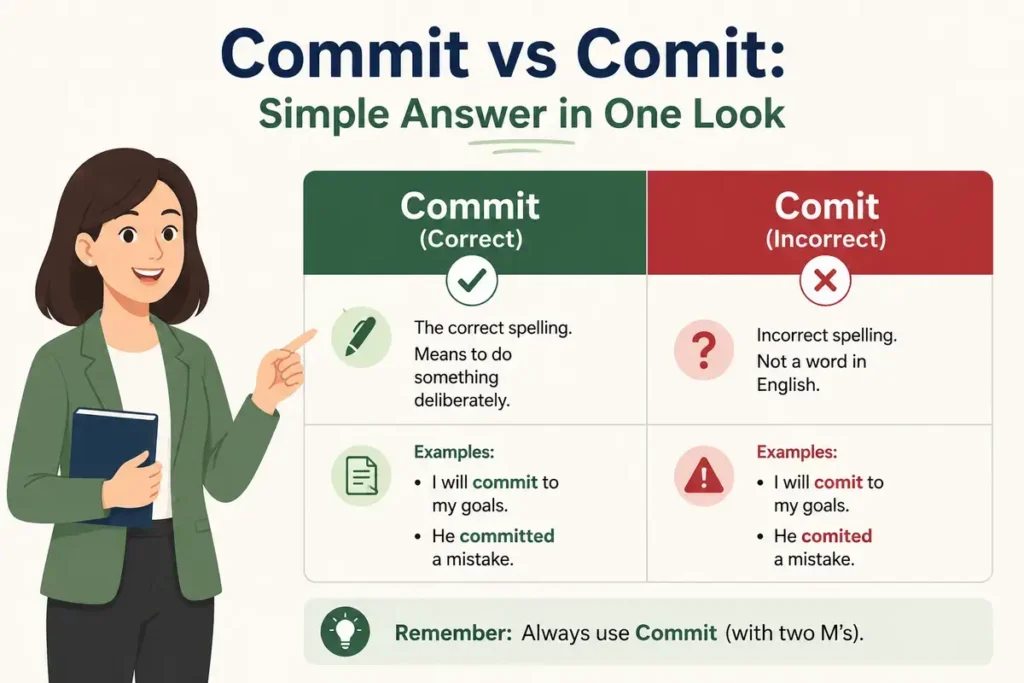
Commit vs Comit: Simple Answer in One Look
Commit is the correct spelling.
Comit is a spelling mistake and is not a real English word.
If you want to write correctly, always use commit.
What Does Commit vs Comit Mean in Simple English?
When people search for commit vs comit, they are really asking one simple question:
Which spelling is correct? The answer is easy.
Commit is a real English verb. It means to promise, dedicate yourself, carry out something, or do something.
Comit has no meaning in English. It is simply a misspelling of commit.
Here are some common meanings of commit.
- To promise yourself to something.
- To give your time or effort.
- To carry out an action.
- To officially decide to do something.
Think about these examples.
- I want to commit to my homework.
- She decided to commit to daily exercise.
- They will commit more time to the project.
Every example uses commit, never comit.
Why Do People Mix Up Commit vs Comit?
Many English learners make this mistake because of spelling patterns. Here are the biggest reasons.
The Double M Is Easy to Forget
Many words have only one middle letter. Because of that, people naturally write comit instead of commit. For example:
- visit
- limit
- credit
These words have only one middle consonant, so people expect commit to work the same way. It does not.
Fast Typing Causes Mistakes
People often type quickly. When they do, one m gets left out. Instead of writing:
commit
they accidentally type:
comit
Pronunciation Does Not Help
When people say commit, they do not clearly hear two m sounds. It sounds almost like there is only one. That makes the spelling confusing.
Spell Check Fixes It
Modern phones and computers usually change comit to commit. That is another clue that commit is the only correct spelling.
Commit vs Comit: Clear Difference Explained Simply
The easiest way to remember commit vs comit is with this comparison.
| Word | Correct? | Meaning |
|---|---|---|
| Commit | ✅ Yes | To promise, dedicate yourself, carry out, or perform an action |
| Comit | ❌ No | Misspelling with no meaning |
You can also remember it like this.
Commit = Correct
Comit = Incorrect
Another simple trick is this:
Commit has two hands working together.
Imagine the two m letters are two hands showing full effort and dedication. If one hand disappears, the spelling becomes wrong.
Which Form Should You Use in Commit vs Comit?
Always choose commit. Never use comit in school, work, emails, essays, or social media if you want correct English. Here is the simple rule.
✅ Write commit
❌ Do not write comit
This rule never changes. Whether you are writing in the present, past, or future, the base spelling always stays commit. Examples:
- I commit to learning English.
- We will commit more time.
- They committed a mistake.
- She is committing herself to the project.
Notice that every form keeps the double m.
Easy Real-Life Sentences You Can Use
These examples show how commit works in everyday English.
- I will commit to studying every evening.
- She wants to commit to healthier eating.
- We should commit more time to this project.
- He did not want to commit to the plan yet.
- They committed themselves to helping others.
- Our team will commit to better customer service.
- Please commit this date to your memory.
- She is ready to commit to the new job.
Now look at the incorrect examples.
❌ I will comit to my goals.
✅ I will commit to my goals.
❌ We comited a mistake.
✅ We committed a mistake.
Where Does Commit Come From? Simple History
The word commit has been part of English for hundreds of years. It comes from the Latin word committere. That old word meant:
- to join together
- to carry out
Over time, English shortened and changed the spelling into commit. The double m stayed as part of the correct spelling. That is why modern English still uses commit, not comit. Many English words came from Latin, and some of them kept double letters. That is why English spelling sometimes looks different from how words sound.
A Quick Memory Trick for Commit vs Comit
Need an easy way to remember? Think about this sentence:
A real commitment takes double effort, so commit has double M.
Or remember this simple rhyme:
Double M means make it right. One M means spelling mistake.
These little tricks help many students remember the correct spelling.
Common Searches Related to Commit vs Comit
People who search and also ask questions like these.
Is comit a real English word?
No. It is only a spelling mistake.
Why does commit have two m’s?
Because that is the correct spelling that came from its history and has stayed the same in modern English.
Can I ever write comit?
No. Standard English dictionaries do not accept comit as a correct spelling.
Is commit a verb?
Yes. It is a verb that has several meanings depending on the sentence.
Is committed spelled with two m’s?
Yes. Every form keeps the double m. Examples include:
- commit
- commits
- committed
- committing
- commitment
Each one keeps both m letters.
As you can see, understanding is actually very simple. Once you remember that commit always has two m letters, this mistake becomes much easier to avoid. In the next section, we’ll look at deeper meanings, common phrases, symbolism, and practical tips that will help you use commit with confidence in everyday English.
Learn the difference in Bougie or Boujee: Which One Should You Use (2026 Guide)?.
How Commit vs Comit Is Understood in Culture and Stories
The idea of commit is found in many stories, movies, books, and everyday life. People often use this word when talking about staying true to a promise or working hard toward a goal.
For example, a sports movie may show a player who decides to commit to practicing every day. A story about friendship may show friends who commit to helping each other during hard times. The word commit often gives the feeling of:
- Keeping a promise.
- Staying loyal.
- Working hard.
- Finishing what you start.
- Taking responsibility.
The misspelling comit does not have any meaning in stories or culture because it is not a real English word. When people search they are usually trying to learn the correct spelling before writing an email, school paper, or social media post.
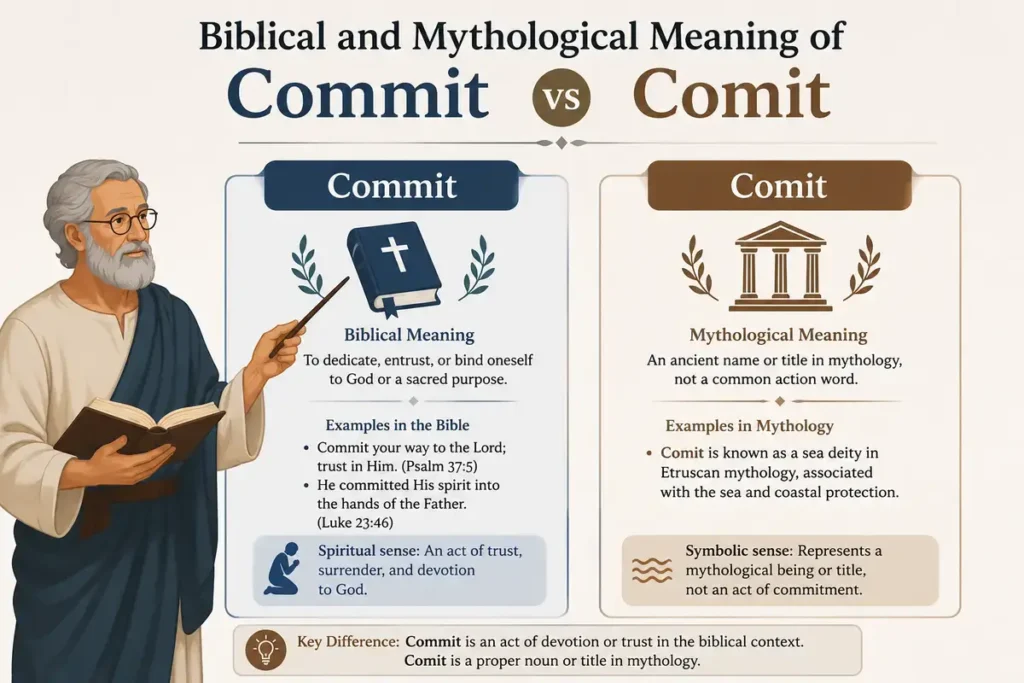
Biblical and Mythological Meaning of Commit vs Comit
The word commit appears many times in ideas found in the Bible, although different Bible translations may use different wording. For example, people are encouraged to commit their plans, work, or lives to God. In simple words, this means trusting God and giving Him your worries, choices, and future. Here, commit means:
- Trust completely.
- Give with confidence.
- Stay faithful.
- Keep your promise.
In mythology, there is no special meaning for commit as a word. However, many heroes in old stories commit themselves to a journey, a promise, or a great task. They choose not to give up even when life becomes difficult. The spelling comit has no biblical or mythological meaning because it is simply an incorrect spelling.
Commit vs Comit Symbolism Explained in Simple Words
What Commit Represents in Commit vs Comit
The word commit often symbolizes positive ideas. It can represent:
- Dedication.
- Loyalty.
- Hard work.
- Responsibility.
- Trust.
- Keeping promises.
- Personal growth.
When someone says, “I commit to this goal,” people usually think they are serious and ready to keep trying.
What Comit Represents in Commit vs Comit
The word comit does not symbolize anything because it is not an English word. Instead, it usually represents:
- A typing mistake.
- A spelling error.
- Forgetting the second m.
That is why you should always replace comit with commit.
Related Words You Should Know About Commit vs Comit
Learning similar words makes much easier to remember.
Commitment
This means a promise or responsibility. Example:
Her commitment to learning English is impressive.
Committed
This describes someone who is loyal or dedicated. Example:
He is committed to helping his family.
Committing
This is the action happening now. Example:
She is committing more time to her studies.
Commitment Ceremony
A ceremony where people publicly promise something.
Promise
To say you will do something. A promise and a commitment are closely connected.
Dedicate
To give your time and effort to something important.
Devote
To spend your energy on a person or goal.
Responsibility
Something you are expected to do. People often commit to their responsibilities.
Obligation
A duty that should be completed.
Loyalty
Being faithful to someone or something.
How People Actually Use Commit vs Comit in Daily English
People use commit every day in conversations, work, school, and family life. Here are some common examples.
- I want to commit to exercising every morning.
- She committed to finishing the project on time.
- We should commit more money to education.
- He is not ready to commit to marriage.
- Please commit these dates to memory.
- Our company committed to better customer service.
- They committed themselves to helping the community.
- I cannot commit to this meeting yet.
- The coach asked every player to commit fully.
- My parents taught me to commit to my goals.
Notice that every correct sentence uses commit, never comit.
Common Mistakes People Make With Commit vs Comit
Many people make the same spelling mistakes. Here are the most common ones.
Mistake 1: Writing Comit
❌ I will comit to the project.
✅ I will commit to the project.
Always remember the double m.
Mistake 2: Forgetting the Double M in Other Forms
❌ comited
✅ committed
❌ comiting
✅ committing
Every form keeps the double m.
Mistake 3: Thinking Both Spellings Are Accepted
Some learners believe British English uses comit.
That is not true.
Both American English and British English use commit.
Mistake 4: Depending Only on Spell Check
Spell check helps, but it is better to learn the correct spelling yourself. The more you practice, the easier it becomes.
Mistake 5: Mixing It With Similar Words
Words like permit, visit, and limit have one middle consonant. Because of that, learners sometimes expect commit to have one m too. English does not always follow the same spelling pattern.
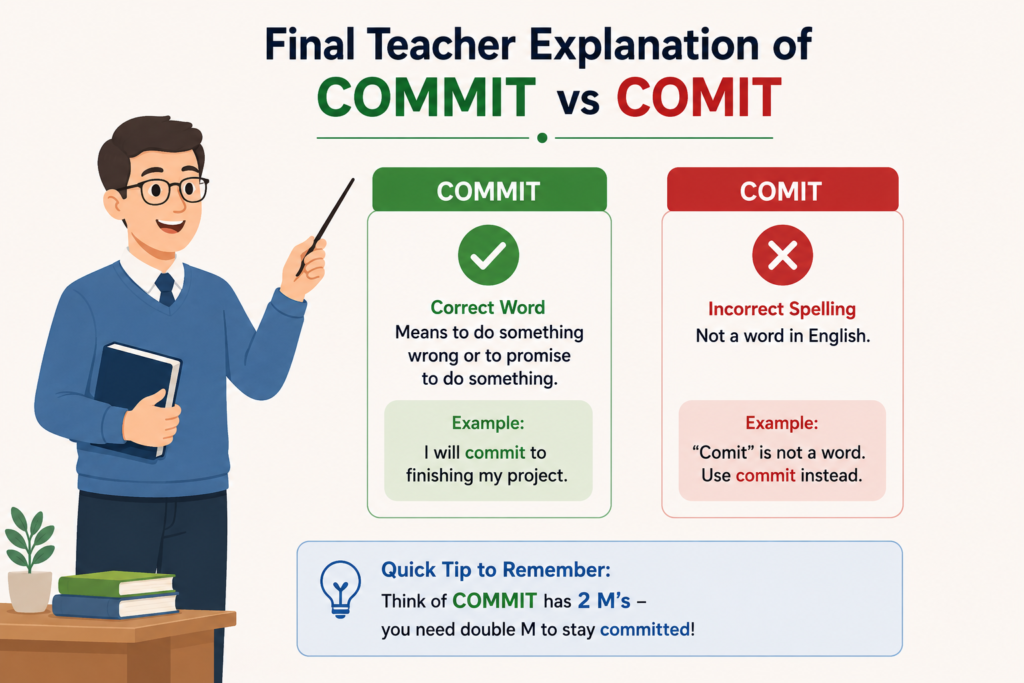
Final Teacher Explanation of Commit vs Comit
Imagine I am standing in front of a classroom. A student asks,
“Should I write commit or comit?”
My answer would be very simple. Always write commit. It has two m letters. The word comit is only a spelling mistake. Whenever you talk about making a promise, working hard, taking responsibility, or deciding to do something, the correct word is commit.
Here is the easiest way to remember it. A strong commitment needs double effort, so commit has double M. If you remember that one sentence, you will probably never spell this word incorrectly again. The more you read and write commit, the more natural it will feel.
Final Answer About Commit vs Comit (Quick Recap)
The answer to commit vs comit is very simple.
Commit is the correct English spelling.
Comit is not a real English word.
Whenever you write about promises, responsibility, dedication, or actions, always choose commit.
For another common grammar confusion, see Feel Or Feal: Which One Is Correct and Easy to Remember.
Conclusion
Learning commit vs comit is much easier than it first seems. The only correct spelling is commit, and it always has two m letters. The spelling comit is simply a common typing or spelling mistake.
Whenever you write about making a promise, taking responsibility, staying dedicated, or carrying out an action, use commit with confidence. A small spelling change can make your writing look much more professional and accurate. Practice the correct spelling a few times, and it will soon become a habit.
Frequently Asked Questions
Is correct?
Commit is correct. Comit is a spelling mistake.
What does commit mean in simple words?
It means to promise, dedicate yourself, or decide to do something.
Why do people confuse?
People often forget the second m because they type quickly or spell the word the way it sounds.
Is comit ever correct?
No. Standard English never accepts comit.
How can I remember?
Remember this simple trick: Commit has double M because real commitment takes double effort.
Does committed also have two m’s?
Yes. Committed, committing, and commitment all keep the double m.
Is commit used in American and British English?
Yes. Both American English and British English use the spelling commit.
Can I use comit in school or work?
No. Always write commit in essays, emails, reports, and professional writing.
