

Many people search for kinesthesiology vs kinesiology because they see both words online, in college programs, and in health books. At first glance, they look almost the same. That makes many people wonder if they have different meanings or if one spelling is wrong.
The short answer is that kinesiology is the standard and widely accepted spelling. Kinesthesiology is a less common spelling that some people use because they connect it with the word kinesthesia, which means the sense of body movement. In most cases, you should use kinesiology unless a school, organization, or course officially uses the other spelling.
This guide explainsin very simple English. By the end, you will know the difference, understand why people mix them up, and feel confident about which word to use.
Still confused? Compare Passerby or Passerbyers Which Word Is Correct (Guide 2026).
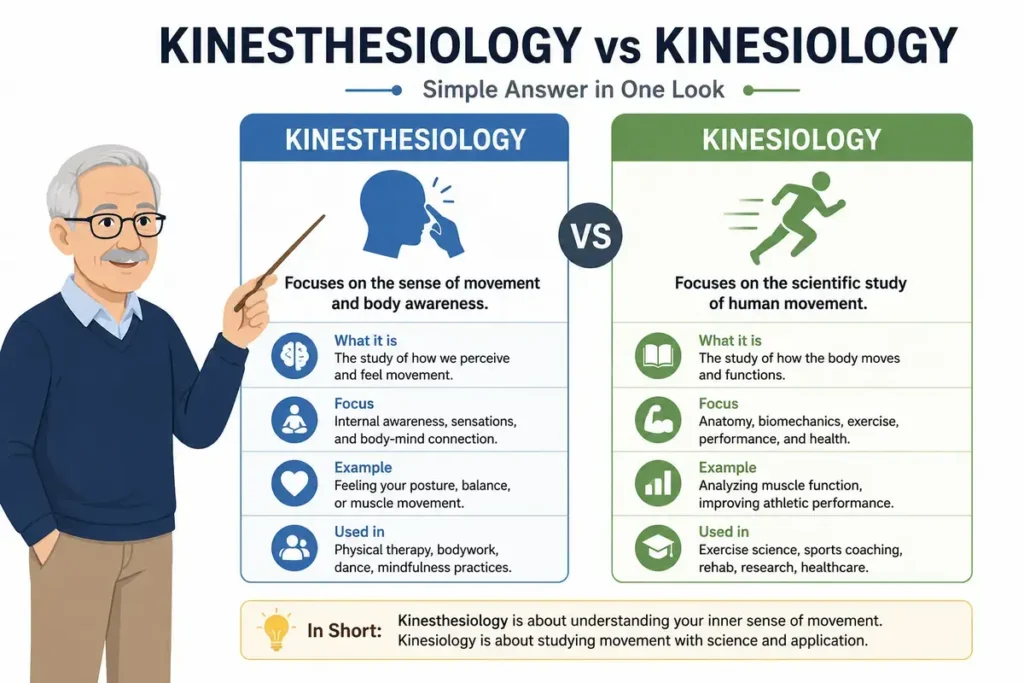
Kinesthesiology vs Kinesiology: Simple Answer in One Look
Kinesiology is the correct and standard word for the study of human movement.
Kinesthesiology is an uncommon alternative spelling that is rarely used. Most schools, books, and professionals prefer kinesiology.
What Does Kinesthesiology vs Kinesiology Mean in Simple English?
To understand kinesthesiology vs kinesiology, first think about what the subject studies. Kinesiology is the study of how the human body moves. It looks at muscles, bones, joints, and the way they work together. It also studies exercise, fitness, sports, and physical health. People who study kinesiology learn things like:
- How muscles help us move.
- How exercise changes the body.
- How to prevent injuries.
- How to improve strength and balance.
- How to help people recover after injuries.
You can think of kinesiology as the science of movement. The word kinesthesiology is usually meant to describe the same subject. It does not normally have a different meaning. The only real difference is the spelling. So when comparing remember this simple idea:
- Both point to the study of movement.
- Kinesiology is the spelling almost everyone uses.
Why Do People Mix Up Kinesthesiology vs Kinesiology?
Many English words look alike. That is why people often become confused. Here are the biggest reasons.
Both Words Look Almost the Same
Only a few letters are different.
Kinesiology
Kinesthesiology
When people read quickly, they may not even notice the extra letters.
People Think About “Kinesthesia”
There is another English word called kinesthesia. Kinesthesia means your body’s natural ability to sense movement and position without looking. Because of this word, some people believe kinesthesiology should be the correct spelling. That is why the confusion happens.
Different Websites Use Different Spellings
Some websites use the uncommon spelling. Others use the standard spelling. When learners see both, they start asking which one is right.
Spelling Errors Spread Online
Sometimes people simply copy a spelling they have already seen. Over time, that spelling appears on blogs, forums, or social media, even if it is not the standard form.
Kinesthesiology vs Kinesiology: Clear Difference Explained Simply
The easiest way to compare them is side by side.
| Kinesiology | Kinesthesiology |
|---|---|
| Standard spelling | Rare spelling |
| Used by most universities | Rarely used by schools |
| Found in textbooks | Seen only sometimes |
| Preferred by professionals | Less accepted |
| Best choice for writing | Usually not recommended |
Another simple way to remember it is this:
Kinesiology = standard and safe.
Kinesthesiology = uncommon alternative.
If your teacher asks you to write about the science of human movement, choose kinesiology unless told otherwise.
Which Form Should You Use in Kinesthesiology vs Kinesiology?
For almost every situation, you should use kinesiology. Use it when writing:
- School assignments.
- College applications.
- Research papers.
- Health articles.
- Exercise blogs.
- Sports reports.
- Professional documents.
You might only use kinesthesiology if:
- An organization officially uses that spelling.
- A course title includes it.
- You are directly quoting a source.
If you are unsure, choosing kinesiology is the safest decision.
Easy Real-Life Sentences Using Kinesthesiology vs Kinesiology
These examples show how people normally use the word.
- My sister is studying kinesiology at college.
- He wants to become a sports therapist after finishing his kinesiology degree.
- The professor teaches kinesiology every Monday.
- She enjoys learning how muscles work in kinesiology class.
- Our school added a new kinesiology program.
- I searched because I saw both spellings online.
- Most universities use the word kinesiology in their course names.
- My friend accidentally wrote kinesthesiology, but the textbook used kinesiology.
Where Does Kinesthesiology vs Kinesiology Come From? (Simple History)
The history is actually easy to understand. The word kinesiology comes from the Greek word kinesis, which means movement. Later, English added -logy, which means the study of. So the meaning becomes:
Kinesis + logy = the study of movement.
The word kinesthesia comes from similar Greek roots but refers to the body’s sense of movement. Because these words are closely related, some people created or used the spelling kinesthesiology. Over time, however, kinesiology became the accepted spelling in universities, medical fields, sports science, and professional writing.
Today, if you search college programs around the world, you will almost always see kinesiology instead of kinesthesiology. As you can see, understanding is not difficult once you know the history. In the next section, we will look deeper at how these words are used in education, culture, professional careers, and everyday English so you can use the correct spelling with complete confidence.
How Is Kinesthesiology vs Kinesiology Understood in Culture and Stories?
When people hear kinesthesiology vs kinesiology, they usually think about sports, fitness, exercise, or healthy living. The words are connected with movement, strength, and learning how the body works.
In many cultures, movement is seen as a sign of good health. Walking, running, dancing, and playing sports all show how important movement is in everyday life. Because kinesiology is the study of movement, people often connect it with:
- Living a healthy life.
- Staying active.
- Helping others recover from injuries.
- Becoming stronger.
- Learning about the human body.
Many movies and sports stories also show physical therapists, trainers, coaches, and athletes working together. Even if they never say the word kinesiology, they often use ideas that come from this field. Students who study kinesiology may later become:
- Physical therapists.
- Athletic trainers.
- Fitness coaches.
- Exercise specialists.
- Sports scientists.
- Health educators.
So, in everyday culture, kinesiology is often linked with helping people move better and live healthier lives. The uncommon spelling kinesthesiology usually carries the same meaning. Most people simply see it as another spelling rather than a different subject.
A related grammar guide is How the Turntables Meaning: How to Use It Correctly.
Does Kinesthesiology vs Kinesiology Have a Biblical or Mythological Meaning?
When discussing kinesthesiology vs kinesiology, there is no direct Biblical meaning. Neither word appears in the Bible because they are modern scientific terms. However, the Bible often talks about taking care of the body, serving others, and using our strength wisely. Many people believe learning about healthy movement supports those ideas, but the words themselves are not religious.
There is also no direct mythological meaning. Ancient Greek culture valued athletics, running, wrestling, and physical training. Since the word kinesiology comes from the Greek word kinesis, meaning “movement,” its roots connect to the Greek language rather than Greek myths. So the simple answer is:
- No direct Biblical meaning.
- No direct mythological meaning.
- The words mainly belong to science, education, and health.

Kinesthesiology vs Kinesiology Symbolism Explained in Simple Words
What Does Kinesiology Represent in Kinesthesiology vs Kinesiology?
In kinesthesiology vs kinesiology, the standard word kinesiology often represents:
- Healthy movement.
- Learning.
- Exercise.
- Recovery.
- Balance.
- Growth.
- Helping people live active lives.
Many students choose kinesiology because they enjoy sports or want to help injured people recover. The word has become a symbol of understanding how the body works.
What Does Kinesthesiology Represent in Kinesthesiology vs Kinesiology?
The word kinesthesiology usually represents the same ideas. However, because it is much less common, it can also represent:
- An alternative spelling.
- Personal preference.
- Older or uncommon usage.
- Confusion between similar words.
Emotionally, there is no real difference between the two words. The biggest difference is simply that kinesiology is accepted almost everywhere, while kinesthesiology is rarely used.
Related Words You Should Know About Kinesthesiology vs Kinesiology
Learning a few related words will make much easier to remember.
Kinesis
This Greek word means movement. It is the root of kinesiology.
Kinesthesia
This means your body’s ability to feel movement and position without looking.
Biomechanics
This is the study of how muscles, bones, and joints move together.
Anatomy
Anatomy is the study of body parts and how they are built.
Physiology
Physiology explains how different parts of the body work.
Physical Therapy
This focuses on helping people recover after injuries or surgery.
Exercise Science
Exercise science studies how exercise affects the body and health.
Sports Medicine
Sports medicine helps prevent and treat sports injuries.
Motor Skills
Motor skills are the movements people use every day, such as walking, writing, and throwing a ball.
Rehabilitation
Rehabilitation helps people regain strength and movement after illness or injury.
How Do People Actually Use Kinesthesiology vs Kinesiology in Daily English?
Most people use kinesiology in conversations about college, health, or sports. Here are some natural examples.
- I’m thinking about studying kinesiology next year.
- My cousin has a degree in kinesiology.
- She teaches kinesiology at the university.
- Our school started a new kinesiology program.
- The coach recommended a student with a kinesiology background.
- My brother loves learning about muscles in his kinesiology class.
- The textbook only used the spelling kinesiology.
- I accidentally wrote kinesthesiology, then corrected it to kinesiology.
In daily English, you will almost always hear people say kinesiology.
Common Mistakes People Make With Kinesthesiology vs Kinesiology
Many learners make the same mistakes. The good news is that they are easy to fix.
Mistake 1: Thinking Both Spellings Are Equally Common
❌ Kinesiology and kinesthesiology are both used everywhere.
✅ Kinesiology is the standard spelling used by most schools and professionals.
Mistake 2: Believing They Have Different Meanings
❌ Kinesthesiology and kinesiology are two different subjects.
✅ They usually refer to the same study of human movement.
Mistake 3: Using the Longer Spelling in School Work
❌ I am studying kinesthesiology.
✅ I am studying kinesiology.
Unless your school officially uses the longer spelling, choose kinesiology.
Mistake 4: Mixing Up Kinesiology With Kinesthesia
These are related words, but they are not the same.
- Kinesiology = study of movement.
- Kinesthesia = sense of body movement.
Mistake 5: Assuming Every Website Uses the Standard Spelling
Some websites contain spelling mistakes or uncommon spellings. Always check trusted dictionaries, universities, or textbooks if you are unsure.
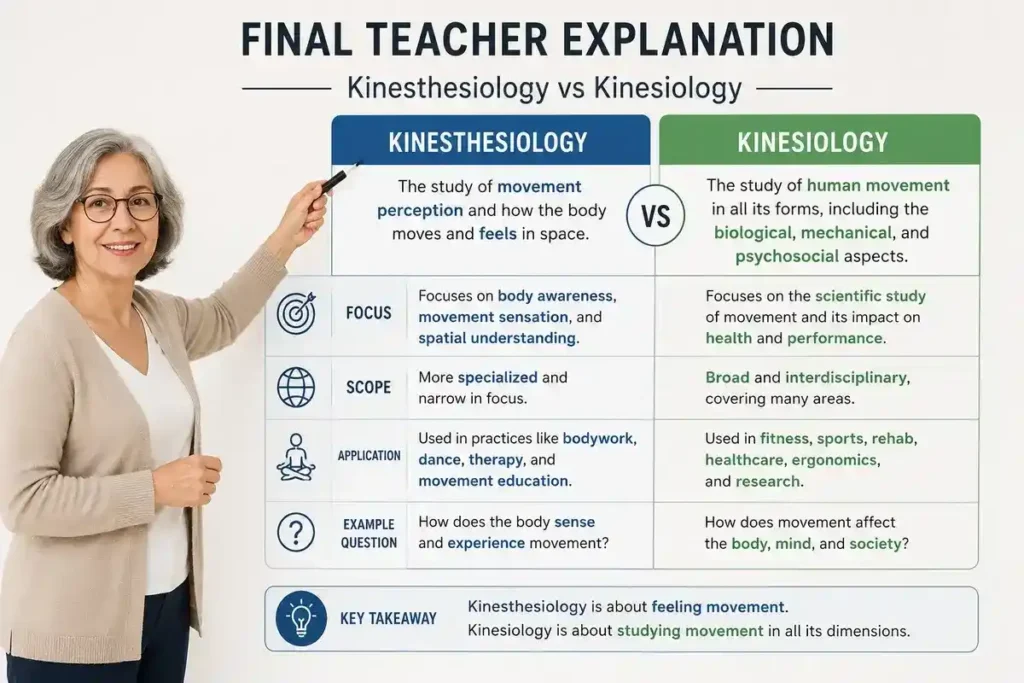
Final Teacher Explanation of Kinesthesiology vs Kinesiology
Imagine we are sitting together in class. You raise your hand and ask, “Teacher, which word should I use?” My answer would be very simple. Use kinesiology. It is the spelling you will find in universities, textbooks, research papers, and professional writing.
The spelling kinesthesiology is not completely unknown, but it is uncommon. Most people never use it in everyday writing. The reason people become confused is that another word, kinesthesia, looks very similar. That similarity causes many learners to add extra letters when spelling kinesiology. So here is the classroom rule you can remember:
If you are talking about the study of human movement, write kinesiology.
If you ever see kinesthesiology, understand that it usually refers to the same idea, but it is not the preferred spelling.
That one simple rule will help you avoid mistakes almost every time.
Final Answer About Kinesthesiology vs Kinesiology (Quick Recap)
When comparing the correct and widely accepted spelling is kinesiology. Both words usually refer to the study of human movement, but kinesthesiology is an uncommon alternative spelling. For school, work, research, and everyday writing, kinesiology is the best choice.
Many readers also check Bellies vs Bellys: Which One Is Correct in English?.
Conclusion
Understanding kinesthesiology vs kinesiology is easier than it first appears. Both words usually point to the study of human movement, muscles, exercise, and physical health. The main difference is the spelling, not the meaning.
For almost every situation, choose kinesiology. It is the accepted spelling used by universities, health professionals, researchers, and dictionaries. Once you remember that kinesiology is the standard form, you can write with confidence and avoid one of the most common spelling mistakes related to this subject.
Frequently Asked Questions
What does kinesiology mean in simple words?
Kinesiology is the study of how the human body moves. It looks at muscles, bones, exercise, and movement.
Is kinesiology or kinesthesiology correct?
Kinesiology is the standard and correct spelling used by most universities and professionals.
Why do people confuse?
People confuse them because kinesthesia is another real word that looks very similar.
Can I use both words in writing?
You usually should use kinesiology. Use kinesthesiology only if a specific organization or source officially uses that spelling.
Is kinesthesiology a different subject?
No. In most cases, it refers to the same study of human movement.
Which spelling do colleges use?
Nearly all colleges and universities use kinesiology for their programs and degrees.
How can I remember the correct spelling?
Remember this simple rule: kinesiology = the study of movement. It is the spelling found in textbooks and classrooms.
Does the extra “esth” change the meaning?
No. The extra letters do not usually change the meaning. They only create a less common spelling.
