
Many English learners get confused about the spelling of suing or sueing. Both words seem possible because they come from the verb “sue.” When people add “ing” to a verb, they often wonder if the final letter should stay or disappear.
If you have searched for suing or sueing, you are not alone. This is one of the most common spelling questions in English. The good news is that the answer is simple once you understand the rule.
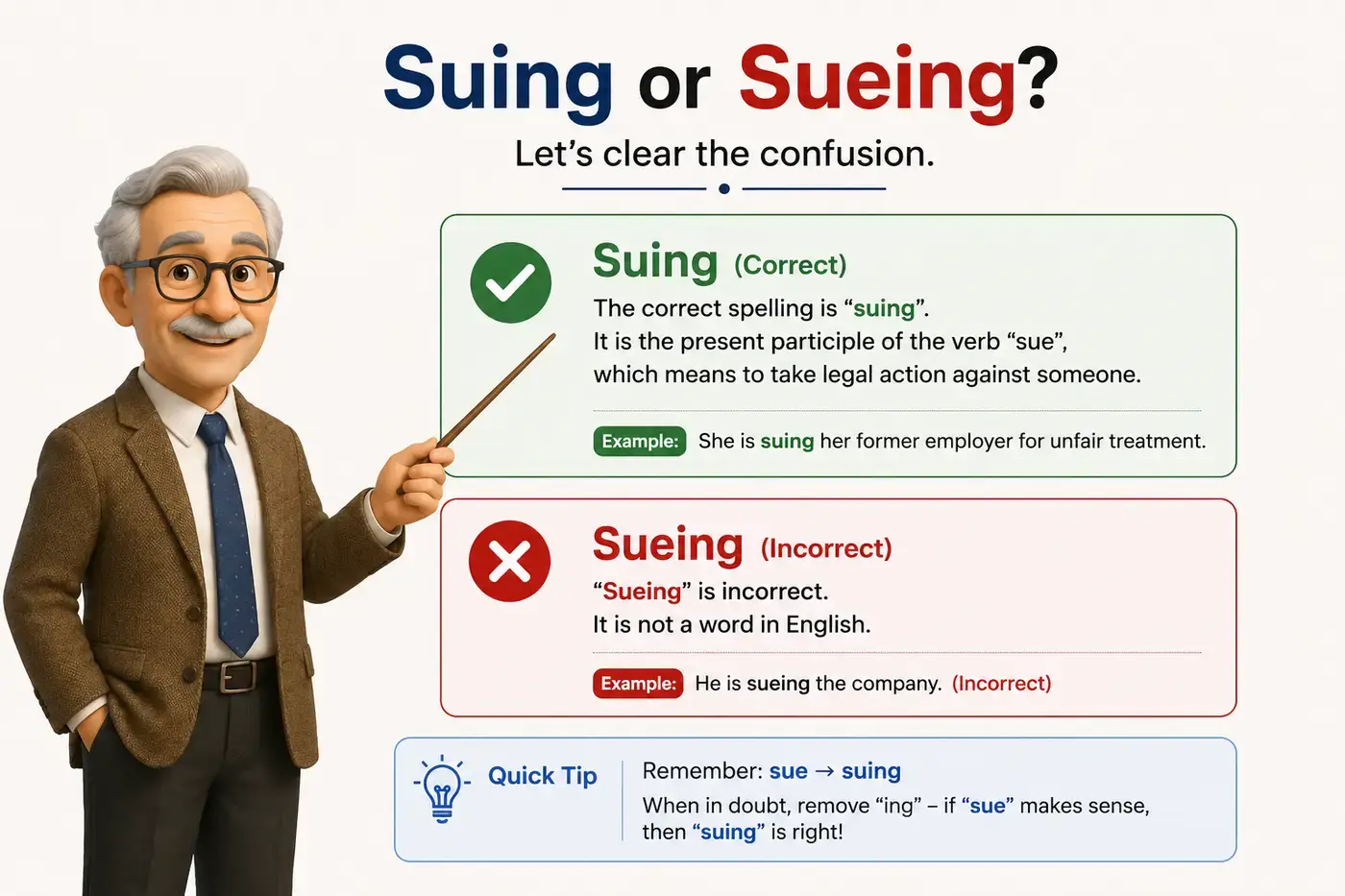
The correct spelling is usually “suing.” The form “sueing” is considered incorrect in standard modern English. Knowing this small difference can help you avoid mistakes in school, work, and everyday writing.
You may also want to read Tweek vs Tweak: Easy Guide For Better English.
Suing or Sueing: Simple Answer in One Look
Suing is correct.
Sueing is incorrect in standard English.
If you are writing about taking legal action against someone, always use “suing.”
What Does Suing or Sueing Mean in Simple English?
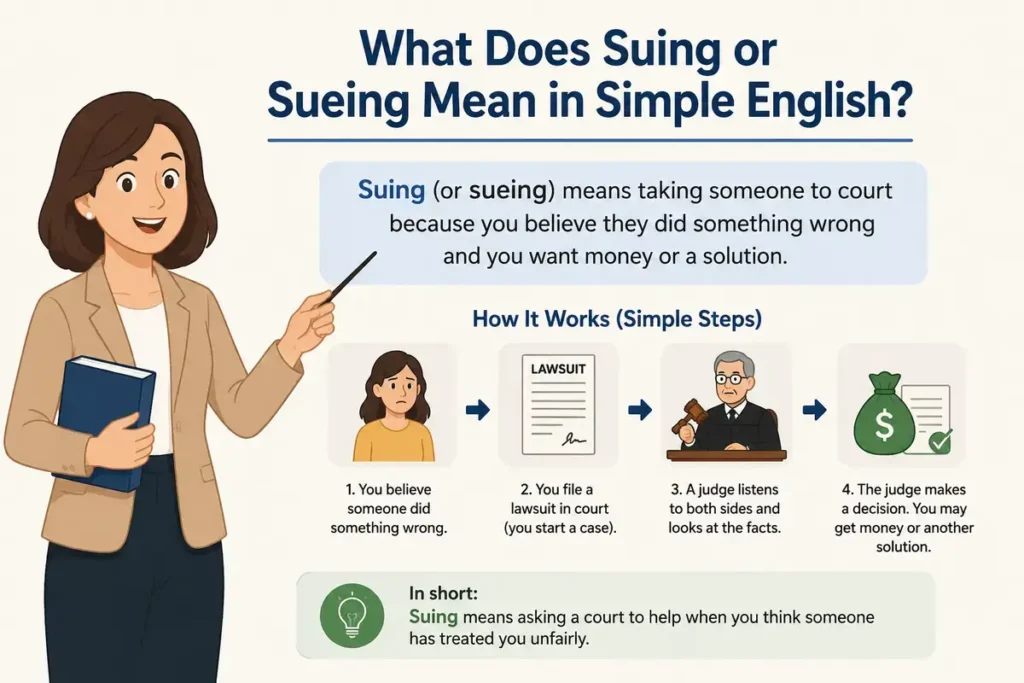
Before learning the spelling, it helps to understand the meaning. The word “suing” comes from the verb “sue.” To sue someone means to take legal action against a person, company, or organization in court. People sue when they believe they have been treated unfairly or have suffered harm. For example:
- A customer may sue a company.
- A worker may sue an employer.
- A driver may sue another driver after an accident.
When we say “suing,” we are talking about the action happening now or over a period of time. Example:
“She is suing the company for damages.”
This means she has started legal action against the company.
Simple Meaning of Suing
Suing means:
- Taking someone to court.
- Starting a legal case.
- Seeking help from the law.
- Asking a court to decide a dispute.
It is a word often used in news stories, business reports, and everyday conversations about legal matters.
What About Sueing?
Many people think “sueing” should be correct because the base word is “sue.”
However, standard English spelling rules do not use “sueing.”
Writers, teachers, dictionaries, and editors use “suing.”
That is why “sueing” is treated as a spelling mistake.
Why Do People Mix These Words Suing or Sueing?
The confusion happens because English spelling can sometimes seem inconsistent. People look at the word “sue” and think:
“If the word is sue, shouldn’t the next form be sueing?”
That idea seems logical. After all, the original word contains the letter “e.” Many learners try to keep every letter from the original word when adding “ing.” For example:
- Free → freeing
- Agree → agreeing
- See → seeing
Because of these examples, some writers naturally create “sueing.” The problem is that English follows a different pattern for the verb “sue.” The accepted spelling is:
- Sue → suing
Not:
- Sue → sueing
The Letters Look Strange Together
Another reason people make this mistake is visual confusion. When you first see “suing,” it may look unusual. Some people feel that a letter is missing. Because of that feeling, they add an extra “e” and create “sueing.” But English dictionaries and style guides do not accept that spelling.
Spell Check Does Not Always Help
Some writing tools automatically correct mistakes. Others may not catch them right away. As a result, people sometimes continue using “sueing” without realizing it is incorrect.
Suing or Sueing: Clear Difference Explained Simply
When comparing suing or sueing, the difference is very easy to understand.
| Word | Correct? | Meaning |
|---|---|---|
| Suing | Yes | Taking legal action |
| Sueing | No | Incorrect spelling |
Quick Visual Comparison of Suing or Sueing
Correct:
- She is suing the company.
- They are suing their landlord.
- He is suing for damages.
Incorrect:
- She is sueing the company.
- They are sueing their landlord.
- He is sueing for damages.
Easy Way to Remember
Look at the correct word:
Suing
Notice that the extra “e” disappears. If you remember this simple pattern, you will avoid the mistake every time. Think:
“Sue becomes suing.”
Not:
“Sue becomes sueing.”
One Letter Makes the Difference
Only one letter separates the two forms. Yet that single letter determines whether the spelling is correct or incorrect. That is why paying attention to the word matters.
Suing or Sueing: Which Form Should You Use?
You should always use “suing.”
This is the accepted spelling in:
- Schools
- Colleges
- Newspapers
- Court documents
- Business writing
- Online articles
- Professional communication
When Is Sueing Correct?
In modern standard English, it is not correct. If you write “sueing,” most teachers, editors, and proofreaders will mark it as a spelling error.
The Safe Rule
Whenever you need the “-ing” form of “sue,” use:
Suing
Do not add the extra “e.”
This rule works in nearly every situation.
Teacher’s Shortcut
Remember this sentence:
“The person is suing, not sueing.”
Repeating that phrase a few times can help you remember the correct spelling.
How to Use Suing in Everyday English
The word often appears in real-life situations. You may hear it on television, in news reports, or in conversations about legal problems. Here are some common examples.
Talking About a Company
“The customer is suing the company.”
This means the customer has started a legal case against the company.
Talking About an Accident
“The driver is suing after the accident.”
This means the driver is taking legal action.
Talking About Property
“The neighbor is suing over the fence dispute.”
This means a legal disagreement exists about the property boundary.
Talking About Money
“They are suing for compensation.”
This means they want money through a legal case. These examples all use the correct spelling: suing.
Easy Real-Life Sentences You Can Use for Suing or Sueing
Here are some simple examples.
- She is suing the company.
- They are suing for damages.
- He is suing after the accident.
- The family is suing the landlord.
- We are suing the contractor.
- The customer is suing the business.
- The worker is suing the employer.
- Several people are suing the manufacturer.
These examples sound natural and match everyday English usage.
Common Phrases With Suing
You may often hear:
- Suing for damages.
- Suing for compensation.
- Suing the company.
- Suing the landlord.
- Suing the employer.
- Suing over an injury.
- Suing over a contract dispute.
These phrases appear frequently in legal and news writing.
Common Mistakes People Make using Suing or Sueing
Many spelling mistakes happen because people focus on pronunciation instead of spelling.
Since “sue” ends with an “e,” writers sometimes assume the “e” must stay.
This creates the incorrect form “sueing.”
Mistake Example
Incorrect:
“I am sueing the company.”
Correct:
“I am suing the company.”
Another Example
Incorrect:
“They are sueing for compensation.”
Correct:
“They are suing for compensation.”
Looking at correct examples repeatedly helps build good spelling habits.
Where Does Suing or Sueing Come From? (Simple History)
The word “sue” has a very long history. It comes from older words that meant to seek justice, follow a legal process, or make a request through the courts. Over time, English adopted the word “sue” as a legal term. Today, it still carries that same basic meaning. When people say someone is suing, they mean that person is asking a court to resolve a problem.
Why the Spelling Changed
English spelling developed over hundreds of years. As language rules became more standardized, dictionaries settled on “suing” as the correct present-action form of “sue.” Because of that standardization, “sueing” never became accepted in modern English.
Why Knowing the History Helps
Understanding the history reminds us that English spelling is not always based on what looks logical. Sometimes accepted usage decides the correct form. In this case, accepted usage clearly favors “suing.”
Is Suing Common in Modern English?
Yes. The word appears regularly in:
- News reports
- Court stories
- Business articles
- Legal discussions
- Television programs
- Online publications
You will often read headlines such as:
- A customer is suing a company.
- Employees are suing their employer.
- Residents are suing over environmental concerns.
Because the word is so common, learning the correct spelling is useful.
Still confused? Compare Coachs Or Coaches: Easy Grammar Guide (2026).
Frequently Confused Forms Related to Suing
Many learners also ask about these forms:
- Sue
- Sued
- Suing
Examples:
- I want to sue the company.
- She sued the company last year.
- She is suing the company now.
All three forms are correct. The only incorrect form in standard English is “sueing.”
Transition to Deeper Meaning and Usage
Now that you understand the basic difference between suing or sueing, the next section will go beyond spelling rules. We will look at how the word is used in society, media, culture, everyday conversations, and modern life so you can fully understand its meaning and usage.
How Suing or Sueing Is Understood in Culture and Stories
When people hear the word “suing,” they often think about courtrooms, lawyers, judges, and legal disputes. Movies, TV shows, books, and news stories frequently use this word when a person believes they have been treated unfairly.
In many stories, a character decides to sue because they want justice. They feel someone has harmed them, broken a promise, or caused a problem that needs to be fixed. For example:
- A customer sues a company after buying a dangerous product.
- A worker sues an employer after being treated unfairly.
- A homeowner sues a contractor over poor work.
Because of these stories, the word “suing” often carries the idea of standing up for your rights. Some people view lawsuits positively because they can help solve problems. Others view them negatively because lawsuits can be expensive, stressful, and time-consuming. That is why the word sometimes creates strong reactions when people hear it.
Suing or Sueing in Movies and Television
Movies often show characters suing someone after a major event. You may see:
- A business owner suing a competitor.
- A family suing a hospital.
- A celebrity suing a newspaper.
These stories help people understand how legal systems work. Since “suing” appears frequently in entertainment, many people learn the word long before they ever see a real court case.
Biblical and Mythological Meaning of Suing or Sueing
The word “suing” itself does not have a special biblical or mythological meaning. However, ideas connected to suing appear in many religious and ancient stories. These ideas include:
- Justice
- Fairness
- Responsibility
- Resolving disputes
In Biblical Teachings
The Bible contains examples of disagreements between people and discussions about fairness and judgment. The focus is usually on solving problems peacefully when possible. Many biblical teachings encourage forgiveness, honesty, and fair treatment of others.
In Ancient Myths
Ancient myths often include conflicts between people, rulers, heroes, and gods. When disagreements happened, someone usually had to decide what was fair. While the word “suing” was not used in those stories, the idea of seeking justice was common. So, the deeper theme connected to suing is often fairness and accountability.
Symbolism Suing or Sueing Explained in Simple Words
What Suing Represents
The correct word “suing” often symbolizes:
- Seeking justice.
- Standing up for yourself.
- Solving a serious disagreement.
- Asking for fairness.
- Protecting your rights.
For many people, suing represents a formal way to handle a problem instead of fighting or arguing endlessly. It can symbolize responsibility because courts are designed to review facts and make decisions.
What Sueing Represents
The word “sueing” does not carry a separate meaning because it is not the accepted spelling. Instead, it often represents a spelling mistake or misunderstanding of English spelling rules. When readers see “sueing,” they usually recognize the intended meaning, but they may view it as incorrect writing.
Suing or Sueing Symbolism Comparison
| Form | Symbolic Meaning |
|---|---|
| Suing | Justice, fairness, legal action, responsibility |
| Sueing | Spelling confusion, writing mistake, misunderstanding |
This is why using the correct form helps your writing appear clear and professional.
Related Words You Should Know About Suing or Sueing
Learning related words makes understanding easier.
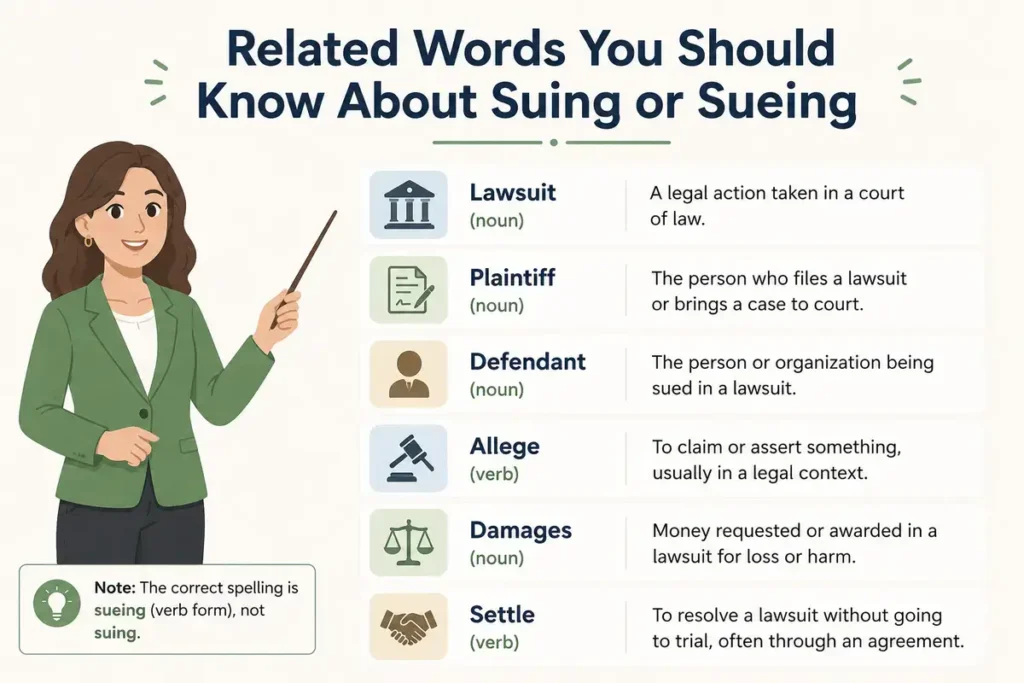
Lawsuit
A lawsuit is a legal case brought before a court. Example:
“The lawsuit lasted several months.”
Court
A court is the place where legal cases are decided. Example:
“The case went to court.”
Lawyer
A lawyer is a person trained to help with legal matters. Example:
“She hired a lawyer.”
Judge
A judge listens to a case and helps make legal decisions. Example:
“The judge announced the decision.”
Plaintiff
The plaintiff is the person who starts a lawsuit. Example:
“The plaintiff filed a complaint.”
Defendant
The defendant is the person or organization being sued. Example:
“The defendant denied the claim.”
Compensation
Compensation is money given to someone after harm or loss. Example:
“They received compensation.”
Settlement
A settlement is an agreement that resolves a dispute. Example:
“The companies reached a settlement.”
How People Actually Use Suing or Sueing in Daily English
Most people use the word “suing” when talking about legal issues in everyday life. Here are some natural examples.
- “She is suing the company after the accident.”
- “They are suing for damages.”
- “The family is suing the hospital.”
- “He is thinking about suing his former employer.”
- “Several customers are suing the business.”
- “The actor is suing a magazine.”
- “My neighbor is suing over property damage.”
- “The company is suing for breach of contract.”
- “People were surprised she decided to sue.”
- “The case started after they began suing each other.”
These examples sound natural because they use the accepted spelling.
Informal Conversations
You might hear people say:
- “Are they suing?”
- “Why is she suing them?”
- “I heard the company is suing someone.”
- “He’s thinking about suing.”
These are common expressions in spoken English.
Common Mistakes With Suing or Sueing
Many writers make the same mistakes when using this word. The good news is that they are easy to fix.
Mistake 1: Writing Sueing
Incorrect:
“She is sueing the company.”
Correct:
“She is suing the company.”
Always remove the extra “e.”
Mistake 2: Thinking Both Spellings Are Correct
Some spelling pairs in English are both accepted. For example:
- Color and colour.
- Theater and theatre.
However, suing and sueing are not the same situation. Only “suing” is considered correct in standard English.
Mistake 3: Forgetting the Meaning
Some learners focus so much on spelling that they forget the meaning. Remember: Suing means taking legal action. Keeping the meaning in mind often makes the correct spelling easier to remember.
Mistake 4: Copying Incorrect Online Examples
The internet contains many spelling mistakes. Just because you see “sueing” somewhere does not mean it is correct. Always check trusted dictionaries and reliable writing sources.
Final Teacher Explanation of Suing or Sueing
Imagine we are sitting in an English classroom. A student raises a hand and asks:
“Should I write suing or sueing?”
My answer would be very simple.
Use “suing.”
That is the correct spelling.
The word comes from “sue,” which means to take legal action against someone. Even though some people think “sueing” looks logical, standard English does not use that spelling. Whenever you write about a court case, legal claim, or lawsuit, choose “suing.” If you remember one thing from this lesson, remember this:
“Suing is correct. Sueing is incorrect.”
That single rule will help you avoid mistakes in school, work, and everyday writing.
Final Answer: Suing or Sueing?
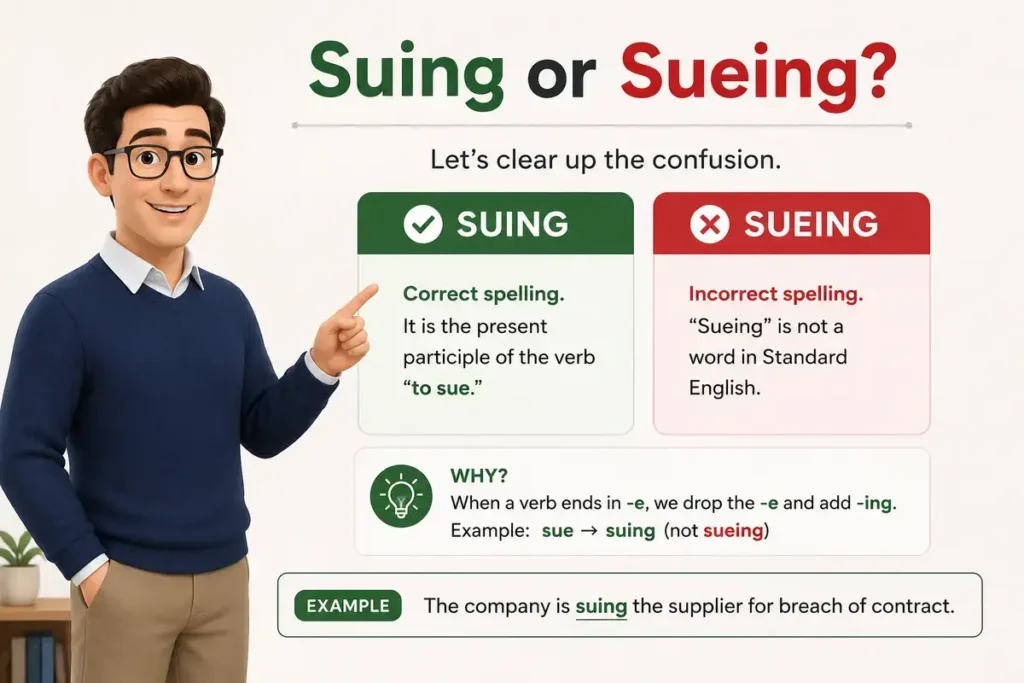
The correct spelling is “suing.”
“Sueing” is not accepted in standard modern English.
If you are writing about taking legal action, always use “suing.”
For another common grammar confusion, see Bearable vs Bareable: Smart Grammar Rules for (2026).
Conclusion
The confusion between suing or sueing happens because the base word is “sue.” Many learners naturally think the extra “e” should remain when adding “ing.” However, standard English follows a different pattern. The correct spelling is “suing.”
The word means taking legal action against a person, company, or organization. It is commonly used in news reports, legal discussions, business writing, and everyday conversations. If you ever feel unsure, remember this simple classroom rule:
Use “suing” every time.
Frequently Asked Questions (FAQs)
Is suing or sueing correct?
“Suing” is correct. “Sueing” is considered a spelling mistake in standard English.
What does suing mean in simple words?
Suing means taking legal action against a person or organization in court.
Why do people write sueing?
People often think the final “e” should stay when adding “ing” to the word “sue.”
Can I use sueing in formal writing?
No. Formal writing should use the correct spelling, which is “suing.”
How do I remember the correct spelling?
Remember this simple rule: Sue becomes suing, not sueing.
Is suing used in everyday English?
Yes. It appears often in news stories, business discussions, and conversations about legal matters.
Does suing always involve a court?
Usually, yes. Suing refers to starting or pursuing a legal case.
Are suing and lawsuit the same thing?
Not exactly. Suing is the action. A lawsuit is the legal case itself.
