
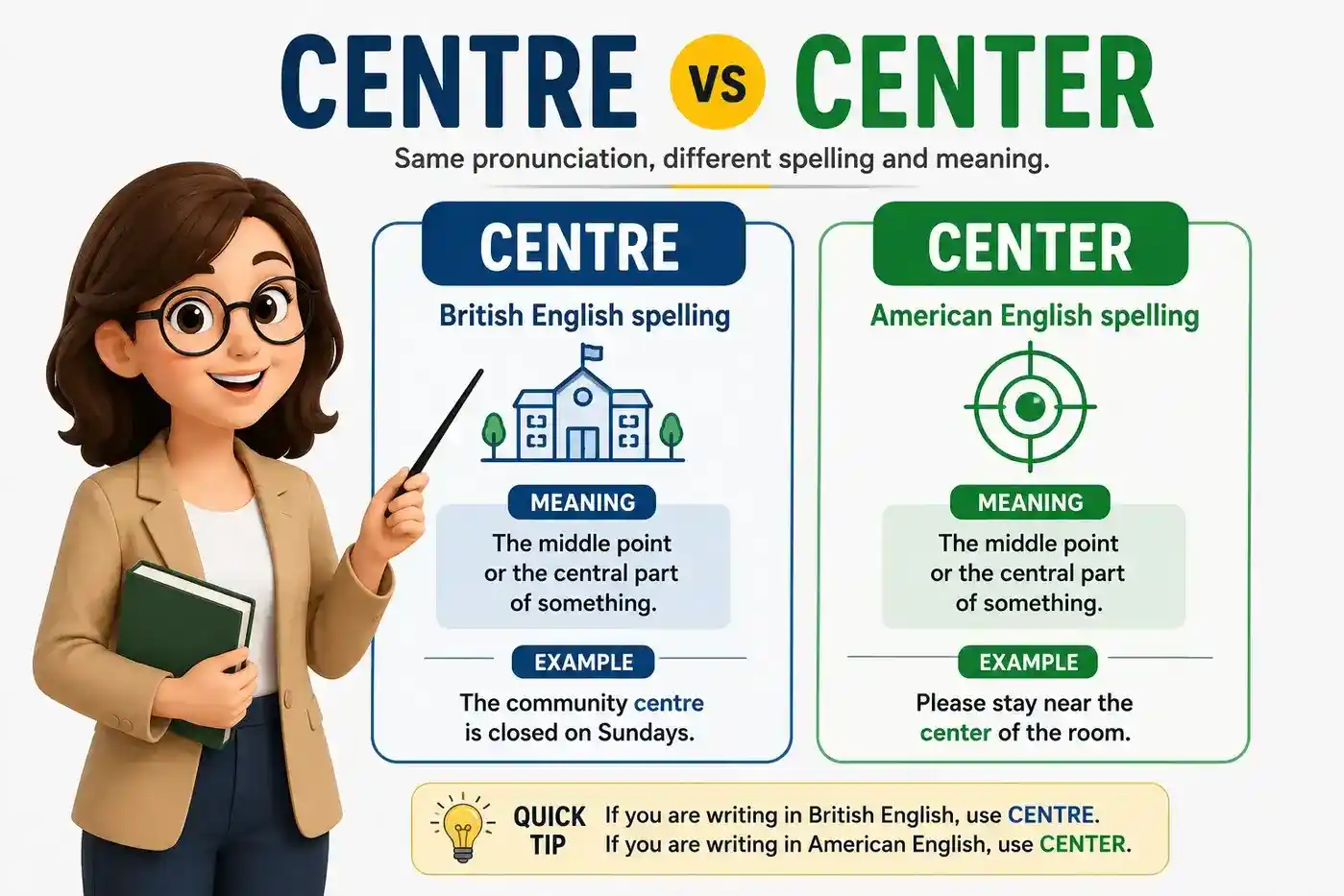
Have you ever seen the words centre and center and wondered if one of them is wrong? You are not alone. Many English learners and even native speakers get confused about centre vs center because both words have the same meaning.
The good news is that this difference is very easy to understand. The choice between centre vs center mostly depends on the type of English you use. One form is common in the United States, while the other is used in many other English-speaking countries.
In this guide, you will learn the simple difference between centre vs center, when to use each one, and how to remember the correct spelling. By the end, you will feel confident using the right form in everyday writing.
Learn the difference in Combatting or Combating: Which Spelling Is Correct?.
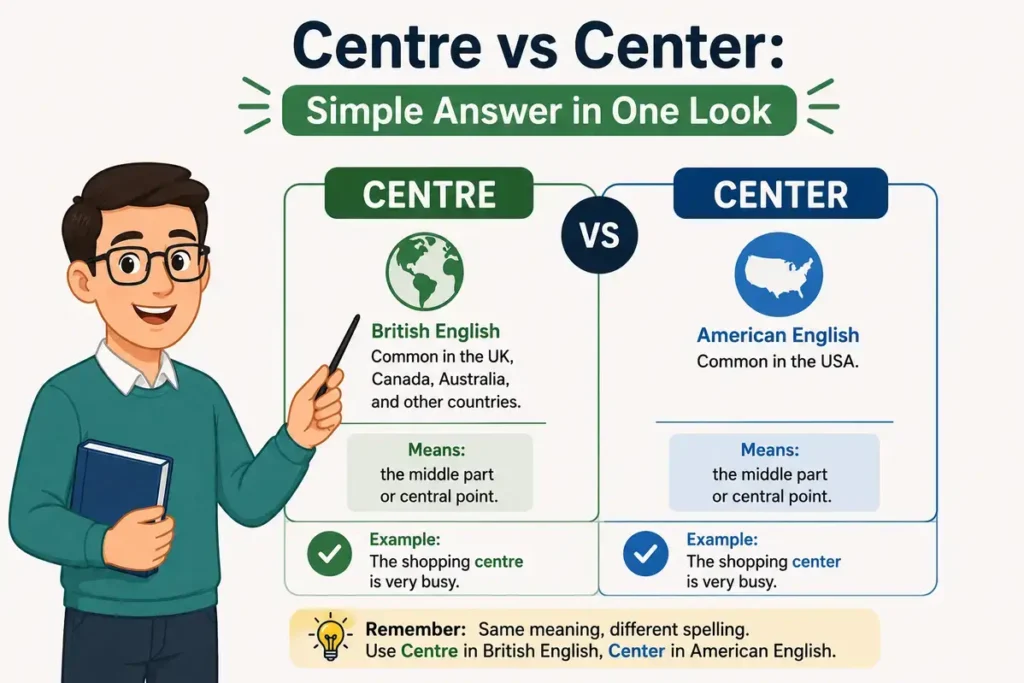
Centre vs Center: Simple Answer in One Look
Center is the American English spelling.
Centre is the British English spelling.
Both words mean the middle point of something. Neither spelling is wrong. You simply choose the one that matches your audience.
Quick Example
- American English: The shopping center opens at 9 a.m.
- British English: The shopping centre opens at 9 a.m.
What Does Centre vs Center Mean in Simple English?
The words centre and center both refer to the middle part of something. They can also describe a place where a particular activity happens. Think about a pizza. The middle piece of the pizza is its center or centre.
Now think about a community building where people meet for activities. You could call it a community center or community centre depending on the style of English you use.
Centre vs Center Meaning
The words can mean:
- The middle point of something.
- A place where services or activities happen.
- The main area of a town or city.
- The point that attracts the most attention.
Examples
- The child stood in the center of the circle.
- The new sports centre has a swimming pool.
- We met in the city center after school.
- The town centre was crowded during the festival.
The meaning stays exactly the same. Only the spelling changes.
Why Do People Mix These Words Centre vs Center?
Many people become confused about centre vs center because they see both spellings online, in books, and in movies. English is spoken in many countries. Different regions have developed their own spelling preferences over time.
Reasons for the Confusion
1. Both Spellings Are Correct
Unlike some spelling mistakes, this is not a right-versus-wrong situation. Both words are accepted forms of English.
2. The Internet Brings Different English Styles Together
You may read an article written in the United States and then watch a video created in the United Kingdom.
One source uses center.
Another source uses centre.
This can make learners think they are different words.
3. Schools Teach Different Standards
Students in the United States usually learn center.
Students in countries that follow British English often learn centre.
4. Brands and Business Names Use Either Form
You might see:
- Medical Center
- Shopping Centre
- Community Center
- Leisure Centre
The spelling often depends on the country where the organization is located.
Everyday Example
Imagine you move from Canada to the United States. You may have written “town centre” for years. After moving, you begin seeing “town center” everywhere. This change can feel confusing at first, even though the meaning never changes.
Centre vs Center: Clear Difference Explained Simply
The easiest way to understand centre vs center is to focus on location and audience.
Mini Comparison
| Feature | Center | Centre |
|---|---|---|
| Type of English | American English | British English |
| Used in the United States | Yes | Rarely |
| Used in the United Kingdom | Rarely | Yes |
| Meaning | Middle place or activity hub | Middle place or activity hub |
| Pronunciation | Same | Same |
Think of It This Way
If you are writing for an American audience, use center.
If you are writing for a British audience, use centre.
Visual Memory Trick
Center = America
The spelling ends with -er, which Americans commonly use in words like:
- theater → theatre (British)
- meter → metre (British)
Centre = Britain
The spelling ends with -re, which appears in several British English words.
Important Point
Do not switch between the two spellings in the same piece of writing. Choose one style and stay consistent. For example:
✅ The city center has many restaurants.
❌ The city centre has many restaurants near the shopping center.
The second example mixes spelling styles, which can distract readers.
Centre vs Center: Which Form Should You Use?
The answer depends on who will read your writing.
Use “Center” If:
- You are writing in American English.
- Your audience is mainly from the United States.
- Your school or workplace follows US style guides.
- You create content for American readers.
Examples
- Student Center
- Medical Center
- City Center
- Conference Center
Use “Centre” If:
- You are writing in British English.
- Your readers are from the United Kingdom.
- Your school follows British spelling rules.
- You write for audiences in countries that prefer British English.
Examples
- Student Centre
- Medical Centre
- City Centre
- Conference Centre
What About International Audiences?
If you write for people around the world, choose one style and use it consistently. Many international businesses decide based on:
- Their headquarters location.
- Their target audience.
- Their existing brand guidelines.
Consistency matters more than the spelling choice itself.
Easy Real-Life Sentences You Can Use for Centre vs Center
Here are simple examples showing how centre vs center works in everyday situations.
Using Center
- Meet me at the shopping center after lunch.
- The teacher stood in the center of the classroom.
- Our town opened a new community center.
- The basketball player moved toward the center of the court.
- The science center offers fun activities for children.
- The hotel is located near the city center.
- Please place the picture in the center of the page.
- The student center provides helpful services.
Using Centre
- The sports centre closes at eight o’clock.
- We walked through the town centre yesterday.
- The child stood in the centre of the group.
- The medical centre serves local families.
- Their new leisure centre opened last month.
- The community centre hosts weekly events.
- Place the design in the centre of the poster.
- The shopping centre was busy during the weekend.
Notice that the meaning stays the same in every example. Only the spelling changes.
Where Does Centre vs Center Come From? (Simple History)
The story behind centre vs center goes back hundreds of years. The word originally came from Latin and French before becoming part of English. For a long time, English spelling was not fully standardized. People often wrote words in different ways. Later, spelling traditions became more organized.
British English Kept “Centre”
British English continued using the -re ending in words such as:
- centre
- metre
- theatre
American English Preferred “Center”
American English gradually adopted the -er ending for many of these words:
- center
- meter
- theater
This change made spellings more consistent within American English.
Did the Meaning Change?
No.
The meaning remained exactly the same. The only difference was the spelling style that each region preferred.
Simple History Lesson to Remember Centre vs Center
British English → centre
American English → center
Same meaning. Different spelling traditions.
A Helpful Reminder
When you see centre vs center, do not think of them as competing words. Instead, think of them as two versions of the same word used by different English-speaking communities. Both forms are correct when used in the right context. As your English skills grow, you will notice many other examples of American and British spelling differences. Understanding these patterns can make reading and writing much easier.
In the next section, we will look more closely at how these spellings appear in everyday communication, common phrases, professional writing, and cultural contexts. You will also learn practical tips to avoid mistakes and build confidence when choosing the right form for your audience.
How Is Centre vs Center Understood in Culture and Stories?
When people discuss centre vs center, they are usually talking about spelling. Still, the idea behind these words has a deeper meaning in everyday life and culture. The center or centre often represents the place where things come together. Think about a family sitting around a dinner table. The conversation may naturally focus on one person or one topic. That person or topic becomes the “center” of attention.
In many communities, a community center or community centre is more than just a building. It is a place where people learn, celebrate, exercise, and spend time together. Stories also use this idea. For example:
- A hero may become the center of an important event.
- A city centre may be shown as the heart of a community.
- A family member may be the center of love and support.
No matter which spelling is used, the idea remains the same. The center is often seen as a place of connection, balance, and importance.
Still confused? Compare Aerial vs Arial: Learn The Right Word complete guide (2026).
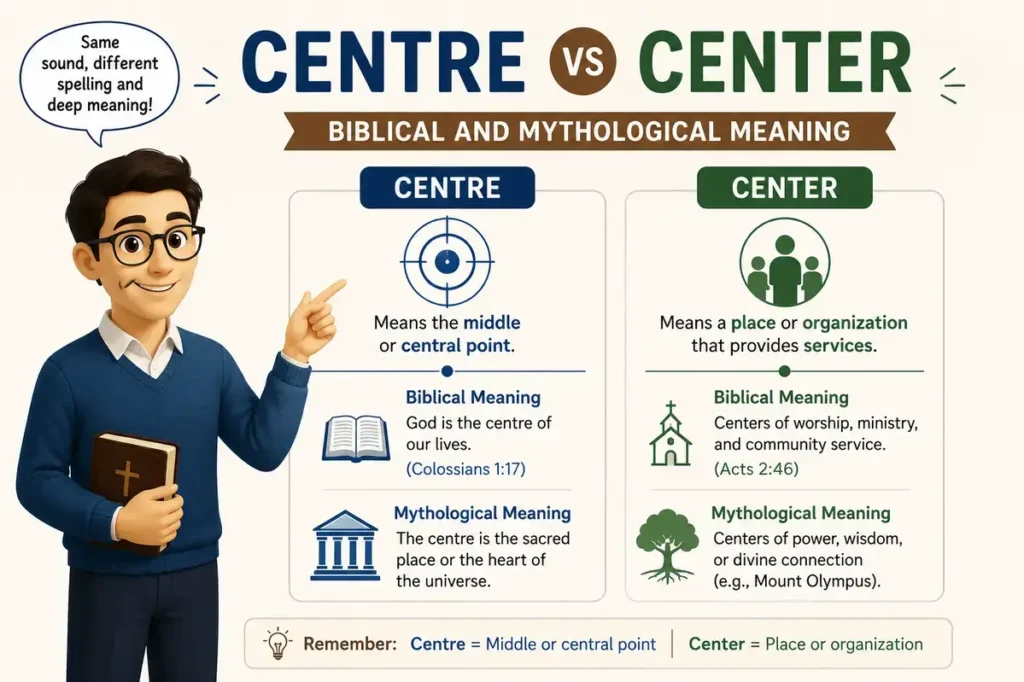
Centre vs Center: Biblical and Mythological Meaning
The words centre and center themselves do not have a special biblical meaning. However, the idea of a center appears in many religious and traditional stories. In simple terms, the center often symbolizes:
- Focus.
- Stability.
- Guidance.
- Unity.
For example, some people talk about keeping faith at the center of their lives. This means giving it an important place in daily decisions. In mythology, important locations are sometimes described as the “center of the world.” These places represent power, wisdom, or connection. The exact spelling, centre or center, does not change the meaning. The symbolism comes from the idea of being in the middle or holding things together.
Centre vs Center Symbolism Explained in Simple Words
Both spellings share the same symbolic meaning because they describe the same concept.
What Does Center Represent?
In American English, center often represents:
- Balance.
- Focus.
- Importance.
- Leadership.
- Unity.
Examples:
- Being the center of attention means everyone notices you.
- Keeping family at the center of life means family comes first.
- Finding your center can mean staying calm and balanced.
What Does Centre Represent?
In British English, centre carries the same ideas:
- Togetherness.
- Stability.
- Community.
- Purpose.
- Connection.
Examples:
- The community centre brings people together.
- The town centre is often the busiest area.
- Putting kindness at the centre of your actions means making it a priority.
Centre vs Center Symbolism Comparison
| Center | Centre |
|---|---|
| American spelling | British spelling |
| Represents focus | Represents focus |
| Suggests balance | Suggests balance |
| Symbolizes importance | Symbolizes importance |
| Means connection | Means connection |
The emotional meaning stays the same.
Only the spelling changes.
Related Words You Should Know About Centre vs Center
Learning related words can help you understand more clearly.
Central
Means something close to the middle or very important.
Example: The library is in a central location.
Middle
The point between two sides.
Example: She sat in the middle of the row.
Core
The most important part of something.
Example: Honesty is at the core of friendship.
Hub
A place where activities happen.
Example: The airport is a travel hub.
Focus
The thing receiving attention.
Example: Education became the focus of the meeting.
Heart
Often used to describe the emotional center of something.
Example: The park is the heart of the neighborhood.
Main
The most important or central part.
Example: The main office is downtown.
These words have slightly different meanings, but they all connect to the idea of importance or being in the middle.
How Do People Actually Use Centre vs Center in Daily English?
Most people use these words without thinking too much about them.The spelling usually depends on where they live. Here are some natural examples.
Daily English Examples Using Center
- I left my bag at the shopping center.
- Please move the table to the center of the room.
- The student center offers free tutoring.
- He stood in the center of the stage.
- The medical center is open all day.
- Keep the picture in the center of the page.
- The conference center is near the airport.
- The city center gets busy during rush hour.
Daily English Examples Using Centre
- We met at the leisure centre after work.
- The town centre was full of tourists.
- The community centre hosts dance classes.
- Please place your name in the centre of the paper.
- The sports centre added new equipment.
- The medical centre helped many patients.
- Children gathered in the centre of the playground.
- The shopping centre stayed open late.
Notice something important. The sentences work exactly the same way. The only difference is the spelling style.
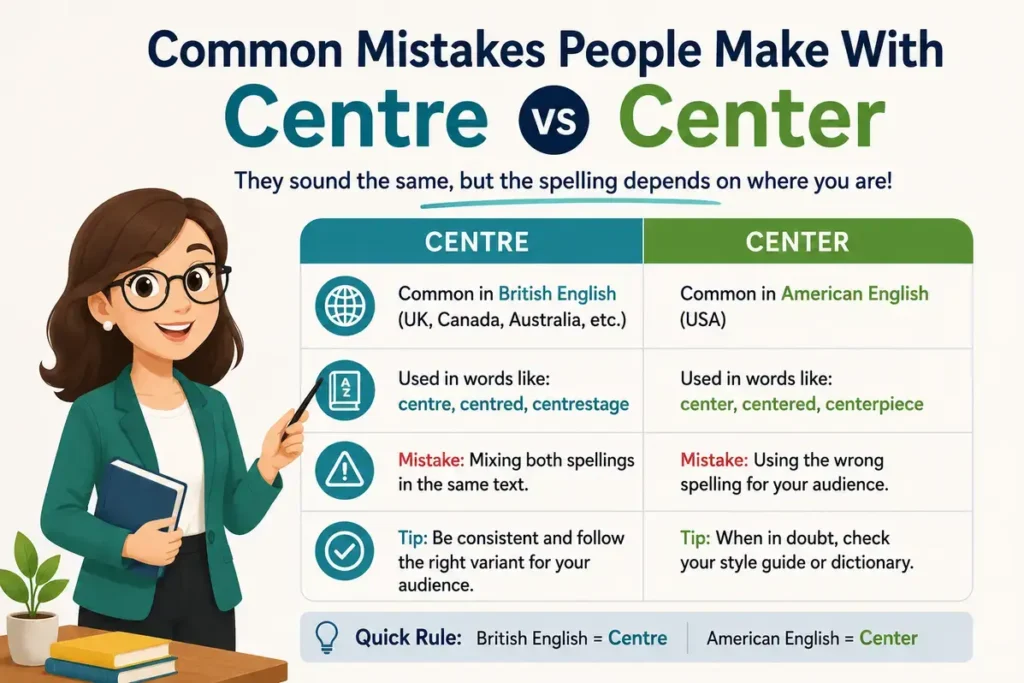
Common Mistakes People Make With Centre vs Center
Because both forms are correct, people sometimes make avoidable mistakes. Here are the most common ones.
Mistake 1: Mixing Both Spellings in One Article
❌ The city centre has a large shopping center.
✅ The city center has a large shopping center.
✅ The city centre has a large shopping centre.
Choose one style and stay consistent.
Mistake 2: Thinking One Form Is Wrong
❌ Centre is incorrect.
❌ Center is incorrect.
✅ Both spellings are correct.
The right choice depends on the type of English you are using.
Mistake 3: Ignoring the Audience
If you write for American readers, center often feels more natural.
If you write for British readers, centre may be expected.
Always think about who will read your work.
Mistake 4: Changing Brand Names
Some organizations officially use one spelling. Always respect the official name. For example, if a business uses “Centre” in its title, do not change it to “Center.”
Mistake 5: Assuming Pronunciation Changes
Many learners think the words sound different. They do not. Centre and center are pronounced the same way. Remember this simple rule: Different spelling. Same meaning. Same pronunciation.
Final Teacher Explanation About Centre vs Center
Imagine you are sitting in an English classroom, and a student asks: “Teacher, which one is correct: centre or center?” My answer would be simple. Both are correct.
Use center when writing in American English.
Use centre when writing in British English.
That is all you need to remember. Do not worry about choosing the “perfect” version. Instead, focus on consistency.
If your school uses American English, stay with center.
If your exams follow British English, use centre.
The meaning never changes. The pronunciation stays the same. The only difference is the spelling tradition. As you continue learning English, you will notice other examples like this. Rather than feeling confused, think of them as different accents in written form. English is spoken around the world, and these variations are part of what makes the language interesting.
Final Answer: Centre vs Center Quick Recap
The difference is simple.
Center is the American English spelling.
Centre is the British English spelling.
Both words mean the middle point of something or a place where activities happen. Choose the spelling that matches your audience and use it consistently throughout your writing.
Need another quick comparison? Read Clutz or Klutz: How Should You Use It (2026 Guide)?.
Conclusion
Understanding does not have to be difficult. Both words have the same meaning and the same pronunciation. The only real difference is the spelling style used in different parts of the English-speaking world.
If you write for American readers, use center.
If you write for British readers, use centre.
Most importantly, do not mix the two forms in the same piece of writing. As a teacher would say, this is not about finding the “right” word and avoiding the “wrong” one. It is about understanding your audience and choosing the spelling that fits the situation. Once you remember this simple rule, the confusion disappears.
Frequently Asked Questions (FAQs)
What does centre vs center mean in simple words?
Both words mean the middle part of something or a place where activities happen. The meaning is exactly the same.
Is center or centre correct?
Both are correct. Center is American English, and centre is British English.
Why do people get confused between centre vs center?
People see both spellings online, in books, and in media from different countries. This makes them wonder which one is correct.
When should I use center?
Use center when writing in American English or for readers in the United States.
When should I use centre?
Use centre when writing in British English or for audiences that follow British spelling conventions.
Can I use both centre and center in the same article?
It is better not to mix them. Choose one spelling style and use it consistently.
Are centre and center pronounced differently?
No. They are pronounced the same way.
Is one spelling more formal than the other?
No. Both are standard spellings in their respective forms of English.
