
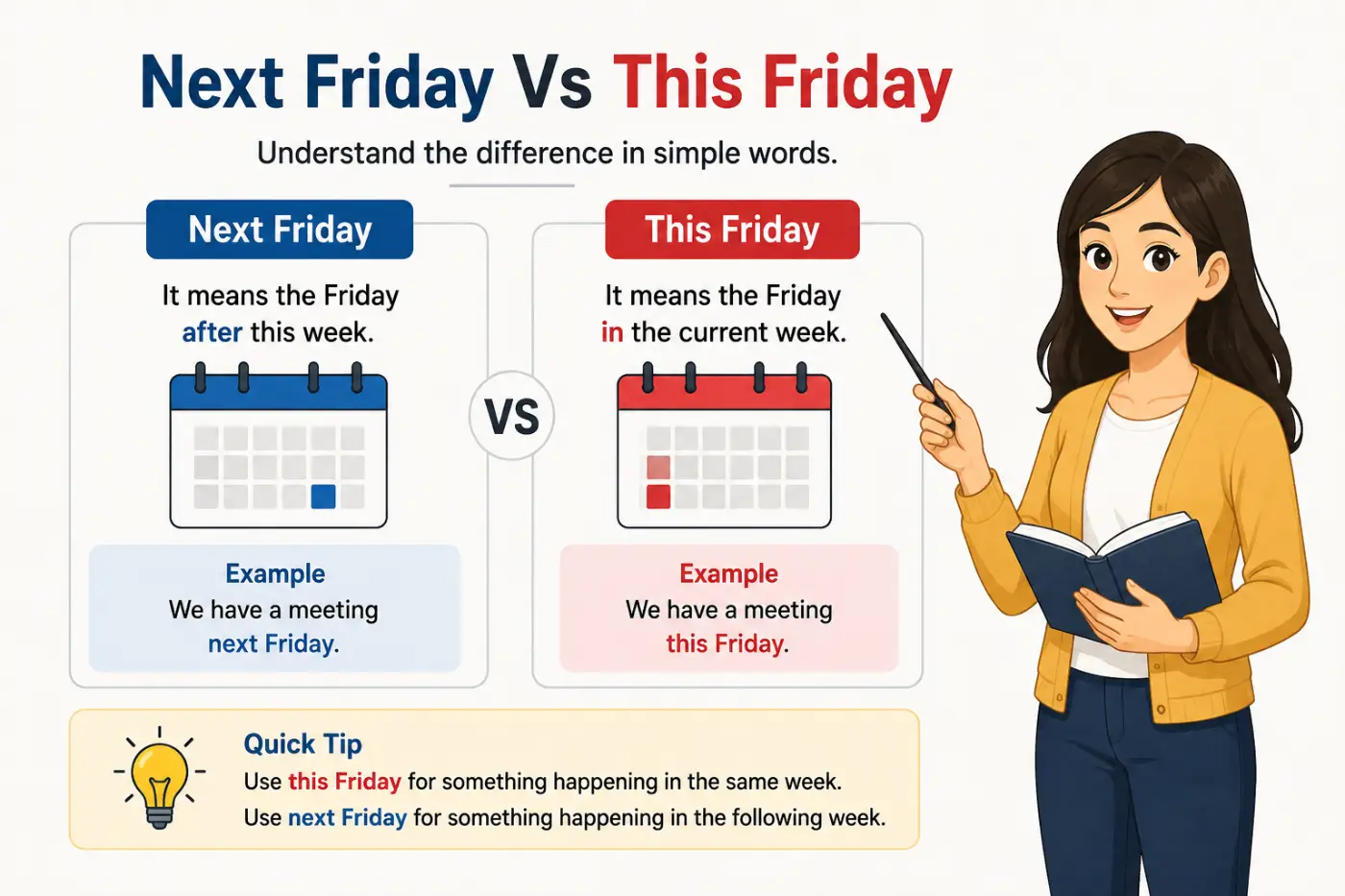
Many English learners get confused about next friday vs this friday because both can talk about a Friday in the future. The problem is that people do not always mean the same Friday. The meaning depends on the day you are speaking and sometimes even the speaker’s personal habit.
If you understand clearly you will avoid confusion in daily conversations emails text messages and work meetings. A few simple rules can help you choose the right words.
This guide explains in very simple English. You will learn what each one means why people mix them up how to use them correctly and how to avoid common mistakes.
For another common grammar confusion, see Coachs Or Coaches: Easy Grammar Guide (2026).
Simple Answer in One Look
This Friday usually means the closest Friday.
Next Friday usually means the Friday after this Friday.
Still some people use next Friday to mean the very next Friday. That is why adding the date is often the clearest choice.
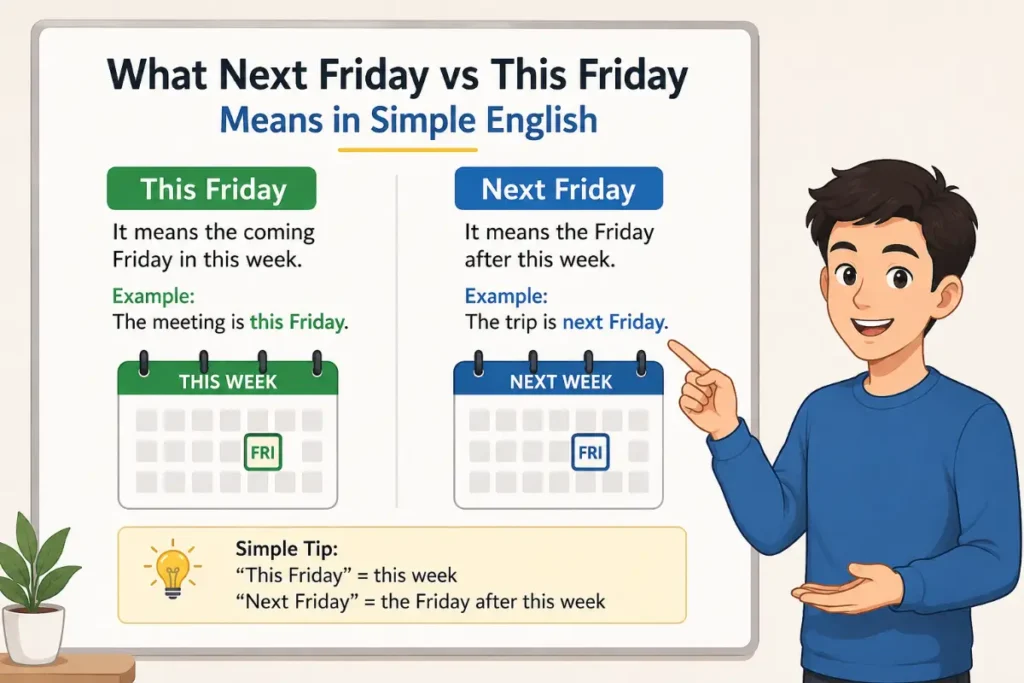
What Next Friday vs This Friday Means in Simple English
Think about standing on a road.
You are looking ahead at the days of the week.
The first Friday you reach is usually this Friday.
The Friday after that is usually next Friday.
Here is a simple example.
Today is Monday.
The Friday coming in a few days is this Friday.
The Friday one week later is next Friday.
Now look at another example.
Today is Saturday.
The Friday that comes six days later is usually next Friday because this week’s Friday has already passed.
This is why the current day matters when using these expressions. Many people learn this idea naturally as they speak English. Even native speakers sometimes ask for clarification because the meaning can change depending on the situation.
Why People Mix These Words Next Friday or This Friday
The confusion does not come from bad English. It comes from different speaking habits. Some people think about the current week. Others think only about the next Friday that will arrive. Imagine two friends talking on Wednesday.
Friend A says:
“We have a meeting this Friday.”
Everyone understands the meeting is only two days away.
Now another person says:
“We have a meeting next Friday.”
Some listeners think that means nine days away.
Others think it still means two days away.
That is why people sometimes ask questions like these.
“Do you mean this coming Friday?”
“Do you mean the Friday after?”
This happens in schools.
It happens with family plans.
It happens in text messages.
Even native English speakers sometimes stop and check the meaning before making plans.
Clear Difference Explained Simply
Here is the easiest way to remember it.
| This Friday | Next Friday |
|---|---|
| Usually the closest Friday | Usually the Friday after this Friday |
| Often only a few days away | Often about one week later |
| Used for near plans | Used for later plans |
| Can feel more immediate | Can feel more distant |
You can also remember it like this.
- This Friday points to the nearest Friday.
- Next Friday usually points to the following Friday.
- If people may misunderstand you use the date.
- Clear communication is always better than guessing.
Think of a calendar.
Monday
Tuesday
Wednesday
Thursday
Friday ← This Friday
Saturday
Sunday
Monday
Tuesday
Wednesday
Thursday
Friday ← Next Friday
Seeing the days this way makes the difference much easier.
Which Form Should You Use Next Friday and This Friday
Use this Friday when you mean the nearest Friday.
Example:
“I will call you this Friday.”
Use next Friday when you mean the Friday after the nearest one.
Example:
“We will start the project next Friday.”
If you think someone might misunderstand you add the date.
For example.
“The meeting is on Friday August 14.”
This removes all confusion.
This is very common in business emails.
Teachers also write the full date on school notices.
Doctors often include the exact date for appointments.
Adding the date saves time because everyone understands the same thing.
Easy Real Life Sentences You Can Use
Here are simple examples you can copy in everyday English.
- I have a dentist appointment this Friday.
- We are visiting my grandparents next Friday.
- Can you finish the report this Friday?
- Our class starts next Friday.
- We are having pizza this Friday.
- My cousin arrives next Friday.
- Are you free this Friday evening?
- We will celebrate her birthday next Friday.
These examples sound natural in conversations.
They are easy to remember because they match real life.
Where Next Friday vs This Friday Expression Comes From Simple History
English speakers have talked about days of the week for hundreds of years.
The word this comes from an old English word that means something close to you.
The word next comes from an old English word that means nearest or following.
Over time people began using these words with days of the week. Most of the time the meaning was clear because people knew the situation. Modern life changed things. People now make plans by phone email video calls and text messages. Sometimes the speaker and listener are thinking about different calendars.
That is one reason still causes confusion today.
Different English speaking countries also have small differences in everyday use.
Some Americans use next Friday for the coming Friday.
Others use it for the Friday after.
Many people in the United Kingdom follow the same pattern but individual speakers may still use it differently. Because there is no single rule that every person follows good communicators focus on being clear instead of trying to guess what others mean. If the plan is very important they often say something like these examples.
“The meeting is this Friday July 10.”
“The meeting is next Friday July 17.”
Adding the date makes the meaning clear for everyone.
Another helpful habit is asking one short question.
“Do you mean this coming Friday?”
That simple question can prevent missed appointments late arrivals and planning mistakes.
As you continue learning English it also helps to understand how these expressions are used in different situations cultures and everyday conversations. The next section explains those deeper meanings along with common mistakes practical tips related expressions and simple ways to remember them forever.
How Is Understood in Culture and Stories
People from different places do not always use the same way. That is normal. Language grows through everyday conversations. Families friends schools and workplaces all develop small speaking habits.
In many homes people simply say:
“See you this Friday.”
Everyone already knows which Friday they mean because they share the same schedule.
In other situations people may say:
“Let’s meet next Friday.”
Someone may ask:
“Do you mean this coming Friday or the Friday after?”
That question is not rude. It simply helps everyone stay on the same page.
Movies and TV shows sometimes even make jokes about this confusion. Two people think they are talking about the same day but they arrive one week apart. The joke happens because both people understood the words differently. Business meetings also show why clear language matters.
A manager might say:
“The project starts next Friday.”
Someone else may reply:
“Can you confirm the date?”
Adding the date removes confusion.
The lesson is simple.
Good communication is more important than trying to follow one perfect rule.
You may also want to read Laser or Lazer Meaning, Usage, and Correct Spelling Guide.
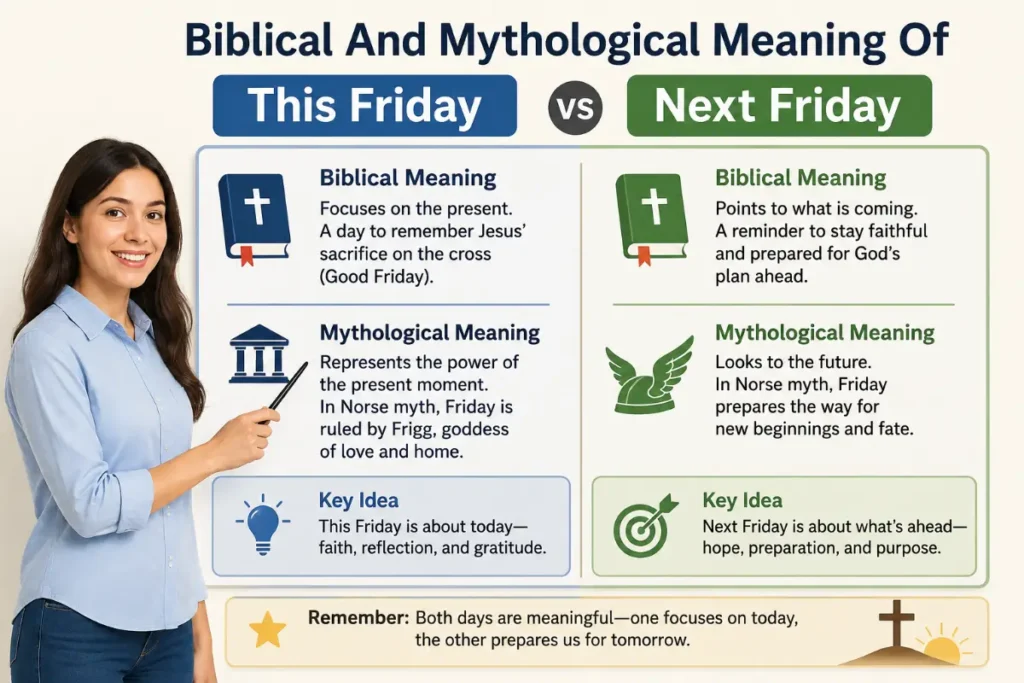
Biblical And Mythological Meaning Of Next Friday vs This Friday
There is no special Biblical meaning. The Bible talks about days weeks and seasons but it does not teach a special rule about saying “this Friday” or “next Friday.” The same is true for mythology. Ancient stories from Greece Rome and many other cultures do not give these expressions any special meaning.
These are simply modern English expressions that help people talk about time. So you can use them without worrying about any religious or mythological meaning.
Symbolism Explained In Simple Words
What Next Friday Represents
When people hear next Friday they often think about planning ahead.
It can suggest waiting preparing or looking toward the future.
For example:
“We will start our vacation next Friday.”
The speaker is thinking about something that is still a little farther away.
It can also give people more time to prepare.
What This Friday Represents
This Friday usually feels closer.
It often creates a feeling of urgency because the day is almost here.
For example:
“Our test is this Friday.”
Students know they should start studying soon.
You can think of it like this.
This Friday feels close.
Next Friday feels a little farther away.
That simple picture helps many learners remember the difference.
Related Words You Should Know Next Friday or This Friday
This Week
Means the current week you are living in.
Example: We have two quizzes this week.
Next Week
Means the week after the current one.
Example: We are traveling next week.
This Weekend
Usually means the nearest Saturday and Sunday.
Example: We are going hiking this weekend.
Next Weekend
Means the weekend after this one.
Example: My cousins are visiting next weekend.
This Coming Friday
A very clear way to mean the nearest Friday.
Example: The game is this coming Friday.
Following Friday
Means the Friday after the nearest Friday.
Example: We will meet the following Friday.
Upcoming Friday
Another clear way to talk about the closest Friday.
Example: The sale starts the upcoming Friday.
Calendar Date
The exact date removes confusion.
Example: The meeting is on Friday September 18.
How People Actually Use It In Daily English
Here are natural examples that you may hear every day.
“Are you free this Friday?”
“I cannot come this Friday.”
“We are leaving next Friday.”
“Our soccer game is this Friday.”
“The party is next Friday.”
“Can we move the meeting to next Friday?”
“My parents are visiting this Friday.”
“I will finish the report this Friday.”
“We have an exam next Friday.”
“Please send me the file before this Friday.”
Notice that these sentences sound natural because people use them in daily life.
When there is any chance of confusion many speakers simply add the date.
For example:
“Our meeting is Friday October 9.”
That sentence is clear for everyone.
Common Mistakes People Make With Next Friday and This Friday
One common mistake is assuming everyone understands the same meaning.
Incorrect:
“The meeting is next Friday.”
Some people think that means the nearest Friday.
Others think it means one week later.
Better:
“The meeting is next Friday August 21.”
Another mistake is changing your meaning during one conversation.
For example:
“We will meet this Friday.”
A few minutes later you say:
“No. I meant next Friday.”
This can confuse everyone.
Think carefully before speaking.
Another mistake is forgetting today’s day.
If today is Monday the nearest Friday is usually called this Friday.
If today is Saturday many people naturally say next Friday because the Friday of that week has already passed.
Finally many learners become nervous because they think there must always be one perfect answer.
English does not always work that way.
Different speakers have different habits.
Your goal is not to win an argument.
Your goal is to communicate clearly.
Final Teacher Explanation
Imagine I am standing in front of a classroom.
A student asks:
“Teacher which one is correct?”
My answer is simple.
Both expressions are correct.
The difference is the time they usually describe.
This Friday normally means the closest Friday.
Next Friday normally means the Friday after that.
But people do not always follow exactly the same pattern.
That is why smart English speakers often include the date.
If your appointment is important write:
“Friday March 13.”
No one will misunderstand you.
Always remember that clear communication is better than perfect grammar.
If the other person looks unsure simply ask:
“Which Friday do you mean?”
That small question can save a lot of confusion.
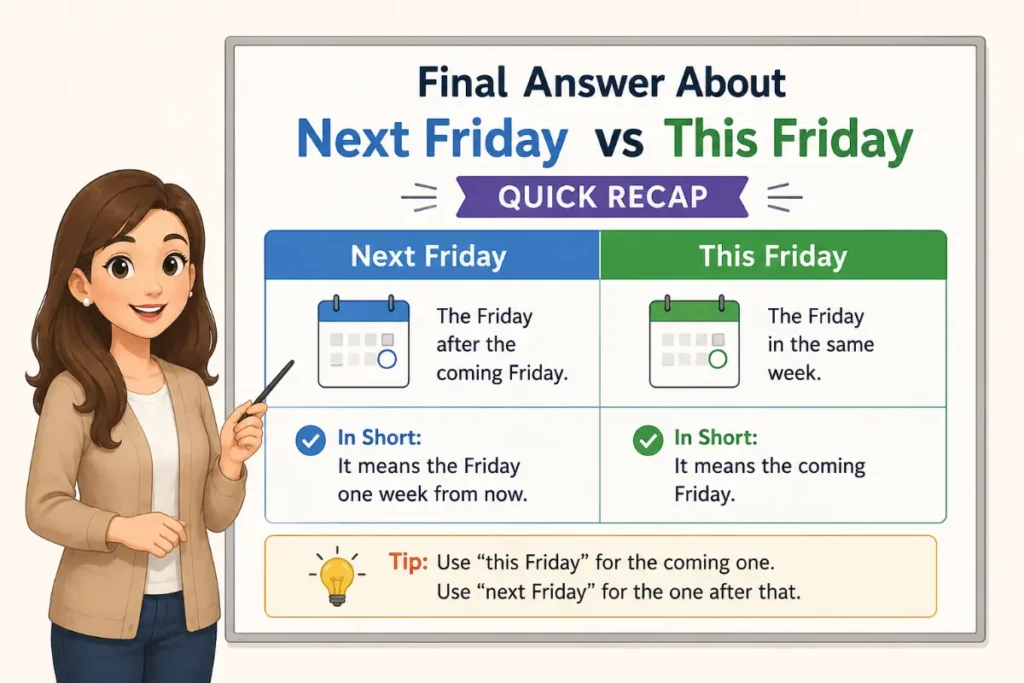
Final Answer About Next Friday vs This Friday Quick Recap
The easiest way to understand of words is to picture a calendar. The nearest Friday is usually this Friday. The Friday after that is usually next Friday.
Still remember that not every English speaker uses these expressions in exactly the same way. If the date really matters add the calendar date or ask a short question. That simple habit makes your English clear friendly and easy to understand.
When you remember people instead of rules your English becomes stronger. Your goal is not only to use correct words. Your goal is to help everyone understand your meaning.
Need another quick comparison? Read Propose vs Purpose: Which Word Should You Use (2026).
Conclusion
Understanding becomes much easier once you think about the calendar instead of only the words. In most situations this Friday means the nearest Friday and next Friday means the Friday after that.
Even native English speakers sometimes ask for clarification because different people use these expressions differently. There is nothing wrong with asking which Friday someone means.
The easiest takeaway is this. Use this Friday for the closest Friday. Use next Friday for the following Friday. If the plan is important always include the date so everyone understands the same day.
Frequently Asked Questions
What does next friday vs this friday mean in simple words?
This Friday usually means the nearest Friday. Next Friday usually means the Friday after that.
Is it correct to use this Friday or next Friday?
Yes. Both are correct. Choose the one that matches the day you mean.
When should I use this Friday?
Use this Friday when you are talking about the closest Friday in most situations.
Why do people get confused between?
People have different speaking habits. Some think about the current week while others think about the next Friday that arrives.
Can I use both forms in writing?
Yes. Both are correct in writing. Adding the exact date makes your meaning much clearer.
How can I avoid confusion?
Mention the calendar date along with Friday. That removes almost all misunderstanding.
Is this coming Friday the same as this Friday?
Yes. In most conversations this coming Friday means the nearest Friday.
Which expression is better for business emails?
Use either expression with the full date. For example, “Friday, August 14.” This is the clearest and most professional choice.
