
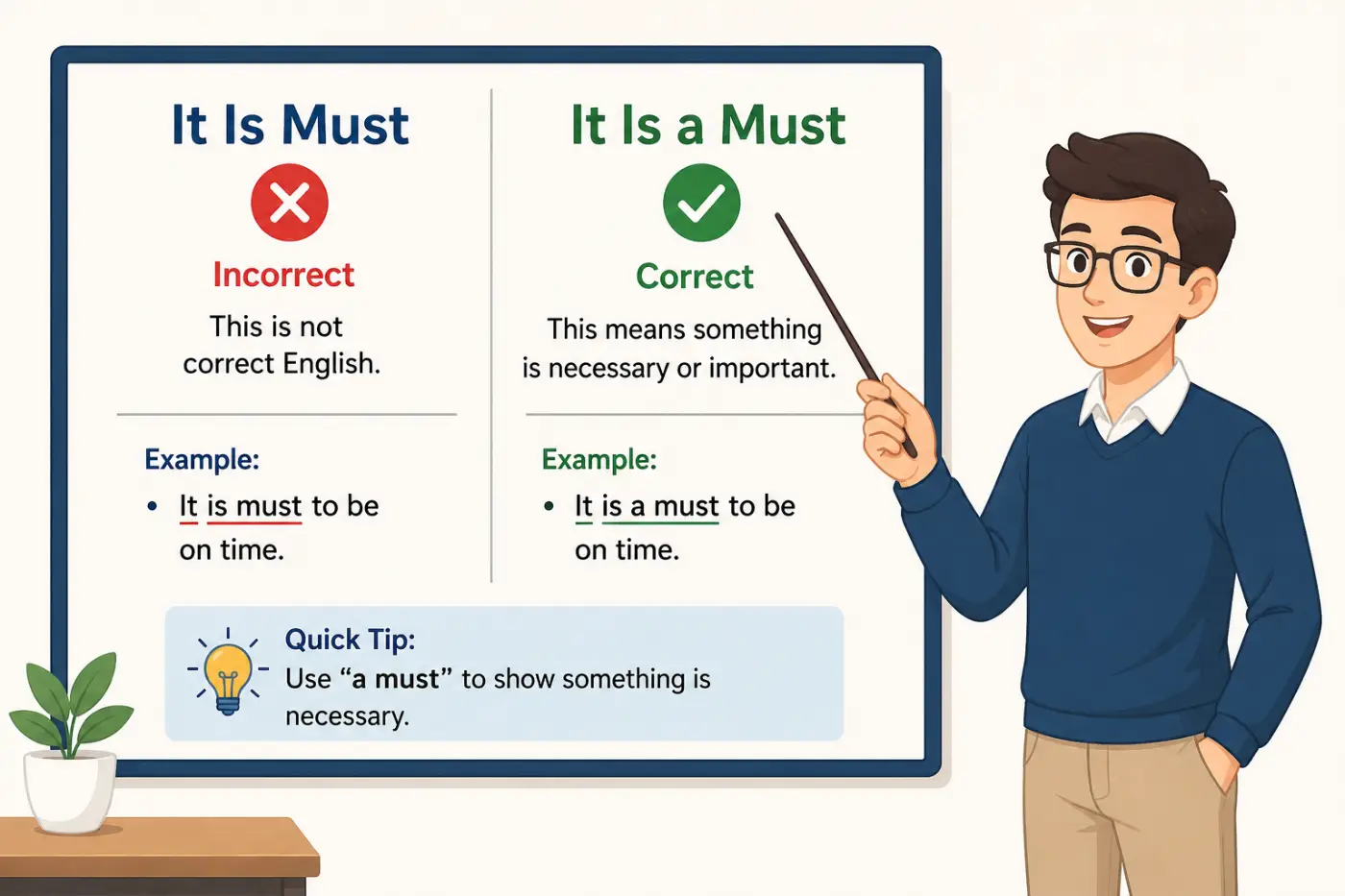
Many English learners ask about it is must vs it is a must because both expressions sound similar. One of them is correct in standard English, while the other is not. If you want to speak and write naturally, knowing the difference is very helpful.
The short answer is easy. “It is a must” is correct. “It is must” is not correct in normal English because the noun must needs the article a in this expression.
This guide explains it is must vs it is a must in very simple English. You will learn what each expression means, why people get confused, how to use the correct form, and how to avoid common mistakes in daily conversations and writing.
Many readers also check Bellies vs Bellys: Which One Is Correct in English?.
Simple Answer in One Look
When comparing it is must vs it is a must, the correct expression is it is a must.
Correct: It is a must.
Incorrect: It is must.
“It is a must” means something is very necessary or strongly recommended.
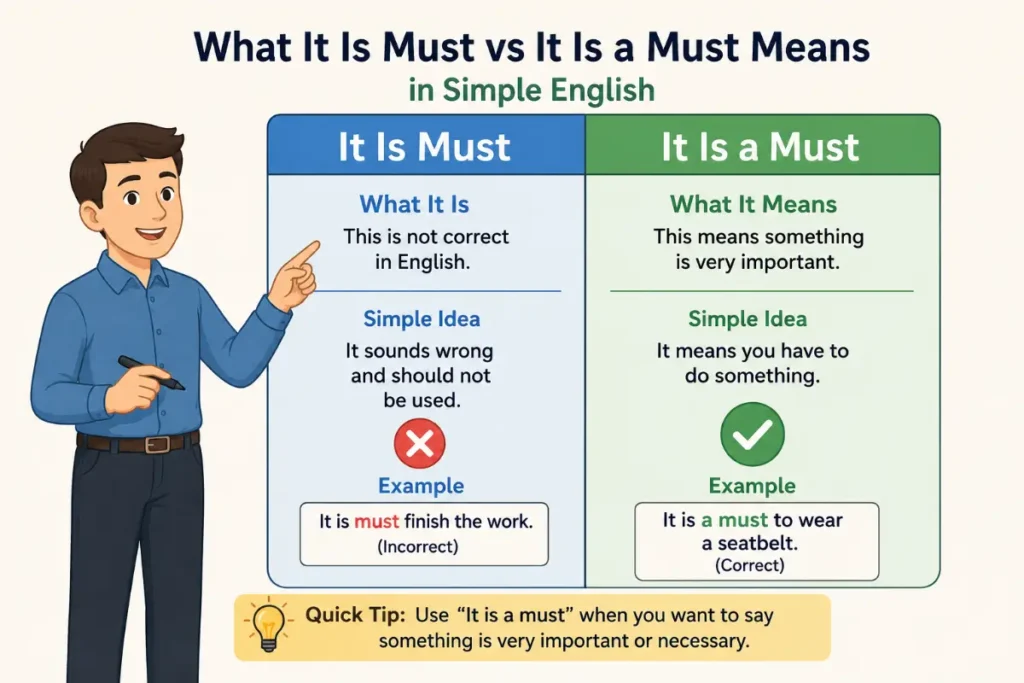
What It Is Must vs It Is a Must Means in Simple English
The phrase it is a must means something should definitely be done. It tells people that an action is necessary, required, or highly recommended.
Think of it as saying:
- You should do it.
- You really need it.
- Do not skip it.
- It is necessary.
For example:
- Wearing a seat belt is a must.
- Drinking enough water is a must during hot weather.
- A passport is a must for international travel.
In each example, the speaker wants to show that something is very important.
Now look at the incorrect form.
It is must.
This sentence does not sound natural because the word must is being used as a noun in this expression. English requires the article a before that noun.
That is why native speakers say:
- It is a must.
They do not normally say:
- It is must.
Why Does “A” Matter?
The small word a makes a big difference.
Compare these examples.
Correct:
- Reading every day is a must.
- Practice is a must.
- Good communication is a must.
Incorrect:
- Reading every day is must.
- Practice is must.
- Good communication is must.
Without a, the sentence is incomplete and sounds wrong.
Another Meaning of “Must”
The word must can also be a helping verb.
For example:
- You must study.
- We must leave now.
- She must be careful.
Here, must means “have to” or “need to.”
Notice the pattern.
- You must study.
- They must work.
- I must go.
In these sentences, must is not a noun. It is helping the main verb.
That is different from:
- Studying is a must.
- Exercise is a must.
Here, must works like a noun that means “something necessary.”
Understanding these two uses makes English much easier.
Why People Mix These Words
Many learners become confused when comparing it is must vs it is a must. There are several simple reasons.
They Already Know “Must”
Most students first learn sentences like these:
- You must listen.
- You must stop.
- We must wait.
Since they see must alone many times, they think it can also stand alone after is.
That creates this mistake:
- It is must.
Some Languages Do Not Use Articles
Many languages do not use words like a and an the same way English does.
Because of that, learners sometimes leave out a without realizing it.
For example:
Correct:
- It is a must.
Incorrect:
- It is must.
They Hear Fast English
Native speakers often speak quickly.
“It is a must” may sound like:
- It’s a must.
If someone only hears the sentence and does not see it written, they may think the a is missing.
Online Mistakes
Not every sentence on the internet is correct.
Sometimes learners copy incorrect English from social media posts or comments.
That is another reason people ask about it is must vs it is a must.
Literal Translation
Some learners translate directly from their first language.
The translation may not include an article, so they write:
- It is must.
Instead, English needs:
- It is a must.
Clear Difference Explained Simply
Here is the easiest way to remember the difference.
| It is a must | It is must |
|---|---|
| Correct English | Incorrect English |
| Means something is necessary | Not natural English |
| Used by native speakers | Grammar mistake |
| Common in speaking and writing | Should be avoided |
Another easy comparison:
It is a must
- Correct
- Natural
- Standard English
- Sounds fluent
It is must
- Incorrect
- Missing the article
- Sounds incomplete
- Avoid using it
Quick Memory Trick
If you can replace the phrase with necessary, then use a must.
For example:
- Exercise is necessary.
- Exercise is a must.
Both sentences have nearly the same meaning.
Which Form Should You Use?
Always choose it is a must.
Whenever you want to say something is necessary, essential, or highly recommended.
Use It for Rules
- Wearing a helmet is a must.
- Following safety rules is a must.
Use It for Advice
- Getting enough sleep is a must.
- Drinking water is a must.
At School
- Homework is a must.
- Practice is a must before the exam.
For Work
- Good teamwork is a must.
- Clear communication is a must.
For Travel
- A valid passport is a must.
- Travel insurance is a must for long trips.
The pattern is simple.
Something + is + a must.
Examples:
- Respect is a must.
- Honesty is a must.
- Preparation is a must.
- Planning is a must.
- Patience is a must.
Once you remember this pattern, you will rarely make a mistake.
Similar Expressions
You can also use these expressions.
- It is necessary.
- It is essential.
- It is required.
- It is very important.
- You should not skip it.
For example:
Instead of:
- Exercise is a must.
You can also say:
- Exercise is essential.
- Exercise is necessary.
- Exercise is very important.
All of these are natural English.
Easy Real-Life Sentences You Can Use
Here are everyday examples using the correct expression.
- A healthy breakfast is a must before school.
- Wearing sunscreen is a must in summer.
- Good manners are a must everywhere.
- Practice is a must if you want to improve.
- A strong password is a must for online safety.
- Water is a must after a long run.
- Reading every day is a must for better English.
- A smile is a must when meeting new people.
Now compare them with incorrect sentences.
Incorrect:
- Reading every day is must.
- Water is must.
- Practice is must.
Correct:
- Reading every day is a must.
- Water is a must.
- Practice is a must.
Reading both versions side by side helps you remember the correct pattern.
Short Conversations
Friend: Should I carry my ID?
Answer: Yes. It is a must.
Student: Do I need to study before the test?
Teacher: Yes. Studying is a must.
Traveler: Do I need a passport?
Officer: Yes. It is a must for international travel.
These examples show how naturally the phrase fits into daily English.
Where This Expression Comes From (Simple History)
The word must has been part of English for hundreds of years. Long ago, people mostly used must as a helping verb to show duty or necessity.
Examples include:
- You must obey.
- We must leave.
Over time, English speakers also began using must as a noun in expressions like a must.
In this newer meaning, a must refers to something that is necessary or something that should not be missed.
You can hear it in many situations.
- This book is a must.
- This movie is a must.
- Safety training is a must.
- A map is a must for hikers.
Today, a must is a common and natural expression in newspapers, books, conversations, advertisements, and everyday English.
That is why the phrase it is a must sounds completely natural, while it is must does not. As English changed over time, this expression became a simple and popular way to talk about things that people should definitely do or have. The more you read, listen, and practice, the easier it becomes to recognize the correct form. Soon, choosing it is a must instead of it is must will feel automatic, and you will use it confidently in both speaking and writing.
In the next section, we will go beyond the basic grammar. You will learn how this expression is understood in everyday culture, where people commonly use it, what it symbolizes, common mistakes to avoid, related words, and a final teacher’s explanation that makes the phrase easy to remember forever.
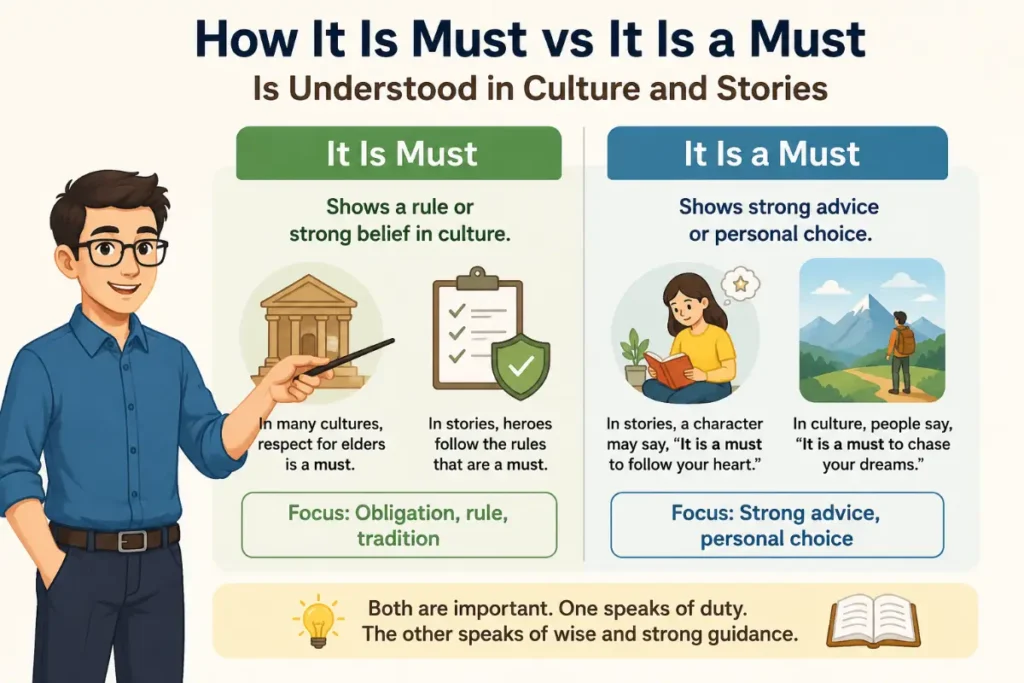
How It Is Must vs It Is a Must Is Understood in Culture and Stories
Language often shows what people think is valuable. The phrase it is a must is more than a grammar pattern. It also shows that something has great value or should never be ignored.
People use this expression when talking about safety, respect, learning, health, and good habits. These are things that many cultures see as necessary for a happy and successful life.
For example:
- Kindness is a must.
- Honesty is a must.
- Education is a must.
These sentences do not mean the law forces you to do these things. Instead, they show that people strongly believe they are important. You will also hear this phrase when people recommend something.
For example:
- This book is a must for new teachers.
- That movie is a must for science fiction fans.
- This restaurant is a must if you visit New York.
In these examples, a must means something is highly recommended.
Stories also use this expression to show what a character needs before reaching a goal.
For example:
- Courage is a must before facing danger.
- Trust is a must in a good friendship.
- Teamwork is a must to win the game.
These examples help readers understand what really matters.
The incorrect form it is must does not have any special meaning in culture or stories. It is simply a grammar mistake. Writers, teachers, and native speakers use it is a must instead.
Many readers also check Any Time vs Anytime: Which Is Correct and How to Use (2026).
Biblical and Mythological Meaning
The exact phrase it is a must does not appear as a special expression in the Bible or in famous myths. However, many Bible stories teach that some actions are necessary.
For example, people are encouraged to:
- Love others.
- Tell the truth.
- Help people in need.
- Show forgiveness.
- Trust God.
Someone explaining these ideas in modern English might say:
- Kindness is a must.
- Faith is a must.
- Honesty is a must.
These are modern ways of expressing an old idea.
The same is true in mythology.
Many heroes needed courage, wisdom, or patience before completing their journey.
Today, someone may describe these qualities by saying:
- Courage is a must for every hero.
- Wisdom is a must for a good leader.
These are modern expressions, not direct quotations from religious or mythological texts.
Symbolism Explained in Simple Words
What It Is a Must Represents
The expression it is a must represents ideas such as:
- Responsibility
- Importance
- Readiness
- Good planning
- Strong advice
- Something that should not be skipped
When someone says something is a must, they want you to understand that it deserves attention.
For example:
- A helmet is a must for bike riders.
This symbolizes safety.
Another example:
- Practice is a must before the performance.
This symbolizes preparation.
What It Is Must Represents
The expression it is must does not represent a different meaning.
Instead, it represents a common learning mistake.
Many English learners forget the article a because their first language may not use articles the same way.
So when people see it is must, they usually understand that the writer is still learning English.
The sentence does not create a new meaning. It is simply incomplete.
Remember this simple comparison.
It is a must
- Correct English
- Shows necessity
- Sounds natural
- Used by native speakers
It is must
- Incorrect English
- Missing the article
- Sounds incomplete
- Avoid in speaking and writing
Related Words You Should Know
Learning related words helps you understand it is must vs it is a must even better.
Necessary
Something that is needed. Example:
A passport is necessary for many international trips.
Essential
Something very important. Example:
Water is essential for life.
Required
Something you must have or do because of a rule. Example:
An ID card is required.
Important
Something with great value. Example:
Sleep is important for good health.
Needed
Something people should have. Example:
A map is needed for the hike.
Obligation
Something you are expected to do. Example:
Paying taxes is an obligation.
Duty
Something that is your responsibility. Example:
Helping your family is your duty.
Recommendation
Friendly advice about something good. Example:
Reading this book is my recommendation.
Have to
A common expression that means something is necessary. Example:
You have to finish your homework.
Must
A helping verb that shows necessity. Example:
You must wear your seat belt.
These words have similar meanings, but they are not always used in the same way.
How It Is Must vs It Is a Must Is Actually Used in Daily English
Native speakers almost always use it is a must.
Here are real-life examples.
- A driver’s license is a must for this job.
- Good communication is a must in every team.
- Water is a must during summer.
- Practice is a must if you want better results.
- Saving money is a must for future plans.
- A password is a must for online accounts.
- A smile is a must when greeting customers.
- Regular exercise is a must for a healthy lifestyle.
- Reading every day is a must for improving English.
- Patience is a must when teaching young children.
You may also hear shorter versions.
- That’s a must.
- This is a must.
- It’s a must.
These sound very natural in everyday conversation.
You should avoid saying:
- It is must.
- This is must.
- That is must.
These forms are not correct in standard English.
Common Mistakes People Make
Many learners make the same mistakes when comparing it is must vs it is a must.
Mistake 1: Leaving Out “A”
Incorrect:
It is must.
Correct:
It is a must.
This is the most common mistake.
Mistake 2: Using “Must” Like a Noun Without an Article
Incorrect:
Homework is must.
Correct:
Homework is a must.
Always remember the article.
Mistake 3: Mixing the Helping Verb and the Noun
Correct:
You must study.
Correct:
Studying is a must.
These are both correct, but they follow different patterns.
Mistake 4: Translating Directly
Some learners translate from another language.
That can create sentences like:
It is must.
Instead, think in English.
Use:
It is a must.
Mistake 5: Copying Incorrect Online English
Not every website or social media post uses correct grammar.
If you are unsure, remember the simple rule.
Something + is + a must.
Examples:
- Respect is a must.
- Safety is a must.
- Practice is a must.
Final Teacher Explanation
Imagine you are sitting in an English classroom.
A student asks,
“Teacher, which one is correct? It is must or it is a must?”
The answer is simple.
Always choose it is a must.
The article a is needed because must is working as a noun in this expression.
Think about these examples.
- Water is a must.
- Honesty is a must.
- A passport is a must.
- Practice is a must.
These all sound natural.
Now compare them.
- Water is must.
- Honesty is must.
- Practice is must.
These sound incomplete because the article is missing.
Here is one easy trick.
If you can replace the phrase with necessary, then a must is probably the correct choice.
For example:
- Exercise is necessary.
- Exercise is a must.
Both sentences share almost the same meaning.
This simple rule will help you every time.
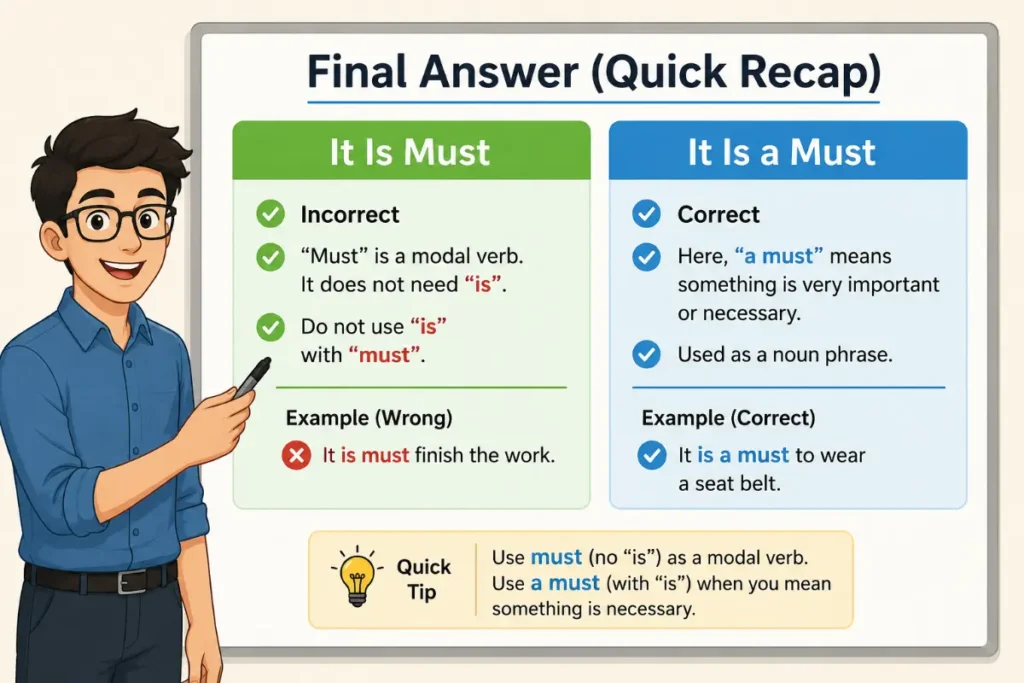
Final Answer About It Is Must vs It Is a Must (Quick Recap)
When comparing it is must vs it is a must, the correct expression is always it is a must. This phrase means that something is necessary, essential, or strongly recommended. It is common in everyday conversations, books, news articles, and professional writing.
The form it is must is not correct in standard English because the noun must needs the article a in this expression. Native speakers do not normally use the incorrect form.
The easiest way to remember this lesson is to think of a must as another way of saying necessary. If something is very important and should not be skipped, you can confidently say, It is a must.
You may also want to read Time Flies or Time Flys: Which Is Correct and Why (2026)?.
Conclusion
By now, the difference between it is must vs it is a must should feel simple. The correct expression is it is a must, and it means something is necessary or strongly recommended. The form it is must is a grammar mistake and should be avoided.
The best way to remember this rule is to practice it in everyday sentences. The more you read and hear correct English, the more natural it is a must will sound.
Take away this one simple rule: If something is necessary, say “it is a must,” never “it is must.”
Frequently Asked Questions (FAQs)
What does it is a must mean in simple words?
It means something is very necessary or highly recommended.
Is it is must correct English?
No. Standard English uses it is a must.
Which is correct: it is must vs it is a must?
It is a must is the correct expression.
When should I use it is a must?
Use it when something should definitely be done or should not be missed.
Why do people confuse it is must vs it is a must?
Many learners forget the article a or translate directly from another language.
Can I use it is a must in formal writing?
Yes. It is acceptable in both formal and informal English.
Can I replace it is a must with another phrase?
Yes. You can also say it is necessary, it is essential, or it is required, depending on the situation.
Is must always followed by a?
No. When must is a helping verb, it does not use a.
Example:
- You must listen.
When it is used as a noun in this expression, use a.
Example:
- Listening is a must.
