
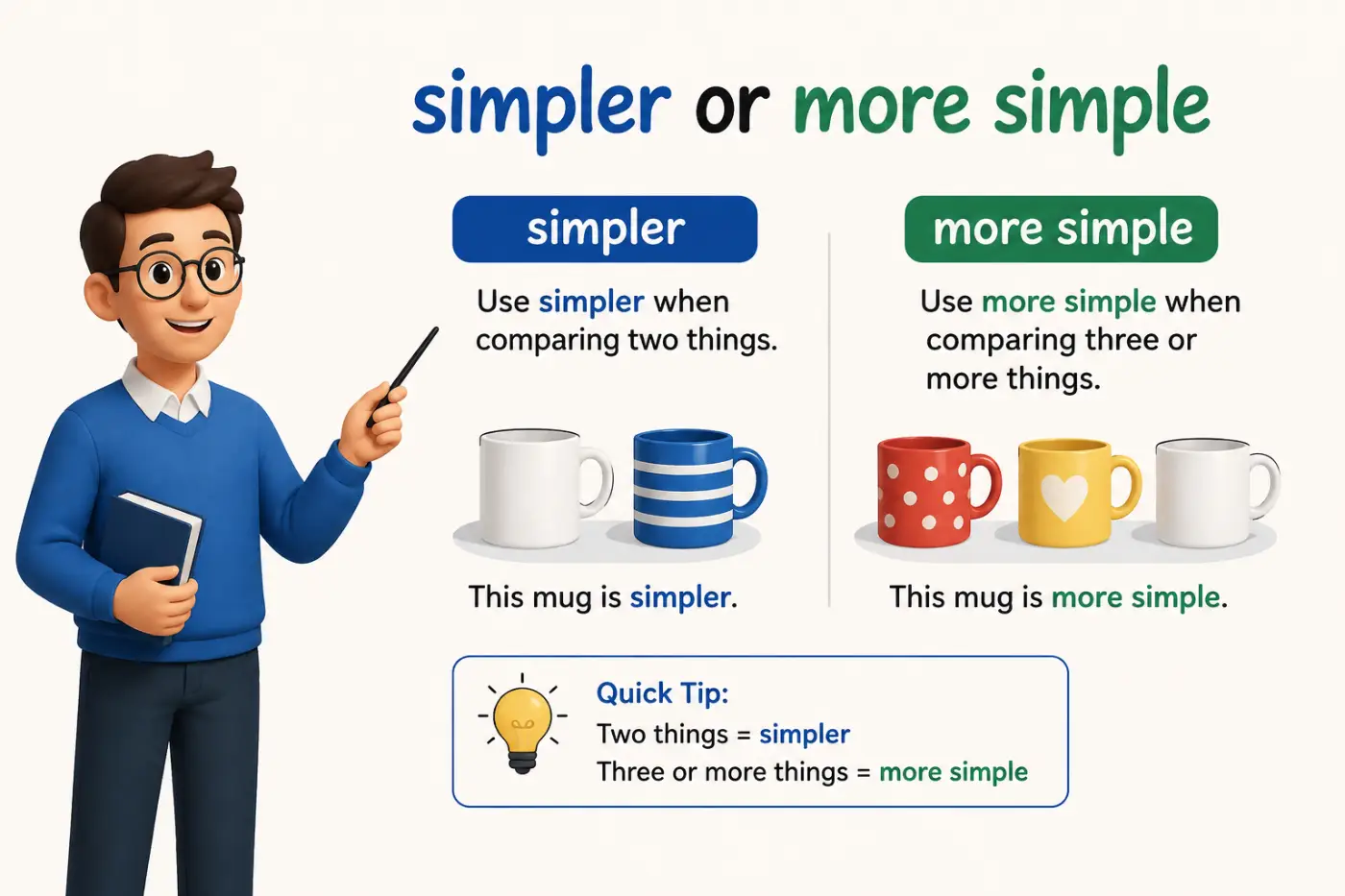
Many English learners ask about simpler or more simple because both forms look possible. You may hear both in conversations or see both in books. That can make the choice confusing.
The good news is that the answer is easy. In most everyday situations, simpler is the correct and more natural choice. Native English speakers usually prefer it because it sounds shorter and smoother.
Still, more simple is not always wrong. There are a few situations where people use it for style or emphasis. This guide explains everything in clear and simple English so you know exactly when to use each form.
Many readers also check Fair vs Good: Differences,Meaning and Examples (2026).
Simple Answer In One Look
Simpler is the normal and preferred form in everyday English.
More simple is also correct, but it is much less common and is mainly used for emphasis or personal style.
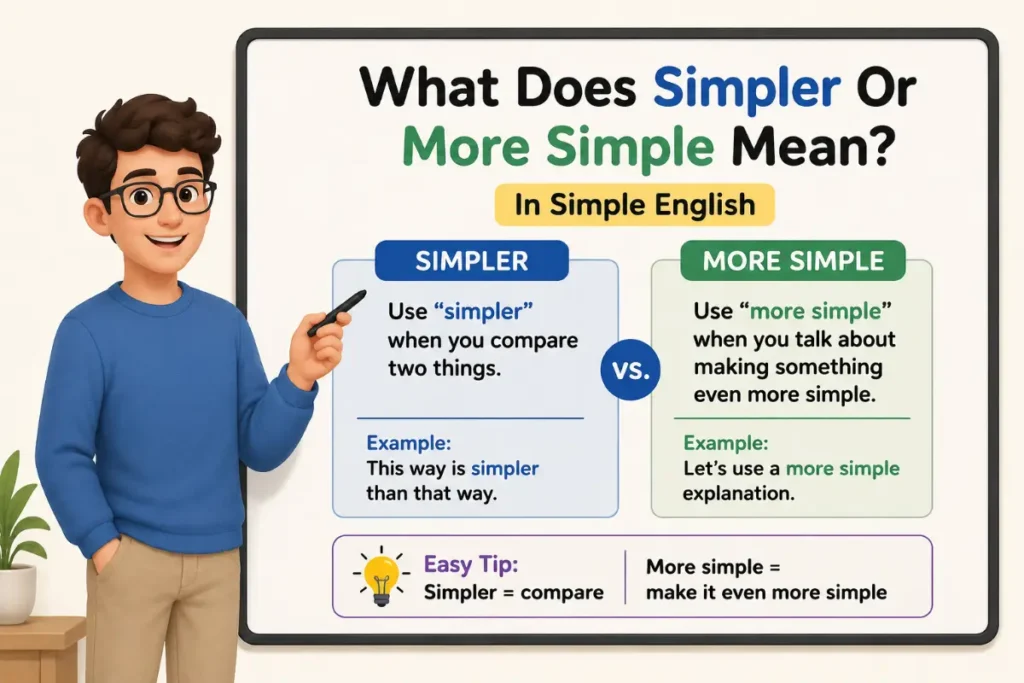
What Does Simpler Or More Simple Mean In Simple English?
The words simpler and more simple both compare two things. They show that one thing is easier to understand, easier to do, or less complicated than another. Think of the word simple first. Simple means easy. When you compare two things, you need a comparative form. English gives you two possible ways.
One way is to add er to the adjective.
Simple becomes simpler.
The other way is to put more before the adjective.
Simple becomes more simple.
Both forms carry the same basic meaning.
Look at these examples.
This lesson is simpler than yesterday’s lesson.
This lesson is more simple than yesterday’s lesson.
Both sentences are correct. However, the first one sounds more natural to most English speakers.
Imagine two maps.
One map has many streets.
The other map has only a few streets.
You can say:
The second map is simpler.
Most people would choose this sentence instead of saying:
The second map is more simple.
That is why learners usually hear simpler much more often.
A good way to remember this is that shorter words often take er when we compare them.
Simple follows this common pattern in everyday English.
Why Do People Mix These Words Simpler Vs More Simple?
Many people become confused because English has two different ways to make comparisons.
Sometimes you add er.
Sometimes you use more.
Look at these examples.
Small becomes smaller.
Fast becomes faster.
Happy becomes happier.
Beautiful becomes more beautiful.
Interesting becomes more interesting.
Comfortable becomes more comfortable.
Now look at the word simple.
It sits between these groups.
Because it has two syllables, some learners think it should always use more.
Others think it should always use er.
That is why the question about simpler or more simple comes up so often.
Another reason is that people hear both forms in movies, books, speeches, and online videos.
For example, a teacher might say:
Can you give me a simpler explanation?
Another speaker may say:
Can you make it more simple?
Both sentences are understandable.
The first one simply sounds more natural in everyday American and British English.
Some learners also translate directly from their first language. In many languages, comparisons always use a word that means more. Because of that, they naturally say more simple.
As they become more familiar with English, they notice that native speakers usually choose simpler.
Clear Difference Explained Simply
The meaning is almost the same.
The main difference is how natural each form sounds.
| Simpler | More Simple |
|---|---|
| More common | Less common |
| Sounds natural in daily English | Sounds more formal or more emphatic |
| Preferred in speaking | Sometimes used for style |
| Short and smooth | Longer expression |
| Best choice in most situations | Used in fewer situations |
Here are some easy comparisons.
Simple: This answer is simpler.
Less common: This answer is more simple.
Simple: We need a simpler plan.
Less common: We need a more simple plan.
Simple: She gave a simpler example.
Less common: She gave a more simple example.
Notice that the meaning does not change very much.
The biggest difference is the way the sentence sounds.
If you want natural English, choose simpler.
Which Form Should You Use Simpler And More Simple?
For almost every everyday conversation, use simpler. This is the form that teachers usually recommend. It is also the form that appears more often in newspapers, websites, classrooms, and daily conversations.
Here is an easy rule.
If you are comparing two things and the adjective is simple, use simpler.
Examples:
This road is simpler to follow.
Her instructions are simpler.
That method is simpler than mine.
My new phone is simpler to use.
This recipe is simpler to make.
There are a few times when people choose more simple.
Sometimes a writer wants a special rhythm.
Sometimes it matches the style of nearby words.
Even then, simpler is still a safe choice.
If you are taking an English test, writing an email, speaking in class, or talking with friends, simpler is usually your best answer.
Easy Real Life Sentences You Can Use
Here are simple examples you can use every day.
This game is simpler than the last one.
Please use simpler words.
Can you give me a simpler answer?
This phone is simpler to use.
Her plan is simpler than ours.
The new design looks simpler.
I need a simpler explanation.
The teacher made the lesson simpler for everyone.
These sentences sound natural and are easy to understand.
Where Simpler Vs More Simple Expression Comes From Simple History
The word simple comes from Latin through Old French before becoming part of English many centuries ago. Its original meaning was something like plain, single, or not complicated. As English developed, people formed the comparative by adding er, creating the word simpler. English also developed another way to compare adjectives by using more.
That is why both simpler and more simple are grammatically possible. Over time, everyday English strongly favored simpler because it is shorter and easier to say. Today, that is still the form most native speakers naturally choose.
As you continue learning English, you will notice that many grammar questions are not really about right or wrong. They are about what sounds most natural to native speakers. In the next section, you will learn how simpler and more simple are used in real conversations, writing, culture, common mistakes, and practical situations so you can use them with confidence.
How Is Understood In Culture And Stories
People often connect the idea of being simple with good communication. Across many cultures, a simple message is seen as easier to understand and easier to remember. Teachers often try to give simpler lessons so every student can follow along. Parents also use simpler words when talking to young children. The goal is not to remove meaning. The goal is to make ideas clear.
Stories also show the value of keeping things simple. A hero may solve a difficult problem with a simple idea instead of a complicated plan. This teaches that the best answer is not always the hardest one.
In everyday life, people often say things like:
“Can you make that simpler?”
“Please use simpler words.”
“I need a simpler explanation.”
These expressions show that people value clear communication. When someone says, “Make it more simple,” everyone still understands the message. Even so, most native speakers naturally say, “Make it simpler.” That is why simpler has become the common choice in everyday English.
Learn the difference in Bellies vs Bellys: Which One Is Correct in English?.
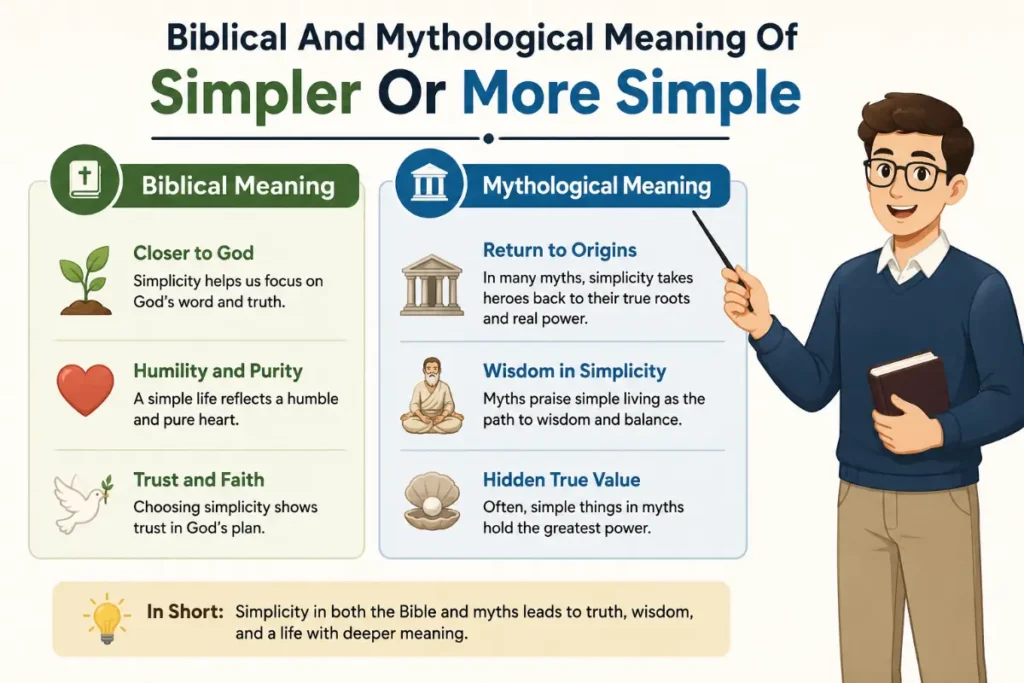
Biblical And Mythological Meaning Of Simpler Or More Simple
The Bible does not teach a grammar rule about words. However, many Bible translations try to use simple language so more people can understand the message. Modern versions often replace difficult words with simpler ones. The main idea is that truth should be clear and easy to understand.
Mythology also does not discuss simpler or more simple as grammar. Still, many old stories were passed from person to person using simple language. This helped people remember them for many years.
So while these expressions have no special religious or mythological meaning, the idea of speaking clearly appears in many traditions around the world.
Symbolism Explained In Simple Words
What Simpler Represents
The word simpler often represents clarity.
It reminds people of easy learning, clear thinking, and better understanding.
When someone asks for a simpler explanation, they are asking for less confusion and more clarity.
It can also represent kindness because explaining something simply helps other people learn.
What More Simple Represents
More simple represents the same basic idea.
It also means easier or less complicated.
The difference is mostly in style, not meaning.
Some writers choose more simple because they want extra emphasis or because it fits the rhythm of a sentence.
Even then, the message stays the same.
If your goal is natural everyday English, simpler is still the better choice.
Related Words You Should Know
Simple
Means easy to understand or not complicated.
Simpler
The common comparative form of simple. It compares two things.
Simplest
The highest degree. It means the easiest of all.
Simplify
Means to make something easier.
Example: Please simplify the directions.
Simplicity
Means the quality of being simple.
Example: People like the simplicity of the design.
Clearly
Means in an easy-to-understand way.
Example: She explained the lesson clearly.
Easy
Means not hard to do or understand.
Example: This game is easy to play.
Easier
The comparative form of easy.
Example: This method is easier than the old one.
Plain
Means simple without extra details.
Example: He gave a plain answer.
Straightforward
Means clear and easy to follow.
Example: The instructions are straightforward.
Learning these related words will help you build stronger English sentences and choose the right expression more naturally.
How People Actually Use Simpler And More Simple In Daily English
Here are examples you may hear every day.
Can you give me a simpler answer?
This recipe is simpler than the last one.
I need simpler instructions.
The new app is much simpler to use.
Please explain it in simpler words.
Her idea is simpler and easier to follow.
This design looks simpler.
Our teacher always gives simpler examples.
Can you make this sentence simpler?
I wish the directions were simpler.
Now look at a few examples with more simple.
Can you make it more simple for beginners?
I need a more simple explanation.
The manager wanted a more simple design.
These sentences are correct, but most native speakers would naturally replace more simple with simpler.
That small change makes the sentence sound smoother.
Common Mistakes People Make
Many learners make the same mistakes when choosing between words.
Mistake:
This book is more simpler than that one.
Correct:
This book is simpler than that one.
Why?
Do not use more and er together.
Mistake:
This answer is simple than mine.
Correct:
This answer is simpler than mine.
When comparing two things, use the comparative form.
Mistake:
This lesson is the simpler.
Correct:
This lesson is simpler.
Or:
This is the simplest lesson.
Use simplest only when comparing more than two things and talking about the easiest one.
Mistake:
I always use more simple because it sounds safer.
Better choice:
I usually use simpler because it is more natural.
Remember this easy rule.
If you are not sure which one to choose, use simpler.
You will almost always sound natural.
Final Teacher Explanation About Simpler Vs More Simple
Imagine you are sitting in an English classroom.
A student raises a hand and asks, “Should I say these words?”
My answer would be very easy.
Both are grammatically correct.
However, simpler is the form that native English speakers use most of the time.
It sounds smoother.
It feels more natural.
That is why teachers, dictionaries, and grammar guides usually recommend it.
You do not need to worry every time you compare two things.
Just remember this simple classroom rule.
Use simpler in normal speaking and writing.
Use more simple only if you have a special reason or prefer that style.
If you follow this advice, your English will sound more natural and more confident.
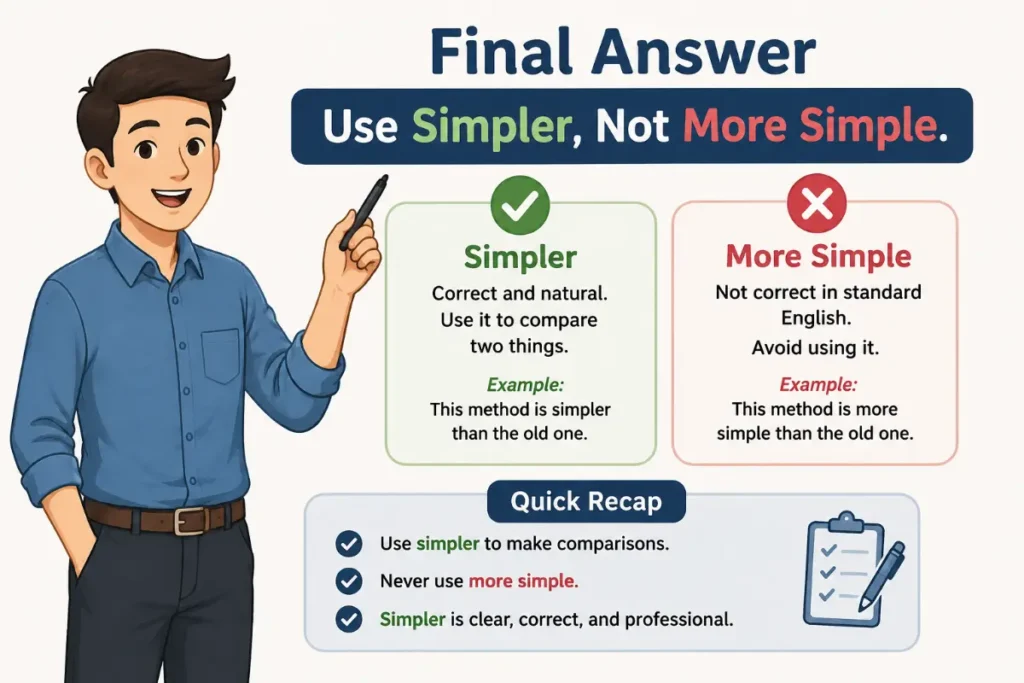
Final Answer About Simpler Or More Simple Quick Recap
The question about words have a simple answer. Both forms are correct English, but they are not used equally. In everyday speaking and writing, simpler is the clear winner. It is the form that most native speakers choose because it is shorter, smoother, and more natural. You can safely use it in school, at work, in emails, and in conversations.
Whenever you compare two things and want to say one is easier or less complicated, choose simpler. It is the easiest choice to remember and the one you will hear most often.
For another common grammar confusion, see Figoro or Masingo: Which Word Should You Use (2026)?.
Conclusion
You now know the difference between words . While both expressions are grammatically correct, simpler is the form that sounds most natural in modern English.
The best way to improve your English is to notice how native speakers use words in real conversations. The more you read and listen, the easier these small grammar choices become.
Keep one simple rule in mind. When you wonder about simpler or more simple, choose simpler for almost every everyday situation.
Frequently Asked Questions FAQs
What does simpler mean in simple words?
Simpler means easier to understand, easier to do, or less complicated than something else.
Which is correct?
Both are correct, but simpler is much more common in everyday English.
When should I use simpler?
Use simpler when comparing two things in normal speaking or writing.
Why do people get confused?
English sometimes uses er and sometimes uses more to make comparisons. That makes learners unsure which form to choose.
Can I use more simple in writing?
Yes. It is grammatically correct, but simpler is usually the better and more natural choice.
Is simpler used in American English?
Yes. American English strongly prefers simpler in everyday speech and writing.
Which form sounds more natural?
Simpler sounds more natural to most native English speakers.
How can I remember the correct choice?
Think of this easy rule. If you are comparing two things and using the word simple, choose simpler.
