
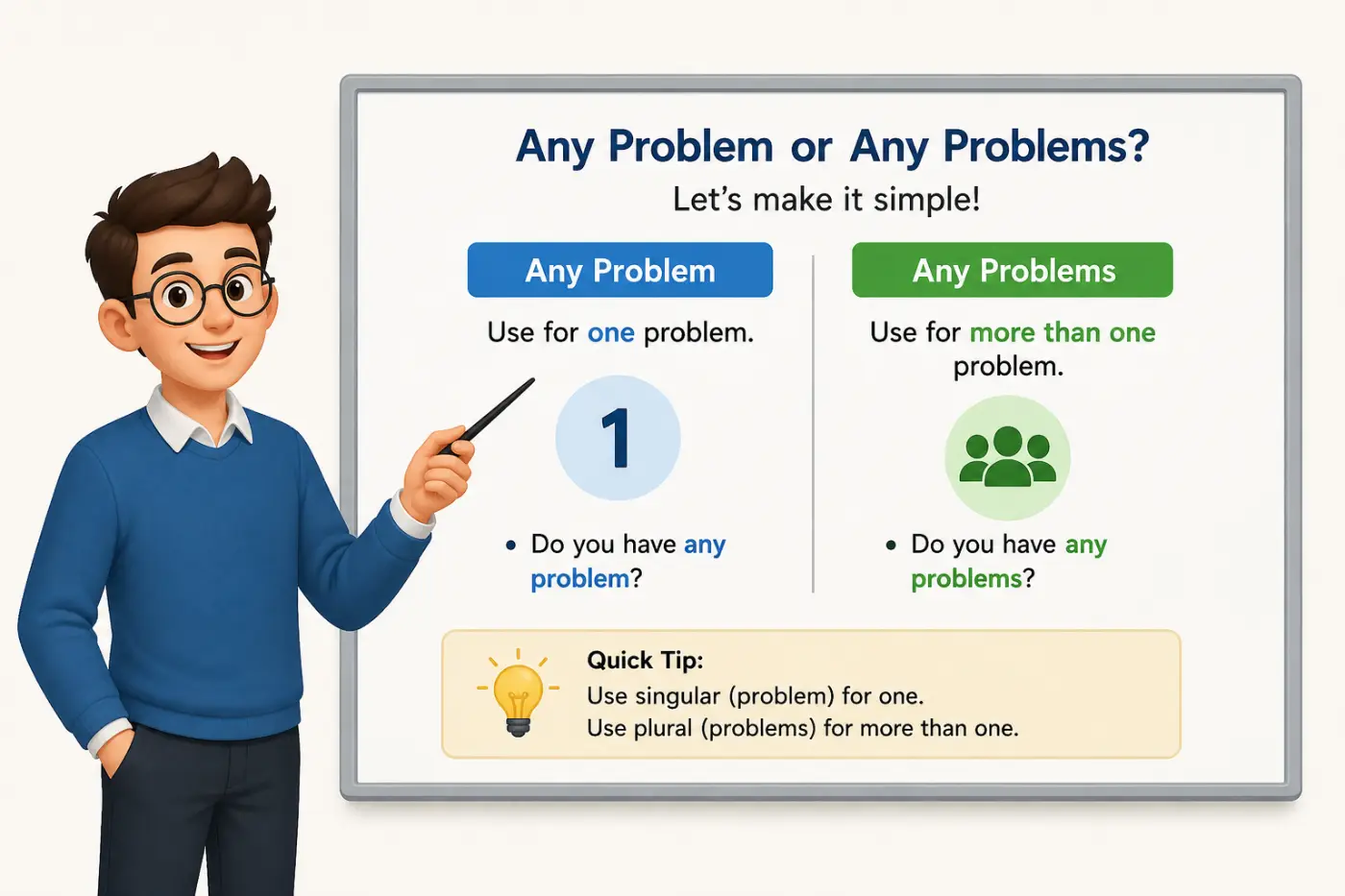
Many English learners ask about any problem or any problems because both forms look correct. The good news is that both are correct. The right choice depends on what you want to say. Sometimes you talk about one possible problem. Other times you talk about more than one possible problem.
This small difference can change the meaning of your sentence. Once you understand the idea it becomes very easy to choose the right form. You do not need difficult grammar rules. You only need to know what you are talking about.
In this guide you will learn the difference between in simple English. You will see easy examples common mistakes and real life sentences that you can use every day.
Learn the difference in Affend vs Offend: Meaning, Difference, and Examples.
Simple Answer in One Look
- Use any problem when you mean one possible problem.
- Use any problems when you mean one or more problems in general.
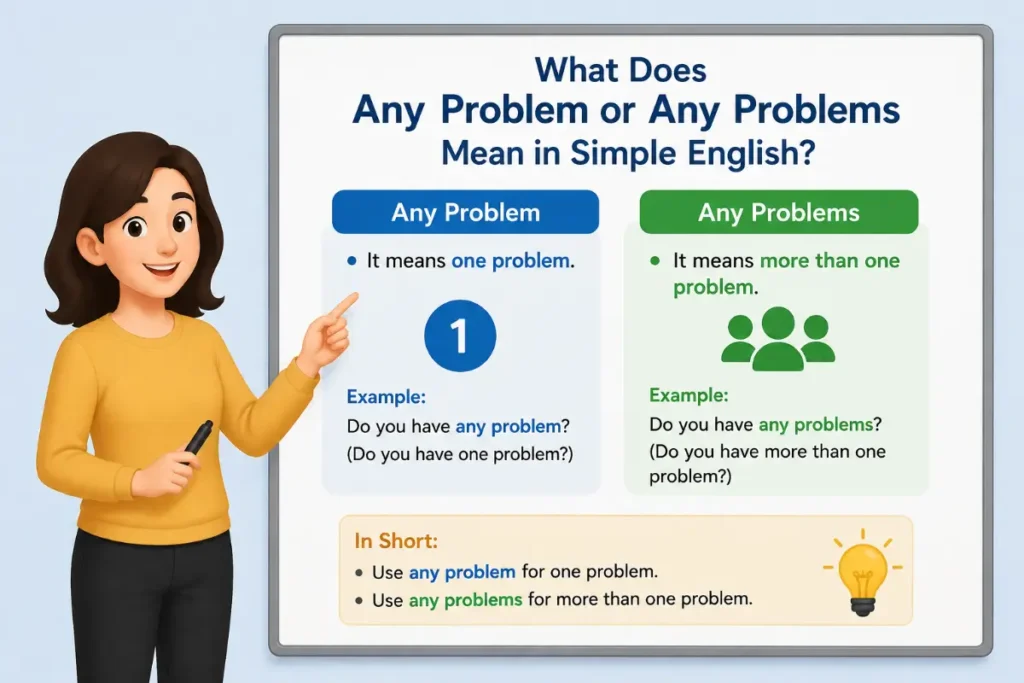
What Does Any Problem or Any Problems Mean in Simple English
The word any talks about something that is not specific. It can mean one thing many things or none at all depending on the sentence.
The word problem means a difficulty or something that needs to be fixed.
When you say any problem you are thinking about one possible difficulty.
When you say any problems you are thinking about one or more possible difficulties.
Look at these examples.
- Tell me if you have any problem.
- Tell me if you have any problems.
Both sentences are correct. The second one is more common in everyday English because people often think about all possible problems instead of just one.
Think of it like this.
One possible difficulty equals any problem.
One or more possible difficulties equals any problems.
This simple idea will help you make the right choice most of the time.
Why Do People Mix These Words
Many people become confused because they hear both forms in conversations books and movies.
Here are some reasons why this happens.
Both Forms Are Correct
Most English mistakes happen because one form is wrong. That is not true here. Both expressions are correct so learners wonder which one sounds better.
For example
- Do you have any problem?
- Do you have any problems?
Native speakers understand both.
Different Countries Use Them Differently
Some speakers use any problem more often in certain situations.
Others naturally choose any problems.
This makes learners think one version is always right. That is not true.
Many Languages Use Only One Form
In some languages people do not change between singular and plural in the same way.
Because of this learners often translate directly from their own language.
Small Difference in Meaning
The difference is very small.
That is why many people cannot hear it right away.
With practice the difference becomes clear.
Clear Difference Explained Simply
Here is an easy comparison.
| Any Problem | Any Problems |
|---|---|
| Talks about one possible problem. | Talks about one or more possible problems. |
| Focuses on a single difficulty. | Focuses on possible difficulties in general. |
| Less common in everyday speech. | More common in everyday conversation. |
| Often sounds more specific. | Often sounds more natural. |
Now compare these examples.
Any problem
- Is there any problem with your order?
- If there is any problem call me.
Here the speaker is thinking about one possible issue.
Any problems
- Are there any problems with your order?
- If you have any problems call me.
Here the speaker is talking about every possible issue that may happen.
Which Form Should You Use Any Problem or Any Problems
This is the easiest rule to remember.
Use any problem when you are thinking about one possible issue.
Examples
- Is there any problem?
- Was there any problem at school?
- Do you see any problem here?
Use any problems when you mean one or many possible issues.
Examples
- Do you have any problems?
- Are there any problems today?
- Please tell me about any problems you find.
If you are not sure which one to choose everyday English usually sounds more natural with any problems because people often speak about possible issues as a group.
In Questions
Questions are where people see these expressions most often.
Look at these examples.
- Do you have any problem?
- Do you have any problems?
- Is there any problem?
- Are there any problems?
- Did you notice any problem?
- Did you notice any problems?
Notice something simple.
If the sentence talks about one possible issue use the singular noun.
If it talks about possible issues in general use the plural noun.
In Negative Sentences
Negative sentences also use both forms.
Examples
- I do not have any problem with your idea.
- I do not have any problems with your idea.
- We did not find any problem.
- We did not find any problems.
Again both are correct.
The plural version is more common because it naturally includes all possible issues.
After If
You will often hear these expressions after if.
Examples
- If there is any problem please call me.
- If you have any problems please email us.
- If there is any problem we will help.
- If you have any problems we are ready to help.
These are very common in customer service schools hospitals and workplaces.
Easy Trick to Remember
Ask yourself one question.
Am I talking about one possible issue or many possible issues?
If the answer is one use any problem.
If the answer is one or more use any problems.
This simple question will help you every time.
Common Situations Where People Use
You can hear these expressions almost everywhere.
At school
- Do you have any problems with your homework?
- Is there any problem with your project?
At work
- Let me know if you have any problems.
- Tell me if there is any problem.
Shopping
- Is there any problem with this phone?
- Did you have any problems using the app?
These examples show how natural both forms are.
Common Mistakes Students Make Any Problem or Any Problems
Many learners make small mistakes.
Mistake One
Do you have any problemes?
Wrong because problemes is not an English word.
Correct
Do you have any problems?
Mistake Two
Do you have any a problem?
Wrong because any does not go with a here.
Correct
Do you have any problem?
Mistake Three
Are there any problem?
Wrong because are there needs a plural noun.
Correct
Are there any problems?
Mistake Four
Is there any problems?
Wrong because is there matches a singular noun.
Correct
Is there any problem?
You may also want to read Shiny vs Shiney: Which Spelling Is Correct (2026 Guide)?.
Easy Real Life Sentences You Can Use
Here are simple examples you can use every day.
- Tell me if you have any problems.
- Call me if there is any problem.
- We did not have any problems during the trip.
- Is there any problem with your computer?
- I cannot see any problems here.
- Please ask if you have any problems.
- Did you find any problem in the report?
- We solved every problem before lunch.
Read these sentences aloud. You will quickly become comfortable using both forms.
Where This Expression Comes From Simple History
The word problem comes from an old Greek word that meant something put forward for discussion or something that needed a solution Later it became part of Latin and then English. The word any has been part of English for hundreds of years. It has always been used to talk about one thing many things or no things in a general way. Over time English speakers naturally used any with both singular and plural nouns.
As you have seen the choice between is not about right or wrong. It is about meaning and context. In the next section you will learn how native speakers use these expressions in daily life how they appear in culture and writing the mistakes that even advanced learners make and the best ways to remember the difference forever.

How Any Problem or Any Problems Is Understood in Culture and Stories
People everywhere face problems. That is why the words appear in books movies TV shows and daily conversations. They are not special words. They are simple words that people use when talking about life. In many stories a character asks a question like this.
“Is there any problem?”
This question shows that the speaker wants to help. It also shows care and concern. In other stories someone may say this.
“If you have any problems come and see me.”
This sounds warm and friendly. The speaker is saying that help is always available. Teachers often say this to students.
“If you have any problems with your homework ask me.”
Parents say it to children.
“If you have any problems at school tell us.”
Doctors may say it to patients.
“If you have any problems after taking this medicine call us.”
These examples show that is often connected with kindness support and solving difficulties.
The expression is not negative. Instead it often opens the door for help.
Biblical and Mythological Meaning
There is no special Biblical or mythological meaning. The words are ordinary English expressions. Still many stories in the Bible teach people to ask for help when facing problems. They also encourage patience wisdom and faith during difficult times.
Many old myths from different cultures also tell stories about heroes solving one problem after another. These stories remind us that problems are a normal part of life.
So while these expression has no special religious meaning the idea behind the words is easy to understand. Every person faces challenges and every challenge can have a solution.
Symbolism Explained in Simple Words
What Any Problem Represents
The phrase any problem usually represents one specific challenge.
It makes people think about one clear issue that needs attention.
For example.
- Is there any problem with the machine?
- Was there any problem during the meeting?
The focus stays on one possible difficulty.
It can also suggest that the speaker believes only one issue may exist.
What Any Problems Represents
The phrase any problems represents all possible difficulties.
It feels more open and general.
For example.
- Do you have any problems at work?
- Please tell us about any problems you notice.
The speaker is ready to hear about one problem or many problems.
This is why any problems is more common in everyday English.
It covers every possibility without limiting the conversation.
Related Words You Should Know Any Problem or Any Problems
Here are some useful words that are closely related.
Issue
An issue is another word for a problem. People often use it in work or business conversations.
Difficulty
A difficulty is something that is hard to do or understand. It can be small or large.
Trouble
Trouble means a problem that causes stress or worry. It is very common in spoken English.
Challenge
A challenge is a difficult task that can help you grow or improve.
Obstacle
An obstacle is something that blocks your progress or makes success harder.
Solution
A solution is the answer to a problem.
Fix
A fix is a simple way to repair or solve a problem.
Error
An error is a mistake. Errors often create problems.
Concern
A concern is something that makes you feel worried.
Question
People sometimes ask a question because they think there may be a problem.
Learning these words will make your English sound more natural.
How People Actually Use It in Daily English
Native speakers use these expressions every day.
Here are some natural examples.
- If you have any problems please send me a message.
- Is there any problem with your order?
- We did not have any problems on our vacation.
- Tell your teacher if you have any problems in class.
- Is there any problem with the internet today?
- Call us if you have any problems after installing the app.
- Did you notice any problems with the new update?
- I do not see any problem with your idea.
- If there is any problem we will fix it quickly.
- Are there any problems that we should know about?
Notice something interesting.
The plural form appears more often because people usually want to include every possible issue.
Common Mistakes People Make
Students often make the same mistakes.
Mistake One
Wrong
Do you have any a problem?
Correct
Do you have any problem?
Never use a after any in this expression.
Mistake Two
Wrong
Are there any problem?
Correct
Are there any problems?
Use the plural noun after are there.
Mistake Three
Wrong
Is there any problems?
Correct
Is there any problem?
A singular verb matches a singular noun.
Mistake Four
Wrong
I have any problems.
Correct
I have problems.
Correct
I do not have any problems.
The word any is usually used in questions negative sentences or when talking about possibilities.
Mistake Five
Thinking only one form is correct.
Many learners believe any problem is wrong or any problems is wrong.
The truth is simple.
Both are correct.
Choose the one that matches your meaning.
Final Teacher Explanation
Imagine you are sitting in an English classroom.
A student asks me which is correct.
“Teacher should I say?”
My answer is always the same.
Both are correct.
Now ask yourself one easy question.
Am I talking about one possible problem or all possible problems?
If you are thinking about one possible issue use any problem.
If you are talking about possible issues in general use any problems.
That is the whole idea.
You do not need difficult grammar rules.
You only need to think about your meaning.
With practice this choice becomes natural.
Soon you will use both forms without stopping to think.
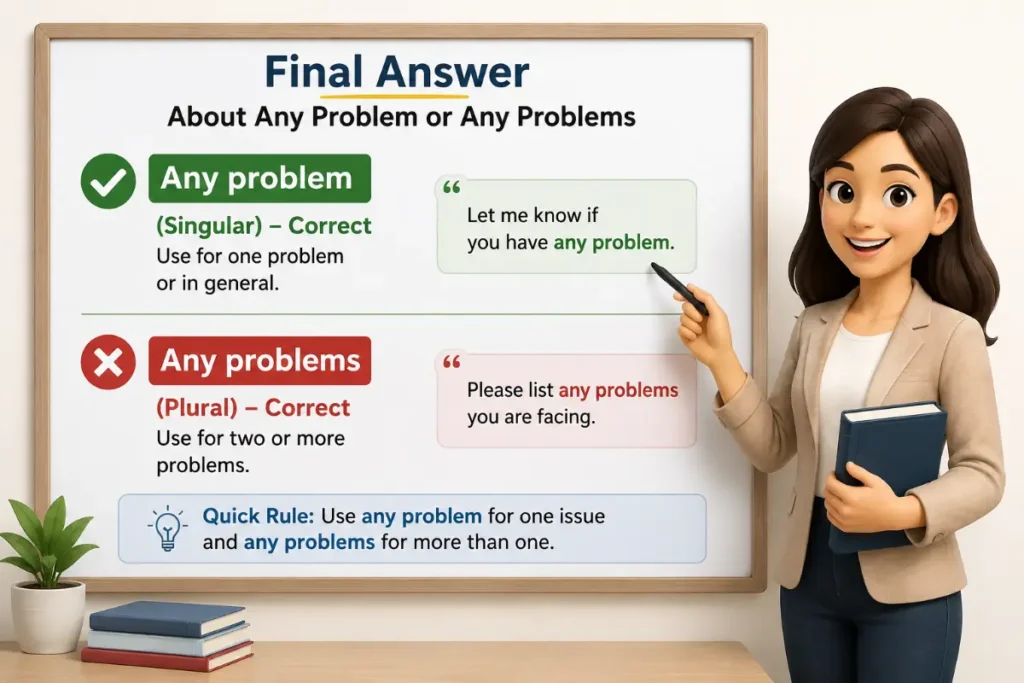
Final Answer About Any Problem or Any Problems
If someone asks which is correct between words the answer is simple. Both expressions are correct. The difference is not about right or wrong. It is about the meaning you want to share.
Use any problem when you are thinking about one possible difficulty. Use any problems when you are talking about one or more possible difficulties in general. In everyday English the plural form is more common because it sounds natural in many situations.
The easiest rule to remember is this. Think about your message first. One possible issue means any problem. General or multiple possible issues means any problems.
You may also want to read Finaly or Finally: Which Spelling Is Correct?.
Conclusion
Now you know the difference. Both expressions are correct and both are used by native English speakers every day. The best choice depends on what you want to say.
When you mean one possible issue use any problem. When you mean one or more possible issues use any problems. This simple rule will help you speak and write with confidence.
The easiest takeaway is this. One possible issue equals any problem. One or more possible issues equals any problems. Remember this simple idea and you will make the right choice every time.
Frequently Asked Questions
What does any problem mean in simple words?
It means one possible difficulty or issue.
Which is correct?
Yes. Both are correct. Choose the one that matches your meaning.
When should I use any problem?
Use it when you are talking about one possible problem.
When should I use any problems?
Use it when you mean one or more possible problems in general.
Why do people get confused?
People hear both forms in real conversations. Since both are correct the choice can seem confusing at first.
Can I use both forms in formal writing?
Yes. Both are correct in formal and informal English. Pick the form that matches your meaning.
Which form is more common in everyday English?
Any problems is more common because it naturally includes every possible issue.
Is there an easy trick to remember the difference?
Yes. Think about the number of possible issues. One issue means any problem. One or more possible issues means any problems.
