
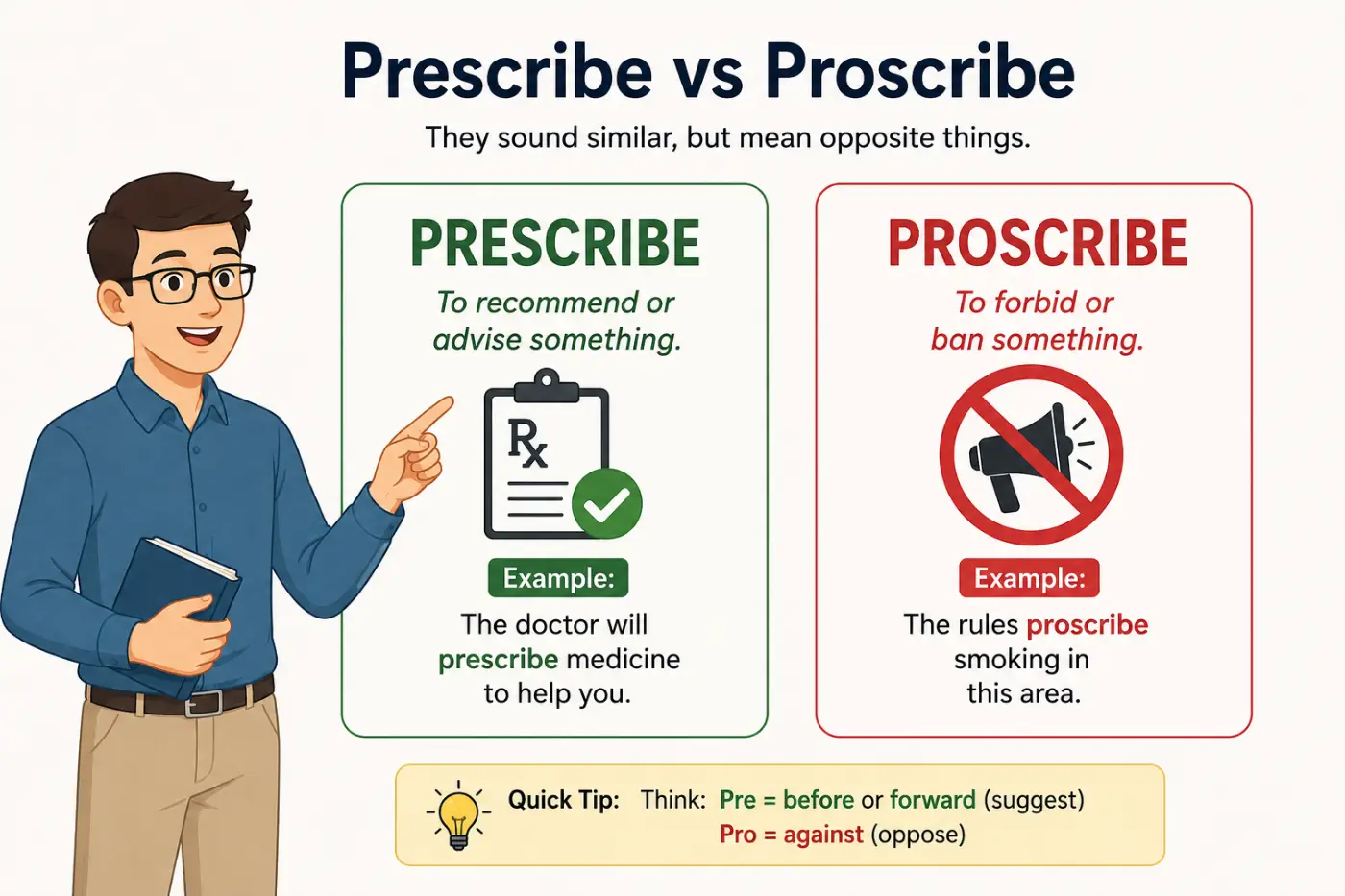
Many people get confused by prescribe vs proscribe because the two words look and sound very similar. They even share many of the same letters. Still, they have almost opposite meanings. That is why people often choose the wrong word when writing or speaking.
The good news is that learning is much easier than it seems. Once you understand the basic idea behind each word, you will know which one fits your sentence. You do not need to memorize long grammar rules. A few simple examples can make everything clear.
This guide explains in plain US English. You will learn what each word means, why people mix them up, how to remember the difference, and how to use both words with confidence in real life.
Need another quick comparison? Read Centre vs Center Explained in Simple English.
Simple Answer in One Look
Prescribe means to recommend, order, or officially tell someone to use something.
Proscribe means to forbid, ban, or officially say something is not allowed.
One gives permission or instructions. The other takes permission away.
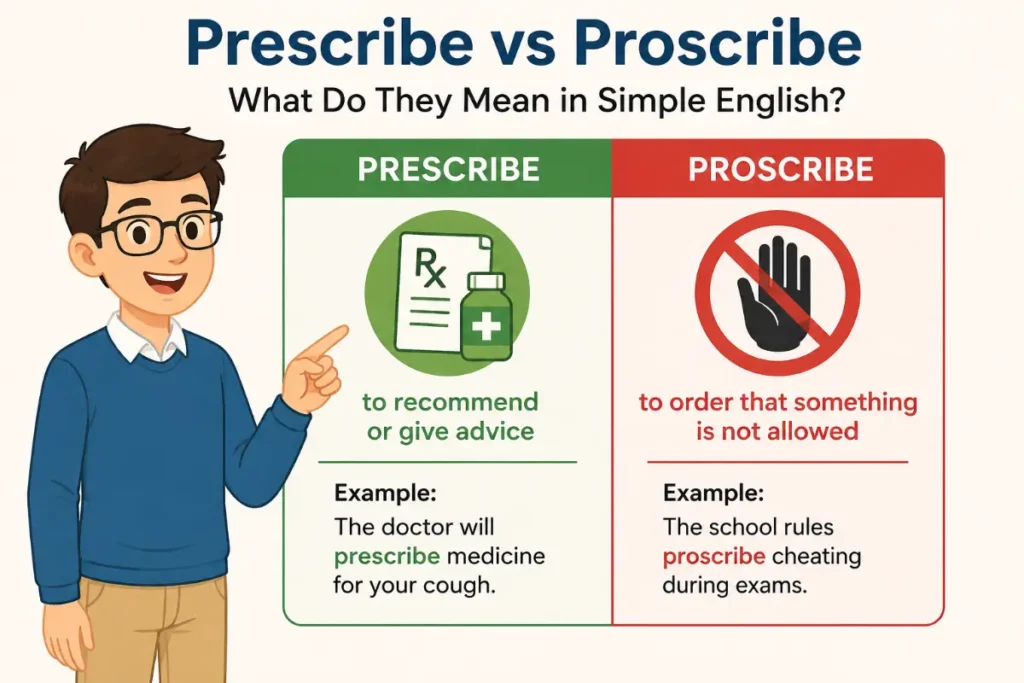
What Does Prescribe vs Proscribe Mean in Simple English?
The easiest way to understand these words is to think about what each one tells people to do.
What Does “Prescribe” Mean?
Prescribe means to tell someone that they should use or do something.
Doctors prescribe medicine.
Teachers may prescribe extra reading.
A coach may prescribe a training plan.
The word usually means that someone with knowledge or authority recommends or orders something.
Simple examples:
- The doctor prescribed medicine for my cough.
- My teacher prescribed two books for summer reading.
- The trainer prescribed daily exercise.
- The dentist prescribed a special toothpaste.
- The nurse prescribed rest after the surgery.
In every example, someone is giving helpful instructions.
What Does “Proscribe” Mean?
Proscribe means to officially forbid or ban something.
Governments may proscribe dangerous activities.
Schools may proscribe certain behaviors.
Organizations may proscribe unsafe actions.
Simple examples:
- The school proscribed smoking on campus.
- The city proscribed dangerous fireworks.
- The company proscribed sharing private information.
- The law proscribes illegal hunting.
- The club proscribed cheating during games.
Here, someone is stopping people from doing something.
Think About It Like This
Prescribe = Say Yes
“You should use this.”
Proscribe = Say No
“You must not use this.”
That simple picture helps many learners remember the difference.
Why Do People Mix These Words?
There are several reasons why causes confusion.
They Look Almost the Same
Only the beginning of each word is different.
- prescribe
- proscribe
When reading quickly, many people do not notice the small change.
They Sound Similar
Both words have almost the same rhythm.
If you hear them during a conversation, it is easy to confuse one with the other.
Both Are Used in Formal English
These words often appear in books, news articles, legal writing, and medical writing.
Since many people do not hear them every day, they may forget which one means “recommend” and which one means “forbid.”
Both Involve Authority
Another reason people confuse is that both words describe actions taken by someone with authority.
For example:
A doctor prescribes medicine.
A government proscribes illegal activities.
Since both involve official decisions, learners sometimes switch them by mistake.
One Letter Changes Everything
The biggest challenge is that only one small part changes.
Pre- and pro- look alike.
Still, their meanings are completely different.
That tiny change creates a very big difference.
Clear Difference Explained Simply
Here is an easy comparison.
| Prescribe | Proscribe |
|---|---|
| Means recommend | Means forbid |
| Means order someone to use something | Means order someone not to use something |
| Often used by doctors | Often used in laws and rules |
| Positive direction | Negative restriction |
| Gives instructions | Creates a ban |
Another quick way to remember:
Prescribe = Provide a plan.
Proscribe = Prevent an action.
Visual Memory Trick
Imagine two signs.
Doctor’s office:
“Take this medicine.”
That is prescribe.
A warning sign:
“Do Not Enter.”
That is proscribe.
The pictures are very different, making the meanings easy to remember.
Which Form Should You Use Prescribe vs Proscribe?
Choosing between both words becomes simple if you ask one question.
Is Someone Recommending Something?
Use prescribe.
Examples:
- The doctor prescribed antibiotics.
- The coach prescribed more practice.
- The teacher prescribed extra homework.
Is Someone Banning Something?
Use proscribe.
Examples:
- The law proscribes bribery.
- The school proscribes bullying.
- The company proscribes unsafe behavior.
Easy Rule
If the meaning is:
“Use this.”
Choose prescribe.
If the meaning is:
“Do not use this.”
Choose proscribe.
That rule works in almost every situation.
Easy Real-Life Sentences You Can Use
Here are simple everyday examples.
- The doctor prescribed medicine for my fever.
- My teacher prescribed three chapters to read.
- The dentist prescribed a mouthwash.
- The city proscribed loud fireworks after midnight.
- The school proscribes cheating during exams.
- Our company proscribes sharing passwords.
- The coach prescribed a healthy diet.
- The government proscribed the dangerous chemical.
Notice that prescribe appears when giving advice or instructions.
Proscribe appears when talking about rules or bans.
Where Does Prescribe vs Proscribe Come From? (Simple History)
These two words come from Latin.
That is one reason they look so much alike.
The Story Behind “Prescribe”
The word prescribe comes from a Latin word that meant to write before or to give written directions.
Long ago, doctors wrote instructions for medicine.
Over time, prescribe became the word we use when someone officially recommends medicine, treatment, or another course of action.
Even today, doctors still write prescriptions.
That connection makes the meaning easy to remember.
The Story Behind “Proscribe”
The word proscribe also comes from Latin.
Many years ago, it meant to announce publicly that someone or something was forbidden.
In ancient times, rulers sometimes published lists of people who were banned or declared enemies.
Because of that history, proscribe slowly came to mean to officially forbid or outlaw something.
Today the word is usually used in laws, government, rules, and formal writing.
Why Their History Matters
Both words started from Latin words about writing official instructions.
That shared history explains why they look almost identical today.
Their meanings changed over time in different directions.
One became connected with recommendations.
The other became connected with bans.
Remember this simple idea:
- Prescribe writes instructions to follow.
- Proscribe writes rules about what not to do.
That single idea can help you remember the difference for years.
As you continue learning English, you will notice that many confusing word pairs become much easier once you know their meanings, real-life uses, and simple history. In the next section, you will learn deeper examples, cultural uses, symbolism, common mistakes, and practical tips that make even easier to remember and use correctly every day.
How Is Understood in Culture and Stories?
The words are not only used in medicine and law. They also appear in stories, books, news reports, and movies. Writers use these words to show the difference between guidance and restriction.
A caring parent may prescribe a healthy bedtime routine.
A school may proscribe dangerous behavior.
Stories often use these ideas to show the difference between helping people and controlling people. One word gives direction. The other sets limits. In many cultures, people respect those who prescribe helpful advice because it is meant to improve life. At the same time, people understand that some things must be proscribed to keep everyone safe. This is why these two words often appear together when talking about rules, health, education, and government.
A related grammar guide is Commit vs Comit: Easy Meaning and Examples.
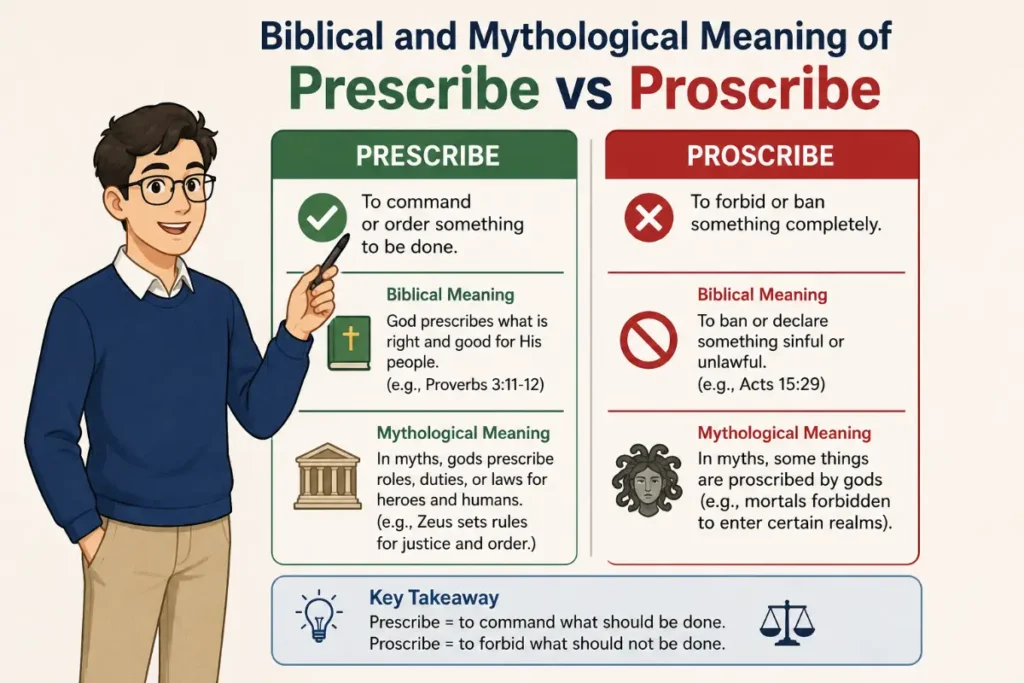
Biblical and Mythological Meaning of Prescribe vs Proscribe
The Bible does not use the modern English words prescribe and proscribe as we use them today. Still, the ideas behind the words appear many times. God gives commandments and instructions for people to follow. These are similar to prescribing a way of living. The Bible also forbids certain actions. These are similar to proscribing behavior that is harmful or sinful.
For example:
- Loving your neighbor is an instruction that points people toward good choices.
- Stealing and lying are forbidden actions.
In mythology, wise leaders often give guidance to heroes. That is similar to prescribing a path.
At the same time, many stories include forbidden places, forbidden magic, or forbidden actions. Those ideas are similar to proscribing something. These comparisons help us understand the meanings without changing the original stories.
Symbolism Explained in Simple Words
What Prescribe Represents
In a symbolic way, prescribe represents guidance.
It suggests:
- Care
- Help
- Healing
- Good advice
- Direction
- Wisdom
- Support
When someone prescribes something, they are usually trying to improve a situation.
What Proscribe Represents
Symbolically, proscribe represents limits.
It suggests:
- Rules
- Protection
- Safety
- Boundaries
- Discipline
- Law
- Prevention
When something is proscribed, the goal is usually to stop harm before it happens.
The easiest comparison is this:
Prescribe points you toward something good.
Proscribe keeps you away from something harmful.
Related Words You Should Know About Prescribe vs Proscribe
Prescription
A written order from a doctor for medicine or treatment.
Prescriptive
Giving rules or recommended ways to do something.
Recommendation
Helpful advice about what someone should do.
Instruction
A direction that explains what to do.
Advice
A suggestion meant to help someone.
Rule
A statement that tells people what they should or should not do.
Ban
An official decision that does not allow something.
Forbid
To tell someone they must not do something.
Prohibition
An official act of stopping or banning something.
Restriction
A limit placed on an action or activity.
Learning these related words makes much easier to remember.
How Do People Actually Use It in Daily English?
Most people hear prescribe much more often than proscribe.
Here are some natural examples.
“My doctor prescribed a new medicine.”
“The dentist prescribed a special toothpaste.”
“The teacher prescribed extra reading before the test.”
“Our coach prescribed more practice this week.”
“The city proscribed fireworks during the dry season.”
“The school proscribes bullying.”
“The company proscribes using personal phones during work.”
“The law proscribes drunk driving.”
“My trainer prescribed stretching every morning.”
“Our club proscribes cheating in competitions.”
Notice something interesting.
In everyday conversations, people usually talk about doctors, teachers, coaches, and parents prescribing something.
The word proscribe is more common in news stories, legal writing, government rules, and formal documents.
Common Mistakes People Make with Prescribe vs Proscribe
Many learners make the same mistakes.
Mistake 1: Using Prescribe Instead of Proscribe
Incorrect:
“The law prescribed illegal hunting.”
Correct:
“The law proscribed illegal hunting.”
The law is banning the activity, not recommending it.
Mistake 2: Using Proscribe Instead of Prescribe
Incorrect:
“The doctor proscribed antibiotics.”
Correct:
“The doctor prescribed antibiotics.”
Doctors recommend medicine. They do not ban it.
Mistake 3: Choosing the Word Because It Looks Right
Some writers simply guess because the spellings are so close.
Instead of guessing, remember this simple question.
Is someone recommending something?
Choose prescribe.
Is someone banning something?
Choose proscribe.
Mistake 4: Thinking They Mean the Same Thing
Although the words look alike, their meanings are almost opposite.
One encourages.
One forbids.
That is why choosing the correct word matters.
Final Teacher Explanation About Prescribe vs Proscribe
Imagine you are sitting in an English classroom.
I write two signs on the board.
The first sign says:
“Take this medicine.”
That is prescribe.
The second sign says:
“Do Not Enter.”
That is proscribe.
Those two signs explain almost everything.
When someone wants you to do something helpful, use prescribe.
When someone officially stops you from doing something, use proscribe.
You do not need difficult grammar rules.
Just remember one simple picture.
One hand is offering help.
The other hand is holding up a stop sign.
That picture makes easy to remember every time.
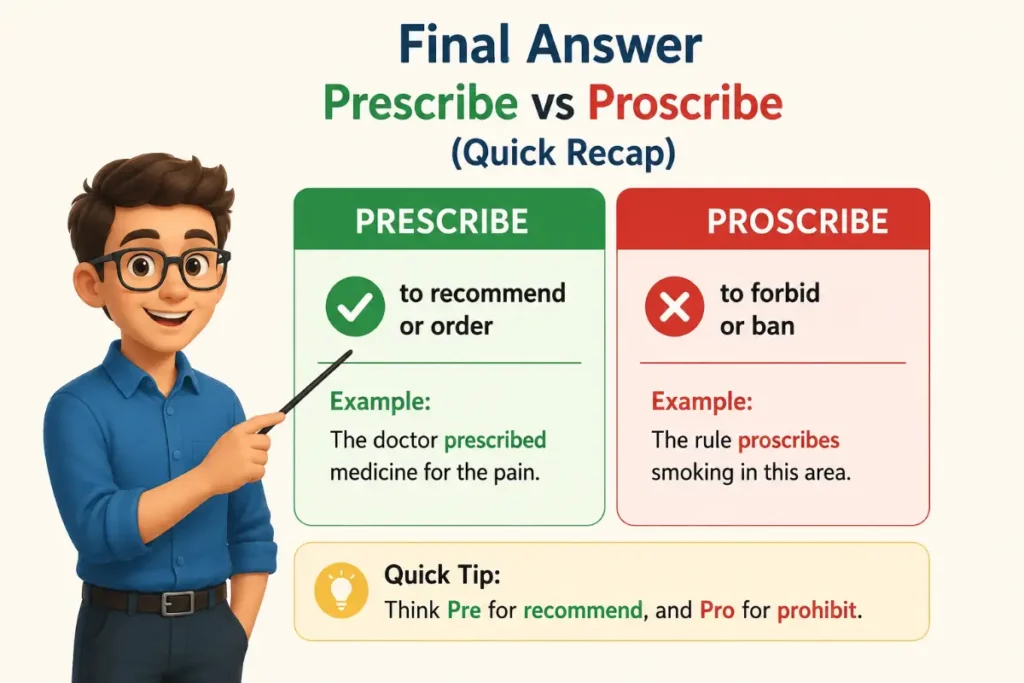
Final Answer About Prescribe vs Proscribe (Quick Recap)
The difference between is simple once you know the basic idea.
Prescribe means to recommend, order, or direct someone to do something. Doctors prescribe medicine. Teachers prescribe reading. Coaches prescribe exercise plans.
Proscribe means to forbid, ban, or officially stop something. Governments proscribe illegal activities. Schools proscribe cheating. Companies proscribe unsafe behavior.
If you remember that prescribe gives directions while proscribe creates restrictions, you will almost never confuse these words again.
You may also want to read Mentioned vs Mentionned: Easy Guide With Examples.
Conclusion
Understanding does not have to be difficult. Even though the words look almost the same, their meanings are very different. One tells people what they should do. The other tells people what they must not do.
The more you read and practice, the easier these words become. Real-life examples help you remember them much better than long grammar rules.
The easiest takeaway is this: Prescribe means recommend. Proscribe means forbid. Keep that simple rule in mind, and you will choose the correct word with confidence every time.
Frequently Asked Questions (FAQs)
What does prescribe mean in simple words?
Prescribe means to recommend or officially tell someone to use or do something, such as medicine or a treatment.
What does proscribe mean in simple words?
Proscribe means to officially forbid, ban, or say that something is not allowed.
What is the main difference?
Prescribe recommends an action. Proscribe forbids an action.
Why do people confuse?
The words look and sound very similar, but they have almost opposite meanings.
Can doctors use the word proscribe?
No. Doctors usually prescribe medicine or treatment. They do not proscribe medicine in normal medical English.
Is proscribe a common everyday word?
Not really. It is more common in legal, government, and formal writing than in everyday conversation.
How can I remember?
Think of a doctor giving you medicine for prescribe and a red stop sign for proscribe.
Can I use prescribe and proscribe in the same sentence?
Yes. For example: “The doctor prescribed medicine, while the law proscribed selling it without a license.”
